English
 Le français
 Türkçe




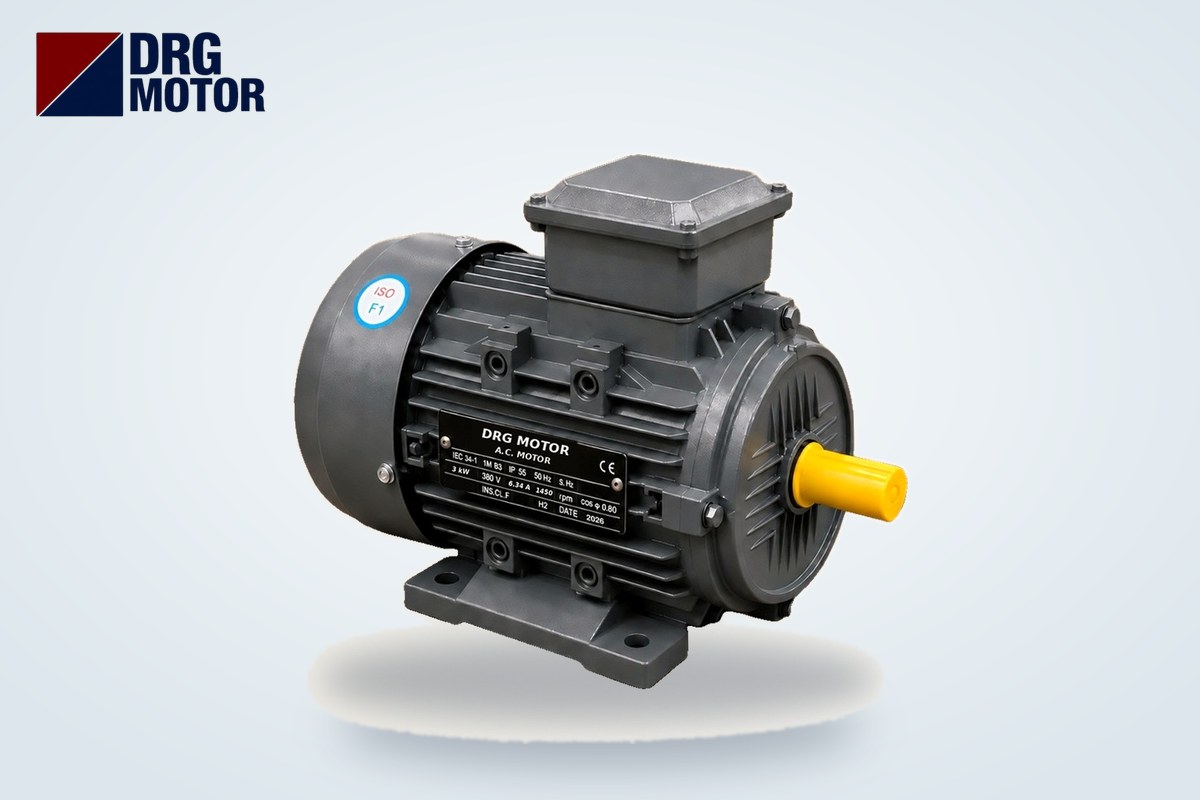

A 3 kW, 1500 rpm (4-pole) three-phase motor connected in star (Y) on a 380 V supply draws 6.34 A at full load; at 400 V it draws 6.02 A. At the same power, a 3000 rpm motor draws 6.02 A and a 1000 rpm motor 7.20 A. If the motor is connected in delta (Δ) on a 220 V three-phase supply, the line current rises by about √3 to ≈ 11.0 A for the 1500 rpm model. Shaft power and the current through each winding stay the same in both cases.
The reason for this difference is the nameplate voltage. Every 3 kW motor in our store is rated 230/400 V (Δ/Y), which means the windings are designed for 230 V. On a 400 V supply, star connection puts 230 V across each winding; on a 230 V three-phase supply, delta connection is needed so that the windings see the line voltage directly. All values are taken from the technical data of the models on our Buy Electric Motors Online page.
Below you will first see the current table for four models, then figures showing how star and delta connection change the line current.
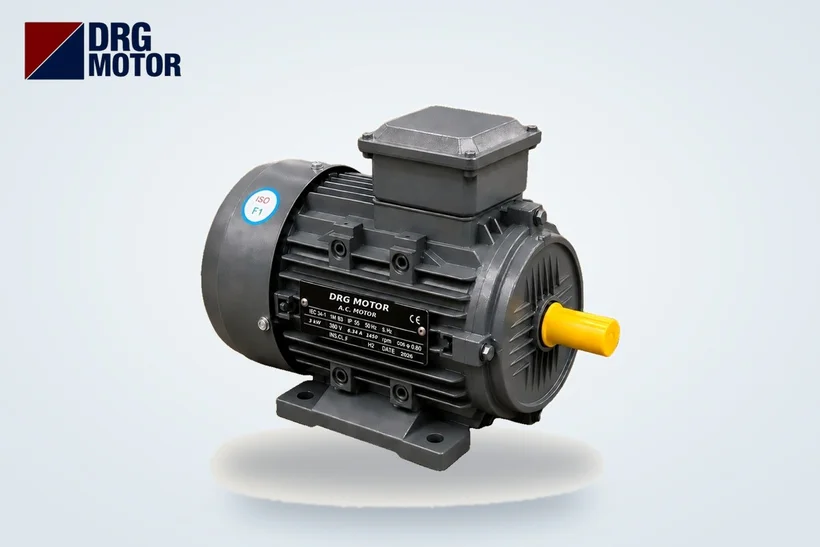
3 kW Motor Current Table (380 and 400 V, Star Connected)
Alongside the standard 2, 4 and 6-pole models, the table includes the compact 2-pole model in a 90L frame. The compact model fits into one frame size smaller; its electrical values are identical to the 2-pole model in the 100L frame. The starting current column is the catalogue Is/In ratio multiplied by In.
| Model | Frame | Synchronous / rated speed | cos φ | In 380 V (Y) | In 400 V (Y) | Is/In | Is 380 V (calculated) | Torque |
|---|---|---|---|---|---|---|---|---|
| DRG-100L-2 | 100L | 3000 / 2895 rpm | 0.87 | 6.02 A | 5.71 A | 7.8 | ≈ 47.0 A | 9.9 Nm |
| DRG-90L-2K | 90L | 3000 / 2895 rpm | 0.87 | 6.02 A | 5.71 A | 7.8 | ≈ 47.0 A | 9.9 Nm |
| DRG-100L2-4 | 100L | 1500 / 1450 rpm | 0.82 | 6.34 A | 6.02 A | 7.6 | ≈ 48.2 A | 19.8 Nm |
| DRG-132S-6 | 132S | 1000 / 968 rpm | 0.74 | 7.20 A | 6.84 A | 6.8 | ≈ 49.0 A | 29.6 Nm |
Current rises from 6.02 A on the 2-pole model to 7.20 A on the 6-pole model. The main reason is that the power factor drops from 0.87 to 0.74. Torque, on the other hand, is inversely proportional to speed: the 1000 rpm model's 29.6 Nm is about three times that of the 3000 rpm model. For other ratings, see our motor current chart.
We can also check with the formula: √3 × 380 × 6.34 × 0.82 ≈ 3.42 kW. This is the power the motor draws from the supply. The 3 kW on the nameplate is shaft power; the difference is the motor's losses. Torque check: 9550 × 3 / 1450 ≈ 19.8 Nm, the same as the catalogue value.
The difference between 380 V and 400 V is also consistent with the calculation: 6.34 × 380 / 400 ≈ 6.02 A, and the catalogue 400 V value is 6.02 A. If your supply is close to 400 V, lower the overload setting slightly. The reading on a clamp meter depends on the motor's load at that moment: if the machine is not at full load, a current below the nameplate value is normal. A current that stays above the nameplate value indicates overload, low voltage or mechanical strain such as a seized bearing or an over-tensioned belt.
Why Is It Connected in Star on a 380 V Supply?
In a motor rated 230/400 V, each winding is wound for 230 V. In star connection each winding sits between a phase and the star point and sees 1/√3 of the line voltage: 400 / 1.732 ≈ 231 V. That is why star is the correct connection on the 380–400 V supply used in Türkiye. In the terminal box, terminals W2-U2-V2 are shorted with links and the supply goes to U1-V1-W1.
In star connection, line current and winding current are the same. A clamp meter on the supply cable shows 6.34 A at full load on the 1500 rpm model, and this current flows directly through the winding.
If the same motor is mistakenly connected in delta on a 380 V supply, each winding sees 380 V instead of 230 V. Magnetising current rises sharply, the motor draws excessive current even at no load, the overload trips, and without protection the winding soon burns out. If you open the terminal box of a 3 kW motor and find the links in delta, stop and measure the supply voltage before commissioning.
Delta Connection on a 220 V Three-Phase Supply: Line Current ×√3
Some older installations, marine applications and imported machines have a 220–230 V three-phase supply. A motor rated 230/400 V is connected in delta on such a supply, with U1-W2, V1-U2 and W1-V2 linked at the terminals. Each winding again sees about 230 V, so the motor delivers the same shaft power and torque.
What changes is the line current. Because the same power is carried at a lower voltage, line current increases in proportion to the voltage ratio: 6.34 × 380 / 220 ≈ 11.0 A. This is almost the same as √3 × 6.34 ≈ 11.0 A. In delta, the current through each winding is 1/√3 of the line current: ≈ 6.32 A. As you can see, the winding current is the same as in star; nothing changes from the motor's point of view.
| Supply | Connection | Line current (clamp meter) | Winding current | Starting current (line) |
|---|---|---|---|---|
| 380 V three-phase | Star (Y) | 6.34 A | 6.34 A | ≈ 48.2 A |
| 220 V three-phase | Delta (Δ) | ≈ 11.0 A | ≈ 6.32 A | ≈ 83.2 A |
Practical conclusion: on a 220 V three-phase supply, the overload relay, contactor, fuse and cable must be selected for a current roughly √3 times larger. Forgetting to change the overload setting when moving a panel built for 380 V to a 220 V three-phase site is the most common reason for a motor tripping on every start. For a step-by-step guide to fitting the terminal links, see our article motor terminal connection: star and delta.
A brief note: a three-phase motor will not run on a single-phase 220 V socket, and running it with a capacitor is not recommended.
Starting Current and Starting Method
With direct-on-line starting at 380 V, the starting current of 3 kW motors is ≈ 47.0 A for 2 poles, ≈ 48.2 A for 4 poles and ≈ 49.0 A for 6 poles. This surge falls to rated current within a few seconds as the load accelerates. For the 1500 rpm model connected in delta on a 220 V three-phase supply, the same ratio gives a line starting current of ≈ 83.2 A.
Because a 230/400 V motor already runs in star on a 380 V supply, it is not suitable for star-delta starting. In star-delta starting, the motor runs in delta, so you need a motor that can run in delta at supply voltage, i.e. one rated 400/690 V. Direct-on-line starting is common at 3 kW. If you must reduce starting current, a soft starter or a variable frequency drive is used. Compare methods on our starting methods and star-delta page.
Common Mistake: Connecting a 4 kW or Larger Motor in Star
In our store, motors of 4 kW and above are rated 400/690 V (e.g. DRG-112M-4). These motors are connected in delta on a 380–400 V supply. Someone used to 3 kW motors who also connects a 4 kW motor in star puts only 1/√3 of the required voltage across each winding (≈ 219 V instead of 380 V). The motor spins at no load, but under load the torque is insufficient, current rises and it overheats. The rule is simple: the connection is determined by the nameplate voltage, not by kW.
Overload Setting and Commissioning Checklist
- Measure the supply: is it 380–400 V three-phase or 220–230 V three-phase?
- Read the nameplate: if it is 230/400 V, connect in star at 380–400 V and in delta on 220–230 V three-phase.
- Set the overload relay to the line current (In): 6.34 A for the 1500 rpm model in star at 380 V, 6.02 A at 400 V; ≈ 11.0 A in delta at 220 V.
- The contactor's AC-3 rating must not be lower than In; the fuse or breaker must not trip on the starting surge.
- Cable gland: 1 × M25×1.5 on the 100L and 90L frames, 2 × M32×1.5 on the 132S frame.
- Check the direction of rotation at first start; measure and compare the current of all three phases at full load.
To see the overload, fuse and contactor range for a given motor current, use our overload relay, fuse and contactor selection tool. Other calculations are gathered on the electric motor calculators page.
Motors in This Power Rating
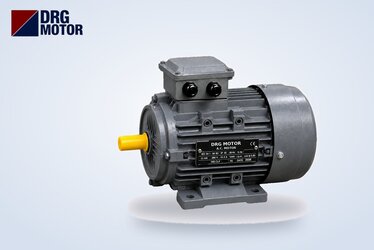
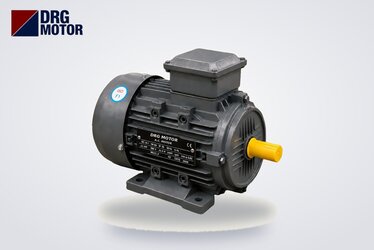
3 kW three-phase motors are available in our store with aluminium and cast iron frames at 3000, 1500 and 1000 rpm, plus a compact cast iron model in a 90L frame:
- DRG-100L-2 – 3 kW – 3000 rpm – 100L aluminium
- DRG-100L2-4 – 3 kW – 1500 rpm – 100L aluminium
- DRG-132S-6 – 3 kW – 1000 rpm – 132S aluminium
- DRG-100L-2 – 3 kW – 3000 rpm – 100L cast iron
- DRG-90L-2K – 3 kW – 3000 rpm – 90L cast iron
- DRG-100L2-4 – 3 kW – 1500 rpm – 100L cast iron
- DRG-132S-6 – 3 kW – 1000 rpm – 132S cast iron
Click to see current prices and order these motors nowSEE PRICES →
Frequently Asked Questions
How many amps does a 3 kW motor draw at 380 V?
At full load, the 2-pole DRG-100L-2 draws 6.02 A, the 4-pole DRG-100L2-4 6.34 A and the 6-pole DRG-132S-6 7.20 A. These values are for star connection.
How many amps does a 3 kW motor draw in delta?
Correctly connected in delta on a 220 V three-phase supply, the 1500 rpm model draws a line current of ≈ 11.0 A, which is √3 times the star current. Connecting it in delta on a 380 V supply is wrong; the motor will draw excessive current.
What is the starting current of a 3 kW motor?
With direct-on-line starting at 380 V it is between ≈ 47.0 and 49.0 A. It is found by multiplying the catalogue Is/In ratio (6.8–7.8) by the rated current.
Can a 3 kW motor be started star-delta?
A 3 kW motor rated 230/400 V cannot be started star-delta on a 380 V supply, because it is already connected in star for normal running. Star-delta requires a motor rated 400/690 V.
To choose the right 3 kW model for your supply and machine, call us on +90 (542) 666 11 11, email [email protected] or reach us via our contact page. Every power and speed option is among the 120 models in our online store.