English
 Le français
 Türkçe




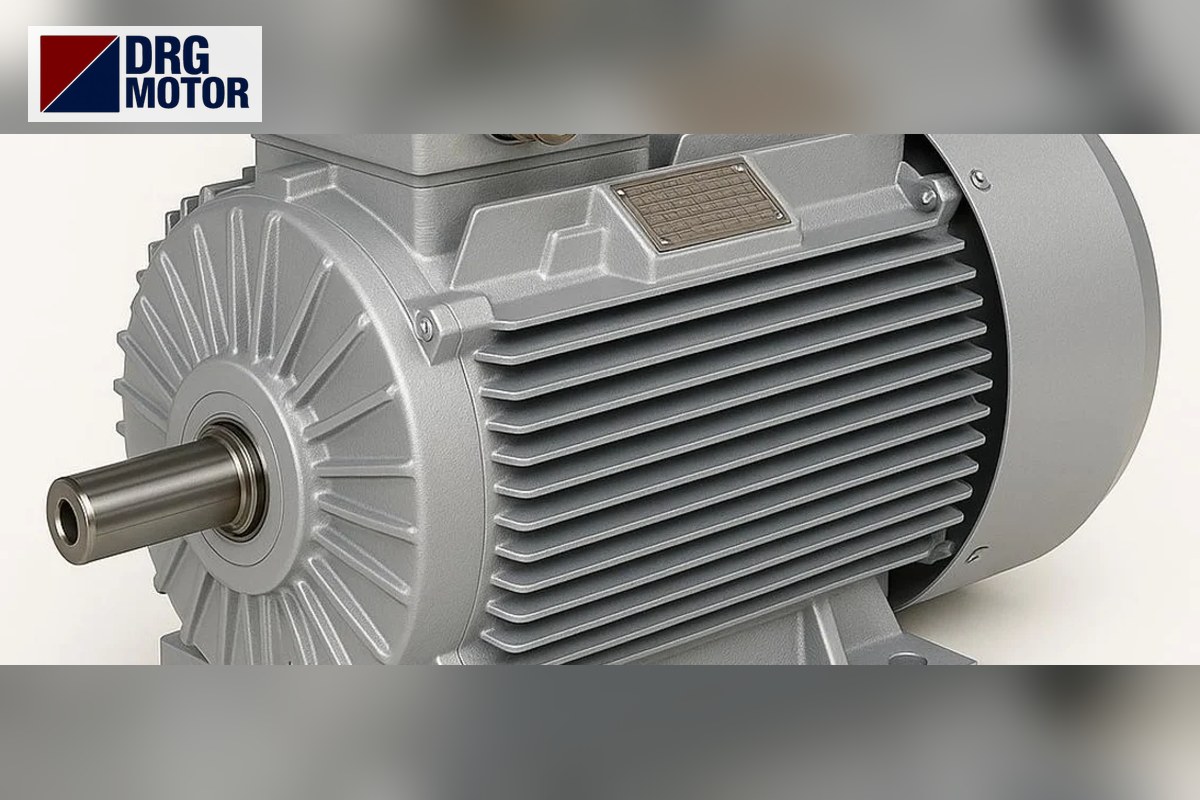

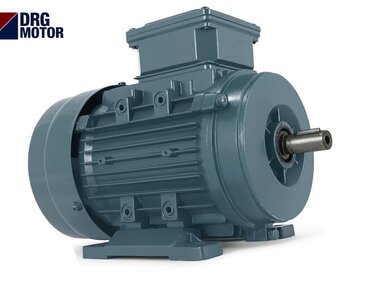
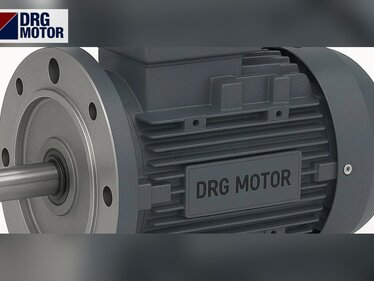
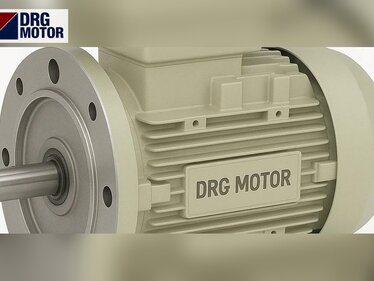
A large flange electric motor carries a plain-hole B5 (FF) flange on its front end shield that is wider than the housing, and its main advantage is load carrying and centring: because the bolts sit on a circle far from the shaft axis they carry less force for the same torque, and the long spigot seats the motor on the axis of the mating part in one step. For example, the bolt circle is 500 mm on frame 250M and 215 mm on frame 112M; although the 4-pole motor on 250M has about 13.4 times the torque of the one on 112M, the total force on the bolt circle rises only about 5.8 times. The price of a large flange motor is set by frame, power and speed, not by the flange; current prices model by model are on the Buy Electric Motors Online page.
This article explains, using three example frames, why the large flange is chosen and from which frame size onwards. For B5 dimensions of all frames see our B5 motor flange dimensions table; we do not repeat that table here.
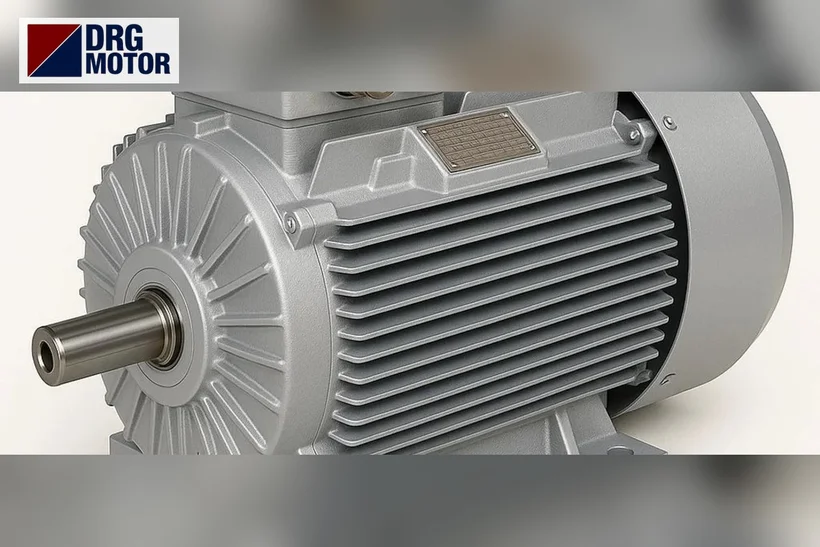
Three mechanical advantages of the large flange
1. A long torque lever arm
When the motor runs, the housing passes the reaction of the shaft torque to the mating part through the flange bolts. The total tangential force on the bolts is the torque divided by the bolt circle radius. The larger the circle, the smaller the force; the large flange is therefore more resistant to bolt loosening and hole ovalisation on high-torque drives.
2. A wide base against bending load
On a motor running horizontally and held by its flange only, the housing weight creates a bending moment at the flange. This moment is resisted by the distance between the upper and lower flange bolts; as the bolt circle grows, this distance, and with it the bolts' lever arm, increases.
3. Centring and repeatable mounting
The spigot diameter (N) and spigot length (T) of the large flange grow with the frame. The spigot seats the motor shaft on the mating part's axis without coupling alignment; when the motor is removed and refitted the axis returns to the same place. In pumps, gearboxes and vertical fans, where the shaft enters the mating part directly, this has a direct effect on bearing and seal life.
Large flange dimensions and torque arm on three frames
The table below lists the B5 flange dimensions of frames 112M, 160L and 250M, the rated torque of the 4-pole motor on each frame, and the total tangential force this torque creates at the bolt circle. The force is an example value calculated as Mn / (M/2).
| Dimension | What does it do? | 112M (DRG-112M-4) | 160L (DRG-160L-4) | 250M (DRG-250M-4) |
|---|---|---|---|---|
| P (mm) | Flange outer diameter | 250 | 350 | 550 |
| AC (mm) | Housing diameter | 230 | 314 | 485 |
| (P − AC)/2 (mm) | Flange projection beyond housing | 10 | 18 | 32.5 |
| M (mm) | Bolt circle – torque lever arm | 215 | 300 | 500 |
| S (mm) | Bolt hole diameter | 14.5 | 18.5 | 18.5 |
| N (mm) | Spigot diameter | 180 | 250 | 450 |
| T (mm) | Spigot length | 4 | 5 | 5 |
| LA (mm) | Flange thickness | 14 | 15 | 22 |
| D×E (mm) | Shaft | 28×60 | 42×110 | 65×140 |
| Mn (Nm) | 4-pole rated torque | 26.3 | 97.8 | 353.7 |
| Mn / (M/2) (N) | Total tangential force at bolt circle | 240 | 650 | 1410 |
Two conclusions follow. First, as the frame grows from 112M to 250M the bolt circle grows about 2.3 times; thanks to this, while torque increases 13.4 times the bolt force increases 5.8 times. Second, the flange thickness rises from 14 mm to 22 mm and the spigot length from 4 mm to 5 mm; the flange does not just get wider, it gets stiffer.
What does the pole number change on the same frame?
On frame 250M the 2-pole and 4-pole 55 kW motors share the same FF500 flange, but the load picture differs. DRG-250M-2 delivers 176.9 Nm at 2970 rpm, while DRG-250M-4 delivers 353.7 Nm at 1485 rpm. At a 250 mm bolt circle radius this means a total bolt force of about 710 N and 1410 N. The shaft is sized accordingly: 60×140 mm on the 2-pole and 65×140 mm on the 4-pole. So even with the same flange, moving to the 4-pole motor means rechecking the coupling hub and the torque capacity of the mating part.
From which frame is the large flange preferred?
There is no hard limit; the decision depends on torque, motor weight and the design of the mating part. In practice the following frame works well:
- Frames 63–112: Both small and large flanges are common. The mating part's flange decides.
- Frame 132: Torque rises to 49.1 Nm (7.5 kW, 4-pole); on gearbox and pump inputs the large flange clearly takes the lead.
- Frame 160 and above: The housing gets longer, the weight increases, and the shaft reaches 42 mm. For a motor fixed by its flange only, the large flange is the normal choice; in horizontal heavy-duty use, foot support (B35) is added.
In vertical mounting (shaft down) the motor's entire weight hangs from the flange; using the large flange from medium frames upwards is then the safe approach. We cover the bearing side of vertical mounting in our horizontal vs vertical motor mounting article.
Applications that suit the large flange
- Gearbox inputs: The motor input of helical and bevel gearboxes is usually machined for a B5 flange; input torque is high.
- Close-coupled and vertical pumps: The spigot limits misalignment between the shaft and the pump impeller.
- Vertical-axis fans and extractors: The motor hangs from the flange; for B5 flange fan motor applications see our fan motor supply article.
- Agitators and mixers: Under shock loads, the long torque arm helps against bolt loosening.
Points to watch when choosing a large flange
- The flange projects beyond the housing: The (P − AC)/2 row in the table shows how far the flange extends beyond the housing; allow for it in a narrow machine recess.
- Bolt access is from the motor side: Leave room behind the flange for the spanner and bolts; the terminal box should not end up in this area.
- Same flange, different shaft: The flange family does not tell you the shaft diameter; the FF300 family has two shaft diameters and the FF500 family three. On frames 225 and above the 2-pole shaft is thinner than the 4-pole shaft.
- Flange thickness and bolt length: Choose the bolt length from LA plus the thread depth of the mating part.
Technical factors that affect the price of a large flange motor
- Frame and power: The flange family grows with the frame; frame and power set the price.
- Pole number: A low-speed motor moves to a larger frame and flange at the same power.
- Housing material: 15 kW and above is cast iron only; smaller powers are also offered in aluminium.
- Mounting type: B5 alone or with feet as B35; options such as thermal protection.
To see models side by side on these criteria, browse the 120 models in our online store and add your B5 choice to the order note.
Large flange checklist
- Does the mating part have plain holes, with the bolt entering from the motor side?
- Were the bolt circle (M) and spigot (N) measured?
- Does the part of the flange projecting beyond the housing fit the machine recess?
- Is there room behind the flange for the bolt and spanner?
- If the motor is horizontal and heavy, is foot support (B35) needed?
- Do the shaft diameter and key fit the coupling or gearbox hub?
Cast iron motors you can order with a large flange
- DRG-132M-4 – 7.5 kW – 1460 rpm – 132M frame, flange FF265
- DRG-160M-4 – 11 kW – 1465 rpm – 160M frame, flange FF300
- DRG-180M-4 – 18.5 kW – 1470 rpm – 180M frame, flange FF300
- DRG-200L-4 – 30 kW – 1475 rpm – 200L frame, flange FF350
- DRG-250M-4 – 55 kW – 1485 rpm – 250M frame, flange FF500
Click to see current prices and order these motors nowSEE PRICES →
Frequently Asked Questions
Is a large flange the same as a B5 flange?
Yes. The large flange is coded B5 in IEC mounting codes and FF as a flange type; its holes are plain and its diameter is larger than the housing.
Is the shaft of a large flange motor different from a small flange one?
No. On the same frame the shaft size is independent of the flange type; only the front end shield changes.
Can a large flange motor run horizontally without feet?
On small and medium frames, yes. On large and long frames the weight puts bending load on the flange bolts, so foot-and-flange B35 is safer.
Should I choose a large flange for a gearbox?
Choose the type the gearbox input flange is machined for. On helical and bevel gearboxes the input is mostly B5; for details see our geared motor selection guide.
All models that can be ordered with a large flange are listed by power and speed on the Buy Electric Motors Online page. Send the mating part dimensions to [email protected] or call +90 (542) 666 11 11; other channels are on our contact page. DRG Motor is an electric motor manufacturer and supplier.