English
 Le français
 Türkçe

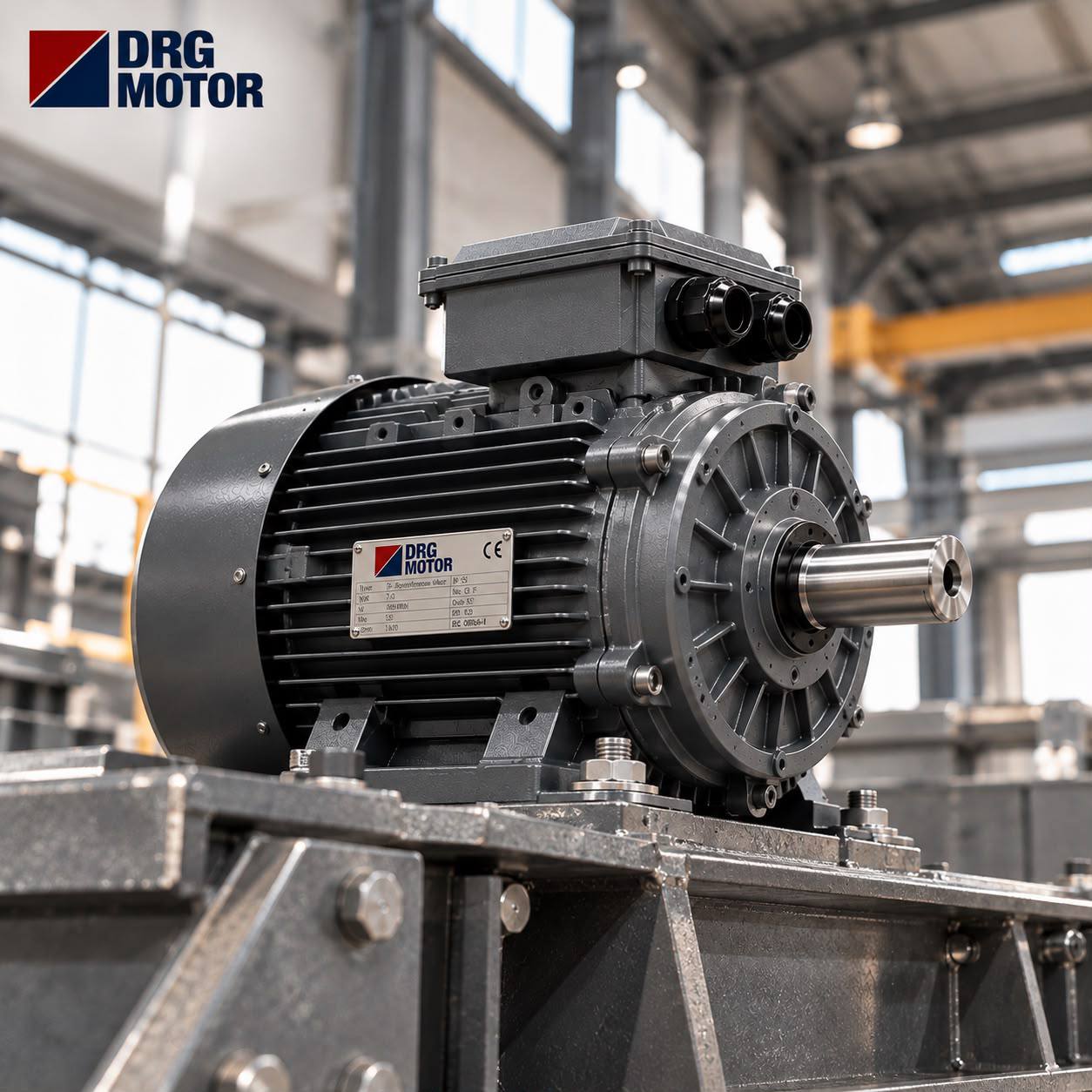

A quotation request from a quarry operator was one line long: "110 motor for the crusher, price?" When we called back it turned out the machine was a primary jaw crusher, the existing motor was 6-pole, the pulleys had just been replaced and the panel used star-delta starting. Had a 4-pole motor of the same power been offered, the crusher speed would have risen by almost one and a half times and the pulley arrangement would have had to be recalculated from scratch. On a stone crusher, motor selection is less about kilowatts than about how the crusher turns and how it starts. In this guide we go step by step through how to read the motor according to crusher type, the starting and pulley calculation, what to watch for on a dusty site, and what information to give when asking for a quotation.
The Crusher Type Defines the Motor's Character
In a jaw crusher the moving jaw is connected to an eccentric shaft with large flywheels at both ends. The motor turns one of these flywheels by belt. The load is impulsive: on every stroke the stone is squeezed, broken and discharged. The flywheel absorbs most of this fluctuation and the load seen by the motor approaches the average; but the flywheel itself makes starting heavier.
In an impact (hammer or rotor) crusher a heavy rotor turns at high speed and breaks the stone with blow bars or hammers. The rotor inertia is large; starting takes a long time and the motor draws high current throughout. If feeding is uneven or oversized blocks arrive, the load spikes instantly.
A cone crusher usually works at the secondary and tertiary stages; a horizontal input shaft is driven by belts and pulleys. The load is smoother, but torque rises as the crushing chamber fills, so feed control should be considered together with motor protection. On the screening side, vibrating screens run on much smaller power, mostly with an eccentric shaft or a vibration motor; asking for the screen motor as a separate item instead of putting it in the same quotation as the crusher motor avoids confusion.
Starting Torque and Flywheel: Why Does the Motor Struggle?
What crushers have in common is that at start-up the motor must accelerate a large rotating mass. This mass is reflected to the motor through the pulley ratio: the inertia on the crusher side is divided by the square of the pulley ratio when referred to the motor shaft. The larger the ratio, the smaller the inertia seen by the motor, but because the motor runs faster the energy that has to be supplied remains the same.
You can roughly estimate the starting time with t ≈ J·ω / Tacc. Here J is the total inertia referred to the motor, ω the rated angular speed of the motor and Tacc the average accelerating torque left after subtracting the load torque from the motor torque during start-up. If the crusher starts empty, the load torque is small; starting a jammed or full crusher is a completely different situation and must be stated when asking for a quotation. We explained the background of the high torque requirement separately in our article on why a stone crushing plant motor needs high torque.
Hitting the Crusher Speed with the Belt and Pulley Ratio
The crusher manufacturer gives a speed range for the machine; the number of motor poles and the pulley diameters are chosen accordingly. The pulley ratio is found from i = nmotor / ncrusher = Dcrusher pulley / Dmotor pulley. The smaller the motor pulley, the more sharply the belt bends and the shorter the belt life; so do not go below the minimum pulley diameter recommended for the belt profile. Belt speed is checked with v = π·D·n / 60.
With a belt drive, the motor shaft and bearings carry a radial load. This load grows with belt tension; mounting the pulley as close as possible to the shaft shoulder and not over-tensioning the belts are decisive for bearing life. Giving the pulley diameters, belt type and number of belts in your request allows the supplier to evaluate shaft and bearing load.
Worked Example: 4-Pole or 6-Pole on a 110 kW Jaw Crusher?
Consider a jaw crusher whose flywheel shaft must turn at about 250 rpm, with a 1250 mm pulley. Two options:
- 6-pole, 110 kW (DRG-315L1-6): from the rated torque of 1063 Nm in the store list, the rated speed is 110000 × 60 / (2π × 1063) ≈ 988 rpm. With a 315 mm motor pulley the crusher speed is 988 × 315 / 1250 ≈ 249 rpm and the belt speed π × 0.315 × 988 / 60 ≈ 16.3 m/s.
- 4-pole, 110 kW (DRG-315S-4): from the rated torque of 706 Nm the rated speed is ≈ 1488 rpm. For the same crusher speed the motor pulley drops to 210 mm: 1488 × 210 / 1250 ≈ 250 rpm, belt speed ≈ 16.4 m/s.
The power and torque delivered to the crusher shaft are the same in both cases; the difference is on the motor side. The 4-pole motor has a smaller frame (315S versus 315L) and is listed in the store at 219,516.00 TRY excl. VAT, against 231,215.60 TRY for the 6-pole. On the other hand, a 210 mm pulley may be borderline for the belt profile, and a smaller pulley means a higher belt force to transmit the same torque. Moreover, if the existing pulleys were made for 6 poles, a 4-pole motor would turn the crusher about one and a half times faster without a pulley change, which is unacceptable.
Let us also check the starting side. Assume the total inertia of the flywheels and moving parts on the crusher shaft is 540 kg·m². With the 4-pole option the ratio is 1250 / 210 ≈ 5.95, so the inertia referred to the motor is 540 / 5.95² ≈ 15.2 kg·m² (excluding the motor's own rotor). If the average accelerating torque is half the rated torque (353 Nm), starting takes about 15.2 × 155.8 / 353 ≈ 6.7 s; if it is a quarter, about 13.5 s. These times must be taken into account when setting thermal protection and choosing the starting method. You can use our electric motor calculators with your own values.
Star-Delta or Soft Starter?
On crusher motors of 75 kW and above, direct-on-line starting strains both the network and the mechanics. With star-delta starting the motor is first connected in star; starting current and starting torque drop to one third of the delta values. This is often enough for a crusher that starts empty, but on machines with heavy flywheels, switching to delta before the speed has risen sufficiently in star causes a second current surge. For star-delta, the motor must be wound to run in delta at the supply voltage; for example, a motor rated 400 V delta on a 400 V network.
A soft starter raises the voltage steplessly and limits current and mechanical shock; since the current limit and ramp time are adjustable, control is easier with heavy inertia. However, because it also reduces torque with the square of the voltage, starting time becomes longer and the soft starter must be sized for that time. Whichever method is chosen, stating the one used in the existing panel in your request ensures that the winding connection is prepared correctly.
Dust, Vibration and Site-Appropriate Protection
In a crushing and screening plant the motor's biggest enemy is fine stone dust. Dust covers the fan cover grille and the frame fins and weakens cooling. As defined in the DRG Motor catalogue, IP55 means protection against harmful dust ingress and against water jets from all directions; this level should be the basis on open, dusty sites. In addition, the air intake side of the motor should not be pressed against a wall or base plate, the fins should be cleaned periodically and the terminal box gasket must be in place.
The crusher frame vibrates constantly. The slide rail on which the motor sits must be rigid, the foot bolts must be checked, and the slide rail bolts must be locked when adjusting belt tension so that the motor does not shift. On large frames, a cast iron housing is the preferred construction in a vibrating environment. In plants with long cable runs, the cable cross-section must be calculated according to starting current and voltage drop.
Sample Models and Prices in the 75–355 kW Range
Below are cast iron models selected from the power steps most often seen on crusher motors. You can browse all models on the buy electric motors online page.
| Model | Power | Speed | Frame | Price (excl. VAT) | Price (incl. VAT) |
|---|---|---|---|---|---|
| DRG-280S-4 | 75 kW | 1500 rpm | 280S | 131,670.00 TRY | 158,004.00 TRY |
| DRG-315S-4 | 110 kW | 1500 rpm | 315S | 219,516.00 TRY | 263,419.20 TRY |
| DRG-315L1-6 | 110 kW | 1000 rpm | 315L | 231,215.60 TRY | 277,458.72 TRY |
| DRG-315L1-4 | 160 kW | 1500 rpm | 315L | 276,944.80 TRY | 332,333.76 TRY |
| DRG-355M-4 | 250 kW | 1500 rpm | 355M | 443,580.50 TRY | 532,296.60 TRY |
| DRG-400M-4 | 355 kW | 1500 rpm | 400M | 532,813.60 TRY | 639,376.32 TRY |
Prices are taken from the DRG Motor online store list dated 24.09.2026; a 3% discount applies to bank transfer/EFT payments, shipping is not included in the price and is paid by the buyer.
Information to Give When Requesting a Quotation
A correct quotation starts with correct information. When you fill in and send the list below, the supplier can settle both the motor and the connection details in one go:
- Crusher type: jaw, impact, cone or screen; primary or secondary.
- Capacity (tonnes/hour) and feed material: limestone, basalt, river gravel, etc.
- Crusher speed and pulley diameters (motor and crusher side), belt type and number.
- A photo of the existing motor nameplate: power, speed, voltage, current, frame size.
- Supply voltage and frequency.
- Starting method: direct, star-delta, soft starter or drive.
- Mounting: foot-mounted (B3) on a slide rail or flange; shaft diameter and length.
- Starting condition: empty or with a full crusher; environment (open site, dust, altitude).
Comparing Quotations Side by Side
When several quotations arrive, looking only at the total figure is misleading; the offers may not describe the same motor. The table below helps you compare item by item:
| Check item | What to look at | What happens if it is missing |
|---|---|---|
| Power and number of poles | Compatible with the existing motor and pulley ratio? | Crusher speed changes, pulleys must be replaced. |
| Frame size | Do the slide rail holes and shaft height match? | The base and slide rail need modification. |
| Shaft diameter and length | Does it fit the existing pulley hub? | The pulley must be machined or replaced. |
| Voltage and connection | Suitable for the starting method in the panel? | Star-delta will not work, the panel must change. |
| Protection degree | Is IP55 specified for a dusty open site? | Cooling and winding life are put at risk. |
| Price scope | Are VAT, shipping and payment method stated separately? | The total cost changes later. |
Frequently Asked Questions
Does moving the crusher motor up one power step make the crusher faster?
No. Crusher speed is set by the number of poles and the pulley ratio. A power increase only enlarges the margin for covering torque; if the pulleys are the same and the number of poles does not change, the crusher speed stays practically the same.
Should a jaw crusher use 4 poles or 6 poles?
The speed required by the crusher and the existing pulley arrangement decide. Four poles mean a smaller frame and pulley, but a small pulley can increase belt and bearing loads. If the existing arrangement is designed for 6 poles, continuing with the same pole count requires the fewest changes.
What can be done for a crusher that cannot start with star-delta?
First make sure the crusher starts empty. If the speed still does not rise enough in star, a soft starter with an adjustable ramp or a drive can be considered; starting time and thermal setting should be reviewed together.
Is the old motor's nameplate absolutely necessary for a quotation?
It is not mandatory, but it speeds up the process considerably. If the nameplate cannot be read, the right model can also be determined from the frame size, shaft diameter, foot hole dimensions and pulley diameters.
Send us your crusher details and a photo of the existing motor nameplate, and let us settle the right model and price together: phone +90 (542) 666 11 11, e-mail [email protected] or our contact page.