English
 Le français
 Türkçe




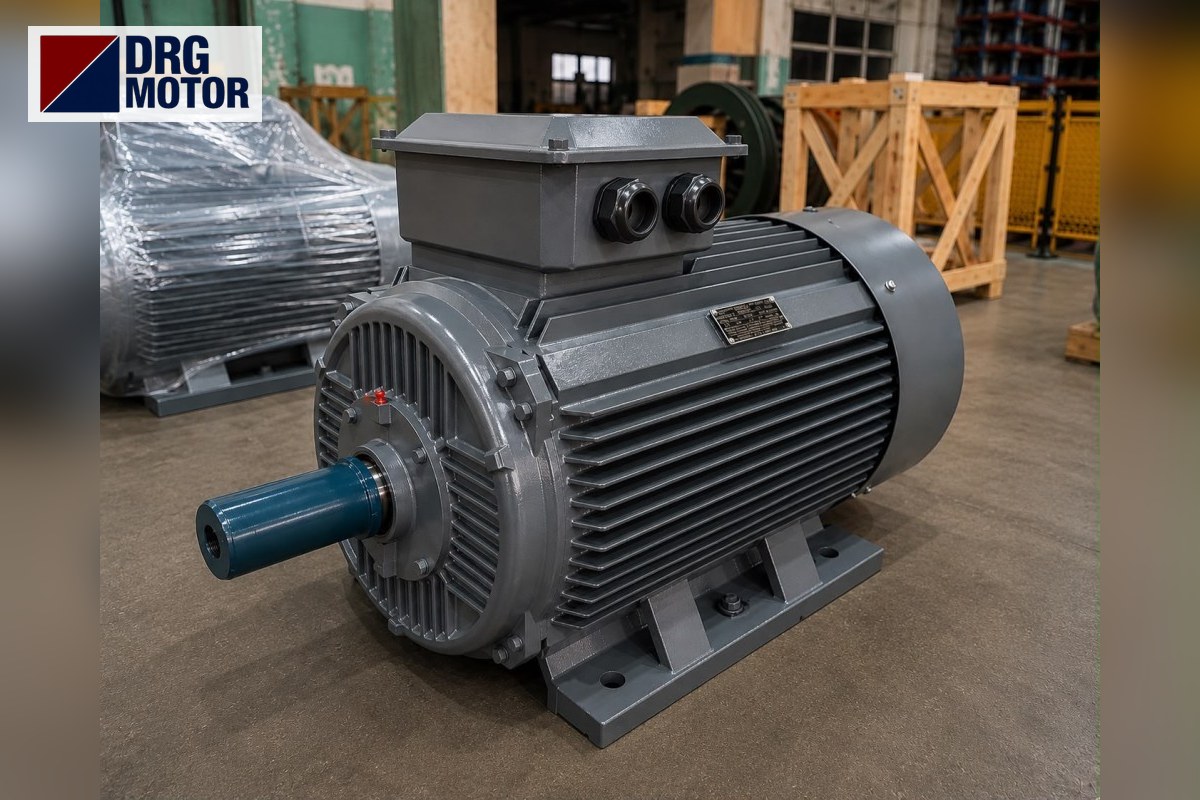

A 75 HP (55 kW) motor draws roughly 65–68 kVA of apparent power from the network while running; during the first seconds of a direct-on-line start this jumps to about 496–500 kVA. So at 55 kW the real question is not the motor's power but whether the transformer can handle that start. At 400 V the current is 93.5 A for the 2-pole DRG-250M-2, 97.6 A for the 4-pole DRG-250M-4 and 98.1 A for the 6-pole DRG-280M-6. All models and current prices are on our Buy Electric Motors Online page.
In large pump and compressor stations, a 55 kW motor is often the plant's largest single load. Transformer, panel and power factor correction decisions are made around this motor; shaft, bearing and coupling choices depend on how the machine is connected. Below we cover the electrical side first, then the mechanical side. The transformer and panel design must be approved by a qualified electrical engineer or electrician.
kVA and kVAr Drawn by a 55 kW Motor
| Model | Speed | Current 400 V | cos φ | Apparent power (running) | Reactive power | Is/In | Apparent power (DOL start) | Store |
|---|---|---|---|---|---|---|---|---|
| DRG-250M-2 | 2970 rpm | 93.5 A | 0.9 | ≈ 64.8 kVA | ≈ 28.2 kVAr | 7.7 | ≈ 499 kVA | See Prices |
| DRG-250M-4 | 1485 rpm | 97.6 A | 0.86 | ≈ 67.6 kVA | ≈ 34.5 kVAr | 7.4 | ≈ 500 kVA | See Prices |
| DRG-280M-6 | 985 rpm | 98.1 A | 0.86 | ≈ 68.0 kVA | ≈ 34.7 kVAr | 7.3 | ≈ 496 kVA | See Prices |
Apparent power is calculated with S = √3 × U × I (400 V). Reactive power is Q = S × sin φ; because the 6-pole model has higher reactive power, it needs a larger step in the capacitor bank. You can find your plant's capacitor requirement with the power factor correction calculator. A current comparison alongside 90 kW is in our 55, 75 and 90 kW current article.
Example: how many kVAr to raise cos φ to 0.95?
The active power the 4-pole model takes from the network is about P = S × cos φ = 58.2 kW. The required capacitor power is found with Qc = P × (tan φ1 − tan φ2): about 15.4 kVAr for cos φ 0.86 → 0.95. On the 2-pole model cos φ is already 0.9, so the need drops to about 9.1 kVAr; on the 6-pole it is 15.5 kVAr. After correction, the line current through the transformer falls from 97.6 A to about 88.4 A on the 4-pole model. This reduces the load on the transformer and main cable; the current at the motor terminals does not change unless the capacitor is connected on the motor side.
Transformer Margin: Which Transformer Does a 55 kW Motor Strain?
Transformer selection involves two separate checks. The first is continuous load: the motor's running kVA, together with other loads, must stay below the transformer rating. The second is starting: while the motor starts, voltage dips across the transformer winding, and contactors, drives and lighting fed from the same transformer are affected. The table below is a conceptual estimate for the DRG-250M-4, assuming a transformer short-circuit voltage (uk) of 6% and neglecting network impedance; the actual value changes with cable length, network strength and other loads.
| Transformer rating | Transformer rated current (400 V) | Motor share when running | Estimated voltage dip – DOL | Estimated voltage dip – star-delta |
|---|---|---|---|---|
| 160 kVA | ≈ 231 A | 42% | 19% | 6.3% |
| 250 kVA | ≈ 361 A | 27% | 12% | 4.0% |
| 400 kVA | ≈ 577 A | 17% | 7.5% | 2.5% |
| 630 kVA | ≈ 909 A | 11% | 4.8% | 1.6% |
The estimate works like this: the transformer's short-circuit power is about Stransformer / uk (≈ 4167 kVA for 250 kVA). Dividing the starting kVA by this value gives the approximate voltage dip: 500 / 4167 ≈ 12%. In practice, dips above 10–15% at start can make contactors drop out and slow down other motors, so plants with small transformers use star-delta, a soft starter or a drive on 55 kW motors. For transformer and panel planning with larger motors, our 200 and 250 kW transformer-panel article walks through it step by step.
Pole Choice for Large Pumps and Compressors
Centrifugal and vertical turbine pumps
In pump stations, 55 kW is usually coupled directly. Applications needing high head and a small impeller use the 2-pole at 2970 rpm, while slurry and wastewater pumps, which run slower and where wear matters, prefer the 4-pole at 1485 rpm. A centrifugal pump has low starting torque, so star-delta starting rarely causes problems; the main point is to start with the valve closed and open it once the motor has reached speed. For the pump-side power calculation, use the pump and fan motor power calculator.
Screw and piston compressors
On compressors the motor is connected either by coupling or by belt. On a belt-driven compressor, the pulley puts radial load on the shaft; mount it as close as possible to the shaft shoulder and keep belt tension at the manufacturer's value. If a piston compressor has to start against back pressure, the motor starts loaded, which makes the unloader valve a critical part. Compressor motors switch on and off frequently, so always state the number of starts per hour when choosing the overload relay and contactor. Calculate overload and fuse values with the overload, fuse and contactor selection tool.
Shaft, Key and Bearing: Different Shafts in the Same Frame
| Model | IEC frame | Shaft D×E | Key F | Bearing | Overall length L | Frame diameter AC | Cable entry |
|---|---|---|---|---|---|---|---|
| DRG-250M-2 | 250M | 60×140 mm | 18 mm | 6314-C3 | 910 mm | 485 mm | 2 × M63×1.5 |
| DRG-250M-4 | 250M | 65×140 mm | 18 mm | 6314-C3 | 910 mm | 485 mm | 2 × M63×1.5 |
| DRG-280M-6 | 280M | 75×140 mm | 20 mm | 6317-C3 | 1033 mm | 547 mm | 2 × M63×1.5 |
The notable detail in the table: although the 2-pole and 4-pole models share the same 250M frame, their shaft diameters differ (60 mm and 65 mm). The 4-pole motor transmits twice the torque (176.9 Nm versus 353.7 Nm), so it uses a thicker shaft and a wider key (18 → 18 mm). So when switching from 2 to 4 poles, the coupling hub must be re-machined even if the foot holes match. The 6-pole model moves up to the 280M frame; the shaft becomes 75 mm and the bearing 6317-C3, and since shaft height rises to 280 mm, alignment with the pump starts from scratch.
55 kW Pump or Compressor Motor Commissioning Checklist
- List the transformer rating and the other large loads on the same transformer; choose the starting method from that list.
- Measure coupling alignment with a dial gauge; shaft height is 280 mm on the 280M frame and 250 mm on the 250M frame.
- Machine the coupling or pulley hub to the model’s shaft diameter (60 / 65 / 75 mm) and key width.
- On a belt-driven compressor, mount the pulley close to the shaft shoulder and set belt tension by measurement.
- Check that the capacitor bank brings cos φ to the required level while the motor runs.
- Prepare glands and cable lugs that fit the 2 × M63×1.5 entry on the terminal box.
- At first start, measure and record the run-up time and voltage dip; compare at later maintenance.
Technical Features That Affect the Price of a 75 HP Motor
At 55 kW, the main price factors are frame size (250M or 280M), bearing size (6314-C3 or 6317-C3), mounting type (B3, B5, B35) and protection class. The 6-pole model being in the next frame up affects the price directly. All models in this rating have cast iron frames. The current price of each model is on its product page and in our online store.
Motors in This Rating (75 HP / 55 kW)
- DRG-250M-2 – 55 kW – 2970 rpm – 250M cast iron
- DRG-250M-4 – 55 kW – 1485 rpm – 250M cast iron
- DRG-280M-6 – 55 kW – 985 rpm – 280M cast iron
Click to see current prices and order these motors nowSEE PRICES →
Frequently Asked Questions
What size transformer for a 55 kW motor?
The motor draws about 68 kVA while running, but starting sets the transformer size. In the example estimate, a 250 kVA transformer gives about 12% voltage dip on a direct start and about 4.0% in star-delta. A project calculation including other loads is required.
How many amps does a 75 HP motor draw?
93.5–98.1 A at 400 V and 98.5–103 A at 380 V. On a direct start, the 4-pole model's starting current is about 722 A.
What is the shaft diameter of a 55 kW motor?
60×140 mm on the 2-pole, 65×140 mm on the 4-pole and 75×140 mm on the 6-pole.
Which bearing does a 55 kW motor use?
The 250M-frame 2-pole and 4-pole models use 6314-C3 bearings; the 280M-frame 6-pole model uses 6317-C3.
For help selecting a model for your pump or compressor station, call +90 (542) 666 11 11, write to [email protected] or use our contact page. For all 120 models, visit Buy Electric Motors Online.