English
 Le français
 Türkçe




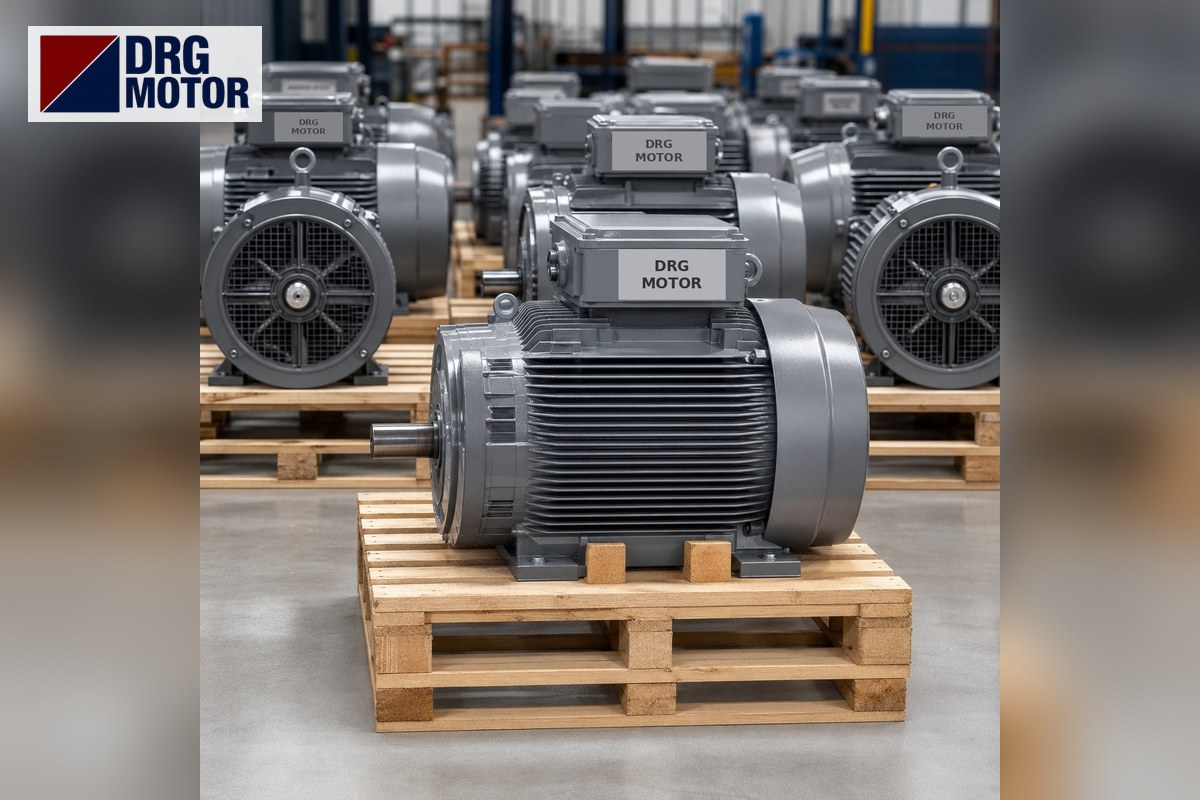

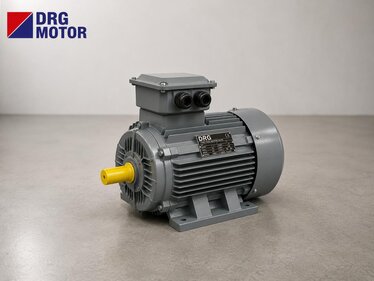
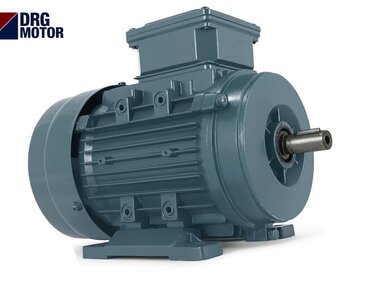
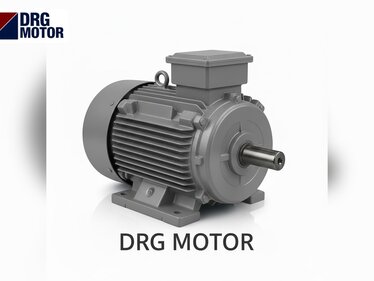
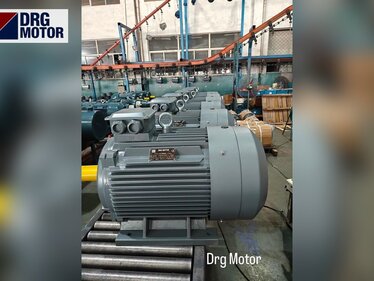
A motor searched for as a "1400 rpm electric motor" is a 4-pole three-phase induction motor running on a 50 Hz supply; its synchronous speed is 1500 rpm and the actual speed on the nameplate depends on the rating. In the DRG catalogue the model that reads exactly 1400 rpm is DRG-801-4 (0.55 kW), while 0.25 and 0.37 kW read 1340, 0.75 kW reads 1420 and 1.1 kW reads 1445 rpm. So "1400 rpm" is not a model name but a rounded trade term used for small 4-pole motors.
The nameplate figure rises with power because of slip: the rotor turns slightly behind the rotating magnetic field, and this lag is proportionally larger in a small motor. A 0.25 kW motor runs 10.67% below synchronous speed, a 1.1 kW motor only 3.67% below. If your old motor's plate says "1400", matching the power and the frame of the replacement matters more than hitting the speed figure exactly.
Every model in this article is listed on the Buy Electric Motors Online page; click a model code in the table below to open its product page.
Where does the "1400 rpm" term come from?
The synchronous speed of an induction motor is ns = 120 × f / p. With f = 50 Hz and p = 4 poles, ns = 120 × 50 / 4 = 1500 rpm. Under load the motor never reaches this speed: current can only be induced in the rotor bars if there is a speed difference between field and rotor. That difference is called slip, s = (ns − n) / ns.
Because the plate values of small 4-pole motors cluster around 1400, installers call this class "1400 motors"; in DRG data the 0.55–1.1 kW range reads 1400–1445 rpm. At 1.5–4 kW the plate settles at 1445–1450, so that group is known as "1450 rpm". By the same logic small 2-pole motors are known as "2800" and larger ones as "2900". Our guide to three-phase induction motor types covers the whole classification and how pole count affects machine selection.
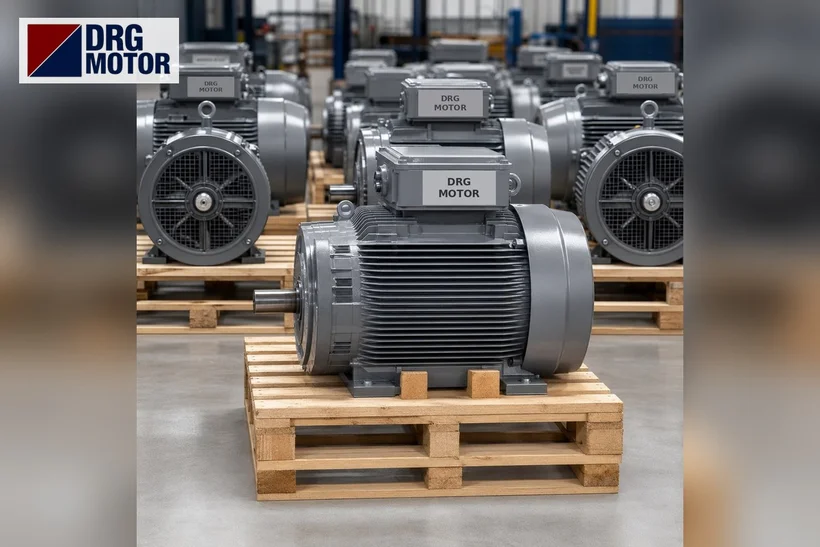
Nameplate speed of 0.25–1.1 kW 4-pole models
The table shows the rated speed of the small 4-pole motors in the DRG shop and how far each one runs below 1500 rpm. The slip column was calculated in Python from (1500 − n) / 1500.
| Model | Power | Frame (IEC) | Rated speed | Below synchronous | Slip | Shop |
|---|---|---|---|---|---|---|
| DRG-711-4 | 0.25 kW | 71 – aluminium | 1340 rpm | 160 rpm | 10.67% | See Prices |
| DRG-712-4 | 0.37 kW | 71 – aluminium | 1340 rpm | 160 rpm | 10.67% | See Prices |
| DRG-801-4 | 0.55 kW | 80 – aluminium / cast iron | 1400 rpm | 100 rpm | 6.67% | See Prices |
| DRG-802-4 | 0.75 kW | 80 – aluminium / cast iron | 1420 rpm | 80 rpm | 5.33% | See Prices |
| DRG-90S-4 | 1.1 kW | 90S – aluminium / cast iron | 1445 rpm | 55 rpm | 3.67% | See Prices |
The 0.25 and 0.37 kW ratings are built in the aluminium 71 frame; from 0.55 kW upward the same model code is offered with either an aluminium or a cast iron housing, and the electrical values are identical for both. Housing material does not change the speed; cast iron suits vibrating, dusty or impact-prone locations, aluminium suits applications where low weight and easy mounting count.
Why does a small motor run slower?
Slip is set jointly by the torque the rotor carries and the rotor resistance. In a small frame the rotor bars are thin with narrow cross-sections, so rotor resistance is relatively high and the same proportional load produces more slip. Large motors have thick bars and wide end rings, which lower resistance and push slip below 1%.
A concrete comparison: DRG-711-4 delivers 1.78 Nm rated torque at 0.25 kW while running 160 rpm below synchronous; DRG-90S-4 delivers 7.27 Nm at 1.1 kW and lags by only 55 rpm. Checking with P × 9550 / n, 0.25 kW at 1340 rpm gives 1.78 Nm, matching the data sheet.
The practical consequence is simple: replace a 1340 rpm motor with a 1445 rpm one and the driven machine turns about 7.8% faster (1445 / 1340 = 1.078). On a fan, pump or conveyor that can noticeably raise flow or belt speed, so re-check the pulley ratio whenever you upsize the power.
How load and speed relate
The plate speed is measured at full load. In the normal operating range slip changes roughly in proportion to load; a 0.25 kW motor at half load runs at about 1500 − 160 / 2 = 1420 rpm. At no load the rotor gets very close to 1500 but never reaches it. A tachometer reading above the plate value therefore usually means a lightly loaded motor; a reading below the plate points to overload, low supply voltage or mechanical binding.
Small 4-pole motors start easily: the Ts/Tn ratio is 2.1 at 0.25–0.37 kW, 2.4 at 0.55 kW and 2.3 at 0.75–1.1 kW. The starting current ratio (Is/In) stays between 5.2 and 6.8; rated current at 400 V ranges from 0.66 A to 2.48 A. Use the overload relay, fuse and contactor selection tool to find the matching relay range.
Dimensions to check when replacing an old 1400 rpm motor
The most common problem in a replacement is not speed but shaft and mounting dimensions. Read the power on the plate, then measure the shaft with a caliper: a 14 mm shaft points to frame 71, 19 mm to frame 80, 24 mm to frame 90. The values below come from DRG catalogue data.
| IEC frame | 4-pole ratings on this frame | Shaft D×E (mm) | Shaft height H (mm) | Overall length L (mm) | Cable entry | Bearing |
|---|---|---|---|---|---|---|
| 71 | 0.25 / 0.37 kW | 14×30 | 71 | 242 | 1 × M20×1.5 | 6202-ZZ-C3 |
| 80 | 0.55 / 0.75 kW | 19×40 | 80 | 304 | 1 × M20×1.5 | 6204-ZZ-C3 |
| 90S | 1.1 kW | 24×50 | 90 | 336 | 1 × M25×1.5 | 6205-ZZ-C3 |
0.55 and 0.75 kW share the same 80 frame, so foot holes and shaft are identical; if the load has grown, a 0.75 kW motor fits the same base. Moving to 1.1 kW enlarges the frame to 90S, the shaft becomes 24 mm and the cable entry M25, so the coupling or pulley hub has to change. Current values for every rating are compared in the motor current chart.
Pre-order checklist
- kW (or HP) on the old plate: 0.25 / 0.37 / 0.55 / 0.75 / 1.1 kW.
- Shaft diameter and length (D×E): 14×30, 19×40 or 24×50 mm.
- Mounting: foot (B3), flange (B5) or both (B35).
- Voltage: all these ratings are 230/400 V (Δ/Y); on a 380/400 V supply the terminal box is connected in star (Y).
- Housing: aluminium or cast iron — 0.25 and 0.37 kW are aluminium only.
- If the machine is speed-sensitive (fan, dosing pump), compare the new plate speed with the old one and check the pulley ratio.
Which technical factors set the price of 1400 rpm motors?
In this class the price is driven by technical features: power (winding and lamination stack grow from 0.25 kW to 1.1 kW), IEC frame size (71, 80, 90S), housing material (aluminium or cast iron), mounting arrangement (B3, B5, B35) and protection class. The speed class itself can call for a larger frame than a 2-pole model of the same power. Current prices are shown on each product page and among the 120 models in our online shop.
Motors in this power range
- DRG-711-4 – 0.25 kW – 1340 rpm – 71 aluminium
- DRG-712-4 – 0.37 kW – 1340 rpm – 71 aluminium
- DRG-801-4 – 0.55 kW – 1400 rpm – 80 aluminium (cast iron version)
- DRG-802-4 – 0.75 kW – 1420 rpm – 80 aluminium (cast iron version)
- DRG-90S-4 – 1.1 kW – 1445 rpm – 90S aluminium (cast iron version)
Click to see current prices and order these motors nowSEE PRICES →
Frequently Asked Questions
How many poles does a 1400 rpm motor have?
Four. Its synchronous speed at 50 Hz is 1500 rpm; plate values between 1340 and 1445 rpm come from slip.
Is there a difference between a 1400 rpm and a 1450 rpm motor?
The pole count is the same; the difference is power. In DRG data 0.55 kW is 1400, 1.1 and 1.5 kW are 1445, and 2.2–4 kW are 1450 rpm. There are no separate "1400" and "1450" models of the same power.
How many amps does a 1400 rpm 0.75 kW motor draw?
DRG-802-4 draws 1.84 A at 380 V and 1.75 A at 400 V; cos φ is 0.75.
Can I replace a 1400 rpm motor with a 2800 rpm motor?
Not unless the machine was designed for it. A 2-pole motor turns roughly twice as fast and delivers half the torque at the same power; on fans and pumps this causes overload, on belt drives the wrong speed.
To match a model, send a photo of the old nameplate to +90 (542) 666 11 11 or [email protected], or reach us through our contact page. All power and speed options are in the Buy Electric Motors Online category.