English
 Le français
 Türkçe




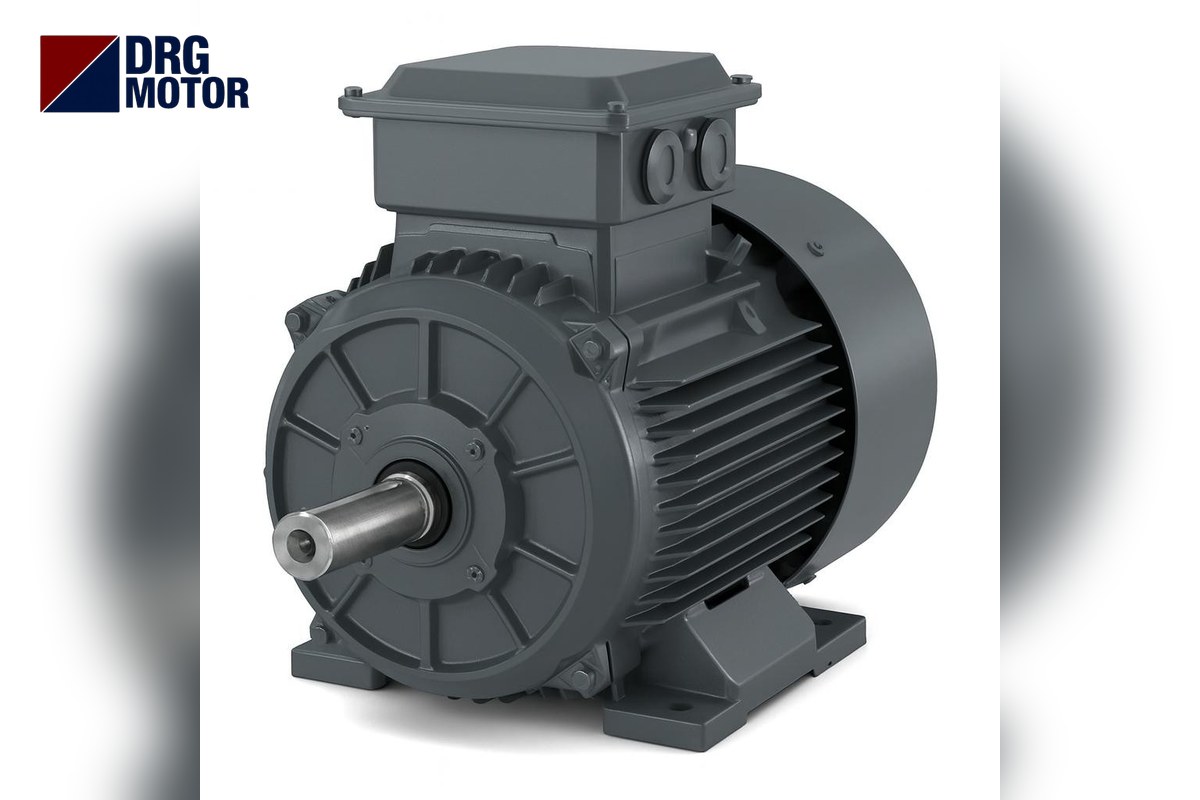

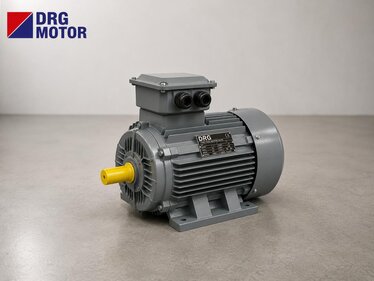
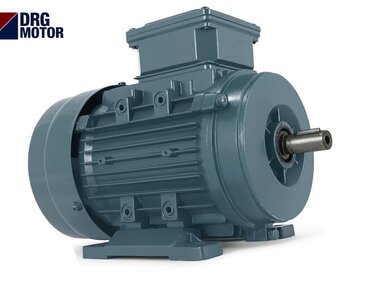
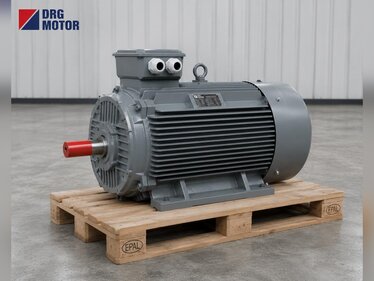
If you are looking for a 7.5 HP motor for a fan or an extractor, the nameplate to look for is 5.5 kW (5.5 kW ≈ 7.38 HP, sold as 7.5 HP). There are four options at this power: the 2930 rpm DRG-132S1-2, the standard 1460 rpm DRG-132S-4, the compact DRG-112M-4K which gives the same electrical values in a one-size-smaller 112M frame, and the 968 rpm DRG-132M2-6. On a fan, motor speed must match the design speed of the impeller, so selection starts with speed before kW. All versions are on our Buy Electric Motors Online page.
The compact frame exists because space is tight in fan casings and extractor brackets: the 112M-4K delivers the same current, speed and torque as the 132S-4 while being 44 mm shorter, with the shaft axis 20 mm lower. This article first covers speed selection with the fan laws, then the dimensional advantage of the compact frame and its limits.
Fan Laws: Why Does Power Change with the Cube of Speed?
A fan impeller follows three basic relations: flow varies in proportion to speed, pressure with the square of speed, and absorbed power with the cube of speed (P₂ = P₁ × (n₂ ÷ n₁)³). Driving the same impeller with motors of different pole numbers gives the following (impeller design speed assumed to be 1460 rpm):
| Motor | Speed (rpm) | Flow ratio | Power ratio (n³) | New power if the impeller absorbs 5.0 kW |
|---|---|---|---|---|
| DRG-132M2-6 | 968 | 0.66 | 0.29 | ≈ 1.46 kW |
| DRG-132S-4 | 1460 | 1.00 | 1.00 | 5.0 kW |
| DRG-132S1-2 | 2930 | 2.01 | 8.08 | ≈ 40.4 kW |
The last row shows the most common mistake: fitting a 3000 rpm motor to an extractor designed for 1500 rpm "to pull more air" raises the impeller's power demand roughly eightfold; the 5.5 kW motor draws excessive current within seconds and the protection trips, and the impeller may not withstand that speed mechanically. The reverse also holds: driving a 1500 rpm impeller with a 1000 rpm motor cuts the flow by about a third. Do not change the speed written on the fan nameplate; if you need more flow, reselect the fan. To check fan power, you can use the pump and fan motor power calculator.
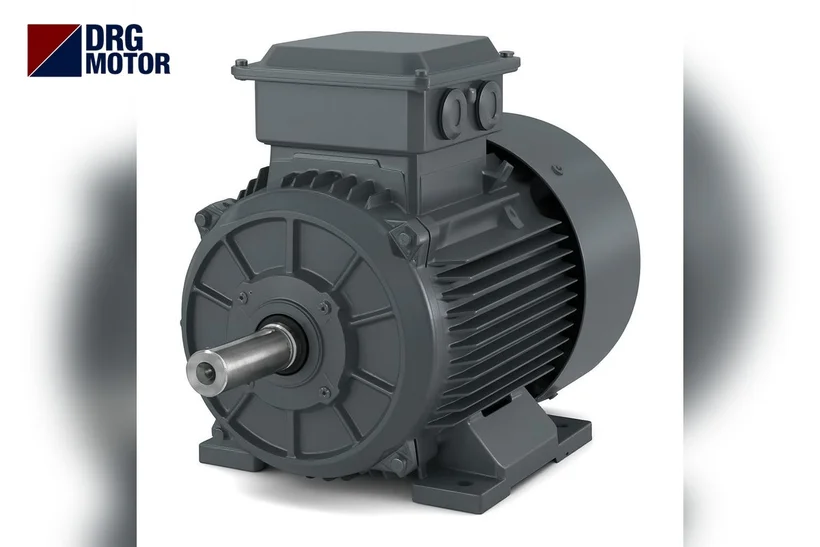
Four Options at 5.5 kW: Electrical Values
| Model | Speed (rpm) | Frame | Current 380 V (A) | cos φ | Torque (Nm) | Is/In | Price |
|---|---|---|---|---|---|---|---|
| DRG-132S1-2 | 2930 | 132S | 10.6 | 0.88 | 17.9 | 8.3 | See Prices |
| DRG-132S-4 | 1460 | 132S | 11.2 | 0.83 | 36.0 | 7.9 | See Prices |
| DRG-112M-4K (compact) | 1460 | 112M | 11.2 | 0.83 | 36.0 | 7.9 | See Prices |
| DRG-132M2-6 | 968 | 132M | 12.7 | 0.75 | 54.3 | 7.0 | See Prices |
In the table the standard 132S-4 and compact 112M-4K rows are identical. The difference is mechanical and is covered in the next section. All 5.5 kW models carry a 400/690 V nameplate and are connected in delta on a 380–400 V supply; for current, overload and panel details, see our article how many amps a 5.5 kW motor draws. On fans, run-up can be long: a large impeller has high inertia and the starting current (11.2 × 7.9 ≈ 88.5 A on the 4-pole model) flows for a long time until the motor reaches rated speed. The overload class and starting method must be chosen for this time, and the work left to a qualified electrician.
Compact DRG-112M-4K: What Do You Gain in Dimensions?
| Dimension (mm) | DRG-132S-4 | DRG-112M-4K |
|---|---|---|
| Shaft height H | 132 | 112 |
| Shaft D × E | 38 × 80 | 28 × 60 |
| Foot holes A × B | 216 × 140 | 190 × 140 |
| Foot to shaft shoulder C | 89 | 70 |
| Overall length L | 438 | 394 |
| Housing diameter AC | 258.4 | 230 |
| Terminal box height AD | 203 | 188 |
| B5 flange outer diameter P | 300 | 250 |
| B5 pitch circle M | 265 | 215 |
| B5 spigot N | 230 | 180 |
| Bearing | 6208-ZZ-C3 | 6206-ZZ-C3 |
The dimensions are the catalogue values of the 112M and 132S frames. The compact motor offers three concrete gains in fan applications:
- Shorter length: L is 394 mm instead of 438 mm. For motors placed inside a duct or behind a fan casing, these 44 mm make room for a cover and guard.
- Smaller flange: B5 flange outer diameter is 250 mm instead of 300 mm. If the motor support plate of an axial fan is small, the 112M flange fits directly.
- Lower axis: Shaft height is 112 mm instead of 132 mm, which keeps the motor slide rail lower on belt-driven extractors.
Limits of the Compact Frame: Shaft, Bearing and Hub
The price of choosing compact is a thinner shaft: 28 × 60 mm instead of 38 × 80 mm. If the fan impeller is mounted directly on the shaft, its hub must be machined for 28 mm; an impeller with a 38 mm hub cannot be fitted to the compact motor, and reducing it with a bush can upset the balance. The bearing is 6206-ZZ-C3 instead of 6208-ZZ-C3; with heavy, large-diameter impellers mounted directly on the shaft, the radial load sits on the front bearing, and the standard 132S frame is the more comfortable choice.
In short: for a light axial fan, a tight casing and a small belt-driven extractor the compact frame has the advantage; when a heavy centrifugal impeller is mounted directly on the shaft, the standard frame is preferred. The compact model comes in aluminium only; if an application calls for cast iron, the standard 132S-4 is chosen.
One more detail matters in replacement jobs: the B5 flange of the compact motor has a 215 mm pitch circle (M) and a 180 mm spigot (N); on the 132S flange these are 265 and 230 mm. The two flanges are therefore not interchangeable. Do not order before measuring the existing fan support and comparing it with the M and N values in the table.
Extractors: Mounting Position and Belt Drive
On roof extractors the motor often runs vertically with the shaft facing down or up. In vertical mounting the flange carries the load and the shaft takes axial load; when ordering, specify the mounting type (B5 flange or B35 foot-and-flange) and that the motor will run vertically. On belt-driven centrifugal extractors fan speed is set by the pulley ratio: for example, with a 1460 rpm motor and a required fan speed of 1100 rpm, the ratio is ≈ 1.33. Because of the fan laws, changing this ratio again affects power with the cube; before increasing fan speed with a larger pulley, repeat the calculation above. The pulley and belt calculator can be used for pulley diameters.
Technical Factors Behind the Price of a 7.5 HP Motor
In the 5.5 kW class the differences come from speed (2, 4 or 6 poles), frame type (standard or compact), housing material (aluminium or cast iron) and mounting type (B3, B5, B35). Remember also that the 6-pole model moves to a 132M frame. Once these choices are made, you can see the current price on the product pages or among the 120 models in our online store.
Fan and Extractor Motor Checklist
- Has the speed on the fan nameplate been read? Is the motor speed in the same class?
- Is the impeller mounted directly on the shaft? Is the hub bore 28 mm or 38 mm?
- Does the motor support plate suit a 250 mm (112M) or a 300 mm (132S) flange?
- Will the motor run vertically? Is the mounting type stated in the order?
- If belt-driven, have the pulley ratio and fan speed been calculated?
- Has protection been selected for a long run-up, and is the terminal box connected in delta?
Motors in This Power Rating
- DRG-132S1-2 – 5.5 kW – 2930 rpm – 132S aluminium
- DRG-132S1-2 – 5.5 kW – 2930 rpm – 132S cast iron
- DRG-132S-4 – 5.5 kW – 1460 rpm – 132S aluminium
- DRG-132S-4 – 5.5 kW – 1460 rpm – 132S cast iron
- DRG-112M-4K – 5.5 kW – 1460 rpm – 112M aluminium (compact)
- DRG-132M2-6 – 5.5 kW – 968 rpm – 132M aluminium
- DRG-132M2-6 – 5.5 kW – 968 rpm – 132M cast iron
Click to see current prices and order these motors nowSEE PRICES →
Frequently Asked Questions
How many kW is a 7.5 HP motor?
7.5 HP is about 5.59 kW; the standard motor rating is 5.5 kW. A motor with 5.5 kW on its nameplate is known as a 7.5 HP motor on the market.
Can a 3000 rpm motor be fitted to an extractor fan?
Only if the fan is designed for 3000 rpm. Driving a 1500 rpm impeller at 3000 rpm raises power about eightfold and overloads the motor.
What is the difference between a compact and a standard 5.5 kW motor?
The electrical values (11.2 A, 1460 rpm, 36.0 Nm) are the same. The compact DRG-112M-4K comes in a 112M frame with a 28 mm shaft and a 250 mm B5 flange; the standard DRG-132S-4 has a 132S frame, 38 mm shaft and 300 mm flange.
What speed should a fan motor have?
It must match the design speed of the impeller. The 1500 rpm class (1460 rpm) is common for axial and centrifugal fans; 1000 rpm is used for large, slow fans and 3000 rpm for small, high-pressure fans.
To choose the right motor for your fan, call +90 (542) 666 11 11, write to [email protected] or use our contact page. Our article on ventilation fan motors also helps with fan motor selection; all models are on the Buy Electric Motors Online page.