English
 Le français
 Türkçe




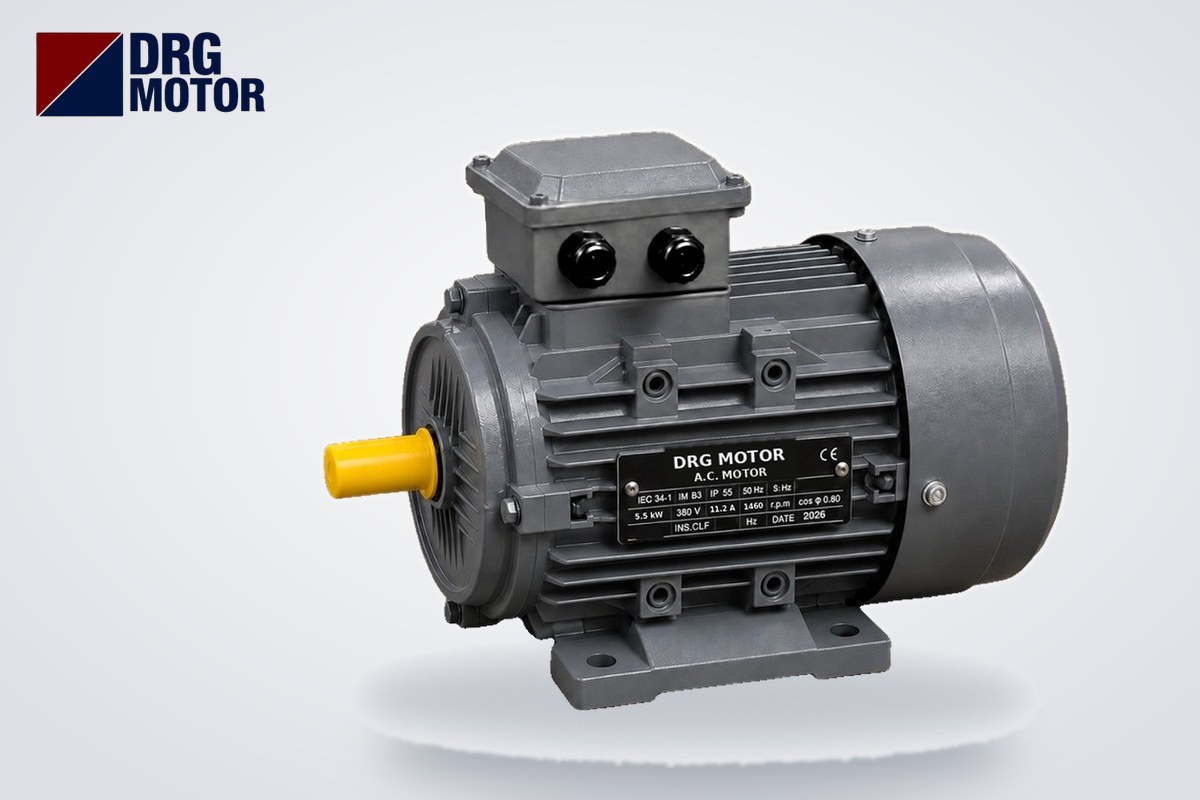

A 5.5 kW (7.5 HP), 1500 rpm three-phase motor draws 11.2 A at full load on a 380 V supply and 10.7 A at 400 V. At the same power, a 3000 rpm motor draws 10.6 A at 380 V and a 1000 rpm motor 12.7 A. With direct-on-line starting, the current at the moment of start rises to about 88.5 A for the 1500 rpm motor; the panel is built around these two values, the rated current and the starting current.
The current changes with speed because of the power factor: as the number of poles increases, cos φ drops (0.88 → 0.83 → 0.75) and more current is drawn from the supply to deliver the same mechanical power. Higher voltage means lower current, and a motor running at part load will show a reading below its nameplate current. All values below are catalogue data of the 5.5 kW models in our Buy Electric Motors Online store.
After the current values, this article explains how to think through a small motor panel: what current the motor protection breaker or overload relay should be set to, why the fuse must ride through the starting current, and where to look for the cable size. We do not give exact breaker or cable values, because these depend on cable length, installation method and ambient temperature.
5.5 kW Motor Current Table: 2, 4 and 6 Poles
All 5.5 kW motors in the store are offered with aluminium and cast iron housings. The housing material does not change the electrical values; for the same model code, current, cos φ, speed and torque are identical in both housings. That is why the table shows the two housings on separate rows with the same figures. The compact DRG-112M-4K carries the values of the 1500 rpm row.
| Model | Housing | IEC | Rated speed (rpm) | cos φ | I 380 V (A) | I 400 V (A) | I 415 V (A) | Is/In | Torque (Nm) |
|---|---|---|---|---|---|---|---|---|---|
| DRG-132S1-2 | Aluminium | 132S | 2930 | 0.88 | 10.6 | 10.1 | 9.75 | 8.3 | 17.9 |
| DRG-132S1-2 | Cast iron | 132S | 2930 | 0.88 | 10.6 | 10.1 | 9.75 | 8.3 | 17.9 |
| DRG-132S-4 | Aluminium | 132S | 1460 | 0.83 | 11.2 | 10.7 | 10.3 | 7.9 | 36.0 |
| DRG-132S-4 | Cast iron | 132S | 1460 | 0.83 | 11.2 | 10.7 | 10.3 | 7.9 | 36.0 |
| DRG-112M-4K | Aluminium | 112M | 1460 | 0.83 | 11.2 | 10.7 | 10.3 | 7.9 | 36.0 |
| DRG-132M2-6 | Aluminium | 132M | 968 | 0.75 | 12.7 | 12.0 | 11.6 | 7.0 | 54.3 |
| DRG-132M2-6 | Cast iron | 132M | 968 | 0.75 | 12.7 | 12.0 | 11.6 | 7.0 | 54.3 |
Two points when reading the table. First, the difference between 380 V and 400 V is small but matters for the overload setting: measure your actual supply voltage and use the closest column. Second, the Is/In ratio differs by speed: 8.3 for the 3000 rpm motor, 7.9 at 1500 rpm and 7.0 at 1000 rpm. For other ratings, see the motor current chart.
400/690 V Δ Connection: How to Wire the Terminals on a 380 V Supply
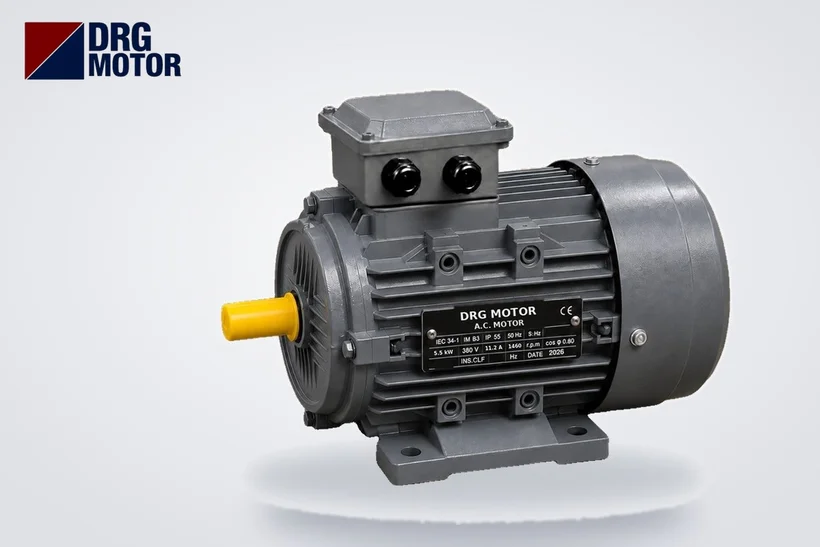
The nameplate of 5.5 kW motors reads 400/690 V (Δ/Y). This means the windings are connected in delta (Δ) at 400 V and in star (Y) at 690 V. On the 380/400 V three-phase network used in Turkey, the motor is connected in delta: the three links in the terminal box are fitted vertically between U1–W2, V1–U2 and W1–V2.
If the same motor is connected in star on a 690 V supply, the line current drops by roughly the ratio 400/690: 10.7 A × 400 / 690 ≈ 6.2 A. This is rarely needed in Turkey, but it explains why the nameplate shows two voltages. The practical consequence is this: because the motor is wound to run in delta at 400 V, it is suitable for star-delta starting. In the star step, the current drawn from the supply is about one third of the direct-on-line value; ≈ 29.5 A for the 1500 rpm motor. For details on starting methods, see the star-delta starting tool.
A common mistake is to connect the 5.5 kW motor in star out of habit from smaller 230/400 V motors. If a 400/690 V motor is connected in star at 400 V, the voltage across each winding stays too low, torque drops, and the motor slows down and heats up under load. Reading the nameplate before wiring the terminals prevents this.
Compact Option: DRG-112M-4K vs DRG-132S-4
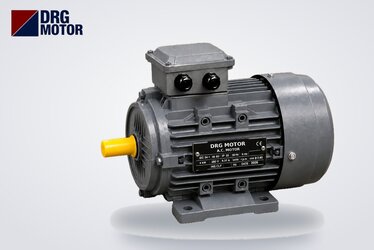
For machines with limited space, for example when replacing the motor on an older machine tool, there is the compact DRG-112M-4K with a 112M frame for 5.5 kW at 1500 rpm. Its electrical values are the same as the standard DRG-132S-4, so the panel, overload setting and fuse calculation do not change. What changes are the mechanical dimensions:
| Feature | DRG-112M-4K (compact) | DRG-132S-4 (standard) |
|---|---|---|
| IEC frame | 112M | 132S |
| Shaft height H (mm) | 112 | 132 |
| Shaft diameter D (mm) | 28 | 38 |
| Overall length L (mm) | 394 | 438 |
| Housing diameter AC (mm) | 230 | 258.4 |
| Foot holes A × B (mm) | 190 × 140 | 216 × 140 |
| Bearing | 6206-ZZ-C3 | 6208-ZZ-C3 |
| Cable entry | 2 × M32×1.5 | 2 × M32×1.5 |
| I 380 V (A) | 11.2 | 11.2 |
| cos φ | 0.83 | 0.83 |
| Rated speed (rpm) | 1460 | 1460 |
On the compact model, the shaft height is 112 mm and the shaft diameter 28 mm. If the existing coupling, pulley or base was made for a 132 frame, take these differences into account; conversely, if you want to fit 5.5 kW into a 112 frame position, the compact model is a direct candidate.
A Small Panel Layout for a 5.5 kW Motor
In a simple direct-on-line panel feeding one motor, the order is usually: main switch or fuse → motor protection circuit breaker (or contactor + overload relay) → motor. Each device is selected against a different current.
Motor protection breaker and overload setting
Overload protection is set to the rated current. For direct-on-line starting at 380 V, the setting for the 1500 rpm motor is around 11.2 A; if your supply is 400 V, 10.7 A. The breaker's setting range should include this value without sitting at the very end of the range. In a star-delta panel, the overload relay is usually connected in the phase winding branch and set to In/√3: 11.2 / 1.732 ≈ 6.5 A. Setting it too high leaves the motor unprotected; setting it too low causes nuisance tripping under load.
The fuse must ride through the starting current
Starting current is found with Is = In × (Is/In). For direct-on-line starting at 380 V: 10.6 × 8.3 ≈ 88.0 A for the 3000 rpm motor, 11.2 × 7.9 ≈ 88.5 A for the 1500 rpm motor and 12.7 × 7.0 ≈ 88.9 A for the 1000 rpm motor. The starting current is close at all three speeds. It lasts only briefly, but it is 7.0–8.3 times the rated current. The fuse or miniature circuit breaker must have a characteristic that does not trip during this short current; if the fuse blows before the motor gets up to speed, the problem is usually the fuse rating or curve, not the motor. For a concrete value, use the overload, fuse and contactor selection tool, which considers starting time and fuse curve together. For the physical reason behind starting current, see our article on why motor starting (inrush) current is high.
Cable size
Cable size depends on rated current, cable length, installation method and the permitted voltage drop. For the same 5.5 kW motor, the distance between panel and motor may be 10 m or 80 m, so quoting a single cross-section would be misleading. Enter the rated current and distance in the motor cable size calculator.
Measuring Current on Site and Comparing It with the Nameplate
With the motor running, measure each of the three phases separately with a clamp meter. If there is a clear difference between phases, first check the supply voltage and the connections. A full-load reading should be close to the table value; if you consistently measure above the nameplate current, the motor may be overloaded, the voltage may be low or the wiring may be wrong.
From the measured current you can roughly find the active power the motor draws from the supply: P = √3 × U × I × cos φ. For the 1500 rpm motor at full load, 1.732 × 380 × 11.2 × 0.83 ≈ 6.12 kW. It is normal for this value to be higher than the 5.5 kW shaft power; the difference is the losses inside the motor. Shaft torque can be checked with 9550 × P / n: 9550 × 5.5 / 1460 ≈ 36.0 Nm, consistent with the catalogue value of 36.0 Nm.
Checklist Before Building the Panel
- Does the nameplate say 400/690 V? On a 380/400 V supply, connect the terminals in delta.
- Measure the supply voltage; set the overload relay to the rated current at that voltage.
- If you use star-delta, check where the overload relay is connected; in the phase branch, set it to In/√3.
- Confirm that the fuse will not trip at the starting current found with Is = In × Is/In, for the whole starting time.
- Calculate the cable size with distance and installation method; take the 2 × M32×1.5 cable entry into account when choosing glands.
- If you switch to the compact model, compare shaft height, shaft diameter and foot hole spacing with the existing base.
- On first start-up, check the direction of rotation and record the current in all three phases.
Motors in This Power Rating
5.5 kW three-phase motors in our store (each model is also listed separately with aluminium and cast iron housing):
- DRG-132S1-2 – 5.5 kW – 3000 rpm – 132S aluminium
- DRG-132S-4 – 5.5 kW – 1500 rpm – 132S aluminium
- DRG-112M-4K – 5.5 kW – 1500 rpm – 112M aluminium (compact)
- DRG-132M2-6 – 5.5 kW – 1000 rpm – 132M aluminium
- DRG-132S-4 – 5.5 kW – 1500 rpm – 132S cast iron
Click to see current prices and order these motors nowSEE PRICES →
Frequently Asked Questions
How many amps does a 5.5 kW motor draw at 380 V?
The 1500 rpm motor draws 11.2 A, the 3000 rpm motor 10.6 A and the 1000 rpm motor 12.7 A (at full load, delta connected).
What is the starting current of a 5.5 kW motor?
With direct-on-line starting at 380 V it is roughly 88.0–88.9 A. With star-delta starting, the current drawn from the supply falls to about one third of that.
What should the overload relay of a 5.5 kW motor be set to?
For direct-on-line starting, to the rated current at the supply voltage: 11.2 A at 380 V for 1500 rpm. In star-delta, if the relay is in the phase branch, ≈ 6.5 A.
Is a 5.5 kW motor connected in star or delta?
Because the nameplate reads 400/690 V, it is connected in delta on a 380/400 V supply. Star connection is used only on a 690 V supply or during the start step of star-delta starting.
If you have questions about models, dimensions or wiring, contact us on +90 (542) 666 11 11 or at [email protected], or use our contact page. To see every power rating and speed, browse the 120 models in our online store.