English
 Le français
 Türkçe




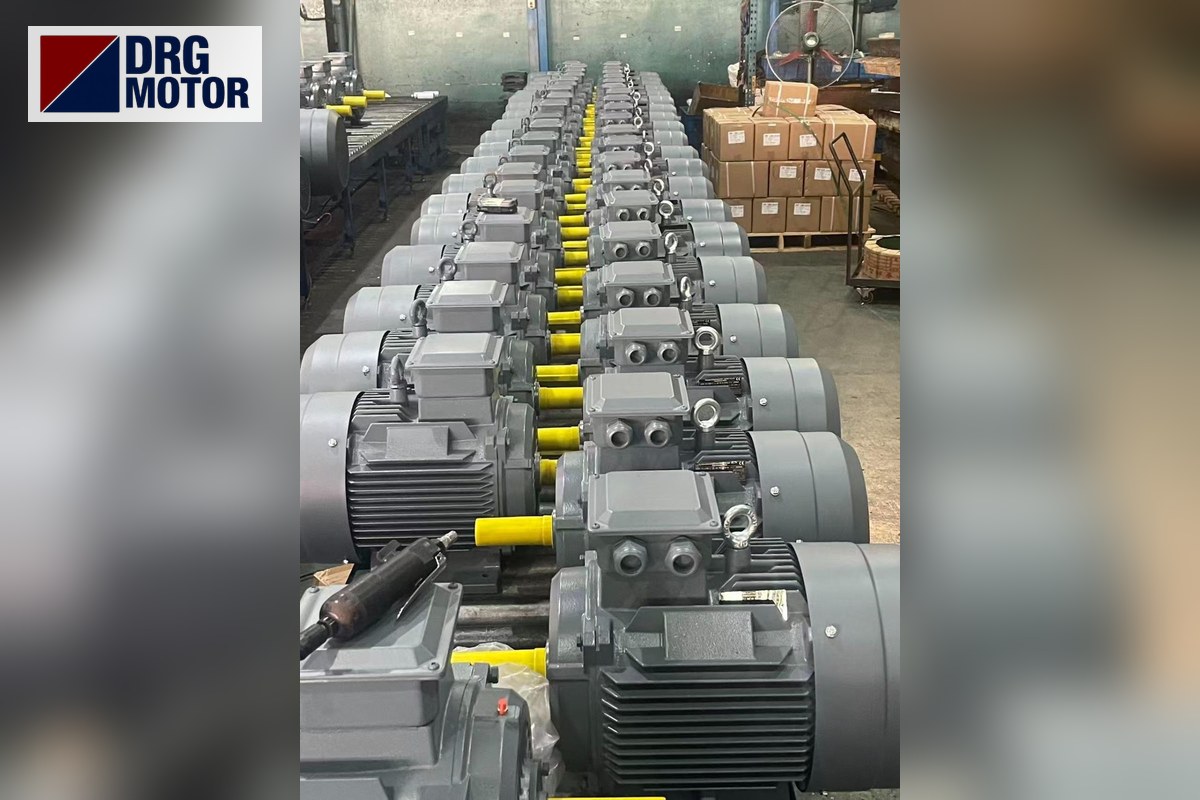

Star-delta starting of a 30 HP (22 kW) motor on a mill or crusher is safe only if the machine starts unloaded. The reason is numerical: the 1500 rpm DRG-180L-4 produces about 286 Nm at direct-on-line start, but in star this falls to one third, about 95 Nm, which is below even the motor’s rated torque of 142.9 Nm. Turning a crusher with material still inside at that torque is usually not possible.
Direct-on-line starting has its own cost: the same motor draws about 326 A at 380 V when starting. The right method depends on the machine’s condition at start and on the strength of the supply. This article gives a decision table, the torque values of the three speeds and the practical effects of starting current. Connection and panel work must be done by a qualified electrician.
The product pages of the three 22 kW cast iron models are linked in the tables; all ratings are on the Buy Electric Motors Online page.
Starting method decision for crushers and mills
| Machine condition at start | Example | Star-delta | Direct-on-line |
|---|---|---|---|
| Starts unloaded; feed opens after the motor reaches speed | hammer mill, crusher with feed belt interlocked | Suitable | Suitable if the network allows |
| Starts with material still inside | stopped full crusher, stone mill | Risky: torque in star may be too low | Usually required |
| Large flywheel / heavy rotor, long run-up | large hammer rotor, jaw crusher with flywheel | Risk of current surge at changeover | Suitable; overload set for run-up time |
| Weak supply (small transformer, generator) | rural mill, site crusher | Preferred, if the load is empty | Risk of voltage collapse |
In short: star-delta lowers current but also lowers torque. For crushing and grinding machines, the real question is “can the motor turn the load at start?”. An interlock that only opens the feed belt once the motor is up to speed makes star-delta usable on most mills.
Signs that a motor cannot start in star
On an existing panel, you can tell on site that star-delta starting is not enough for the machine from these signs: the motor hums loudly in star but its speed does not rise; when the timer expires and it switches to delta, the line jolts and lights flicker; the overload or main breaker trips exactly at the changeover; the machine only starts after several attempts once it has been emptied by hand. These signs do not mean the motor is faulty but that the starting method does not suit the load. The fix is usually to change the feed sequence, empty the machine before stopping, or, if the load really must start full, move to direct-on-line starting with a supply strong enough for it. Lengthening the timer alone is not a solution; if torque in star is insufficient, the motor will not accelerate however long it waits, and the windings heat up needlessly.
Torque values of the three speeds at 22 kW
| Model (cast iron) | Speed (rpm) | In 380 V (A) | Tn (Nm) | Starting torque, DOL (≈ Nm) | Starting torque, in star (≈ Nm) | Breakdown torque (≈ Nm) | Price |
|---|---|---|---|---|---|---|---|
| DRG-180M-2 | 2955 | 40.5 | 71.1 | 142 | 47 | 164 | See Prices |
| DRG-180L-4 | 1470 | 41.8 | 142.9 | 286 | 95 | 329 | See Prices |
| DRG-200L2-6 | 980 | 44.8 | 214.4 | 429 | 143 | 450 | See Prices |
Values are calculated from catalogue ratios: starting torque = Tn × Ts/Tn (Ts/Tn = 2.0 for all three), breakdown torque = Tn × Tmax/Tn (2.3 for 2 and 4 poles, 2.1 for 6 poles); starting torque in star is one third of the DOL value. Actual values vary with network voltage and cable drop.
Breakdown torque matters particularly for crushers: it is the highest torque the motor can carry during a momentary jam without stalling. The 6-pole DRG-200L2-6 has the largest reserve at about 450 Nm, which is why low speed and high torque are preferred on machines that jam often or are fed irregularly.
Which speed for which machine?
- 3000 rpm (DRG-180M-2): directly coupled high-speed hammer mills and fine grinding. Low torque, high rotor tip speed.
- 1500 rpm (DRG-180L-4): most feed and grain mills and belt-driven crushers. The required speed is reached through the pulley ratio.
- 1000 rpm (DRG-200L2-6): jaw crushers, heavy flywheel machines, grinders needing high torque at low speed. It reaches the same speed without the 1470 / 980 = 1.5 pulley reduction.
Starting current: effect on the network
| Model | Is/In | DOL starting current (≈ A) | Starting current in star (≈ A) | Apparent power at DOL start (≈ kVA, 380 V) |
|---|---|---|---|---|
| DRG-180M-2 | 8.2 | 332 | 111 | 219 |
| DRG-180L-4 | 7.8 | 326 | 109 | 215 |
| DRG-200L2-6 | 7.4 | 332 | 111 | 218 |
Calculation: starting current = In × Is/In (41.8 × 7.8 ≈ 326 A), apparent power ≈ √3 × 380 V × starting current. In normal running the same motor takes ≈ 27.5 kVA, while at start it appears as a load of ≈ 215 kVA. This lasts a few seconds, but on a small transformer or generator it can pull the voltage down and affect other machines on the same line.
- Star-delta: cuts starting current to ≈ 109–111 A; the network is relieved, torque drops to one third.
- Star to delta changeover: if the motor switches to delta before approaching rated speed in star, a second current surge occurs. The timer relay must be set to the load’s real run-up time.
- Protection: rated current (40.5–44.8 A at 380 V) is the reference for the overload relay, never the starting surge. A long run-up on a heavy rotor can trip it; choose the overload class according to run-up time.
Contactor and overload details for a 22 kW star-delta panel are covered separately in our article star-delta starting of a 22 kW motor, so we do not repeat them here. Check your own values with the star-delta starting calculator and cable size with the motor cable size calculator.
Shaft, frame and connection dimensions
Crusher and mill drives usually carry a heavy pulley on the shaft end, so shaft diameter and frame matter. The 2- and 4-pole models come in a 180 frame with a 48 × 110 mm shaft; the 6-pole model has a 200L frame and a 55 × 110 mm shaft. Bearings are 6311-C3 in the 180 frame and 6312-C3 in the 200 frame; cable entries are 2 × M40×1.5 and 2 × M50×1.5 respectively. Overall length is 688 mm (2-pole), 726 mm (4-pole) and 779 mm (6-pole). With a 400/690 V nameplate, the running connection on a 380–400 V network is delta. Detailed dimensions are on the technical drawings page.
Which technical factors determine the price of a 30 HP motor?
- Number of poles and frame: the 6-pole model comes in a larger frame (200L) with a thicker shaft.
- Mounting: crushers and mills normally use foot mounting (B3); flange versions are also available.
- Housing material: all models at 22 kW are cast iron.
- Voltage: 400/690 V winding.
Each combination has its own product page showing the up-to-date amount; this blog publishes none. Comparison with other ratings is done in the online shop and its 120 models.
Crusher or mill: points to check
- Does the machine start unloaded? Does the feed open only after the motor reaches speed?
- Does material remain inside after a stop? If so, is there an emptying procedure?
- Is the rotor or flywheel heavy, and how many seconds does run-up take?
- Can the transformer or generator handle a starting load of ≈ 215 kVA?
- Do the pulley and shaft diameter (48 or 55 mm) match, and can belt tension be adjusted?
- Will the cooling fins and fan cover be cleaned regularly in a dusty site?
- If the panel is star-delta, is the timer set to the run-up time?
- Is the motor firmly seated on its base, and will foot bolts be checked against loosening from crusher vibration?
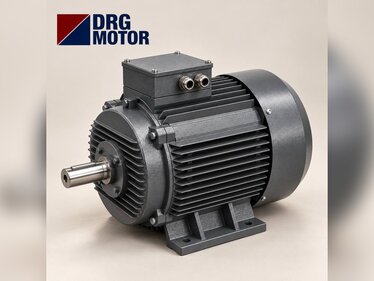
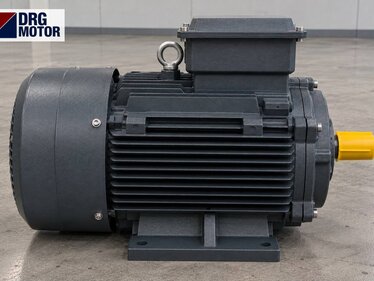
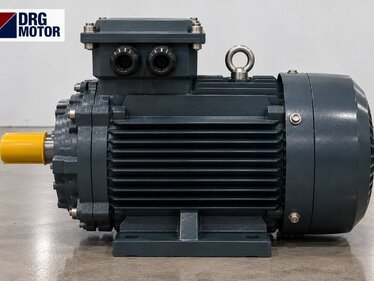
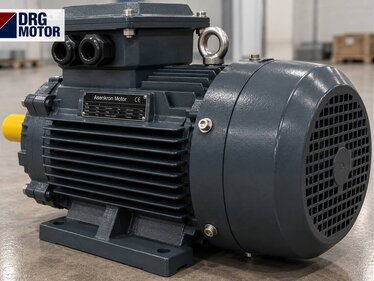
30 HP (22 kW) cast iron motors
- DRG-180M-2 – 22 kW – 3000 rpm – 180M, cast iron
- DRG-180L-4 – 22 kW – 1500 rpm – 180L, cast iron
- DRG-200L2-6 – 22 kW – 1000 rpm – 200L, cast iron
Click to see current prices and order these motors nowSEE PRICES →
Frequently Asked Questions
How many amps does a 30 HP motor draw?
The DRG-180M-2 (3000 rpm) draws 40.5 A at rated load on 380 V, the 1500 rpm DRG-180L-4 41.8 A and the 1000 rpm DRG-200L2-6 44.8 A.
How many amps does a 22 kW motor draw at start?
Direct-on-line, allow about 326–332 A (catalogue Is/In ratios) and about 109–111 A with star-delta.
Can a crusher be started star-delta?
Yes, if the crusher starts unloaded and the feed opens after the motor reaches speed. If it must start full, the torque in star (≈ 95 Nm for 4 poles) may not be enough; direct-on-line starting and a suitable supply are then needed.
How many kW is a 30 HP motor?
30 × 0.7457 ≈ 22.4 kW; the standard power rating is 22 kW.
For advice on starting your machine, call +90 (542) 666 11 11, write to [email protected] or use the contact page. The three 22 kW motors can be ordered from Buy Electric Motors Online.