English
 Le français
 Türkçe




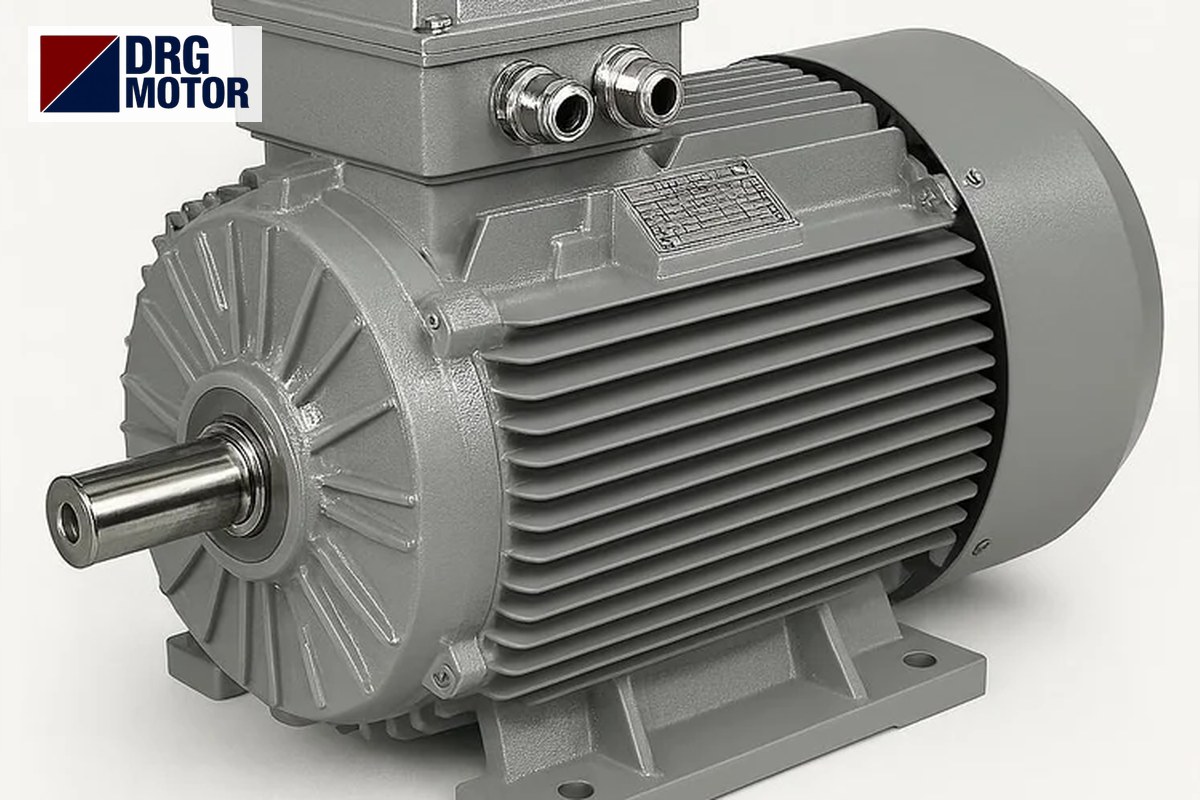

The starting decision for a 30 HP 1500 rpm motor rests on two numbers: when the DRG-180L-4 is connected directly to the supply, it draws 7.8 times its rated current at start, about 326 A at 380 V, and starts with about 286 Nm, 2.0 times its rated torque. In star-delta the line current falls to one third, about 109 A; but torque also drops to one third, about 95 Nm. If the load cannot accelerate with this torque, star-delta does not work.
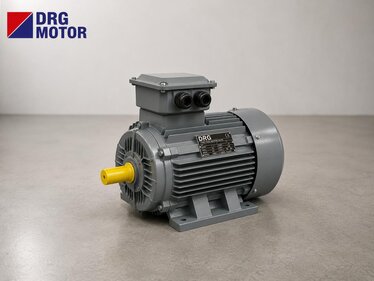
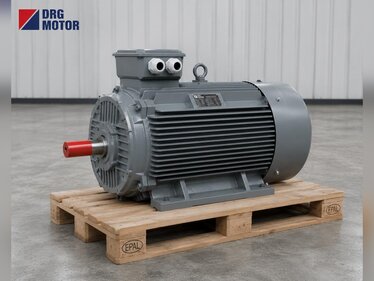
Model code DRG-180L-4: 22 kW, 4-pole, cast-iron 180L frame, 1470 rpm and 142.9 Nm at full load. Its winding is 400/690 V (Δ/Y), so it runs in delta on a 380–400 V network; this is the nameplate suited to star-delta starting. Panel and starter wiring must be done by a qualified electrician.
This motor is manufactured and supplied by DRG Motor; price and ordering information are on the product page in the Buy Electric Motors Online category. Below you will find the data sheet, a numerical comparison of three starting methods, what to watch for with high-inertia loads such as mills and crushers, and the mounting dimensions of the 180L frame.
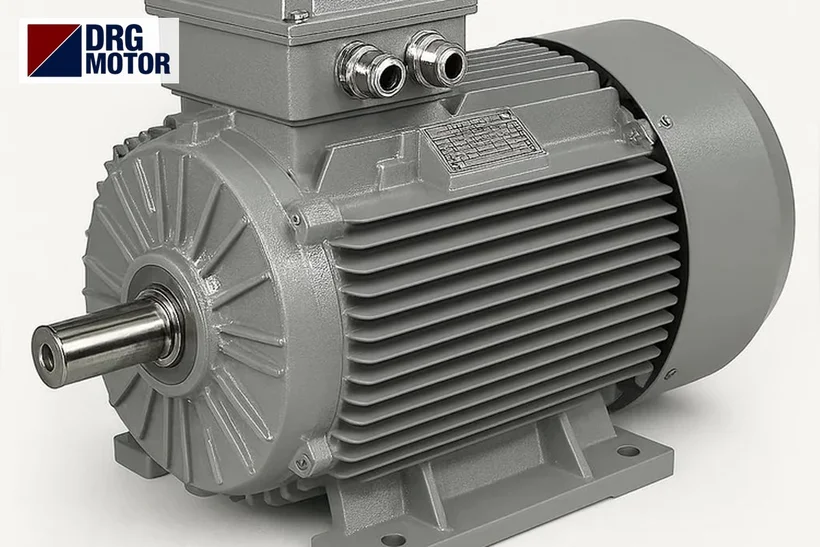
DRG-180L-4 data sheet
Voltage-dependent values:
| Supply voltage | 380 V | 400 V | 415 V |
|---|---|---|---|
| Rated current In | 41.8 A | 39.7 A | 38.3 A |
| Direct starting current (7.8 × In) | ≈ 326 A | ≈ 310 A | ≈ 299 A |
Voltage-independent values: cos φ 0.86; rated torque 142.9 Nm (same as 9550 × 22 / 1470); Ts/Tn 2.0; Tmax/Tn 2.3; Is/In 7.8; slip (1500 − 1470) / 1500 = 2.0%; bearing 6311-C3; cable entry 2 × M40×1.5; shaft 48 × 110 mm, key width 14 mm.
Three starting methods side by side
The soft starter row assumes an initial voltage set to 60% and is an approximate value from simple proportionality (current ≈ voltage, torque ≈ voltage squared); the real value depends on the device setting.
| Method (380 V) | Line starting current | Starting torque | Ratio to rated torque | Suitable load |
|---|---|---|---|---|
| Direct-on-line (DOL) | ≈ 326 A | ≈ 286 Nm | 2.0 | Strong supply, loaded start |
| Star-delta | ≈ 109 A | ≈ 95 Nm | 0.67 | Unloaded or light start |
| Soft starter (60% voltage) | ≈ 196 A | ≈ 103 Nm | 0.72 | Gradual acceleration, pump/fan |
The rule is simple: at start, the load's counter-torque must stay clearly below the torque the chosen method provides. If only 95 Nm is available in star and the load needs 90 Nm, the motor hardly accelerates, the current surge at changeover to delta approaches that of a direct start and the benefit of star-delta is lost. Compare your own values in the motor starting methods and star-delta calculator.
How to set up star-delta on a mill or crusher
Machines such as hammer mills, grinders and crushers carry a heavy rotor or flywheel. With these loads the difficulty is not breakaway friction but the time needed to bring a large mass up to 1470 rpm.
1. Unloaded start
Feeding (hopper gate, feeder belt) must not open until the motor has switched to delta and reached full speed. If material is left in the crushing chamber, empty it first; otherwise 95 Nm in star is not enough.
2. Changeover time
The timer relay should switch to delta when the motor is close to rated speed. Too early and the current surge in delta grows; too late and the motor labours in star at low torque. Set it at first commissioning by watching the current drop with a clamp meter.
3. Overload and fuses
With high-inertia loads acceleration takes long, so the overload relay may trip during start. Choose the trip class and fuse characteristic for this time; the overload, fuse and contactor selection tool gives starting values.
Estimating the starting time roughly
On a machine with a heavy flywheel, the overload and timer settings are dictated by the starting time. For a rough estimate use t ≈ J × ω / (Tmotor − Tload), where J is the total moment of inertia of motor and machine referred to the motor shaft (kg·m²) and ω the rated angular speed. For 1470 rpm, ω = 2π × 1470 / 60 ≈ 153.9 rad/s.
| Assumption (J = 4.0 kg·m²) | Average motor torque | Average load torque | Net accelerating torque | Estimated time |
|---|---|---|---|---|
| Direct start, partly loaded | ≈ 286 Nm | 60 Nm | ≈ 226 Nm | ≈ 2.7 s |
| In star, empty machine | ≈ 95 Nm | 30 Nm | ≈ 65 Nm | ≈ 9.5 s |
The calculation simplifies motor torque as constant during start and only gives the order of magnitude; J must be obtained from the machine builder. Still, the table shows something important: the same machine takes more than three times as long to accelerate in star. During this time the motor draws about 2.6 times rated line current (≈ 109 A); if the overload class and timer relay are not chosen for this duration, the start is interrupted. If the time becomes too long and J cannot be reduced, a direct start or a current-limiting soft starter is safer.
A short note on contactor currents
In a star-delta panel the line and delta contactors carry the winding current, i.e. In/√3 ≈ 24.1 A; the star contactor works at about In/3 ≈ 13.9 A during start. If the overload relay is in the winding branch it is set to about 24.1 A, not 41.8 A. The power and control diagram, timer setting and detailed calculation for 2/4/6-pole 22 kW models are in our article star-delta starting of a 22 kW motor; they are not repeated here.
180L frame mounting dimensions
| B3 foot-mounted (mm) | DRG-180L-4 | DRG-180M-4 (18.5 kW) |
|---|---|---|
| A × B (foot hole spacing) | 279 × 279 | 279 × 241 |
| C | 121 | 121 |
| H (shaft height) | 180 | 180 |
| K (foot hole) | 4–Φ14.5 | 4–Φ14.5 |
| D × E / F | 48 × 110 / 14 | 48 × 110 / 14 |
| AC / AD | 355 / 267 | 355 / 267 |
| L (overall length) | 726 | 688 |
For flange (B5) mounting, the 180L frame flange dimensions are P 350, M 300, N 250, S 18.5, T 5, LA 15 mm. These are identical to the B5 flange of the 160M/160L frame; so on a flanged machine, moving from 15 kW to 22 kW does not change the flange connection, but the shaft grows from 42 mm to 48 mm and the coupling hub must be replaced.
Checklist before commissioning
- Confirm the nameplate reads 400/690 V (Δ/Y); star-delta cannot be applied at 380 V to a 230/400 V wound motor.
- Remove the links in the terminal box; in a star-delta panel the six leads (U1-V1-W1, U2-V2-W2) are each taken to the panel.
- Plan for twice the number of cables for the six-lead connection; entries are 2 × M40×1.5.
- If the load at start exceeds about 95 Nm in star, consider a direct start or a soft starter instead of star-delta.
- On the first start, measure the current surge at star-to-delta changeover and adjust the timer relay.
- Check the direction of rotation without load; on a crusher, reverse rotation can damage hammers and screens.
Motors at and around this power
- DRG-180L-4 – 22 kW – 1470 rpm – 180L cast iron
- DRG-180M-4 – 18.5 kW – 1470 rpm – 180M cast iron
- DRG-200L-4 – 30 kW – 1475 rpm – 200L cast iron
- DRG-180M-2 – 22 kW – 2955 rpm – 180M cast iron
- DRG-200L2-6 – 22 kW – 980 rpm – 200L cast iron
The technical items that affect price are power, number of poles, frame and mounting type (B3, B5, B35); current values are on the product pages.
Click to see current prices and order these motors nowSEE PRICES →
Frequently Asked Questions
How many amps does a 30 HP motor draw at start?
With direct-on-line starting, the DRG-180L-4 draws about 326 A at 380 V. In star-delta the starting current drawn from the line falls to about 109 A.
Is star-delta mandatory for a 22 kW motor?
No. If the supply and transformer can handle a surge of around 326 A, direct starting is possible. On a weak supply with an unloaded start, star-delta is used; if the load is hard to start, a soft starter is preferred.
What is the shaft size of a 30 HP 1500 rpm motor?
The shaft is 48 × 110 mm with a 14 mm key, the same as the next lower power, the 18.5 kW DRG-180M-4.
What should the overload be set to on a 22 kW motor?
For direct-on-line starting, 41.8 A at 380 V; in a star-delta panel with the overload in the winding branch, about 24.1 A.
For questions about the DRG-180L-4 or starting method selection, call +90 (542) 666 11 11 or write to [email protected]; other details are on the contact page. For other powers and speeds, browse the 120 models in our online store.