English
 Le français
 Türkçe




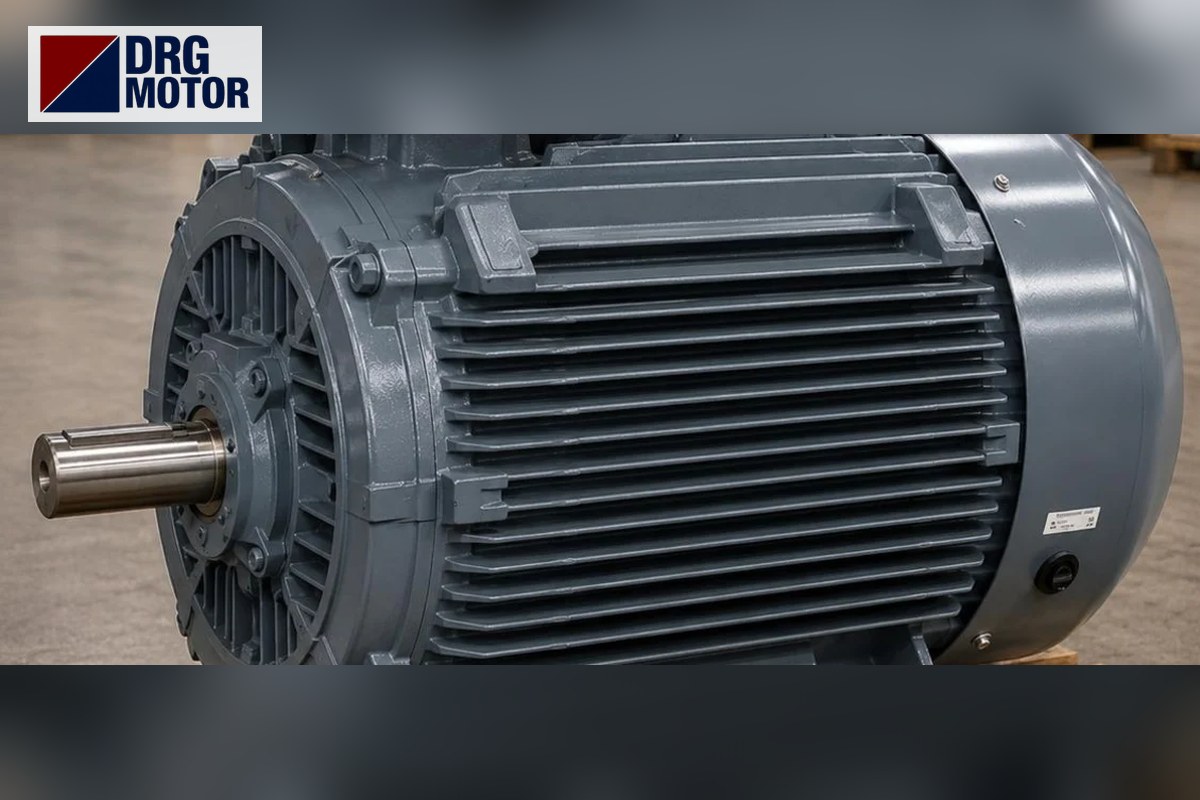

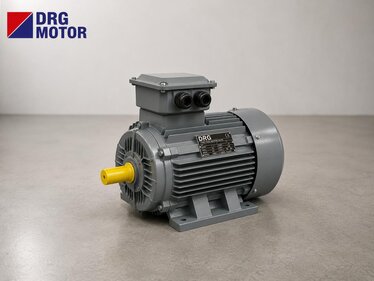
At DRG a 15 HP (11 kW) 1500 rpm motor is available in two frames: the standard 160M-frame DRG-160M-4 and the compact DRG-132M-4K, which fits the same power into a frame one size smaller. In the catalogue their electrical values are identical: 1465 rpm, 20.4 A at 400 V, cos φ 0.85, 71.7 Nm rated torque, Is/In 7.7. The difference between them is entirely mechanical: shaft height 132 mm instead of 160 mm, overall length 476 mm instead of 608 mm, shaft diameter 38 mm instead of 42 mm.
The connection on the machine decides the choice: when replacing an old 11 kW motor, the 160M is usually the answer; when designing a new machine with limited space, the compact 132M comes forward. You can compare both models and the other 11 kW options with the same data layout on the Buy Electric Motors Online page.
Electrical values: the lines both models share
Whichever model is chosen, the same protection and cable calculation applies on the panel side. Catalogue values:
- Power and speed: 11 kW / 15 HP, 4 poles, synchronous 1500, rated 1465 rpm (slip ≈ 2.3%)
- Current: 21.5 A at 380 V · 20.4 A at 400 V · 19.7 A at 415 V
- Voltage: 400/690 V (Δ/Y), delta on 380–400 V supplies
- Torque: Tn 71.7 Nm · Ts/Tn 2.2 · Tmax/Tn 2.3
- Starting current ratio: Is/In 7.7
Two non-electrical lines differ: the bearing (6309-C3 on the 160M, 6208-ZZ-C3 on the compact) and the cable entry (2 × M40×1.5 on the 160M, 2 × M32×1.5 on the compact). Keep this in mind when choosing glands and ordering spare bearings.
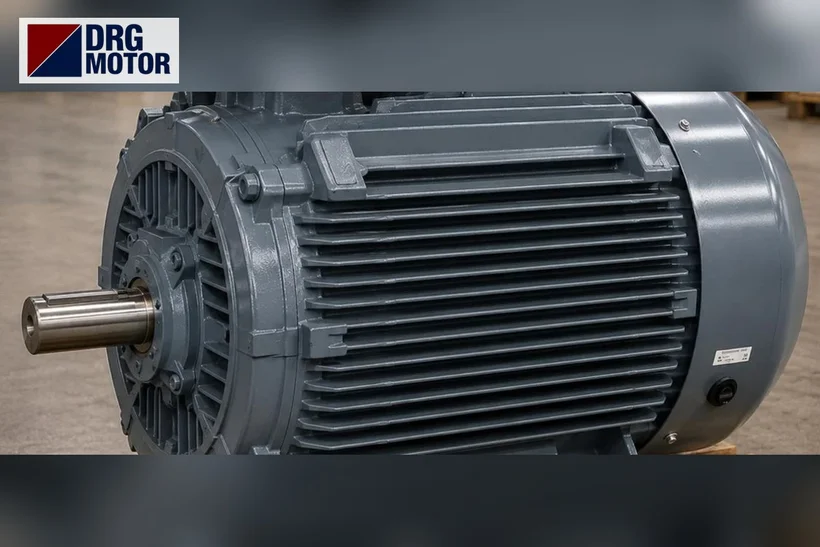
Foot and frame dimensions: 160M and compact 132M side by side
The values below are the catalogue dimensions of the two models (mm). The last column shows how much each dimension shrinks when moving from the standard frame to the compact one.
| Dimension | DRG-160M-4 | DRG-132M-4K | Difference |
|---|---|---|---|
| H – shaft height | 160 | 132 | 28 |
| A – transverse foot spacing | 254 | 216 | 38 |
| B – longitudinal foot spacing | 210 | 178 | 32 |
| C – shaft shoulder → foot hole | 108 | 89 | 19 |
| K – foot holes | 4–Φ14.5 | 4–Φ12 | — |
| D × E – shaft | 42 × 110 | 38 × 80 | — |
| F – key | 12 | 10 | 2 |
| AC – frame diameter | 314 | 258.4 | 55.6 |
| AD – axis → top of terminal box | 251 | 203 | 48 |
| L – overall length | 608 | 476 | 132 |
The 132 mm reduction in length and the 28 mm lower shaft axis can be decisive for motors built into a machine body (hydraulic power units, compact pump sets, packaging machines). The general logic of ordering by frame length is covered in our guide to ordering motors by shaft size and frame length.
B5 flange dimensions: what changes on the gearbox and pump side?
In flange mounting the two models carry different flanges; if a gearbox or pump adapter is machined for one model, the other will not fit. Values from the DRG B5 table (mm):
| Flange dimension | 160 frame (DRG-160M-4) | 132 frame (DRG-132M-4K) |
|---|---|---|
| P – flange outer diameter | 350 | 300 |
| M – bolt circle diameter | 300 | 265 |
| N – spigot diameter | 250 | 230 |
| S – hole diameter | 18.5 | 14.5 |
| T – spigot length | 5 | 4 |
| LA – flange thickness | 15 | 14 |
| DH – shaft end thread | M16×36 | M12×28 |
Practical rule: if the gearbox input flange is P 350 / M 300, the standard 160M fits; if it is P 300 / M 265, the compact 132M fits. Confirm the flange size from the gearbox's own nameplate or drawing before ordering.
Which one, and when?
- DRG-160M-4 (standard): one-for-one replacement of an existing 11 kW 4-pole motor; pulley or coupling with a 42 mm hub; hot and dusty environments where a larger frame surface helps. Available in aluminium (DRG-160M-4 aluminium) and cast iron (DRG-160M-4 cast iron).
- DRG-132M-4K (compact): new designs by machine builders, narrow motor compartments, gearboxes with a 132 flange or connections with a 38 mm shaft. Aluminium housing.
- The borderline case: if the existing base is drilled for a 160M, an adapter plate is needed for the compact motor; this extra part often cancels out the space gained.
Star-delta starting: current and torque calculation at 11 kW
This section concerns panel wiring; contactors, overload relays and terminal connections must be handled by a qualified electrician. Both models have 400/690 V windings, so they run in delta on a 400 V supply and are suitable for star-delta starting.
With direct-on-line start at 400 V the starting current is about 7.7 × 20.4 ≈ 157 A. In the star step both current and torque fall to roughly one third:
- Starting current in star ≈ 157 / 3 ≈ 52 A
- Direct starting torque ≈ 2.2 × 71.7 ≈ 158 Nm; in star ≈ 53 Nm (about 0.73 times rated torque)
Conclusion: in the star step the motor turns with a starting torque below its rated torque. That is enough for fans, unloading compressors and centrifugal pumps that start empty or lightly loaded; on a loaded belt conveyor or a full mixer the motor may fail to accelerate in star, and current rises again at the switch to delta. When direct-on-line starting is possible at 11 kW is covered in our article can 11 and 15 kW motors be started direct-on-line; for contactor selection you can use the star-delta starting tool.
Run-up time and overload setting
Because starting torque drops in star, the run-up time gets longer. The overload relay is set to rated current (about 20.4 A at 400 V); in a star-delta panel it is usually wired at the output of the delta contactor, i.e. on phase current, in which case the setting becomes 20.4 / √3 ≈ 11.8 A. Check on the panel diagram which arrangement is used; a relay in the wrong place either fails to protect the motor or trips for no reason.
Shaft fit: moving from 42 mm to 38 mm
The most commonly overlooked point when moving from the standard model to the compact one is the shaft end. On the 160M the shaft is 42 × 110 mm with a 12 mm key; on the compact 132M it is 38 × 80 mm with a 10 mm key. If the old pulley or coupling hub is machined for 42 mm, it will not fit the new motor; and since the shaft is 30 mm shorter, the pulley alignment shifts. In that case either the hub is re-machined or the 160M is preferred.
Pre-order checklist
- Have the old motor's frame code (160M or other) and foot hole spacing (A × B) been measured?
- Is the shaft hub on the machine 42 mm or 38 mm?
- If flanged, is the gearbox/pump flange P 350 or P 300?
- Starting: direct-on-line or star-delta? Is the load's starting torque below ≈ 53 Nm?
- Overload relay around 20.4 A at 400 V; line length run through the cable size calculator?
- Gland size: M40×1.5 on the 160M, M32×1.5 on the compact.
- Environment: with impact and outdoor exposure, cast iron 160M.
Motors at this power
- DRG-160M-4 | 11 kW | 4-pole, 1465 rpm | standard 160M, aluminium
- DRG-160M-4 | 11 kW | 4-pole, 1465 rpm | standard 160M, cast iron
- DRG-132M-4K | 11 kW | 4-pole, 1465 rpm | compact 132M, aluminium
- DRG-160M1-2 | 11 kW | 2-pole, 2945 rpm | 160M, cast iron
- DRG-160L-4 | 15 kW | 4-pole, 1465 rpm | 160L, cast iron
Click to see current prices and order these motors nowSEE PRICES →
Offering standard and compact frames in one catalogue comes from DRG Motor being an electric motor manufacturer and supplier; you can open both series side by side among the 120 models in our online store.
Frequently Asked Questions
How many amps does a 15 HP 1500 rpm motor draw?
Both the DRG-160M-4 and the DRG-132M-4K draw 20.4 A at 400 V, 21.5 A at 380 V and 19.7 A at 415 V at full load.
Does a compact motor deliver the same power as a standard motor?
According to the catalogue values, yes: both models are 11 kW, 1465 rpm with 71.7 Nm rated torque. What differs are the frame, shaft, flange, bearing and cable entry dimensions.
What is the shaft diameter of an 11 kW 4-pole motor?
42 × 110 mm on the standard 160M frame (12 mm key) and 38 × 80 mm on the compact 132M frame (10 mm key).
Does a 15 HP motor need star-delta starting?
That depends on the supply and operating conditions. Star-delta reduces starting current from about 157 A to around 52 A, but it also lowers starting torque to ≈ 53 Nm; on a machine that starts under load this may not be enough.
Stuck between standard and compact? Send the old motor's nameplate photo and base dimensions to [email protected] or call +90 (542) 666 11 11; all channels are on the contact page.