English
 Le français
 Türkçe




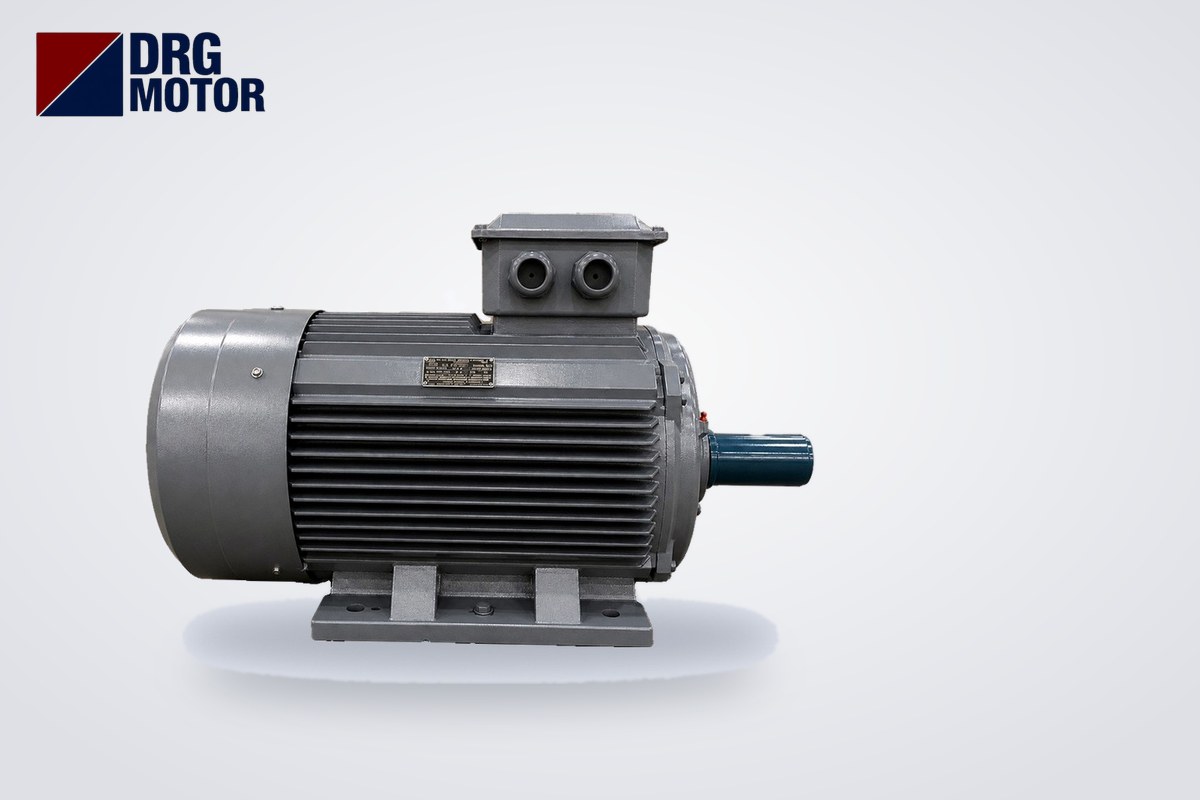

On a 380 V supply at full load, a 110 kW, 1500 rpm three-phase motor draws 197 A, a 132 kW motor 236 A and a 160 kW motor 285 A; at 400 V the same motors draw 187 A, 224 A and 271 A respectively. These are the nameplate values of the DRG-315S-4, DRG-315M-4 and DRG-315L1-4. Rule of thumb: in this power band, allow about 1.7 A per kilowatt at 400 V; on a 690 V supply the current falls to roughly 0.58 times the 400 V value (about 157 A for the 160 kW, 4-pole motor).
Current varies with the number of poles, the supply voltage and the starting moment. At the same power a 6-pole motor has a lower cos φ and draws slightly more current, and at direct-on-line start the inrush reaches 6.7–7.2 times the rated current. Below, we bring together the rated and starting currents of all nine models, their impact on the supply and the starting options. Each model's technical page is available in the Buy Electric Motors Online section.
110, 132 and 160 kW motor current table (2, 4 and 6 poles)
The 380, 400 and 415 V currents in the table are the nameplate data of the store products. The 690 V column is calculated from I ∝ 1/U at the same power and cos φ (400 V current × 400/690). All models have cast iron frames and are rated 400/690 V (Δ/Y).
| Model | Power | Synchronous / rated speed | cos φ | 380 V (A) | 400 V (A) | 415 V (A) | 690 V (A, calculated) |
|---|---|---|---|---|---|---|---|
| DRG-315S-2 | 110 kW | 3000 / 2978 rpm | 0.90 | 195 | 185 | 179 | 107 |
| DRG-315S-4 | 110 kW | 1500 / 1488 rpm | 0.89 | 197 | 187 | 180 | 108 |
| DRG-315L1-6 | 110 kW | 1000 / 988 rpm | 0.85 | 207 | 196 | 189 | 114 |
| DRG-315M-2 | 132 kW | 3000 / 2978 rpm | 0.90 | 234 | 222 | 214 | 129 |
| DRG-315M-4 | 132 kW | 1500 / 1488 rpm | 0.89 | 236 | 224 | 216 | 130 |
| DRG-315L2-6 | 132 kW | 1000 / 988 rpm | 0.86 | 244 | 232 | 224 | 134 |
| DRG-315L1-2 | 160 kW | 3000 / 2980 rpm | 0.91 | 279 | 265 | 256 | 154 |
| DRG-315L1-4 | 160 kW | 1500 / 1488 rpm | 0.89 | 285 | 271 | 261 | 157 |
| DRG-355M1-6 | 160 kW | 1000 / 990 rpm | 0.86 | 296 | 281 | 271 | 163 |
Three practical conclusions follow. First, 2-pole and 4-pole motors of the same power draw very similar currents (265 A and 271 A at 160 kW, 400 V); the 6-pole DRG-355M1-6 is clearly higher at 281 A. Second, the difference between 380 V and 415 V is 24 A for the 160 kW, 4-pole motor, so panel and protection settings must follow the actual site voltage. Third, the rough “2 A per kW” rule overstates current in this band: it gives 320 A for 160 kW, while the real value at 400 V is 271 A. For the next power class down see How Many Amps Do 55, 75 and 90 kW Motors Draw?, and for other ratings the Motor Current Chart.
How to verify the current: a 160 kW calculation
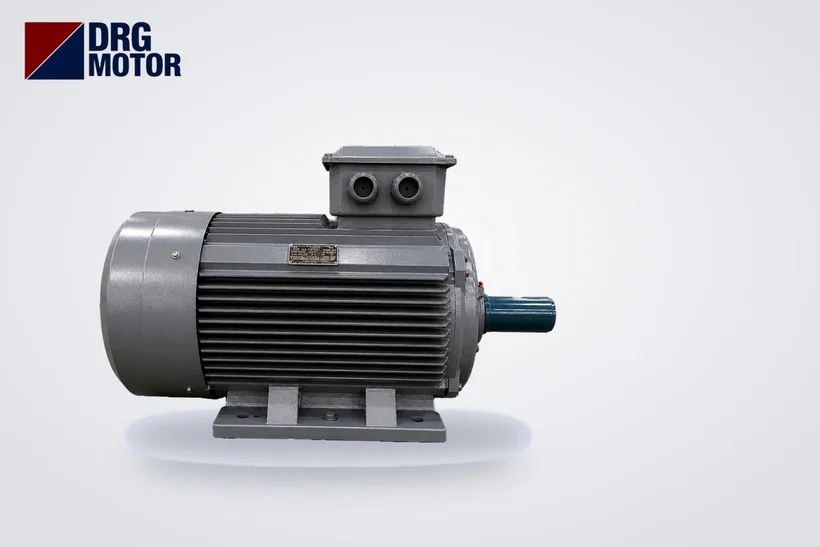
Nameplate current can be checked by back-calculating input power: Pin = √3 × U × I × cos φ. For the DRG-315L1-4 at 400 V: √3 × 400 × 271 × 0.89 ≈ 167.1 kW. This is slightly more than the 160 kW at the shaft; the difference is the motor's own losses, as expected. The apparent power of the same motor is S = √3 × U × I = √3 × 400 × 271 ≈ 188 kVA; this kVA figure is what the panel and supply side are sized on.
When moving to 690 V, power and cos φ stay the same, so current falls in inverse proportion to voltage: 271 × 400 / 690 ≈ 157 A. 690 V is the star-connection design voltage of these 400/690 V motors; on a 400 V network the same motor is connected in delta. Lower current reduces cable size and breaker rating, but 690 V distribution requires a separate network and equipment class; it is not a solution chosen for the motor alone.
Starting current: how many amps at direct-on-line start?
In large motors the deciding factor is the starting current rather than the rated current. In the table below the Is/In ratio comes from the nameplate data and currents are calculated from the 400 V value. The star-delta column shows the theoretical relationship in which line current in star falls to about one third of the DOL value; the real figure depends on load torque and the changeover moment.
| Model | Power | Is/In | DOL starting current, 400 V (A) | Star-delta starting current ≈ Is/3 (A) | Rated apparent power (kVA) | Apparent power at DOL start (kVA) |
|---|---|---|---|---|---|---|
| DRG-315S-2 | 110 kW | 7.1 | 1,314 | 438 | 128 | 910 |
| DRG-315S-4 | 110 kW | 7.0 | 1,309 | 436 | 130 | 907 |
| DRG-315L1-6 | 110 kW | 6.7 | 1,313 | 438 | 136 | 910 |
| DRG-315M-2 | 132 kW | 7.1 | 1,576 | 525 | 154 | 1,092 |
| DRG-315M-4 | 132 kW | 7.0 | 1,568 | 523 | 155 | 1,086 |
| DRG-315L2-6 | 132 kW | 6.8 | 1,578 | 526 | 161 | 1,093 |
| DRG-315L1-2 | 160 kW | 7.2 | 1,908 | 636 | 184 | 1,322 |
| DRG-315L1-4 | 160 kW | 7.1 | 1,924 | 641 | 188 | 1,333 |
| DRG-355M1-6 | 160 kW | 6.8 | 1,911 | 637 | 195 | 1,324 |
The 160 kW, 4-pole motor draws 1,924 A at direct-on-line start and demands about 1,333 kVA of apparent power from the supply at that instant, roughly 7 times its rated apparent power (188 kVA). This sudden load causes a voltage dip on the feeder and the transformer; other motors on the same busbar may slow down, contactor coils may drop out and lighting may flicker. That is why for motors of 110 kW and above the starting method is chosen according to the starting current the supply can carry, before the motor itself; the limit depends on the distribution company the site is connected to and on the site transformer.
Choosing the starting method: star-delta, soft starter and drive
Star-delta on a 400 V network
A 400/690 V motor runs in delta on a 400 V network, so it is suitable for star-delta starting: at start the star-connected winding sees 400 V and current and torque fall to about one third. For the DRG-315S-4, Ts/Tn = 2.0, so starting torque in star is about 0.67 times rated torque. This works for loads with low starting torque such as fans, pumps started against a closed valve or crushers started empty; a loaded conveyor needing high breakaway torque cannot accelerate in star, and a large current surge occurs at changeover.
Star-delta is not possible on a 690 V network
On a 690 V network the same motor runs in star. Switching to delta would apply √3 times the design voltage to the winding, so star-delta starting is not possible at 690 V; a soft starter or a frequency drive is used instead.
Soft starter and frequency drive
A soft starter ramps up the voltage and holds starting current at a set limit, with no changeover surge. A frequency drive can keep starting current at rated level and also provides speed control. For ramp and current limit settings see Soft Starter Parameter Settings, and to compare currents by method use the Motor Starting Methods tool.
| Method | Starting current (160 kW, 4-pole, 400 V) | Suitable when |
|---|---|---|
| Direct-on-line | ≈ 1,924 A | Strong, dedicated transformer; supply conditions allow it |
| Star-delta | ≈ 641 A (theoretical) | 400 V network, low starting-torque load |
| Soft starter | Set current limit | Pumps, fans, crushers; 400 V and 690 V |
| Frequency drive | Around rated current | Speed control needed or heavy starting load |
Cable entry and a cable size example
All nine models have 2 × M63×1.5 cable entries on the terminal box. With star-delta starting the two entries take the two separate cable sets to the motor (U1-V1-W1 and W2-U2-V2); with DOL or soft starter, parallel cables are also routed through these entries when a single set is not enough.
Example (copper, PVC, ~30°C table value): 160 kW, 4-pole, 400 V, In = 271 A. Design current 271 × 1.25 ≈ 339 A; the smallest suitable size in the table is 185 mm², rated 364 A. In star-delta each cable set carries the phase current, In/√3 ≈ 156.5 A; design current is ≈ 196 A, and 70 mm² rated 196 A in the table is borderline, so the next size up is the more comfortable choice. This is an example only: installation method, grouping, ambient temperature and voltage drop can increase the size, and the choice must be verified by an electrical engineer. To calculate with your own distance use the Motor Cable Size Calculator.
Bearings, shaft and frame dimensions
Models also differ significantly in mounting, not just current. In particular, 2-pole models have a 65 mm shaft whereas 4- and 6-pole 315 frames have 85 mm; when replacing on the same frame, choose the coupling accordingly. The 160 kW, 6-pole model moves up to the next frame (355M).
| Model | IEC frame | Bearing | Shaft D × E (mm) | Overall length L (mm) | Rated torque (Nm) | Cable entry |
|---|---|---|---|---|---|---|
| DRG-315S-2 | 315S | 6317-C3 | 65 × 140 | 1194 | 352.8 | 2 × M63×1.5 |
| DRG-315S-4 | 315S | 6319-C3 | 85 × 170 | 1224 | 706.0 | 2 × M63×1.5 |
| DRG-315L1-6 | 315L | 6319-C3 | 85 × 170 | 1334 | 1,063.0 | 2 × M63×1.5 |
| DRG-315M-2 | 315M | 6317-C3 | 65 × 140 | 1304 | 423.3 | 2 × M63×1.5 |
| DRG-315M-4 | 315M | 6319-C3 | 85 × 170 | 1334 | 847.2 | 2 × M63×1.5 |
| DRG-315L2-6 | 315L | 6319-C3 | 85 × 170 | 1334 | 1,276.0 | 2 × M63×1.5 |
| DRG-315L1-2 | 315L | 6317-C3 | 65 × 140 | 1304 | 512.8 | 2 × M63×1.5 |
| DRG-315L1-4 | 315L | 6319-C3 | 85 × 170 | 1334 | 1,027.0 | 2 × M63×1.5 |
| DRG-355M1-6 | 355M | 6322-C3 | 100 × 170 | 1516 | 1,543.0 | 2 × M63×1.5 |
Pre-installation checklist
- Has the site voltage been measured, and was the current taken from the correct 380, 400 or 415 V column?
- Nameplate 400/690 V: delta on a 400 V network, star on a 690 V network?
- Has the DOL starting current (Is/In × In) been compared with the site transformer and the distribution company's conditions?
- If the load needs high starting torque, has a soft starter or drive been considered instead of star-delta?
- Has cable size been calculated for current capacity and distance, with parallel cables planned if needed?
- Is protection set to phase current (In/√3) for star-delta and to In for DOL?
- Do shaft diameter (65 / 85 / 100 mm) and bearing type match the existing coupling and bearing arrangement?
- At first start-up, were all three phase currents measured and compared with the nameplate?
Motors in this power range
All 110, 132 and 160 kW models; product pages include the dimension drawing and full nameplate data:
- DRG-315S-2 – 110 kW – 3000 rpm – cast iron (315S)
- DRG-315S-4 – 110 kW – 1500 rpm – cast iron (315S)
- DRG-315L1-6 – 110 kW – 1000 rpm – cast iron (315L)
- DRG-315M-2 – 132 kW – 3000 rpm – cast iron (315M)
- DRG-315M-4 – 132 kW – 1500 rpm – cast iron (315M)
- DRG-315L2-6 – 132 kW – 1000 rpm – cast iron (315L)
- DRG-315L1-2 – 160 kW – 3000 rpm – cast iron (315L)
- DRG-315L1-4 – 160 kW – 1500 rpm – cast iron (315L)
- DRG-355M1-6 – 160 kW – 1000 rpm – cast iron (355M)
Click to see current prices and order these motors nowSEE PRICES →
Frequently Asked Questions
How many amps does a 110 kW motor draw?
The 110 kW, 1500 rpm DRG-315S-4 draws 197 A at 380 V and 187 A at 400 V at full load. The 2-pole model draws 185 A at 400 V and the 6-pole model 196 A. On a 690 V supply the 4-pole motor's current is about 108 A by calculation.
How many amps does a 132 kW motor draw?
The 132 kW, 1500 rpm DRG-315M-4 draws 236 A at 380 V and 224 A at 400 V. With Is/In = 7.0, its direct-on-line inrush at 400 V reaches about 1,568 A.
How many amps does a 160 kW motor draw?
The 160 kW, 1500 rpm DRG-315L1-4 draws 285 A at 380 V and 271 A at 400 V; the 3000 rpm model draws 265 A and the 1000 rpm model 281 A at 400 V. At 690 V the 4-pole motor's current is about 157 A.
Can a 160 kW motor be started star-delta?
Yes, on a 400 V network; being rated 400/690 V, the motor runs in delta. Theoretical starting current is one third of the DOL value, about 641 A. On a 690 V network, or with a load that needs high starting torque, a soft starter or drive is preferred.
For help with large motor selection, frames and connections, call +90 (542) 666 11 11, email [email protected] or use our contact page. Compare all ratings, including 110–160 kW, among the 120 models in our online store.