English
 Le français
 Türkçe




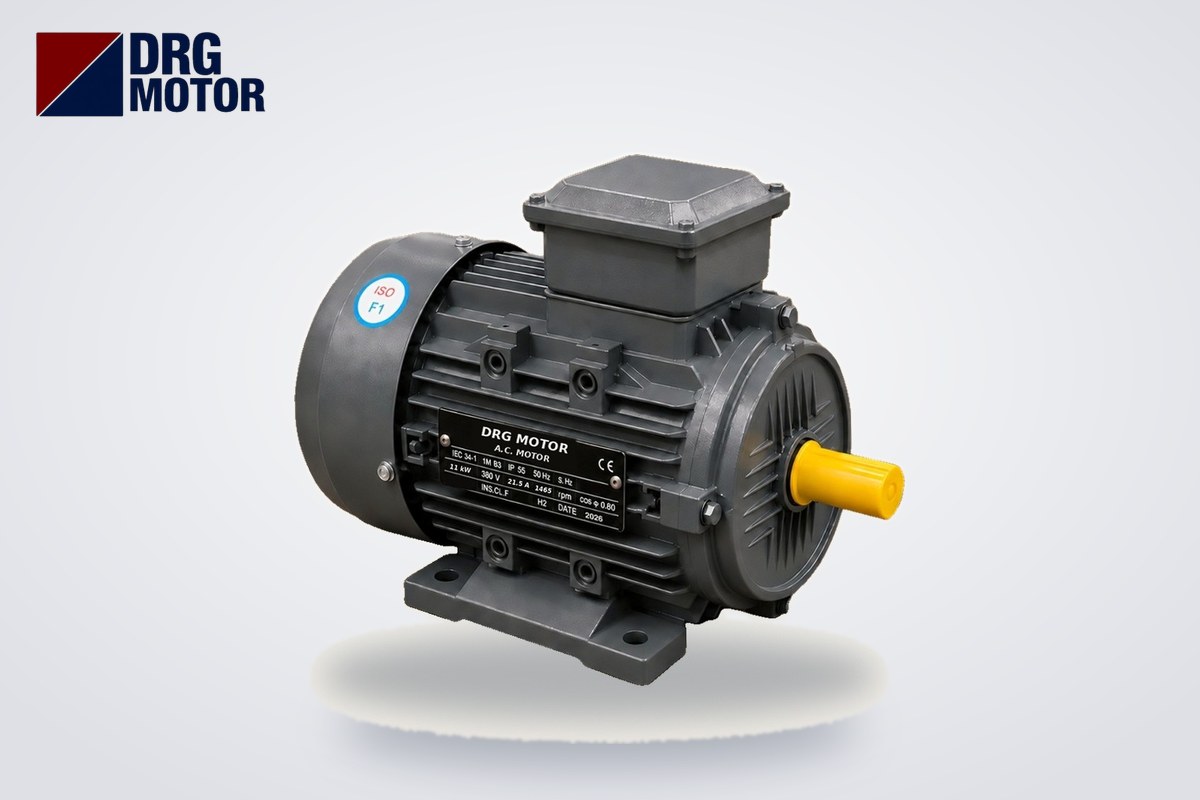

At the same power, a 2-pole motor runs at about 3000 rpm and a 4-pole motor at about 1500 rpm; because the speed is halved, the shaft torque of the 4-pole motor is roughly twice as high. For example, at 11 kW the DRG-160M1-2 delivers 35.7 Nm at 2945 rpm, while the DRG-160M-4 delivers 71.7 Nm at 1465 rpm. The short answer: choose 2 poles for machines that need high speed, such as directly coupled centrifugal pumps, fans and grinders; choose 4 poles for machines that need torque, such as geared conveyors, crushers, mixers and hydraulic pumps.
What decides the choice is not the motor itself but the input speed required by the machine it drives. Current and power drawn from the grid change very little between the two options; a wrong pole number, however, leaves a pump unable to deliver, drives a gearbox to the wrong output speed or makes a loaded machine impossible to start. The comparison below shows this difference for 4, 11 and 37 kW using our store data.
On the Buy Electric Motors Online page, 2-, 4- and 6-pole models are listed side by side for most power ratings; rated speed, current and shaft size are given on every product page, so once you have decided on the pole number you can pick the right model directly.
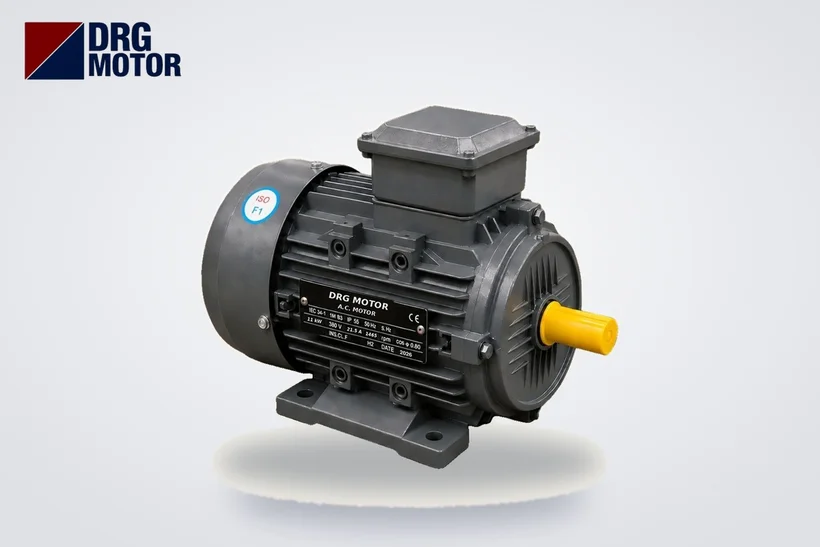
How Does the Number of Poles Set the Motor Speed?
In a three-phase induction motor the stator winding creates a rotating magnetic field whose speed (synchronous speed) depends on the supply frequency and the number of poles: ns = 120 × f / p. On a 50 Hz grid, the synchronous speed is 3000 rpm for a 2-pole motor, 1500 rpm for a 4-pole motor and 1000 rpm for a 6-pole motor. The rotor turns slightly behind this field; the difference is slip, and it grows with load. That is why the nameplate shows the rated full-load speed rather than the synchronous speed: at 4 kW, 2905 rpm for the DRG-112M-2 and 1450 rpm for the DRG-112M-4.
With power constant, torque is inversely proportional to speed: T (Nm) ≈ 9550 × P (kW) / n (rpm). At 37 kW this gives 9550 × 37 / 2960 ≈ 119.4 Nm for the 2-pole motor and 9550 × 37 / 1485 ≈ 237.9 Nm for the 4-pole motor; both match the catalogue values exactly. In other words, a 4-pole motor is not "stronger"; it delivers the same power at half the speed with twice the torque.
2 vs 4 Poles at the Same Power: 4, 11 and 37 kW Comparison Table
All values in the table belong to cast-iron-frame models in the DRG store (380 V, 50 Hz). Click a model code to open its product page.
| Model | Power | Poles | Rated speed | Torque | Current 380 V | cos φ | Is/In | IEC frame | Shaft D×E |
|---|---|---|---|---|---|---|---|---|---|
| DRG-112M-2 | 4 kW | 2 | 2905 rpm | 13.1 Nm | 7.84 A | 0.88 | 8.3 | 112M | 28×60 mm |
| DRG-112M-4 | 4 kW | 4 | 1450 rpm | 26.3 Nm | 8.37 A | 0.82 | 7.8 | 112M | 28×60 mm |
| DRG-160M1-2 | 11 kW | 2 | 2945 rpm | 35.7 Nm | 20.6 A | 0.89 | 8.1 | 160M | 42×110 mm |
| DRG-160M-4 | 11 kW | 4 | 1465 rpm | 71.7 Nm | 21.5 A | 0.85 | 7.7 | 160M | 42×110 mm |
| DRG-200L2-2 | 37 kW | 2 | 2960 rpm | 119.4 Nm | 67.4 A | 0.89 | 7.6 | 200L | 55×110 mm |
| DRG-225S-4 | 37 kW | 4 | 1485 rpm | 237.9 Nm | 69.6 A | 0.86 | 7.4 | 225S | 60×140 mm |
Four conclusions from the table
- Torque close to double: 13.1 → 26.3 Nm, 35.7 → 71.7 Nm and 119.4 → 237.9 Nm. The gearbox, coupling and machine shaft must be selected for this torque.
- Slightly higher current, same consumption: the 4-pole motor has a lower cos φ, so its current is slightly higher (8.37 A instead of 7.84 A at 4 kW). When the active power drawn from the grid is calculated as √3 × U × I × cos φ, both motors draw about 4.5 kW at 4 kW, 12.1 and 12.0 kW at 11 kW, and 39.5 and 39.4 kW at 37 kW. The difference appears not in the billed active energy but on the reactive side, which is handled by power factor correction.
- Frame and shaft are not always the same: at 4 kW both models have a 112M frame and a 28×60 mm shaft; at 11 kW, a 160M frame and a 42×110 mm shaft. At 37 kW, however, the 2-pole model stays in the 200L frame with a 55×110 mm shaft, while the 4-pole model moves up to the 225S frame and a 60×140 mm shaft. There can be a difference even within the same frame: at 45 kW the DRG-225M-2 and the DRG-225M-4 are both 225M frames, but their shafts are 55×110 and 60×140 mm. When changing the pole number, always recheck the coupling and pulley hub.
Selection by Application: Which Pole Number for Which Machine?
If the machine nameplate, pump curve or gearbox catalogue states an input speed, that settles it; the table below is a first guide when that information is missing.
| Machine | Usually | Why |
|---|---|---|
| Directly coupled centrifugal pump | 2 poles (follow the speed on the pump nameplate) | The head delivered by the impeller depends on speed; fitting a 4-pole motor to a pump selected for about 2900 rpm drops pressure and flow considerably. |
| Direct-drive fan, extractor | 2 or 4 poles depending on the fan design speed | Small-diameter, high-pressure centrifugal fans need high speed; on large-diameter fans a lower speed is better for noise and vibration. |
| Geared conveyor, screw conveyor, agitator | 4 poles | Gearbox catalogues mostly give ratios and output speeds for a 4-pole motor speed; on the same gearbox the motor torque is also doubled. |
| Crusher, mill, heavy-start machine | 4 poles (sometimes 6) | For a loaded start the starting torque in Nm is decisive; at the same kW a 4-pole motor has roughly twice the torque. |
| Hydraulic power unit pump | 4 poles | Gear and piston hydraulic pumps mostly run more quietly at around 1500 rpm; flow is calculated from pump displacement × speed. |
| Grinding, sawing, sanding | 2 poles | Cutting and grinding performance depends on peripheral speed; high speed is wanted directly. |
We explain step by step how power, speed and gear ratio are calculated together for geared conveyors in our article Conveyor Belt Motor Selection: Power, Speed and Gearbox Matching.
Adapting Speed with Pulleys: Can a 2-Pole Motor Replace a 4-Pole One?
On belt-and-pulley machines the speed is set by the pulley ratio: nmachine = nmotor × dmotor pulley / dmachine pulley. If a fan must run at 2000 rpm and the motor pulley is 100 mm, the machine pulley is about 147 mm with the 11 kW 2-pole DRG-160M1-2 (2945 rpm) and about 73 mm with the 4-pole DRG-160M-4 (1465 rpm). A small machine pulley reduces the belt wrap angle and can cause slipping; in this example the 2-pole motor gives a more comfortable pulley arrangement.
Reducing speed with pulleys increases torque in the same ratio. Geared down 1:2, the DRG-160M1-2 delivers about 1472 rpm and 71.4 Nm at the machine shaft, excluding belt losses; this is very close to the 1465 rpm and 71.7 Nm of the 4-pole DRG-160M-4. Even so, a direct 4-pole motor is usually the healthier permanent solution: belt tension puts an extra radial load on the motor bearing, belts and pulleys need maintenance, and the motor still carries the noise and bearing load of high speed.
A warning for the opposite direction: speeding up a 4-pole motor with pulleys does not strain it in terms of torque, but shaft power is fixed. Because the power demanded by fans and centrifugal pumps rises with the cube of speed, pushing the machine above its design speed quickly overloads the motor; after such a change, measure the current with a clamp meter and compare it with the nameplate current. You can find the rated currents for different power ratings on our motor current chart page.
Noise, Bearings and Starting: What Matters on Site
Even when the data sheet shows the same power, the two motors behave differently on the machine:
- Noise: the cooling fan of a 2-pole motor turns twice as fast, and fan noise is noticeably higher. In workshops, next to offices or in plants running at night, this is a reason to prefer 4 poles.
- Bearings: within the same frame the bearing type is the same (6206-ZZ-C3 at 4 kW, 6309-C3 at 11 kW), but in a 2-pole motor the bearing makes twice as many revolutions in the same time. Bearing life and the greasing interval shorten as speed rises; on large motors with grease nipples, keep the lubrication interval shorter for 2 poles according to the manufacturer's label.
- Vibration and alignment: at high speed, small errors in balance and coupling alignment turn into vibration and bearing noise more quickly.
- Starting: the starting current ratio is slightly higher on 2-pole models (8.3 versus 7.8 at 4 kW; 8.1 versus 7.7 at 11 kW). Starting torque in Nm, however, is much greater with 4 poles: at 11 kW the DRG-160M-4 starts with about 2.2 × 71.7 ≈ 157.7 Nm and the DRG-160M1-2 with about 2.0 × 35.7 = 71.4 Nm. On a conveyor starting under a full hopper or a crusher full of material, this difference is decisive.
Checklist Before You Order
- What input speed does the machine require? Check the pump nameplate, fan catalogue or gearbox plate.
- Is the rated speed on the old motor's nameplate in the 2900s or the 1400s? Keep the pole number when replacing.
- If the pole number changes, do the new motor's frame, shaft diameter × length and flange match the machine?
- Has the pulley or gear ratio been recalculated for the new speed?
- Will the overload relay be set to the new motor's 380 V nameplate current?
- Will noise and bearing maintenance be a problem in the operating environment?
You can quickly check pulley ratio, torque and current calculations with our electric motor calculators.
The 2- and 4-Pole Motors in This Comparison
- DRG-112M-2 – 4 kW – 3000 rpm – 112M cast iron frame
- DRG-112M-4 – 4 kW – 1500 rpm – 112M cast iron frame
- DRG-160M1-2 – 11 kW – 3000 rpm – 160M cast iron frame
- DRG-160M-4 – 11 kW – 1500 rpm – 160M cast iron frame
- DRG-200L2-2 – 37 kW – 3000 rpm – 200L cast iron frame
- DRG-225S-4 – 37 kW – 1500 rpm – 225S cast iron frame
Click to see current prices and order these motors nowSEE PRICES →
Frequently Asked Questions
What speed does a 2-pole motor run at?
On a 50 Hz grid its synchronous speed is 3000 rpm; under load it drops slightly. In the examples from our store, the rated speed is 2905 rpm at 4 kW, 2945 rpm at 11 kW and 2960 rpm at 37 kW.
Does a 4-pole motor use less electricity?
No. At the same shaft power, the active power drawn from the grid is almost identical; in the calculation above, at 11 kW the 2-pole motor draws about 12.1 kW and the 4-pole motor about 12.0 kW. Consumption is determined by the machine load, not by the number of poles.
Can a 4-pole motor be fitted in place of a 2-pole motor?
If it is, the machine runs at half speed: pump pressure and flow, or fan airflow, drop considerably. In a belt-driven system it can be adapted by changing the ratio. Mechanical fit depends on the power: at 4 and 11 kW the frame and shaft are the same, while at 37 kW the 4-pole model moves to a larger frame and a thicker shaft.
How can you tell how many poles a motor has?
Look at the rated speed on the nameplate: the 2900s mean 2 poles, the 1400s mean 4 poles and the 900s mean 6 poles. In DRG model codes the last digit also gives the pole number; for example, the DRG-112M-4 is a 4-pole and the DRG-112M-2 a 2-pole motor.
Once you have decided on the pole number, you can choose by power, speed and frame from the 120 models in our online store.
Send us your measurement results or a photo of the motor nameplate and we will work out the right model together: phone +90 (542) 666 11 11, e-mail [email protected], contact page drgmotor.com/en/contact.