English
 Le français
 Türkçe




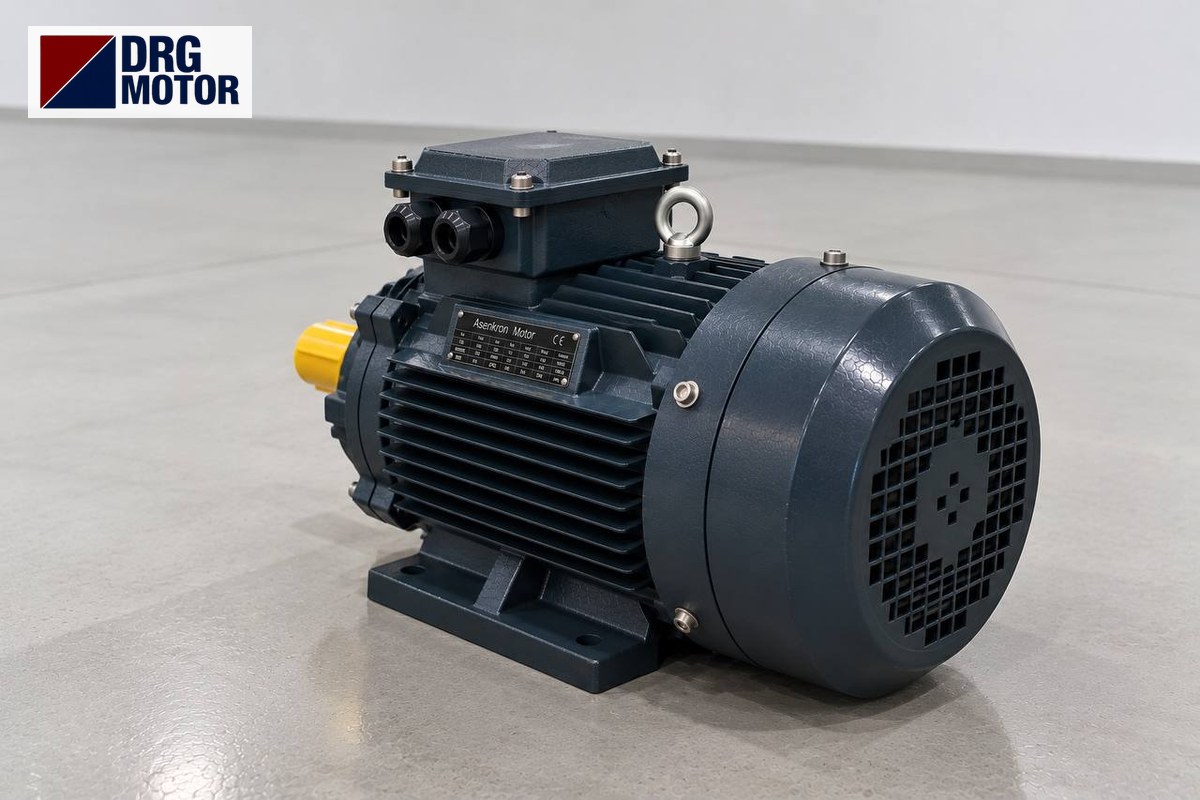

On an olive oil line the motors fall into three groups: the crusher that turns olives into paste (the largest motor, usually 2-pole 3000 rpm), the malaxer that slowly kneads the paste in a warm trough (a 4-pole motor plus gearbox), and the screw and pump motors that move olives, paste or pomace (low power, mostly geared). On medium-sized lines the crusher motor is generally 11–22 kW, the malaxer motor a few kW and conveying motors below 1–2 kW; the exact value is on the machine's nameplate or in the manufacturer's data. For example, the 15 kW, 3000 rpm DRG-160M2-2 runs at 2945 rpm, draws 26.5 A at 400 V and 27.9 A at 380 V, and delivers 48.6 N·m rated torque.
Two things change motor selection the most: the line's hourly capacity and the load of the season. During harvest the line runs day and night for weeks with short stops; through the summer the motors wait in a damp store. So on an olive oil machine the motor is chosen not only by power but so that it does not fail mid-season, and it is checked before the season starts. Electrical connections, the starter panel and insulation testing must be handled by a qualified electrician. You can find suitable models for line motors, with dimensions and current values, on the Buy Electric Motors Online page.
Olive crusher motor: hammer and disc crushers
In a hammer crusher, hammers on a rotating rotor strike the olives against a perforated screen; in a disc crusher, crushing happens between two toothed discs. Both are high-speed machines and the motor is usually coupled directly to the rotor. That is why 2-pole (3000 rpm) motors are common on crushers; some machines use a 4-pole motor with a belt to set speed.
The effect of speed on the paste shows in the hammer tip speed: v = π · D · n / 60. Assuming a rotor diameter of 0.45 m, the tip speed is ≈ 69.4 m/s at 2945 rpm and ≈ 34.5 m/s at the 1465 rpm of a 4-pole motor. A higher tip speed gives finer paste and more heating of the paste. Crusher speed is therefore part of the machine design: do not change the number of poles or the pulley diameter when replacing the motor.
Estimating power from capacity
Crusher power is roughly estimated as capacity × specific crushing energy. The values below are assumptions; specific energy varies with olive variety, ripeness and screen hole size.
- Assumption: capacity 3 t/h, specific crushing energy 5 kWh/t.
- Power: 3 × 5 = 15 kW → DRG-160M2-2 (15 kW, 2945 rpm).
- If the same machine handles 1.5 t/h, the result is 1.5 × 5 = 7.5 kW; a 2-pole motor of the 7.5 kW class is then enough.
- Because of shock loads from pits and small stones, it is common to choose the next standard size rather than the exact calculated limit.
Starting the crusher: star-delta and no-load start
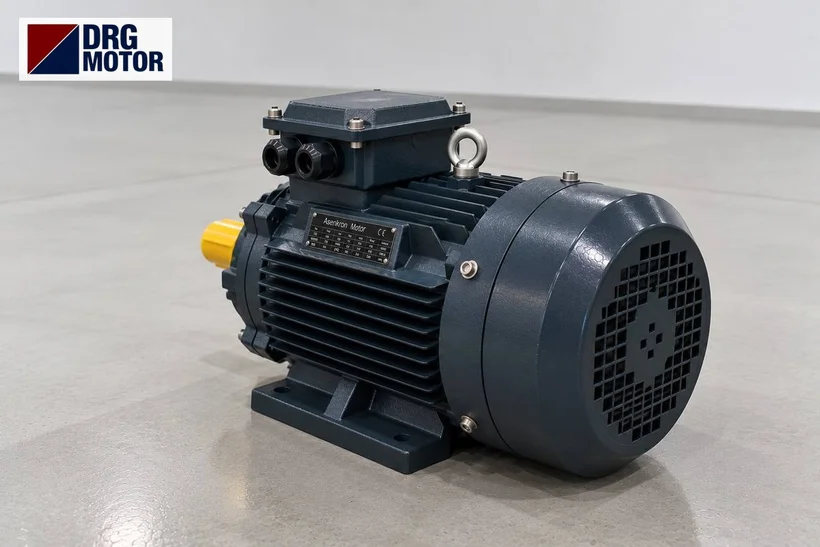
The crusher rotor is heavy and fast; at start-up the motor must accelerate this mass quickly. The 15 kW motor has a starting current ratio Is/In = 8.1: direct-on-line starting briefly draws ≈ 26.5 × 8.1 ≈ 215 A from the supply. DRG models from 4 kW upward are wound for 400/690 V and run in delta at 400 V, which suits star-delta starting. In star, starting current falls to about one third, ≈ 72 A; torque falls in the same ratio.
- Always start the crusher empty; switch on the feed screw only after the crusher has reached full speed. The control circuit should include this sequence interlock.
- If the crusher stopped full (power cut), do not attempt a star start without emptying the paste; torque in star is low, the motor cannot run up and overheats.
- The star-to-delta changeover should happen when the motor is close to rated speed; if the timer is set too short, a second current surge occurs at changeover.
You can compare starting methods on our motor starting methods and star-delta page. Cable size example for the 15 kW motor: 26.5 × 1.25 ≈ 33.1 A; 4 mm² (34 A) in the table is at its limit, so 6 mm² (43 A) gives more margin. On a 40 m run with 6 mm², voltage drop is ΔU = √3 × 26.5 × 0.04 × 3.08 × 0.89 ≈ 5.0 V, about 1.3 percent of 400 V. Use the cable size calculator for your own line.
Malaxer motor: slow, geared and in a warm environment
The malaxer kneads the crushed paste in a hot-water-jacketed trough with slowly turning blades; the paste is mixed for a long time so that oil droplets can coalesce. Blade speed is around a few dozen rpm, so the malaxer uses a 4-pole motor plus gearbox. Lines often have several malaxer troughs, each with its own motor.
- Assumption: blade speed 18 rpm, 1200 N·m on the blade shaft with a full trough, η = 0.85 for the gearbox.
- Power: 1200 × 18 / 9550 = 2.26 kW, or 2.26 / 0.85 = 2.66 kW at the motor → 3 kW DRG-100L2-4.
- Gearbox ratio: 1450 / 18 ≈ 80.6. Rated torque at the blade shaft ≈ 19.8 × 80.6 × 0.85 ≈ 1356 N·m.
- If the paste has cooled and thickened, or the trough is started full, the 4 kW DRG-112M-4 leaves a margin: ≈ 1801 N·m with the same ratio.
The area around the malaxer is warm and humid; steam from the hot water jacket and trough lid can condense on the motor frame. Our catalogue models are IP55 protected with class F insulation; do not hose the motor down, and keep the terminal box cover and cable gland tight. You can check gearbox selection with the gearbox output speed and torque calculator.
Screws, elevators and pumps: conveying motors
Screw conveyors and paste pumps carry the olives from the reception hopper to the washer, from the washer to the crusher and from the crusher to the malaxer. These motors are small but numerous; one of them is often the reason a line stops.
- Screw conveyor (with assumptions): using P ≈ Q · (L · λ + H) / 367 / η; Q = 3 t/h, L = 6 m, λ = 4 (assumed resistance factor for wet olives and paste), H = 2 m, η = 0.8 → 3 × 26 / 367 / 0.8 ≈ 0.27 kW. In practice, for full starts and sticky paste, 0.55–0.75 kW geared motors are seen.
- Paste pump (with assumptions): P = Q · p / (600 · η) (Q in L/min, p in bar); Q = 50 L/min, p = 6 bar, pump efficiency η = 0.5 → 50 × 6 / 300 = 1.0 kW → 1.1 kW DRG-90S-4. You can also find pump power with the pump and fan motor power calculator.
- Leaf removal fan and washing pump: low power; because of the wet environment, the terminal box and cable gland seal are the parts to check most often.
A short note on the decanter
The decanter centrifuge that separates oil from the paste is a separate machine on the line: a main motor turns the high-inertia bowl and a second drive provides the speed difference between bowl and scroll. Starting is long and is usually done with a drive. The decanter motor's power, speed and starting method must be set directly from the manufacturer's data; the calculations in this article should not be used for the decanter.
Pre-season motor maintenance checklist
Motors that stood idle all summer must not fail on the first day of harvest. Carry out these checks two to three weeks before harvest:
- Insulation test: have a qualified electrician megger the winding insulation of motors stored in a damp place; if it is low, do not energise the motor before drying it.
- Bearings: turn the shaft by hand; replace the bearing if it sticks, rumbles or has play. On the crusher motor (160M) the bearing is 6309-C3.
- Fan and grille: clean olive paste and dust residue from the fan cover; a clogged grille means overheating during the season.
- Terminals: tighten terminal nuts, clean oxidised connections and replace the cover gasket.
- Coupling and belt: check crusher coupling elements, belt tension and pulley alignment.
- Overload setting: confirm overload relays are set to the nameplate current; frequent tripping in the season points to a mechanical problem.
- First-day measurement: with the line running, measure each motor's current and log it next to the nameplate current; any rise is then tracked through the season.
- Spare motor: define a spare for the crusher and malaxer motors with the same frame and shaft size; waiting for a motor mid-season stops the line.
For the general framework of motor selection in food plants see our article on electric motor selection in food and beverage plants; here we covered only points specific to olive oil lines.
Which DRG motor for which machine on the line?
The table lists 2-pole cast iron models for the crusher and 4-pole models for the malaxer and conveying. Confirm the power against your machine's nameplate.
| Model | Power / speed | Frame | Current 400 V |
|---|---|---|---|
| DRG-160M1-2 | 11 kW · 2945 rpm | Cast iron · IEC 160M | 19.6 A |
| DRG-160M2-2 | 15 kW · 2945 rpm | Cast iron · IEC 160M | 26.5 A |
| DRG-160L-2 | 18.5 kW · 2940 rpm | Cast iron · IEC 160L | 32.5 A |
| DRG-100L2-4 | 3 kW · 1450 rpm | Cast iron · IEC 100L | 6.02 A |
| DRG-112M-4 | 4 kW · 1450 rpm | Cast iron · IEC 112M | 7.95 A |
| DRG-90S-4 | 1.1 kW · 1445 rpm | Cast iron · IEC 90S | 2.48 A |
| DRG-802-4 | 0.75 kW · 1420 rpm | Cast iron · IEC 80 | 1.75 A |
Catalogue data of the 15 kW crusher motor used in the example:
- Power: 15 kW
- Rated speed: 2945 rpm
- IEC frame: 160M
- Voltage: 400/690 V (Δ/Y)
- Current 380 V / 400 V: 27.9 A / 26.5 A
- cos φ: 0.89
- Rated torque: 48.6 N·m
- Starting torque Ts/Tn: 2
- Breakdown torque Tmax/Tn: 2.3
- Starting current Is/In: 8.1
- Shaft D × E: 42 × 110 mm
- Bearing: 6309-C3
- Cable entry: 2 × M40×1.5
Motors in this power range
- DRG-160M1-2 – 11 kW – 2945 rpm – Cast iron IEC 160M
- DRG-160M2-2 – 15 kW – 2945 rpm – Cast iron IEC 160M
- DRG-160L-2 – 18.5 kW – 2940 rpm – Cast iron IEC 160L
- DRG-100L2-4 – 3 kW – 1450 rpm – Cast iron IEC 100L
- DRG-112M-4 – 4 kW – 1450 rpm – Aluminium IEC 112M
- DRG-90S-4 – 1.1 kW – 1445 rpm – Aluminium IEC 90S
Click to see current prices and order these motors nowSEE PRICES →
Frequently Asked Questions
What kW motor does an olive crusher need?
The exact value is on the machine's nameplate. Without one, estimate from capacity × specific crushing energy: assuming 3 t/h and 5 kWh/t gives 15 kW. Crushers mostly use 2-pole 3000 rpm motors.
How many amps does a 15 kW motor draw?
The 2-pole 15 kW DRG-160M2-2 draws a rated current of 27.9 A at 380 V and 26.5 A at 400 V. With direct-on-line starting, the starting current briefly reaches 8.1 times this; with star-delta it falls to about one third.
What speed is a malaxer motor?
The motor is usually 4-pole 1500 rpm; blade speed is reduced to a few dozen rpm by the gearbox. The example uses a gearbox ratio of 1450 / 18 ≈ 80.6.
Why does a motor fail to start or trip at the start of the season?
The most common causes are reduced winding insulation after a damp summer and dried-out bearing grease. Have a qualified electrician test the insulation before energising, and check the bearing by turning the shaft by hand.
Send us photos of the nameplates on your line and we will draw up a spare and replacement list together before the season: +90 (542) 666 11 11 · [email protected] · Contact. Dimensions and current values of all models are listed among the 120 models in our online store.