English
 Le français
 Türkçe




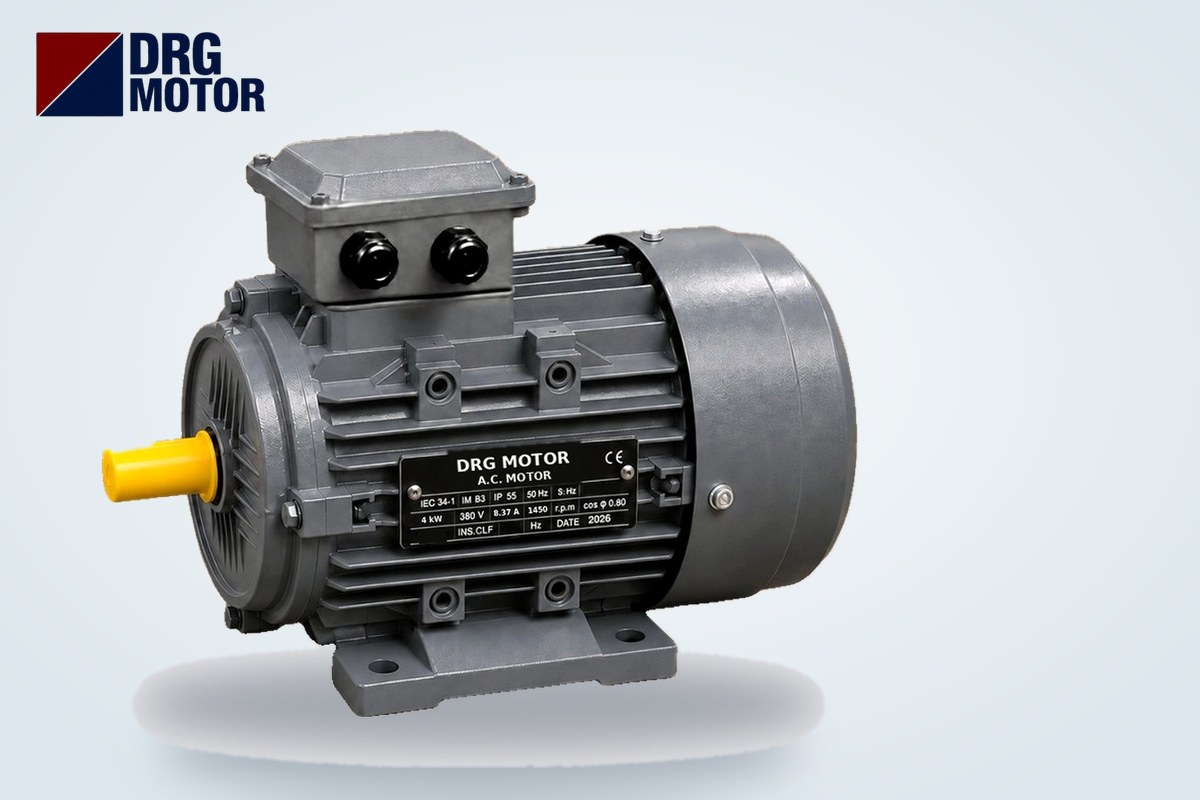

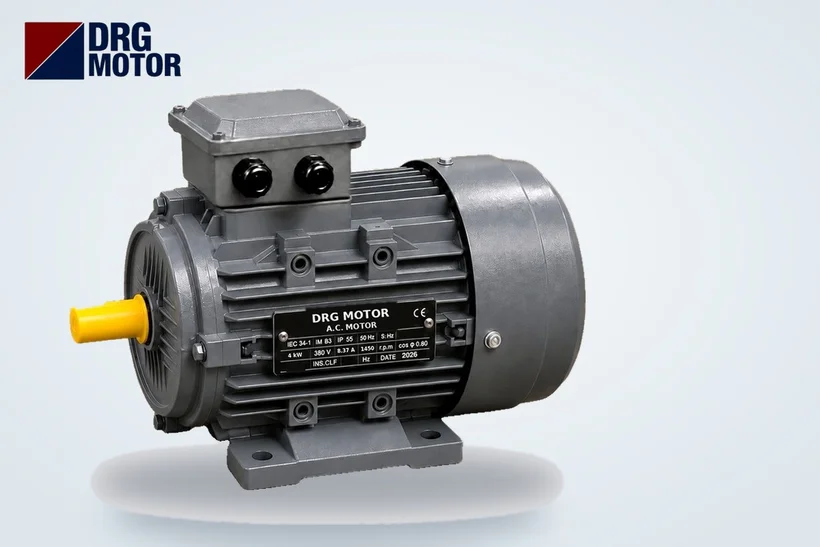
Three-phase motor current is calculated with the formula I = P / (√3 × U × cos φ × η): P is the motor's shaft power (W), U the phase-to-phase voltage (V), cos φ the power factor and η the factor that accounts for the motor's own losses. For example, the data sheet of the 4 kW, 1500 rpm DRG-112M-4 lists a rated current (In) of 8.37 A at 380 V and 7.95 A at 400 V, with a cos φ of 0.82. In practice, the most reliable approach is to use these nameplate values rather than guess the unknowns in the formula, and to run the formula backwards as a check.
The result depends on three things: current falls in inverse proportion as voltage rises; more poles (lower speed for the same power) mean a lower cos φ and higher current; and small motors have proportionally higher losses, so they draw more current per kW. Below you will find every term of the formula, five worked examples from our store data and where the popular "2 A per kW" rule of thumb goes wrong. To find a motor at the power you calculate, browse the 120 models on our Buy Electric Motors Online page.
Three-phase motor current formula and its terms
Each part of the formula has its own physical meaning; leaving one out shifts the result by several amps.
- P (W): The power on the nameplate is the mechanical power delivered at the shaft, not the power drawn from the supply. A motor marked 4 kW draws more than 4 kW from the supply.
- √3 (≈1.732): Comes from the relationship between line voltage and phase quantities in a three-phase system. There is no such factor in a single-phase calculation.
- U (V): The phase-to-phase supply voltage: 380 V, 400 V or 415 V. Using the phase-to-neutral voltage (220/230 V) makes the result wrong by a factor of √3.
- cos φ: Shows how much of the current is the active (working) component. Because the motor also draws reactive current for magnetisation, cos φ is below 1; the data sheet gives it at full load.
- η: The ratio of shaft power to the electrical power drawn from the supply; it represents winding, iron, friction and fan losses. As it varies with motor size and design, using a memorised number gives a wrong result.
The formula applies at full load. At partial load cos φ falls and current does not drop in proportion to load, so do not expect half of In at 50% load.
How to back-calculate from the nameplate In and cos φ
You can use the formula without knowing η: with the nameplate current and cos φ you obtain the electrical power drawn from the supply (input power).
Pinput = √3 × U × In × cos φ
For the 4 kW DRG-112M-4: 1.732 × 380 × 8.37 × 0.82 ≈ 4,517 W ≈ 4.52 kW. With a shaft power of 4 kW, the motor dissipates about 0.52 kW as heat at full load. If you calculate the same motor while ignoring η, you get 4,000 / (1.732 × 380 × 0.82) ≈ 7.41 A, about 1 A short of the real 8.37 A. That gap is enough to leave someone who "calculated the current and set the overload to it" with an unprotected motor or a relay that keeps tripping.
There are three reasons nameplate current is more reliable than calculation: the manufacturer gives a measured value, it removes the need to estimate cos φ and losses separately, and it is the reference for overload relay, cable and contactor selection. The formula is used to estimate the current of a motor whose plate is unreadable, to check a data-sheet figure or to convert it to another voltage.
Worked examples: motor current at small, medium and large power
The five examples below show, for each motor, the nameplate values, the input power back-calculation and the value given by the formula without η. All current and cos φ values come from our store data sheets.
| Model | Power / speed | cos φ | In 380 V (nameplate) | Pinput = √3·U·In·cos φ | Formula without η |
|---|---|---|---|---|---|
| DRG-711-4 | 0.25 kW / 1340 rpm | 0.74 | 0.7 A | 0.34 kW | 0.51 A |
| DRG-90L-2 | 2.2 kW / 2895 rpm | 0.85 | 4.58 A | 2.56 kW | 3.93 A |
| DRG-132M-4 | 7.5 kW / 1460 rpm | 0.84 | 15.0 A | 8.29 kW | 13.57 A |
| DRG-180L-4 | 22 kW / 1470 rpm | 0.86 | 41.8 A | 23.66 kW | 38.87 A |
| DRG-280S-4 | 75 kW / 1486 rpm | 0.88 | 136.0 A | 78.77 kW | 129.49 A |
Example 1 – 0.25 kW small motor
DRG-711-4: Pinput = 1.732 × 380 × 0.7 × 0.74 ≈ 341 W. With a shaft power of 250 W, about 91 W is lost; the ratio of losses to shaft power is largest in small motors. The formula without η gives 0.51 A while the nameplate says 0.7 A: proportionally, this example shows the largest gap.
Example 2 – 2.2 kW, 3000 rpm motor
DRG-90L-2: Pinput = 1.732 × 380 × 4.58 × 0.85 ≈ 2.56 kW. 2-pole motors have a high cos φ (0.85), so their current per kW (4.58 / 2.2 ≈ 2.08 A) stays below that of a 6-pole motor of the same power.
Example 3 – 7.5 kW, 1500 rpm motor
DRG-132M-4: Pinput = 1.732 × 380 × 15.0 × 0.84 ≈ 8.29 kW. At this power the "2 A per kW" rule fits exactly: 7.5 × 2 = 15 A.
Example 4 – 22 kW, 1500 rpm motor
DRG-180L-4: Pinput = 1.732 × 380 × 41.8 × 0.86 ≈ 23.66 kW. The rule of thumb says 44 A; the nameplate says 41.8 A. For a detailed reading of this current and panel preparation, see how many amps do 22 and 30 kW motors draw.
Example 5 – 75 kW large motor
DRG-280S-4: Pinput = 1.732 × 380 × 136.0 × 0.88 ≈ 78.77 kW. The rule gives 150 A; the real value is 136.0 A. At high power the rule overstates current by about 10%; sizing cables and breakers to that excess means oversized equipment.
Converting current between 380 V, 400 V and 690 V
At the same shaft power, current is inversely proportional to voltage: I2 = I1 × U1 / U2. For small voltage differences (380 ↔ 400 ↔ 415 V) this conversion matches the data sheet exactly.
- 22 kW DRG-180L-4, from 380 V to 400 V: 41.8 × 380 / 400 ≈ 39.7 A (data sheet: 39.7 A).
- 4 kW DRG-112M-4, from 380 V to 400 V: 8.37 × 380 / 400 ≈ 7.95 A (data sheet: 7.95 A).
- 22 kW motor connected in star on a 690 V supply: 39.7 × 400 / 690 ≈ 23.0 A.
The 690 V conversion only makes sense for motors rated 400/690 V; in our store, models of 4 kW and above carry this rating and are connected in delta on a 380/400 V supply and in star on a 690 V supply. Motors of 3 kW and below, rated 230/400 V, are connected in star on a 380/400 V supply. The voltage conversion gives the motor's line current; in star-delta starting, the phase current through the contactor and overload relay is calculated separately as In/√3.
Converting HP to kW to find the current
On older machines or imported equipment, power is given in horsepower (HP). The conversion factor is 1 HP = 0.7457 kW.
- 10 HP × 0.7457 ≈ 7.46 kW → nearest standard rating 7.5 kW (DRG-132M-4, 15.0 A at 380 V).
- 20 HP × 0.7457 ≈ 14.91 kW → 15 kW (DRG-160L-4, 28.8 A at 380 V).
- 30 HP × 0.7457 ≈ 22.37 kW → 22 kW (DRG-180L-4, 41.8 A at 380 V).
After converting, it is more accurate to use the nameplate current of the standard-rated motor than to plug numbers into the formula. If the plate uses metric horsepower (PS, 0.7355 kW), the result changes slightly; check the unit on the plate.
Where does the "2 A per kW" rule hold, and where does it fail?
On site, people say "every kW draws about 2 A" at 380 V. Comparing with the 4-pole (1500 rpm) motors in our store data shows the rule works well at medium power and poorly at the extremes:
| Model | Power | In 380 V | Current per kW | Rule (2 A/kW) | Rule error |
|---|---|---|---|---|---|
| DRG-711-4 | 0.25 kW | 0.7 A | 2.80 A/kW | 0.5 A | 29% low |
| DRG-802-4 | 0.75 kW | 1.84 A | 2.45 A/kW | 1.5 A | 18% low |
| DRG-90L-4 | 1.5 kW | 3.47 A | 2.31 A/kW | 3.0 A | 14% low |
| DRG-112M-4 | 4 kW | 8.37 A | 2.09 A/kW | 8.0 A | 4% low |
| DRG-160M-4 | 11 kW | 21.5 A | 1.95 A/kW | 22.0 A | 2% high |
| DRG-225S-4 | 37 kW | 69.6 A | 1.88 A/kW | 74.0 A | 6% high |
| DRG-315S-4 | 110 kW | 197.0 A | 1.79 A/kW | 220.0 A | 12% high |
| DRG-355M-4 | 250 kW | 440.0 A | 1.76 A/kW | 500.0 A | 14% high |
Conclusion: between 3 and 15 kW the rule stays within a few percent. Below 1.5 kW it understates current; set an overload relay by the rule and it will trip while the motor runs. Above 37 kW it overstates current and leads to oversized cables and breakers. The number of poles matters too: at 11 kW, the 2-pole DRG-160M1-2 draws 20.6 A while the 6-pole DRG-160L-6 draws 23.1 A. Ready-made values for every power and speed are in our motor current chart tool.
How is starting current calculated?
With direct-on-line starting, the initial current is found from the Is/In ratio on the data sheet: Istart = In × (Is/In). For the 7.5 kW DRG-132M-4, 15.0 × 7.5 ≈ 112 A; for the 22 kW DRG-180L-4, 41.8 × 7.8 ≈ 326 A. This current flows only during starting, but it is decisive for the fuse type and for the load the supply can handle. Use our overload, fuse and contactor selection tool to choose fuses and overload relays.
Checklist for motor current calculations
- Did you enter the phase-to-phase voltage (380/400 V) rather than phase-to-neutral (220/230 V)?
- Is the power taken as shaft power (kW), and was HP converted with 0.7457?
- Is cos φ the full-load value from the motor's data sheet rather than a guess?
- If η was ignored, have you allowed for the result being lower than the real current?
- If a nameplate current exists, was the calculation compared with it?
- For a different voltage, was the I2 = I1 × U1 / U2 conversion applied?
- Have the motor's rated voltage (230/400 V or 400/690 V) and its connection on the supply been confirmed?
- Was starting current calculated separately from the Is/In ratio?
- Below 1.5 kW and above 37 kW, was the real value used instead of the "2 A per kW" rule?
Motors in this power range
The data sheets of the motors used in the worked examples are linked below:
- DRG-711-4 – 0.25 kW – 1500 rpm – aluminium frame
- DRG-90L-2 – 2.2 kW – 3000 rpm – aluminium frame
- DRG-112M-4 – 4 kW – 1500 rpm – aluminium frame
- DRG-132M-4 – 7.5 kW – 1500 rpm – aluminium frame
- DRG-180L-4 – 22 kW – 1500 rpm – cast iron frame
- DRG-280S-4 – 75 kW – 1500 rpm – cast iron frame
Click to see current prices and order these motors nowSEE PRICES →
Frequently Asked Questions
What formula is used to calculate three-phase motor current?
The formula I = P / (√3 × U × cos φ × η) is used, where P is shaft power in watts and U is phase-to-phase voltage. If η is unknown, the most accurate figure is the rated current on the motor's data sheet; the formula is used to check that value and convert it to another voltage.
How do you find amps from motor power?
For a rough estimate, take about 2 A per kW at 380 V; this rule works well between 3 and 15 kW. Small motors draw more current per kW and large motors less. For example, a 4 kW 1500 rpm motor draws 8.37 A at 380 V.
How do you convert motor current from 380 V to 400 V?
Multiply the current by the voltage ratio: I400 = I380 × 380 / 400. For a 22 kW motor, 41.8 × 0.95 ≈ 39.7 A, identical to the data-sheet value.
Why is cos φ used in motor current calculations?
Besides the active current that does work, a motor draws reactive current for magnetisation. cos φ shows what share of the total current is active; leave it out of the formula and the calculated current comes out noticeably lower than the real one.
To check your calculations or choose the right motor, call us on +90 (542) 666 11 11, email [email protected] or use our contact page. Every power and speed option is available among the 120 models in our online store.