English
 Le français
 Türkçe




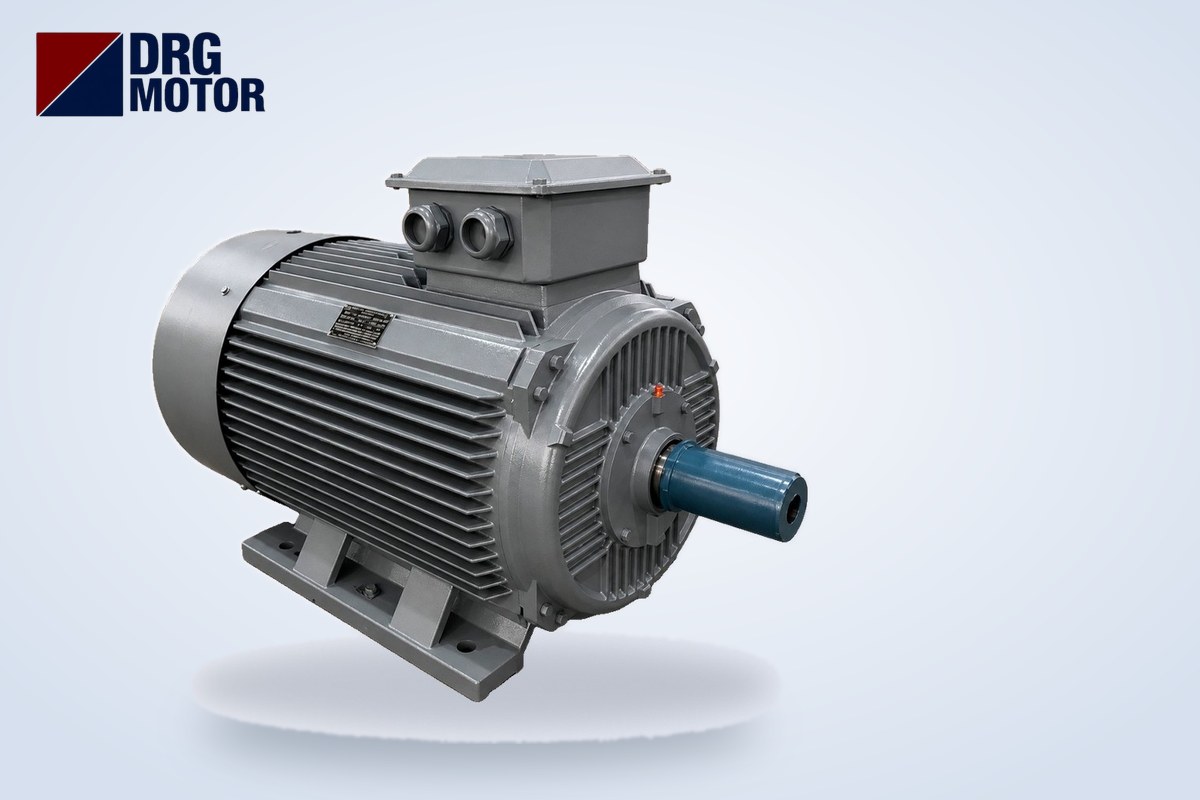

A 22 kW, 1500 rpm three-phase motor draws about 41.8 A at full load on 380 V, and a 30 kW, 1500 rpm motor about 56.6 A. On a 400 V supply these values are 39.7 A and 53.8 A. With direct-on-line starting, the 22 kW motor draws about 326.0 A and the 30 kW motor about 413.2 A at the moment of starting; this is why panels at these powers are usually built with star-delta, a soft starter or a drive.
At the same power, current changes with speed: at 22 kW, the 3000 rpm model draws 40.5 A and the 1000 rpm model 44.8 A; at 30 kW, the 3000 rpm model draws 54.9 A and the 1000 rpm model 59.1 A. Building the panel before the motor is chosen is therefore risky: contactor, overload relay, cable and gland selection depend on both power and speed.
The values below are taken from the technical data of the 22 and 30 kW cast iron motors on our Buy Electric Motors Online page. At the end of the article you will find a checklist to tick off before building the panel.
22 and 30 kW Motor Current Table: 3000, 1500 and 1000 rpm
All six models have 400/690 V windings and are connected in delta (Δ) on a 380–400 V supply. Is is the starting current with direct-on-line starting, calculated as In × (Is/In).
| Model | kW | Speed (synchronous / rated) | IEC frame | cos φ | In 380 V | In 400 V | Is/In | Is 380 V (calculated) | Rated torque | Cable entry |
|---|---|---|---|---|---|---|---|---|---|---|
| DRG-180M-2 | 22 | 3000 / 2955 rpm | 180M | 0.89 | 40.5 A | 38.5 A | 8.2 | ≈ 332.1 A | 71.1 Nm | 2 × M40×1.5 |
| DRG-180L-4 | 22 | 1500 / 1470 rpm | 180L | 0.86 | 41.8 A | 39.7 A | 7.8 | ≈ 326.0 A | 142.9 Nm | 2 × M40×1.5 |
| DRG-200L2-6 | 22 | 1000 / 980 rpm | 200L | 0.81 | 44.8 A | 42.5 A | 7.4 | ≈ 331.5 A | 214.4 Nm | 2 × M50×1.5 |
| DRG-200L1-2 | 30 | 3000 / 2960 rpm | 200L | 0.89 | 54.9 A | 52.1 A | 7.6 | ≈ 417.2 A | 96.8 Nm | 2 × M50×1.5 |
| DRG-200L-4 | 30 | 1500 / 1475 rpm | 200L | 0.86 | 56.6 A | 53.8 A | 7.3 | ≈ 413.2 A | 194.2 Nm | 2 × M50×1.5 |
| DRG-225M-6 | 30 | 1000 / 980 rpm | 225M | 0.83 | 59.1 A | 56.2 A | 6.9 | ≈ 407.8 A | 292.3 Nm | 2 × M50×1.5 |
Three conclusions for the panel follow from the table. First, going from 22 kW to 30 kW, the current rises from 41.8 A to 56.6 A (1500 rpm); choose the cable size and contactor step accordingly. Second, the 1000 rpm models require the highest current and the largest frame at the same power. Third, at 22 kW the cable entry is M40 on the 3000 and 1500 rpm models, and M50 on the 1000 rpm model and all 30 kW models.
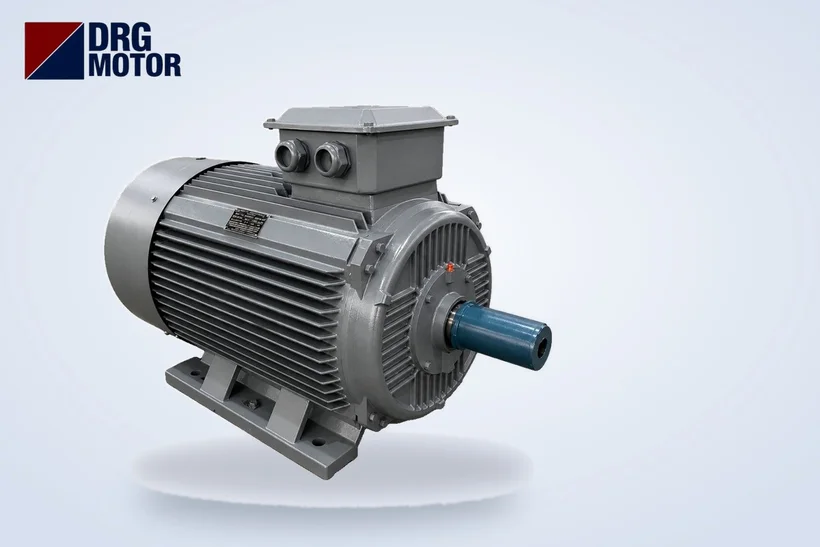
How Does Rated Current Determine Panel Components?
Panel components are chosen by the motor's nameplate current, not its kW rating. For the 22 kW 1500 rpm motor this is 41.8 A, for the 30 kW 1500 rpm motor 56.6 A (380 V).
- Contactor: its AC-3 rated current must not be lower than the motor In. With direct-on-line starting, a single contactor carries the full line current.
- Overload relay: its setting range must include the nameplate current, and it must be set to the nameplate current.
- Cable: the cross-section is determined by In plus line length, installation method and ambient temperature; for an exact value, use the motor cable size calculator.
- Circuit breaker/fuse: it must let the starting current through without tripping and protect against short circuits; for the selection logic see the overload relay, fuse and contactor selection tool.
For details on contactor selection, see our article how to choose a contactor in an electric motor panel; here we only give the current values specific to 22 and 30 kW.
Choosing the Starting Method: DOL, Star-Delta, Soft Starter or Drive
The decision that really determines the panel type is the starting method, because the number of components and the current values change with the method. The table below summarises the starting values for the six models.
| Model | DOL starting Is | Star-stage line current (Is/3) | Winding-branch current (In/√3) | Starting kVA (DOL) | Running kVA |
|---|---|---|---|---|---|
| DRG-180M-2 | ≈ 332.1 A | ≈ 110.7 A | ≈ 23.4 A | ≈ 219 kVA | ≈ 26.7 kVA |
| DRG-180L-4 | ≈ 326.0 A | ≈ 108.7 A | ≈ 24.1 A | ≈ 215 kVA | ≈ 27.5 kVA |
| DRG-200L2-6 | ≈ 331.5 A | ≈ 110.5 A | ≈ 25.9 A | ≈ 218 kVA | ≈ 29.5 kVA |
| DRG-200L1-2 | ≈ 417.2 A | ≈ 139.1 A | ≈ 31.7 A | ≈ 275 kVA | ≈ 36.1 kVA |
| DRG-200L-4 | ≈ 413.2 A | ≈ 137.7 A | ≈ 32.7 A | ≈ 272 kVA | ≈ 37.3 kVA |
| DRG-225M-6 | ≈ 407.8 A | ≈ 135.9 A | ≈ 34.1 A | ≈ 268 kVA | ≈ 38.9 kVA |
Direct-on-line starting
This is the simplest panel, but a 30 kW 1500 rpm motor briefly requires about 272 kVA of apparent power at start; 7.3 times the 37.3 kVA of normal running. It is not suitable with a weak line, a generator supply or a starting-current limit imposed by the distribution company.
Star-delta
These motors with 400/690 V windings are suitable for star-delta starting. In the star stage, line current falls to one third of the DOL value (≈ 137.7 A for 30 kW 1500 rpm), but starting torque also falls to one third: about 129.5 Nm instead of 388.4 Nm. On a machine that starts loaded, this torque may not be enough. The panel contains three contactors (main, delta, star) and a timer relay; the main and delta contactors carry the winding-branch current, i.e. In/√3 (≈ 32.7 A for 30 kW 1500 rpm). For timing and the diagram, use our star-delta starting tool.
Soft starter
It ramps up the voltage and limits the current. In single-motor applications with low load torque (pumps, fans) it saves panel space. If the current limit is set too low, the motor cannot reach speed.
Frequency drive
It keeps the starting current around rated current and provides speed control. A drive is chosen by motor current, not by its kW label: the drive's rated output current must not be less than 41.8 A for the 22 kW 1500 rpm motor and 56.6 A for 30 kW (380 V).
Terminal Box: Δ Connection and Six-Lead Cabling
DRG motors at these powers are rated 400/690 V. This has two direct consequences for the panel:
- Direct-on-line, soft starter or drive: the links in the terminal box are fitted in the delta (Δ) position; three phases plus a protective conductor run from the panel to the motor.
- Star-delta: the terminal links are removed; all six ends (U1, V1, W1, U2, V2, W2) are taken to the panel. This requires two separate power cables or a single multi-core cable, and each cable is sized for the current-carrying winding branch.
A common mistake is connecting a 400/690 V motor in star on a 380 V supply: the motor runs at reduced voltage, speed drops under load and current rises. Always check the delta link position before energising.
Cable Entry: M40 or M50?
Gland size depends on the frame and affects cable planning on the panel side:
- 180 frame (DRG-180M-2, DRG-180L-4): 2 × M40×1.5
- 200 and 225 frame (DRG-200L2-6, DRG-200L1-2, DRG-200L-4, DRG-225M-6): 2 × M50×1.5
If two cables are used in a star-delta panel, bear in mind that both entries will be occupied. Before ordering, check that the cable outer diameter falls within the gland's sealing range; trying to fit a single large cable into an M40 entry is a problem frequently encountered on site.
kVA for Generator and Transformer Sizing
The motor's kW rating is not enough for generator or transformer selection; you need the apparent power drawn from the supply (kVA) and the peak value at start. Calculation: S = √3 × U × I.
- 22 kW 1500 rpm: √3 × 0.38 kV × 41.8 A ≈ 27.5 kVA running; ≈ 215 kVA at DOL start.
- 30 kW 1500 rpm: √3 × 0.38 kV × 56.6 A ≈ 37.3 kVA running; ≈ 272 kVA at DOL start.
Active power drawn from the supply is found with √3 × U × I × cos φ: for the 30 kW 1500 rpm motor, √3 × 0.38 × 56.6 × 0.86 ≈ 32.04 kW. The 30 kW on the nameplate is shaft power; the difference is motor losses.
Checklist Before Building the Panel
- Have the motor model and speed been finalised? At the same kW, the 1000 rpm model requires more current.
- Has the supply voltage been measured (380 V / 400 V)? Current and overload setting change accordingly.
- Has the starting method been chosen; does the load start full (crusher, loaded conveyor, mixer)?
- Do the contactor AC-3 current and overload setting range cover the line current (DOL) or the winding-branch current (star-delta), depending on the method?
- Has the circuit breaker/fuse been chosen so that it does not trip at starting current but protects against short circuits?
- Has the cable size been calculated for length and installation; has cabling for six leads been planned for star-delta?
- Are the gland size (M40 or M50) and cable outer diameter compatible?
- Are the terminal links in the correct position (Δ) or removed for star-delta?
- If a drive is used, is its rated output current not less than the motor nameplate current?
- With a generator supply, can the starting kVA be met?
Motors at This Power
The cast iron 22 and 30 kW models in our store:
- DRG-180M-2 – 22 kW – 3000 rpm – 180M cast iron
- DRG-180L-4 – 22 kW – 1500 rpm – 180L cast iron
- DRG-200L2-6 – 22 kW – 1000 rpm – 200L cast iron
- DRG-200L1-2 – 30 kW – 3000 rpm – 200L cast iron
- DRG-200L-4 – 30 kW – 1500 rpm – 200L cast iron
- DRG-225M-6 – 30 kW – 1000 rpm – 225M cast iron
Click to see current prices and order these motors nowSEE PRICES →
For other powers and speeds, browse the 120 models in our online store, and compare currents of different powers on our motor current chart page.
Frequently Asked Questions
How many amps does a 22 kW motor draw?
At 380 V and full load, the 3000 rpm model draws 40.5 A, the 1500 rpm model 41.8 A and the 1000 rpm model 44.8 A. At 400 V the values are 38.5 A, 39.7 A and 42.5 A respectively.
How many amps does a 30 kW motor draw?
At 380 V and full load, the 3000 rpm model draws 54.9 A, the 1500 rpm model 56.6 A and the 1000 rpm model 59.1 A. At 400 V the values are 52.1 A, 53.8 A and 56.2 A respectively.
What should the overload relay be set to for a 30 kW motor in star-delta?
In star-delta panels, the overload relay is usually connected in the winding branch and set to the winding current, i.e. In/√3: ≈ 32.7 A at 380 V and ≈ 31.1 A at 400 V for the 30 kW 1500 rpm motor. If the relay is in the main line, the setting is the nameplate current of 56.6 A (380 V).
Can a 22 kW motor be started direct-on-line?
Technically yes; the motor is suitable for it. However, since the 1500 rpm model draws ≈ 326.0 A and ≈ 215 kVA at start, the line, transformer or generator must be able to handle it and the distribution company's connection conditions must allow it. Otherwise, star-delta, a soft starter or a drive is preferred.
For your 22 or 30 kW motor and panel planning, you can reach us on +90 (542) 666 11 11 or at [email protected], use our contact page, or order directly from the Buy Electric Motors Online page.