English
 Le français
 Türkçe




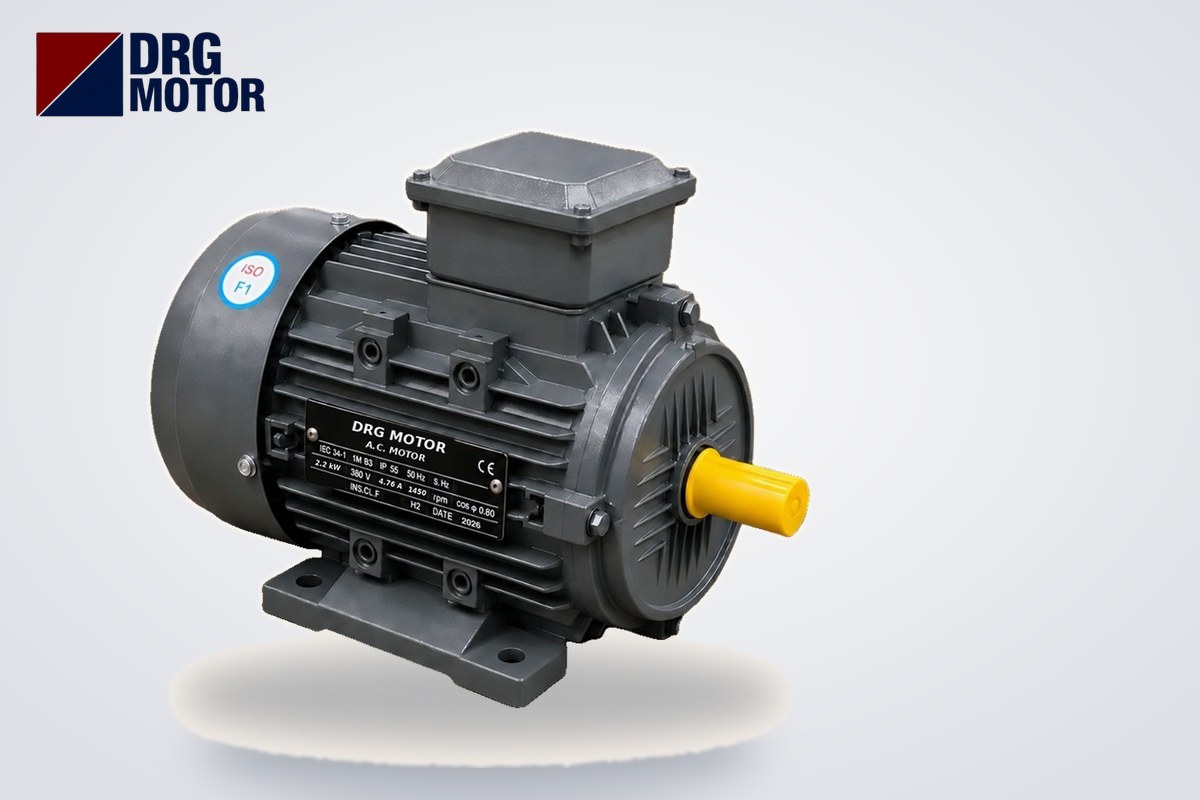

A 2.2 kW (3 HP), 1500 rpm three-phase motor connected in star on a 380 V supply draws 4.76 A at full load; at 400 V the figure is 4.52 A. At the same power, a 3000 rpm motor draws 4.58 A and a 1000 rpm motor 5.36 A. So when feeding a 2.2 kW machine in a workshop, you can count on 4.58–5.36 A of rated current per line, depending on speed; what really needs attention is the starting moment and several machines running on the same circuit.
Current varies with speed because the power factor drops as the number of poles rises: cos φ is 0.85 at 3000 rpm, 0.81 at 1500 rpm and 0.74 at 1000 rpm. If the supply voltage is low and the machine heavily loaded, the measured current will be above the table; at no load or light load it will be clearly lower. The values in this article are catalogue data of the 2.2 kW models in our Buy Electric Motors Online store.
2.2 kW Motor Current Table (380, 400 and 415 V)
The 2.2 kW motors in the store come with aluminium and cast iron housings. The housing material does not change current, cos φ or speed; the table shows the two housings on separate rows with the same electrical values.
| Model | Housing | IEC | Rated speed (rpm) | cos φ | I 380 V (A) | I 400 V (A) | I 415 V (A) | Is/In | Torque (Nm) |
|---|---|---|---|---|---|---|---|---|---|
| DRG-90L-2 | Aluminium | 90L | 2895 | 0.85 | 4.58 | 4.35 | 4.19 | 7.6 | 7.26 |
| DRG-90L-2 | Cast iron | 90L | 2895 | 0.85 | 4.58 | 4.35 | 4.19 | 7.6 | 7.26 |
| DRG-100L1-4 | Aluminium | 100L | 1450 | 0.81 | 4.76 | 4.52 | 4.36 | 7.6 | 14.5 |
| DRG-100L1-4 | Cast iron | 100L | 1450 | 0.81 | 4.76 | 4.52 | 4.36 | 7.6 | 14.5 |
| DRG-112M-6 | Aluminium | 112M | 955 | 0.74 | 5.36 | 5.09 | 4.91 | 6.6 | 22.0 |
| DRG-112M-6 | Cast iron | 112M | 955 | 0.74 | 5.36 | 5.09 | 4.91 | 6.6 | 22.0 |
The 1500 rpm model, the most common in small workshops, has a rated torque of 14.5 Nm, confirmed by 9550 × 2.2 / 1450 ≈ 14.5 Nm. At the same power, the 3000 rpm motor gives 7.26 Nm and the 1000 rpm motor 22.0 Nm: 3000 rpm is common for fast sanders and fans, 1500 rpm for compressors and machines that start under load. For currents at other ratings, see the motor current chart.
230/400 V Nameplate: Why Star Connection on a 380 V Supply?
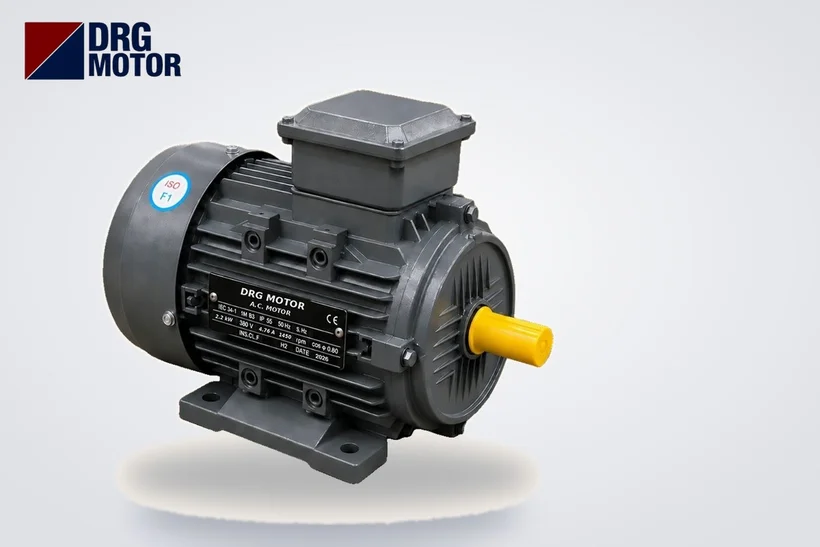
The nameplate of 2.2 kW motors reads 230/400 V (Δ/Y). The winding is designed for 230 V: delta on a 230 V three-phase supply, star on a 400 V supply. On the 380/400 V three-phase network used in Turkey, this motor is connected in star: in the terminal box, W2, U2 and V2 are shorted with a single horizontal link and the three phases go to U1-V1-W1. The 380 V current in the table is the line current of this star connection.
If the same motor is connected in delta on a 230 V three-phase supply, the line current rises by roughly the ratio 400/230: 4.52 × 400 / 230 ≈ 7.9 A. This is rare in workshops, but if a second-hand machine's motor arrives with delta links, they must be changed to star before connecting to 380 V. A 230/400 V motor connected in delta at 380 V sees excessive voltage on its windings, the current rises sharply and the motor overheats quickly.
Because these motors already run in star at 400 V, they are not suitable for star-delta starting; direct-on-line starting is normal at 2.2 kW. We do not recommend running a three-phase motor on single phase (220 V) with a capacitor; power and torque drop and the motor heats up.
Workshop Scenarios: Sander, Compressor, Pillar Drill
In a small furniture, metalwork or machine workshop, a 2.2 kW motor typically appears in these machines:
Belt sander and grinder
Because high belt speed is wanted, a 3000 rpm motor is usually used. The DRG-90L-2 draws 4.58 A at 380 V; with an Is/In ratio of 7.6, about 34.8 A is seen at the first instant. The starting load of a sander is light and the motor gets up to speed quickly.
Piston compressor
A compressor's start is heavier because it can restart against tank pressure. The 1500 rpm DRG-100L1-4 draws 4.76 A at 380 V with a starting current of ≈ 36.2 A; starting torque is 2.3 times rated. Since the pressure switch starts and stops the motor many times a day, it is the most frequently starting load if other machines share the circuit.
Pillar drill
Pillar drills usually run with a smaller motor; in our example we take the 1.1 kW 1500 rpm DRG-90S-4: 2.61 A rated, Is/In = 6.8, ≈ 17.7 A at start.
Three Motors on One Circuit: Total Current Calculation
If these three machines are fed from the same three-phase circuit, the current the line must carry is calculated for two different situations.
| Machine | Model | kW | In 380 V (A) | Is/In | Starting current (A) |
|---|---|---|---|---|---|
| Belt sander | DRG-90L-2 | 2.2 | 4.58 | 7.6 | 34.8 |
| Piston compressor | DRG-100L1-4 | 2.2 | 4.76 | 7.6 | 36.2 |
| Pillar drill | DRG-90S-4 | 1.1 | 2.61 | 6.8 | 17.7 |
| Total | – | 5.5 | 11.95 | – | 88.7 |
All three running at full load: 4.58 + 4.76 + 2.61 = 11.95 A. This simple sum is on the safe side; because the cos φ values differ, the true vector sum is slightly lower. In practice the machines rarely run at full load at the same time, but the circuit and main fuse are designed for this case.
All three starting together: the starting currents add up: 34.8 + 36.2 + 17.7 ≈ 88.7 A. This lasts only briefly, but it can be enough to trip the main fuse, make the lights flicker and cause a voltage drop on a weak circuit.
Staggered starts: the worst moment is when the motor with the highest starting current (the compressor) starts while the other two are running: 36.2 + 4.58 + 2.61 ≈ 43.4 A. Starting the machines a few seconds apart therefore almost halves the peak current on the main circuit. If you build a shared panel, giving the contactors a short delay, or not fitting a single "master start" button, helps for this reason.
Do not forget the voltage at the end of the line
In workshops, machines are often far from the panel, fed by a long cable or a thin circuit added later. Because the current at start rises to 7.6 times rated, the voltage drop grows by the same ratio at that moment. If the voltage at the motor terminals sags, starting torque falls, the compressor cannot get going against tank pressure, the motor draws high current for longer and the overload trips. In that case the problem is the circuit, not the motor: measuring the voltage at the motor terminals during start and recalculating the cable size for the distance gives the right diagnosis. For the same reason, avoid feeding three-phase machines from extension reels.
Power Drawn from the Supply and the Meter
From the measured current you can roughly find the active power the motor takes from the supply with P = √3 × U × I × cos φ. At full load: for the DRG-90L-2, 1.732 × 380 × 4.58 × 0.85 ≈ 2.56 kW; for the DRG-100L1-4 ≈ 2.54 kW; for the DRG-90S-4 ≈ 1.31 kW. It is normal for these values to be slightly above the nameplate (shaft) power; the difference is the losses inside the motor. To estimate monthly consumption with your operating hours, use the energy consumption tool on the electric motor calculators page.
Protection, Fuses and Cables: Practical Workshop Rules
Every motor needs its own protection: a motor protection breaker or a contactor + overload relay set to that motor's rated current (4.76 A at 380 V for a 2.2 kW 1500 rpm motor). Setting the overload high "so it doesn't trip" leaves the motor unprotected when a sanding belt jams or the voltage is low. The circuit fuse must carry the total rated current and must not open at the starting peak calculated above. For concrete selection use the overload, fuse and contactor selection tool, and for the cross-section the motor cable size calculator; suggesting a single cable size without knowing length and installation method would be wrong. For choosing a motor by supply voltage and full-load current, see also our full-load current and supply compatibility guide.
Workshop Circuit Checklist
- Does the nameplate read 230/400 V? On a 380/400 V three-phase supply, connect the terminals in star.
- Set each motor's overload relay to its own nameplate current; do not use one shared overload for all motors.
- Add up the rated currents of the motors on the same circuit; the circuit fuse and cable should be considered for this total.
- Prevent simultaneous starts: switch machines on a few seconds apart.
- Treat frequently starting loads such as compressors as the "highest starting current" in the calculation.
- On first start-up, check the direction of rotation and record the current in all three phases with a clamp meter.
- If you only have a single-phase (220 V) supply, ask your electrician for a suitable solution instead of a three-phase motor.
Motors in This Power Rating
2.2 kW three-phase motors in our store and the 1.1 kW model from the example (each model is also listed separately with aluminium and cast iron housing):
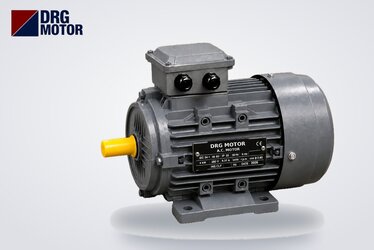
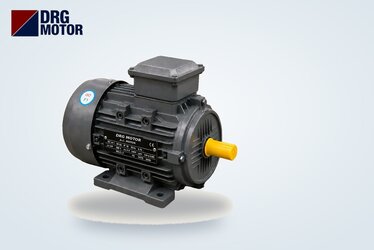
- DRG-90L-2 – 2.2 kW – 3000 rpm – 90L aluminium
- DRG-100L1-4 – 2.2 kW – 1500 rpm – 100L aluminium
- DRG-112M-6 – 2.2 kW – 1000 rpm – 112M aluminium
- DRG-100L1-4 – 2.2 kW – 1500 rpm – 100L cast iron
- DRG-90S-4 – 1.1 kW – 1500 rpm – 90S aluminium
Click to see current prices and order these motors nowSEE PRICES →
Frequently Asked Questions
How many amps does a 2.2 kW motor draw at 380 V?
At full load, the 3000 rpm motor draws 4.58 A, the 1500 rpm motor 4.76 A and the 1000 rpm motor 5.36 A (star connected).
How many amps does a 3 HP motor draw?
3 HP corresponds to 2.2 kW, so the current values are the same as above. A 1500 rpm motor draws 4.52 A at 400 V.
What is the starting current of a 2.2 kW motor?
With direct-on-line starting at 380 V, the 3000 rpm motor draws ≈ 34.8 A and the 1500 rpm motor ≈ 36.2 A. This current lasts until the motor reaches speed.
Is a 2.2 kW motor connected in star or delta?
With a 230/400 V nameplate, it is connected in star on a 380/400 V three-phase supply. Delta is used only on a 230 V three-phase supply.
If you have questions about the right motor or wiring for your workshop, contact us on +90 (542) 666 11 11 or at [email protected], or use our contact page. For every power rating and speed, browse the 120 models in our online store.