English
 Le français
 Türkçe




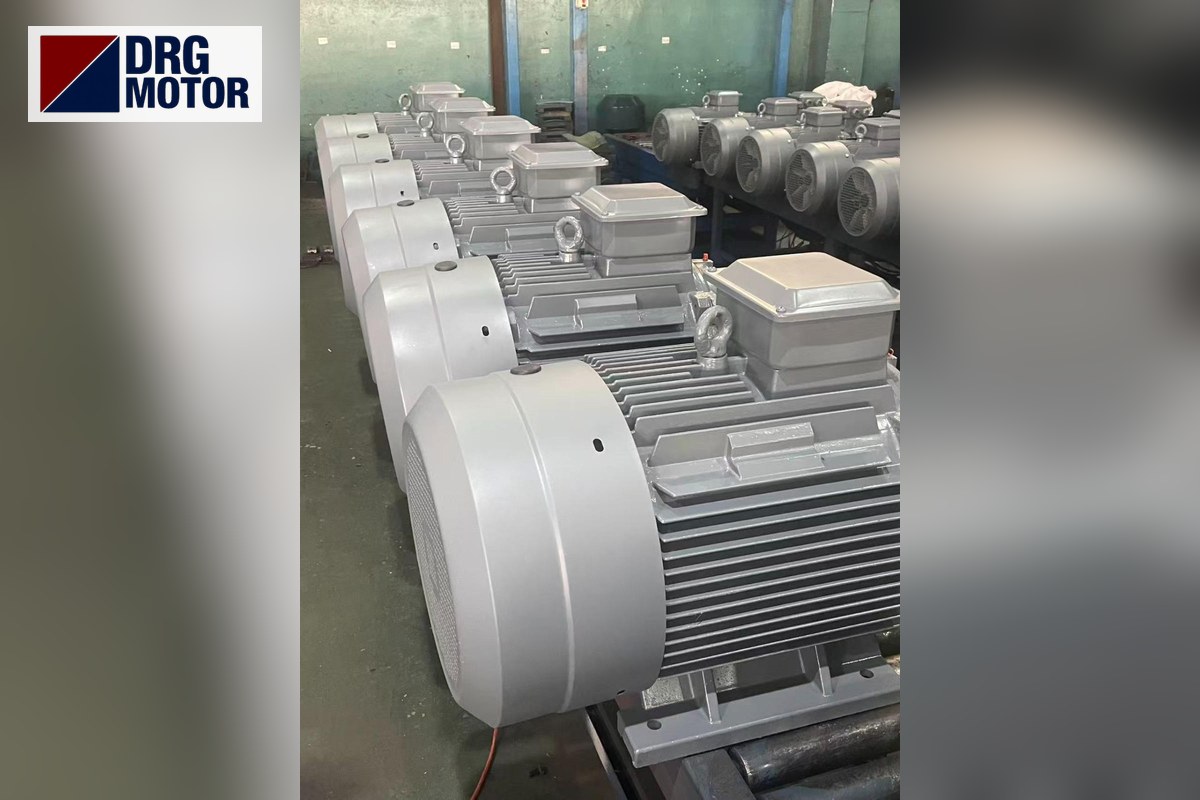

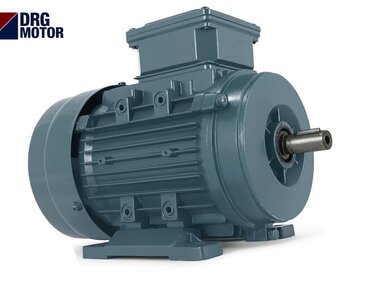
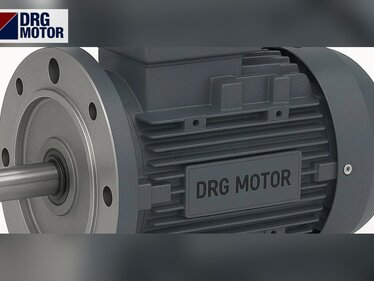
At 5.5 kW the difference between B5 and B35 is not in the flange but underneath the motor: a B35 motor carries the same flange as B5 and adds B3 feet. On the 4-pole DRG-132S-4 the flange is P 300, M 265, N 230 mm in both mountings; B35 adds a 216 × 140 mm foot pattern, 132 mm shaft height and 4–Φ12 foot holes. The compact DRG-112M-4K, which gives the same power from a 112M frame, comes with a smaller flange (P 250, N 180 mm) and a 28×60 mm shaft.
The machine's supporting structure decides. If the motor will be carried only by a pump lantern or gearbox housing, B5 is enough; if the motor must also sit on a baseframe, or be supported by its feet in addition to the flange, ask for B35. You can see all 5.5 kW options on our Buy Electric Motors Online page.
Four models and two mounting dimensions together at 5.5 kW
The table gives each model's B5 flange dimensions and the foot dimensions added on the B35 version in the same row. Foot dimensions come from the B3 dimensions in the product data, flange dimensions from the B5 table of the DRG catalogue.
| Model | Frame | B5 flange P / M / N | B35 feet A × B | C (foot–shaft shoulder) | H (shaft height) | K (foot holes) | Shaft D×E | L | Price |
|---|---|---|---|---|---|---|---|---|---|
| DRG-132S1-2 | 132S | 300 / 265 / 230 | 216 × 140 | 89 | 132 | 4–Φ12 | 38×80 | 438 | See Prices |
| DRG-132S-4 | 132S | 300 / 265 / 230 | 216 × 140 | 89 | 132 | 4–Φ12 | 38×80 | 438 | See Prices |
| DRG-112M-4K | 112M | 250 / 215 / 180 | 190 × 140 | 70 | 112 | 4–Φ12 | 28×60 | 394 | See Prices |
| DRG-132M2-6 | 132M | 300 / 265 / 230 | 216 × 178 | 89 | 132 | 4–Φ12 | 38×80 | 476 | See Prices |
The difference between 132S and 132M is the foot length: dimension B rises from 140 mm to 178 mm and overall length from 438 mm to 476 mm; flange and shaft dimensions are the same. So the 6-pole DRG-132M2-6 fits the same lantern as the 132S models in B5, but in B35 it needs a longer hole spacing on the baseframe.
When is B35 a better choice than B5?
B35 is not a "just to be safe" choice; using two connections at once requires them to be perfectly aligned with each other. B35 makes sense in the following cases:
- If the lantern is thin or long: if the lantern between pump and motor is not rigid enough to carry the motor alone, foot support transfers the load to the baseframe.
- If there is vibration in horizontal mounting: on vibrating machines such as crushers, screens or mixers, the bending load on the flange bolts is reduced.
- If the motor will be removed for maintenance: a foot-mounted motor stays on the baseframe while the flange bolts are undone; it does not drop and the lantern separates easily.
- If the machine maker specified B35: where the baseframe has both foot holes and a flange connection, a B5 motor is left unsupported over the foot gap.
If the motor is mounted vertically, shaft down, and the supporting flange is strong enough, the feet have no function; B5 is then the simpler solution and easier to align. For a general comparison of mounting types, see our article B3, B5, B14 and B35 compared.
Fitting a B35 in place of an old B3 motor
If your existing 5.5 kW motor is foot-mounted (B3) and a B35 motor is going in its place, the foot dimensions do not change: on the same frame the A, B, C, H and K dimensions of B35 are the same as B3, so the existing holes in the baseframe are used. The flange simply stays unused and does no harm to the machine; it is ready if a pump or gearbox with a lantern is connected later. The reverse is not possible: adding a B5 flange to a B3 motor afterwards means replacing the end shield. So on machines where a flange connection may come later, buying the spare motor as B35 from the start removes the need to keep two different types of spare motor on the shelf and also settles which motor goes in when a failure occurs. Just check that there is room in front of the motor for the flange diameter (300 mm on 132S/132M, 250 mm on the compact); a narrow guard or belt cover may foul the flange.
Alignment on B35: seating two connections at once
On a B35 motor the spigot diameter (N) centres the motor on the machine axis, while the feet are bolted to the baseframe. If the distance between the baseframe surface and the flange axis does not match the motor's shaft height H (132 mm for 132S/132M, 112 mm for 112M), tightening the bolts strains the housing and bearings.
In practice follow this order: first fit the flange to the lantern or gearbox and tighten its bolts; then measure the gap under the feet with feeler gauges, fill it with shims and tighten the foot bolts last, without forcing. If a gap opens on the flange side when the foot bolts are tightened, or the shaft becomes hard to turn by hand, there are too few or too many shims. This step is not needed on a B5 motor; it is the price of the support that B35 provides. Our article B3 vs B35 covers the cost side of the choice between B3 and B35.
Compact DRG-112M-4K: same power, one frame smaller
DRG-112M-4K has the same electrical values as the 4-pole 132S model: rated speed 1460 rpm, 11.2 A at 380 V, cos φ 0.83, rated torque 36.0 Nm, Is/In 7.9. The difference is in the frame:
- Shaft height 112 instead of 132 mm, overall length 394 instead of 438 mm.
- Flange P 250 / N 180 instead of P 300 / N 230 mm; bolt circle 215 instead of 265 mm.
- Shaft 28×60 instead of 38×80 mm, key 8 instead of 10 mm.
- Foot pattern (B35) 190 × 140 instead of 216 × 140 mm.
- Bearing 6206-ZZ-C3 instead of 6208-ZZ-C3.
The compact model is useful for raising power where space on the machine is tight or the existing lantern and coupling are machined for a 112 frame. But because the shaft is 28 mm, it does not match a 38 mm coupling hub directly; if you are replacing a motor, check the coupling too.
Connection and starting
All four models are wound for 400/690 V and are delta connected on a 380 V supply; they are suitable for star-delta starting. On the 4-pole models the direct-on-line starting current is about 11.2 × 7.9 ≈ 88.5 A. The 2-pole DRG-132S1-2 draws 10.6 A at 380 V and the 6-pole DRG-132M2-6 12.7 A. You can check the starting method and protective devices with these values on the star-delta starting page; the connection should be made by a qualified electrician.
Checklist before ordering B5 or B35
- Is the spigot on the machine's mating face 180 mm (compact 112M) or 230 mm (132S/132M)?
- Does the baseframe have foot holes; if so, is the spacing 216 × 140, 216 × 178 or 190 × 140 mm?
- Does the distance between baseframe surface and flange axis match the shaft height (112 / 132 mm)?
- Is the coupling hub 28 mm or 38 mm?
- Will the motor run vertically or horizontally; if vertical, shaft up or down?
- If B35 is chosen, are shims and feeler gauges ready for installation?
Technical choices that affect the price of a 5.5 kW flange motor
Mounting type (B5 or foot-mounted B35), frame (standard 132S/132M or compact 112M), housing material and number of poles are the main factors at this power. Current figures per model are on the product pages; for comparison see the 120 models in our online store.
Motors at this power
- DRG-132S1-2 – 5.5 kW – 2930 rpm – 132S: aluminium · cast iron
- DRG-132S-4 – 5.5 kW – 1460 rpm – 132S: aluminium · cast iron
- DRG-112M-4K – 5.5 kW – 1460 rpm – 112M (compact, aluminium)
- DRG-132M2-6 – 5.5 kW – 968 rpm – 132M: aluminium · cast iron
Click to see current prices and order these motors nowSEE PRICES →
Frequently Asked Questions
Are the flange dimensions of B5 and B35 motors the same?
Yes. On the same frame a B35 motor carries the same flange as B5; the only difference is the added B3 feet.
How many amps does a 5.5 kW motor draw?
At 380 V, DRG-132S1-2 draws 10.6 A, DRG-132S-4 and DRG-112M-4K 11.2 A, and DRG-132M2-6 12.7 A.
What is the shaft diameter of a 5.5 kW motor?
38 mm (length 80 mm) on 132S and 132M frames, 28 mm (length 60 mm) on the compact 112M frame.
How many kW is a 7.5 HP flange motor?
A motor sold as 7.5 HP is 5.5 kW.
Send us the dimensions of your machine's mating face and baseframe and we will settle together whether B5 or B35 is needed: +90 (542) 666 11 11 · [email protected] · contact.