English
 Le français
 Türkçe




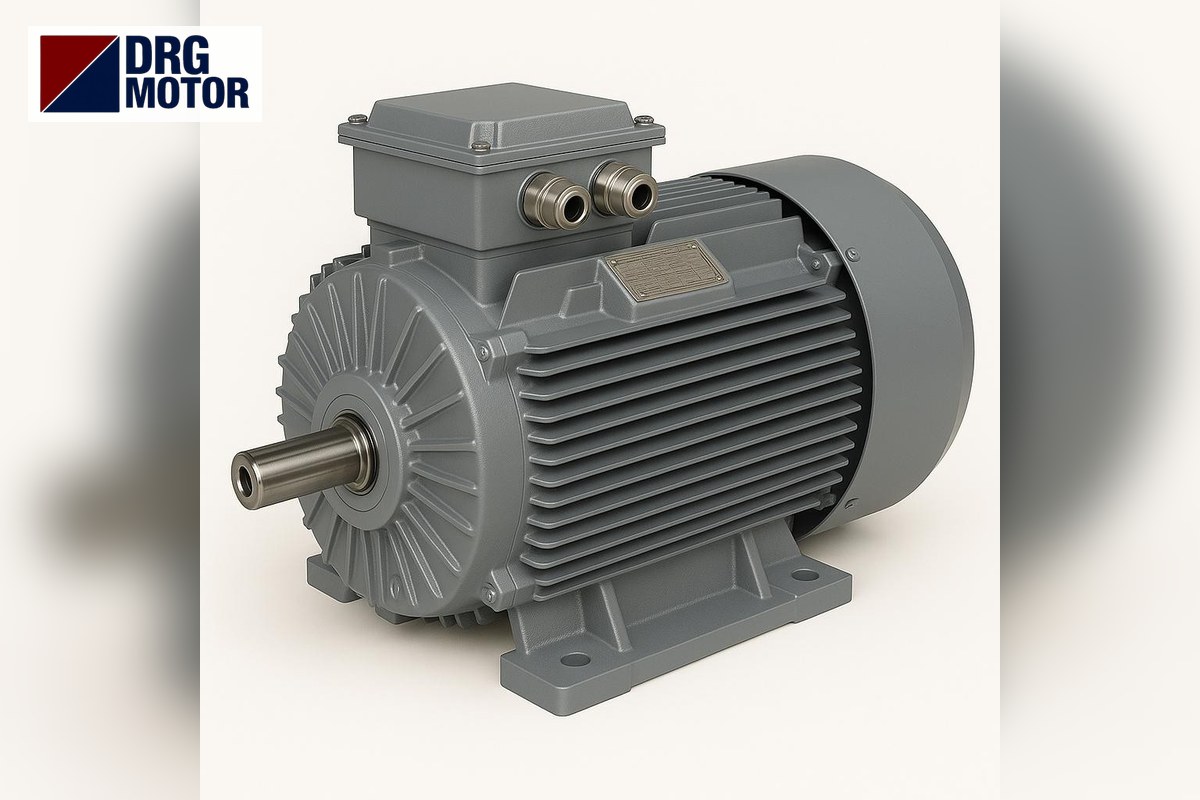

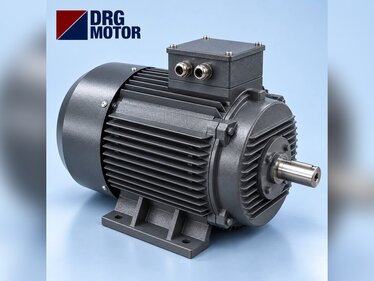
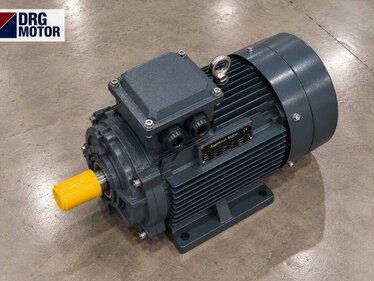
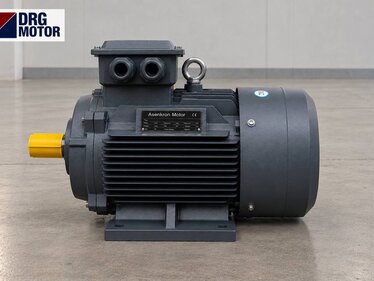
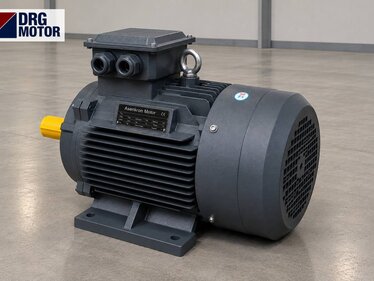
To drive a concrete mixer or a belt conveyor with 5.5 HP, the new motor's nameplate should read 4 kW (4 kW ≈ 5.36 HP; the market rounds it to 5.5 HP). In both applications the drum or belt turns slowly, so the motor almost always works through a gearbox, and the right choice is usually the 1500 rpm DRG-112M-4 or the 1000 rpm DRG-132M1-6; the high-speed DRG-112M-2 belongs on the pump and fan side. You can see the aluminium and cast iron versions of the models on our Buy Electric Motors Online page.
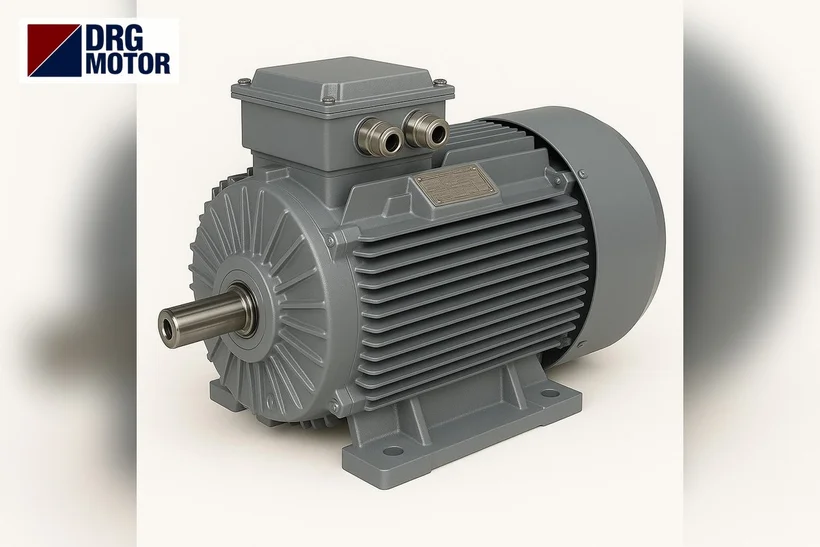
4 kW is also a threshold for connection: our models up to 3 kW carry a 230/400 V nameplate, while from 4 kW the nameplate becomes 400/690 V and the motor is connected in delta (Δ) on a 380–400 V supply. This change raises the question of whether a loaded mixer can start with a star-delta starter. The terminal connection and the starter panel must be installed by a qualified electrician.
The Three Versions of the 4 kW Motor in One Table
| Feature | DRG-112M-2 | DRG-112M-4 | DRG-132M1-6 |
|---|---|---|---|
| Rated speed (rpm) | 2905 | 1450 | 968 |
| IEC frame / shaft height | 112M / 112 mm | 112M / 112 mm | 132M / 132 mm |
| Shaft D × E (mm) | 28 × 60 | 28 × 60 | 38 × 80 |
| Current 380 V / 400 V (A) | 7.84 / 7.45 | 8.37 / 7.95 | 9.46 / 8.99 |
| cos φ | 0.88 | 0.82 | 0.74 |
| Rated torque (Nm) | 13.1 | 26.3 | 39.5 |
| Starting torque Ts/Tn | 2.2 | 2.2 | 2.0 |
| Starting current Is/In | 8.3 | 7.8 | 6.8 |
| Cable entry | 2 × M32×1,5 | 2 × M32×1,5 | 2 × M32×1,5 |
| Bearing | 6206-ZZ-C3 | 6206-ZZ-C3 | 6208-ZZ-C3 |
| Price | See Prices | See Prices | See Prices |
Values are the same for the aluminium and cast iron versions. Note that the 6-pole model moves up to a 132M frame and a 38 mm shaft: if it replaces a 112M motor, the gearbox input hub and flange size change. The overload and fuse side of the current is covered in detail in our article how many amps a 4 kW motor draws; here we use the current only for the starting decision.
From 230/400 V to 400/690 V: Why Does the Nameplate Change?
| Power | Nameplate voltage | Connection on a 380–400 V supply | Terminal links |
|---|---|---|---|
| 2.2 and 3 kW | 230/400 V (Δ/Y) | Star (Y) | Three ends joined on one link |
| 4 kW | 400/690 V (Δ/Y) | Delta (Δ) | Three vertical links |
The first voltage on the nameplate is the voltage at which the winding works in delta. On a 400/690 V motor each phase winding is designed for 400 V, so on a 380–400 V supply it must be connected in delta. If the same motor is connected in star, each winding sees about 230 V: the motor runs, but its torque drops sharply, speed falls under load and current rises, so it overheats. Someone who removes an old 3 kW motor, fits a 4 kW one and leaves the terminal links in star "as before" will see exactly this symptom.
The 400/690 V nameplate also has an advantage: with six leads brought out to the terminal box, the motor is suitable for star-delta starting on a 400 V supply. This method does not work for every load, though; the next section shows why with numbers.
Will a Loaded Mixer Start in Star? Torque Calculation
With star-delta starting the motor starts with the winding in star; both the current drawn from the supply and the starting torque fall to about one third of direct-on-line values. For the 4-pole model:
- Direct-on-line starting current: 8.37 A × 7.8 ≈ 65.3 A → in star ≈ 21.8 A
- Direct-on-line starting torque: 26.3 Nm × 2.2 ≈ 57.9 Nm → in star ≈ 19.3 Nm
The 19.3 Nm available in star is below the motor's rated torque of 26.3 Nm. A mixer containing mortar or concrete may demand a starting torque close to, or even above, rated torque; the motor then cannot accelerate enough in star, and a large current surge appears at the change-over to delta. The 6-pole model behaves similarly: its 39.5 × 2.0 = 79.0 Nm direct starting torque drops to ≈ 26.3 Nm in star, again below its rated 39.5 Nm.
Practical conclusion: a 4 kW mixer or a conveyor that starts loaded is started direct-on-line if the supply allows; star-delta only makes sense on machines that start empty (stopped after the drum is discharged). You can compare starting options and whether your supply can handle the starting current in the star-delta starting tool.
Gear Ratio for Concrete and Mortar Mixers
Mixer drums turn at a few tens of rpm. Taking a drum speed of 25 rpm as an example, the required overall ratio and theoretical drum torque (losses excluded) are:
| Model | Motor speed (rpm) | Ratio (÷ 25 rpm) | Drum torque, losses excluded (Nm) |
|---|---|---|---|
| DRG-112M-2 | 2905 | 116.2 | ≈ 1522 |
| DRG-112M-4 | 1450 | 58.0 | ≈ 1525 |
| DRG-132M1-6 | 968 | 38.7 | ≈ 1529 |
The table shows an important fact: at the same power, drum torque is almost the same; the number of poles does not "add" torque, it only shifts part of the work from the gearbox to the motor. With the 6-pole model the ratio drops to 38.7, so fewer gear stages or a smaller pulley are needed. With the 2-pole model a ratio of 116 means a heavier gearbox and extra noise at high input speed, which is why 2-pole motors are not chosen for mixers. On the starting side, the 4-pole model's Ts/Tn (2.2) is slightly higher than the 6-pole model's (2.0); if the drum often starts under load, this difference should also be considered.
Belt Conveyors: From Belt Speed to Motor Speed
For a conveyor the calculation starts from belt speed. Assume a drive drum diameter of 320 mm and a required belt speed of 1.0 m/s:
- Drum speed: n = v × 60 ÷ (π × D) = 1.0 × 60 ÷ (π × 0.32) ≈ 59.7 rpm
- With the 1500 rpm model (1450 rpm) the gear ratio is ≈ 24.3; with the 1000 rpm model (968 rpm) ≈ 16.2
- If the peripheral force needed to pull the belt is 3000 N, power at the drum is P = F × v = 3000 × 1.0 = 3.0 kW
Gearbox and bearing losses are added to the 3.0 kW drum power; when calculated with the value from the gearbox catalogue, a 4 kW motor leaves a reasonable margin in this example. As belt length, incline or load increase, force grows quickly; always calculate with the belt fully loaded. On conveyors a B3 foot motor with a coupled gearbox, or a B5 flange motor on a shaft-mounted gearbox, are common solutions; match the flange size to the gearbox input flange.
Technical Factors Behind the Price of a 5.5 HP Motor
Differences between 4 kW motors come from the number of poles (132M frame and 38 mm shaft for 6-pole), housing material (aluminium or cast iron), mounting type (B3, B5 or B35) and cable entry layout. In vibrating, dusty environments such as mixers and conveyors a cast iron housing is often preferred. After making these choices you can see the current price on the product page and compare other ratings among the 120 models in our online store.
Checklist for Ordering a Mixer or Conveyor Motor
- Are the drum or pulley speed and the gear ratio known?
- Is the gearbox input shaft/hub 28 mm (112M) or 38 mm (132M)?
- Will the motor be foot-mounted (B3), flange-mounted (B5) or foot-and-flange (B35)?
- Does the machine start loaded? If so, is direct-on-line starting planned instead of star-delta?
- If the old motor was 230/400 V, have the terminal links been changed to delta?
- Are the terminal box cover and glands (2 × M32×1,5) sealed against dust and splashes?
Motors in This Power Rating
- DRG-112M-2 – 4 kW – 2905 rpm – 112M aluminium
- DRG-112M-2 – 4 kW – 2905 rpm – 112M cast iron
- DRG-112M-4 – 4 kW – 1450 rpm – 112M aluminium
- DRG-112M-4 – 4 kW – 1450 rpm – 112M cast iron
- DRG-132M1-6 – 4 kW – 968 rpm – 132M aluminium
- DRG-132M1-6 – 4 kW – 968 rpm – 132M cast iron
Click to see current prices and order these motors nowSEE PRICES →
Frequently Asked Questions
How many kW is a 5.5 HP motor?
The exact equivalent of 5.5 HP is about 4.10 kW; the standard motor rating used is 4 kW. A motor with 4 kW on its nameplate is called a 5.5 HP motor on the market.
Is a 4 kW motor connected in star or delta?
A 4 kW motor with a 400/690 V nameplate is connected in delta on a 380–400 V supply. In star each winding gets a low voltage, and the motor struggles and heats up under load.
What motor speed should I choose for a concrete mixer?
Because the drum turns slowly, a 1500 rpm (DRG-112M-4) or 1000 rpm (DRG-132M1-6) motor is used with a gearbox. The 1000 rpm model needs a smaller gear ratio; the 1500 rpm model fits a smaller frame.
Can a 5.5 HP motor be started star-delta?
Technically yes, because all six leads are brought out to the terminal box. However, the starting torque in star is about 19.3 Nm on the 4-pole model, below rated torque; for mixers and conveyors that start loaded, direct-on-line starting is safer.
To choose the right model for your application, call +90 (542) 666 11 11, write to [email protected] or use our contact page. All power ratings are on our Buy Electric Motors Online page.