English
 Le français
 Türkçe




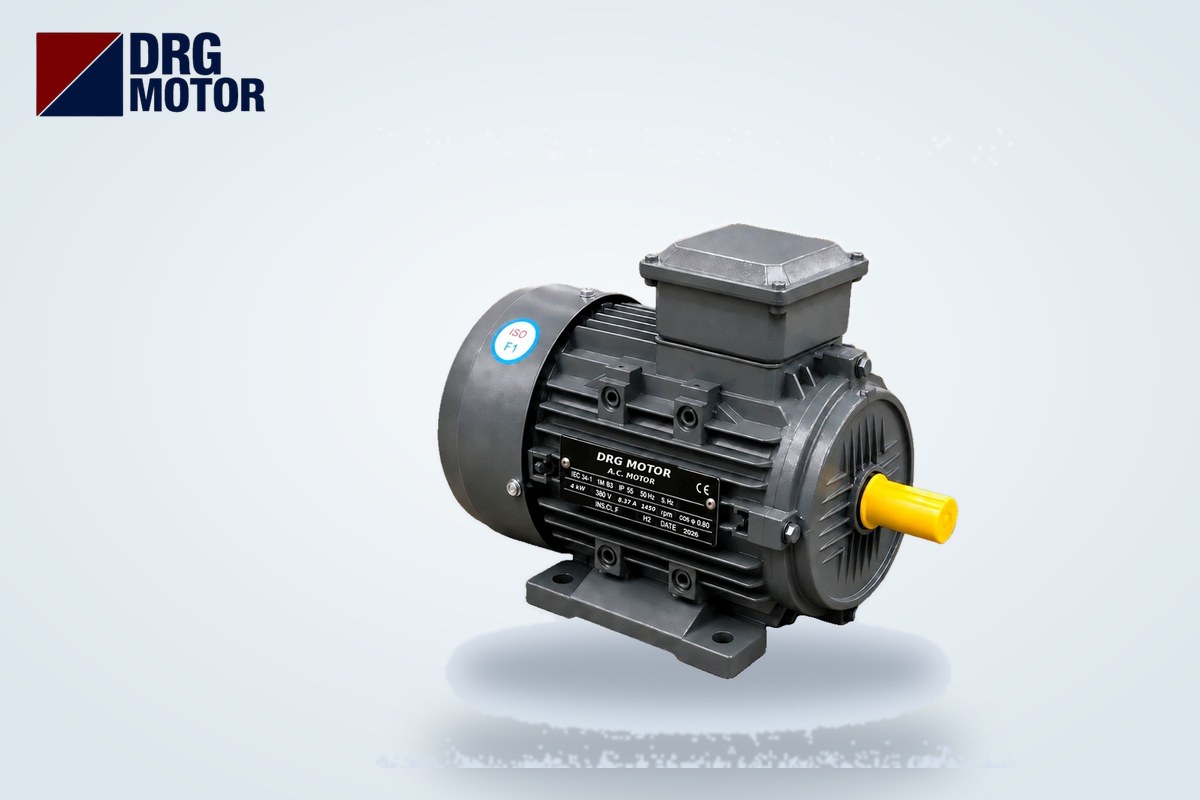

A 4 kW, 1500 rpm (4-pole) three-phase motor draws about 8.37 A at full load on a 380 V supply and 7.95 A at 400 V. At the same power, a 3000 rpm (2-pole) motor draws 7.84 A at 380 V, and a 1000 rpm (6-pole) motor draws 9.46 A. At start-up you will see a current surge of 6.8 to 8.3 times these values, roughly 64–65 A. The overload relay is set to the rated current on the nameplate (In), not to the starting current.
These figures apply at full load. If the motor runs at light load, a clamp meter will show a lower reading. Current also drops when the supply rises from 380 V to 400 V, because the same power is carried at a higher voltage. Current increases with pole count because of the power factor (cos φ): it is 0.74 on the 6-pole motor and 0.88 on the 2-pole one. All values below come from the technical data of the DRG models sold on our Buy Electric Motors Online page.
At the end of this article you will find the list of 4 kW models and what to look for when selecting panel components. First, let's see how current changes with the number of poles.
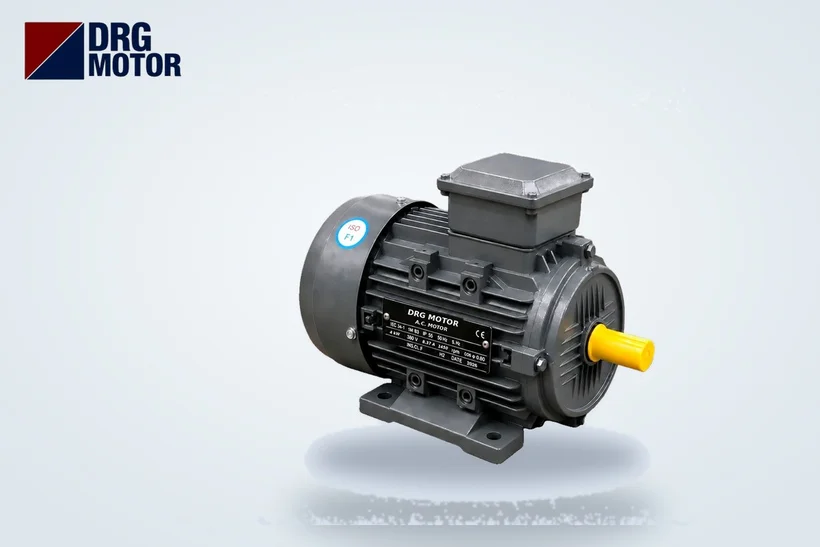
4 kW Motor Current Table: 2, 4 and 6 Poles
The three models in the table have aluminium frames. Their cast iron counterparts have identical electrical values; only the frame material differs. The starting current column is the catalogue Is/In ratio multiplied by the rated current.
| Model | Poles / synchronous speed | Rated speed | cos φ | In 380 V | In 400 V | Is/In | Is (380 V, calculated) | Rated torque |
|---|---|---|---|---|---|---|---|---|
| DRG-112M-2 | 2 / 3000 rpm | 2905 rpm | 0.88 | 7.84 A | 7.45 A | 8.3 | ≈ 65.1 A | 13.1 Nm |
| DRG-112M-4 | 4 / 1500 rpm | 1450 rpm | 0.82 | 8.37 A | 7.95 A | 7.8 | ≈ 65.3 A | 26.3 Nm |
| DRG-132M1-6 | 6 / 1000 rpm | 968 rpm | 0.74 | 9.46 A | 8.99 A | 6.8 | ≈ 64.3 A | 39.5 Nm |
Three points stand out in the table:
- At the same 4 kW, the 6-pole motor draws about 1.6 A more than the 2-pole motor. This is due to its lower cos φ; the shaft power is the same.
- Torque is inversely proportional to speed: the 1000 rpm motor delivers about three times the torque of the 3000 rpm motor (39.5 Nm and 13.1 Nm). For conveyor or gearbox drives this matters more than current.
- Starting currents are very close to each other (≈ 64.3–65.3 A). The 2-pole motor has a low In but a high Is/In ratio (8.3).
To see the values for other ratings, our motor current chart lists everything from 0.25 kW up to large ratings in the same format.
Checking with the Formula: I = P / (√3 · U · cos φ · η)
The line current of a three-phase motor is found with this formula: I = P / (√3 · U · cos φ · η). Here P is shaft power (W), U is line voltage (V), cos φ is the power factor and η is the motor's nameplate efficiency. If you have the nameplate or catalogue, take η from there. The main purpose of the formula is to check whether the nameplate current is consistent with the supply.
For the 4 kW, 1500 rpm motor, first look at the result without η: 4000 / (1.732 × 380 × 0.82) ≈ 7.41 A. This is lower than the 8.37 A on the data sheet. The difference comes from η: to deliver 4 kW at the shaft, the motor draws more power than that from the supply. Calculated the other way round, √3 × 380 × 8.37 × 0.82 ≈ 4.52 kW. The 4 kW on the nameplate is shaft power, not the electrical power drawn from the supply.
The practical conclusion: the current you get without η is always smaller than the real current. If you use that smaller value for panel design, your overload relay and cable selection will fall short. Always base your design on the In value from the nameplate or catalogue.
You can check torque the same way: M = 9550 × P / n = 9550 × 4 / 1450 ≈ 26.3 Nm. This matches the 26.3 Nm in the catalogue.
Starting Current: Calculated as Is/In × In
When an induction motor is first energised, the rotor is stationary, so for a short time it draws several times its rated current. The catalogue Is/In ratio gives this multiple. For the 4 kW, 1500 rpm motor Is/In is 7.8. At 380 V that is 8.37 × 7.8 ≈ 65.3 A, and at 400 V 7.95 × 7.8 ≈ 62.0 A.
This surge falls to rated current within a few seconds as the load accelerates. How long it lasts depends on the inertia of the load: a fan running free starts quickly, a loaded mixer takes longer. If you want the physics behind such a high starting current, our article why is the starting (inrush) current of an electric motor so high explains it in detail.
Because 4 kW motors have 400/690 V windings, they are suitable for star-delta starting. In star, the line current drops to one third of direct-on-line starting: ≈ 21.8 A for the 1500 rpm model. However, starting torque drops by the same ratio. Most 4 kW applications are started direct-on-line; if you have a weak supply or a generator, you can compare the options on our starting methods and star-delta calculation page.
How to Set the Overload Relay and Fuse
A common panel mistake is setting the overload relay to the starting current or to the next standard value up. The correct logic is:
- Overload relay / motor protection circuit breaker: its setting range must include the rated current and it must be set to In. On a 380 V supply the setting for a 4 kW 1500 rpm motor is 8.37 A; on a 400 V supply it is 7.95 A. The overload relay already tolerates the starting surge, because its thermal curve does not react to brief overcurrent.
- Fuse / circuit breaker: protects against short circuits and must not trip on starting current. That is why a motor-protection (time-delay) characteristic is chosen; its rating is determined together with cable size and short-circuit conditions.
- Contactor: its AC-3 current rating must not be lower than the motor's In.
Exact breaker and contactor ratings depend on cable length, installation method and short-circuit level, so we do not give a single figure here. To enter the motor current and see the suitable range, use our overload relay, fuse and contactor selection tool. For cables there is also the motor cable size calculator.
Cable Entry and Terminal Box: a 400/690 V Motor Is Connected in Delta at 380 V
All 4 kW motors in the DRG store have a nameplate voltage of 400/690 V (Δ/Y). This means that on the 380–400 V three-phase supply used in Türkiye, the links in the terminal box must be in the delta (Δ) position. The star (Y) position is for a 690 V supply, or it is used only during start-up with star-delta starting.
In a delta connection, line current and winding current are different. When you clamp the meter around the supply cable, you will see 8.37 A for the 1500 rpm model. The current through each winding is 1/√3 of that, ≈ 4.83 A. Always measure on the supply cable; the overload relay is also set to this line current.
If the motor is mistakenly connected in star on a 380 V supply, each winding receives a lower voltage than it should. The motor may spin at no load, but under load its torque is insufficient, current rises and it overheats. Always check the terminal links during commissioning.
The cable entry is 2 × M32×1.5 on the 112M frame (2 and 4 poles) and the 132M frame (6 poles). Choose the cable gland to this size when ordering. Cable cross-section depends on line length and installation method as well as current.
Pre-Commissioning Checklist
- Measure the supply voltage: is it 380 V or 400 V? The overload setting is 8.37 A or 7.95 A accordingly (4-pole).
- Read the nameplate voltage: if it is 400/690 V, connect in delta on a 380–400 V supply.
- Check that the terminal links are in the delta position and the nuts are tight.
- Set the overload relay to rated current, not to starting current.
- Check that the fuse or breaker has a characteristic that will not trip on the starting surge (≈ 64–65 A).
- Choose the cable gland for the 2 × M32×1.5 size.
- Check the direction of rotation at first start, then measure the current of all three phases at full load and confirm they are close to each other.
If the measured current stays above the nameplate value for a long time, the motor is overloaded or the voltage is low. If the current is unbalanced, check the connections and the supply. You will find all our calculators together on the electric motor calculators page.
Motors in This Power Rating
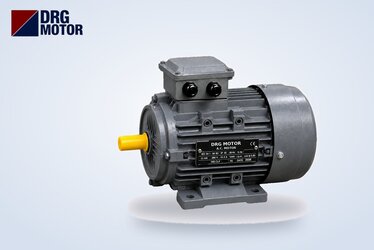
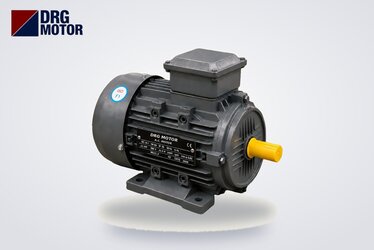
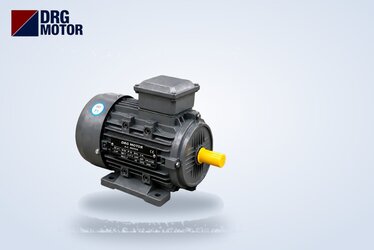
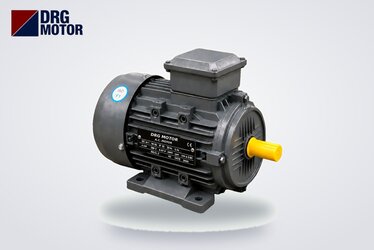
4 kW three-phase motors are available in our store with aluminium and cast iron frames, at 3000, 1500 and 1000 rpm:
- DRG-112M-2 – 4 kW – 3000 rpm – 112M aluminium
- DRG-112M-4 – 4 kW – 1500 rpm – 112M aluminium
- DRG-132M1-6 – 4 kW – 1000 rpm – 132M aluminium
- DRG-112M-2 – 4 kW – 3000 rpm – 112M cast iron
- DRG-112M-4 – 4 kW – 1500 rpm – 112M cast iron
- DRG-132M1-6 – 4 kW – 1000 rpm – 132M cast iron
Click to see current prices and order these motors nowSEE PRICES →
Frequently Asked Questions
How many amps does a 4 kW motor draw at no load?
No-load current is clearly lower than full-load current, but it is not given as a separate value in the catalogue. Magnetising current varies from motor to motor, so quoting a single figure would be misleading. We recommend measuring and recording the no-load current at commissioning; later you can repeat the same measurement and compare the motor's condition.
How many amps does a 4 kW 1500 rpm motor draw at 380 V?
The DRG-112M-4 model draws 8.37 A at full load at 380 V and 7.95 A at 400 V. Its cos φ is 0.82 and its rated speed is 1450 rpm.
What is the starting current of a 4 kW motor?
With direct-on-line starting at 380 V it is ≈ 65.1 A for the 2-pole model, ≈ 65.3 A for the 4-pole and ≈ 64.3 A for the 6-pole. With star-delta starting, the line current falls to about one third of that.
What should the overload relay be set to for a 4 kW motor?
The overload relay is set to the rated current on the motor nameplate. At 380 V this is 7.84 A for 2 poles, 8.37 A for 4 poles and 9.46 A for 6 poles. The setting range of the chosen relay must include this value.
If you need help choosing the right 4 kW model for your application, call us on +90 (542) 666 11 11, email [email protected] or use our contact page. You can browse every power and speed option among the 120 models in our online store.