English
 Le français
 Türkçe




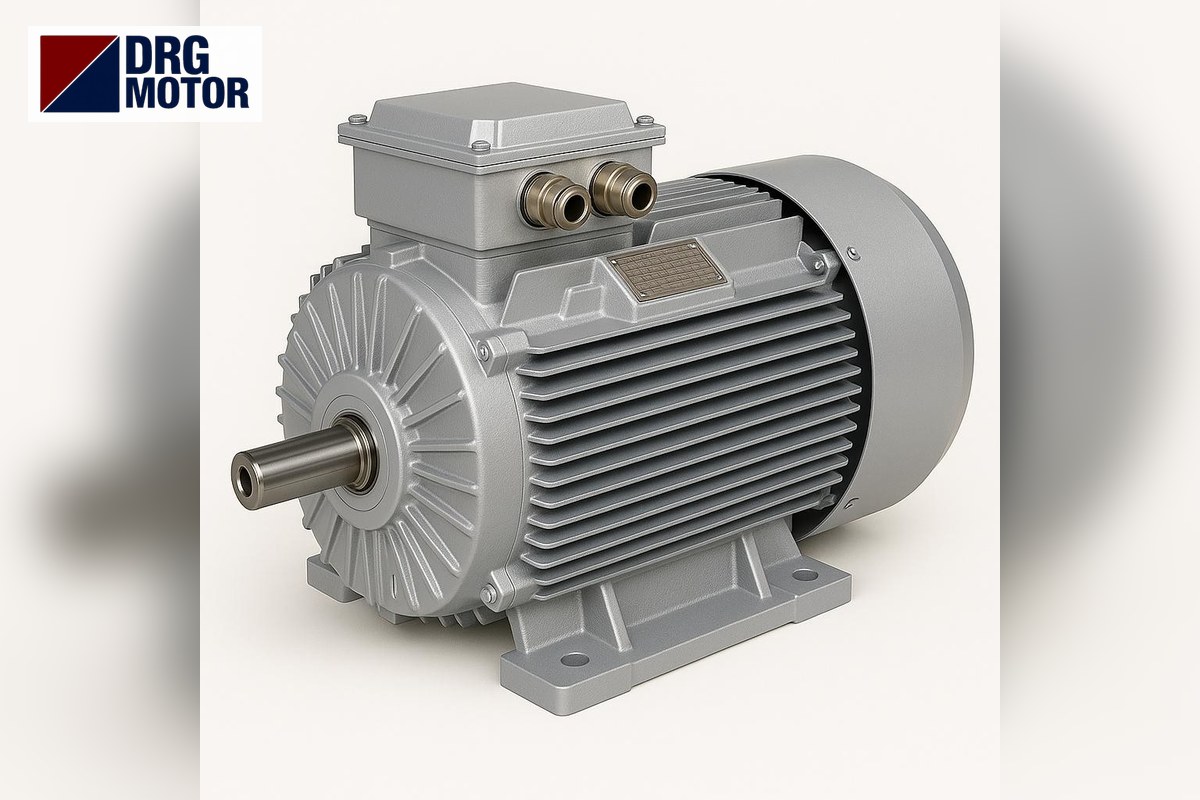

If you need a 20 HP motor for irrigation or water supply, the equivalent is 15 kW, and most centrifugal pumps run on the 2-pole model: the DRG-160M2-2 turns at 2945 rpm, draws 27.9 A at 380 V and full load, and at start-up rises to 8.1 times that current, about 226 A. If the pump is a 1450 rpm design, the 4-pole DRG-160L-4 is used; for slow pumps driven by belt or gearbox, the 6-pole DRG-180L-6.
At this power all our models have cast iron housings; there is no aluminium option at 15 kW. For a motor working in a field, at a well head or in a pump room exposed to humidity, dust and vibration, that is usually what buyers look for anyway. Below we first check whether the pump really needs 15 kW, then look at what the starting current means on site.
The product pages of the three models are linked in the tables below; all ratings are on the Buy Electric Motors Online page.
Does your pump really need 15 kW? A simple power calculation
Power required at the pump shaft: P (kW) = ρ × g × Q × H / (1000 × ηp), where ρ is water density (1000 kg/m³), g = 9.81 m/s², Q the flow (m³/s), H the total head (m) and ηp the pump efficiency from the pump catalogue (0.70 is used here as an example; use your own pump’s value).
- Example 1: 100 m³/h flow, 35 m head → 1000 × 9.81 × (100/3600) × 35 / (1000 × 0.70) ≈ 13.6 kW. The next standard rating is 15 kW, so a 20 HP motor suits this duty.
- Example 2: 150 m³/h, 25 m → ≈ 14.6 kW. Still 15 kW, but with very little margin; if the pump curve allows the flow to increase, look at the next rating up.
You can run the same calculation with your own flow and head in the pump and fan motor power calculator. Remember to add pipe friction losses to the total head; well depth alone is not enough.
15 kW cast iron models and current values
| Model (cast iron) | Poles / speed | Frame | I 380 V | I 400 V | I 415 V | cos φ | Is/In | Starting current 380 V (≈) | Price |
|---|---|---|---|---|---|---|---|---|---|
| DRG-160M2-2 | 2 / 2945 rpm | 160M | 27.9 A | 26.5 A | 25.5 A | 0.89 | 8.1 | 226 A | See Prices |
| DRG-160L-4 | 4 / 1465 rpm | 160L | 28.8 A | 27.3 A | 26.3 A | 0.86 | 7.8 | 225 A | See Prices |
| DRG-180L-6 | 6 / 978 rpm | 180L | 30.9 A | 29.3 A | 28.2 A | 0.81 | 7.3 | 226 A | See Prices |
The starting current column is calculated from the catalogue Is/In ratio (27.9 × 8.1 ≈ 226 A; 28.8 × 7.8 ≈ 225 A; 30.9 × 7.3 ≈ 226 A). All three models draw almost the same current from the network at start, while their rated currents differ by about 3 A.
How does pump speed match motor speed?
A centrifugal pump is designed to run at the speed on its nameplate. Coupling a 2900 rpm pump to a 1465 rpm motor may look like “less wear”, but according to the pump affinity laws the result is a serious loss of performance. With a speed ratio of 1465 / 2945 ≈ 0.50:
- Flow falls in proportion to speed: roughly by half.
- Head falls with the square of speed: 35 m → ≈ 8.7 m.
- Pump power falls with the cube of speed: ≈ 13.6 kW → ≈ 1.7 kW.
In other words, the well may stop producing water. The rule is simple: a 2900 rpm pump takes the DRG-160M2-2, a 1450 rpm pump the DRG-160L-4. The 6-pole DRG-180L-6 makes sense for slow pumps and high-torque drives working through belts or gearboxes rather than direct coupling; its rated torque is 146.5 Nm (48.6 Nm for the 2-pole).
What does starting current affect on site?
A starting current of about 226 A lasts only a few seconds, but it shows up in three places on an irrigation line. The panel and connection work in this section must be carried out by a qualified electrician.
- Long cables: in the field the distance between panel and well is often long. Voltage drop at start is about 8 times that in normal running and reduces the motor’s starting torque. For cable size, see our article cable size and fuse rating for 11 and 15 kW motors and the motor cable size calculator.
- Weak supply: at irrigation points fed by a village line, a small transformer or a generator, a sudden 226 A load can pull the voltage down and drop out the contactor. Star-delta or soft starting is then considered; in star, starting current falls to one third (≈ 75 A).
- Protection setting: the overload relay is set to the rated current (27.9–30.9 A at 380 V), not to the starting current. Use the overload, fuse and contactor selection tool to size protection.
Star-delta starting usually suits a centrifugal pump, as the pump needs little torque at low speed. However, if the check valve at the pump outlet stays closed against a pressurised line, assess the starting load together with your electrician.
Shaft, bearing and frame dimensions
The first thing asked when ordering a pump coupling or pulley is the shaft diameter. The 2- and 4-pole models share the same 42 × 110 mm shaft; the 6-pole model moves to a 180 frame, so its shaft is 48 mm.
| Model | Shaft D × E (mm) | Shaft height H (mm) | Overall length L (mm) | Bearing | Cable entry | Rated torque (Nm) |
|---|---|---|---|---|---|---|
| DRG-160M2-2 | 42 × 110 | 160 | 608 | 6309-C3 | 2 × M40×1.5 | 48.6 |
| DRG-160L-4 | 42 × 110 | 160 | 652 | 6309-C3 | 2 × M40×1.5 | 97.8 |
| DRG-180L-6 | 48 × 110 | 180 | 726 | 6311-C3 | 2 × M40×1.5 | 146.5 |
Alignment on a coupled pump
When motor and pump share a common base and are joined by a coupling, keeping both shafts on the same axis is decisive for bearing life. Shaft height differs between the 160 and 180 frames (160 mm and 180 mm); if the frame changes when a motor is replaced, the base height changes too and the axis must be re-set with shims. Before tightening the coupling bolts, check the alignment of both shafts in height and angle with a dial gauge or straight edge; on a misaligned 2-pole motor, vibration and bearing noise show up quickly.
All models have a 400/690 V nameplate voltage; on a 380–400 V network the terminals are connected in delta. All foot and flange dimensions are on the technical drawings page.
Which technical factors determine the price of a 20 HP motor?
- Number of poles: the 6-pole model comes in a larger frame (180L).
- Mounting: foot-mounted on a pump base (B3) or flange-mounted on the pump casing (B5/B35)?
- Housing: all models at this power are cast iron.
- Voltage: 400/690 V winding, delta on a 380 V network.
Current prices for these options are on the product pages; our blog articles do not quote prices. To compare all ratings, browse the 120 models in our online shop.
Checklist for an irrigation pump motor
- Has the speed on the pump nameplate (2900 or 1450 rpm?) been noted?
- Has power been calculated from flow and total head, and does 15 kW leave enough margin?
- Does the shaft diameter (42 or 48 mm) match the pump coupling?
- Has the cable length between panel and motor been measured and voltage drop calculated?
- Is the supply a transformer or a generator? Can it handle the starting current?
- Is level or pressure protection against dry running planned?
- Is the motor protected from rain and direct sun, with free ventilation?
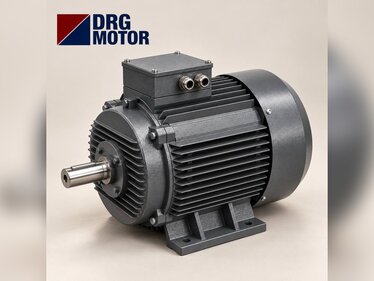
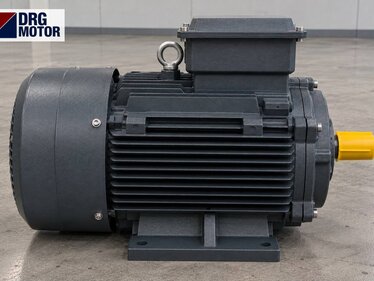
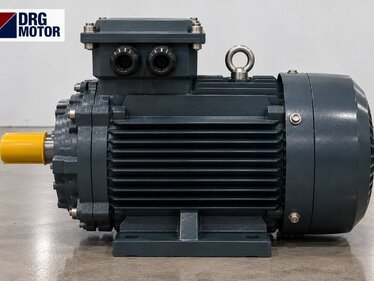
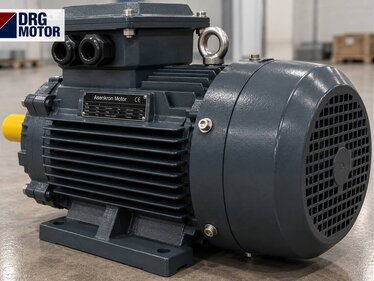
20 HP (15 kW) cast iron motors
- DRG-160M2-2 – 15 kW – 3000 rpm – 160M, cast iron
- DRG-160L-4 – 15 kW – 1500 rpm – 160L, cast iron
- DRG-180L-6 – 15 kW – 1000 rpm – 180L, cast iron
Click to see current prices and order these motors nowSEE PRICES →
Frequently Asked Questions
How many amps does a 20 HP motor draw?
At 380 V and full load, the 3000 rpm DRG-160M2-2 draws 27.9 A, the 1500 rpm DRG-160L-4 28.8 A and the 1000 rpm DRG-180L-6 30.9 A.
How many amps does a 15 kW motor draw at start?
Based on the catalogue Is/In ratios, about 225–226 A with direct-on-line starting. With star-delta starting this falls to one third, about 75 A.
2-pole or 4-pole for an irrigation pump?
Check the speed on the pump nameplate: a 2900 rpm pump runs with a 2-pole motor, a 1450 rpm pump with a 4-pole motor. Changing the speed reduces flow and head.
How many kW is a 20 HP motor?
20 × 0.7457 ≈ 14.9 kW; the standard rating is 15 kW.
For help choosing a motor from your pump data, contact +90 (542) 666 11 11, [email protected] or our contact page. All 15 kW models are on the Buy Electric Motors Online page.