English
 Le français
 Türkçe




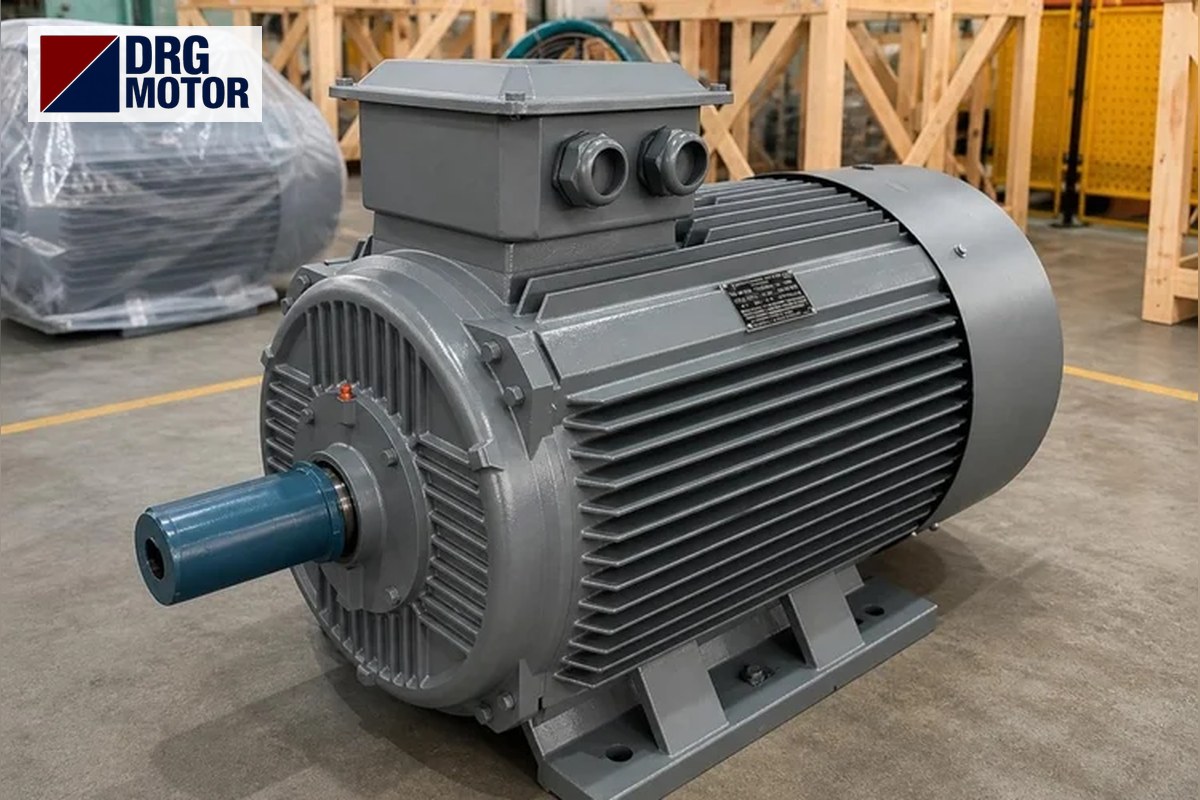

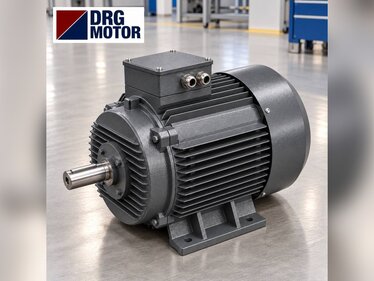
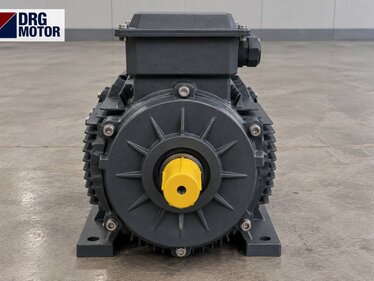
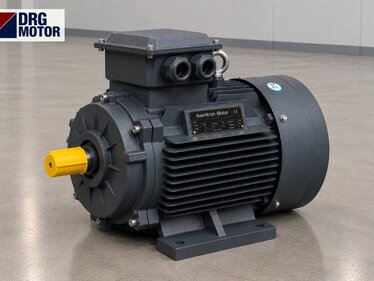
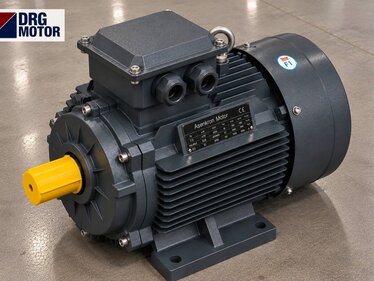
If you need a "20 HP 3000 rpm" motor for a centrifugal pump, the match is the DRG-160M2-2: 15 kW, 2-pole, cast-iron 160M frame, 2945 rpm at full load. The motor draws 27.9 A at 380 V, 26.5 A at 400 V and 25.5 A at 415 V; cos φ is 0.89 and rated torque 48.6 Nm. Because the pump shaft turns at this speed too, the pump curve must be read for a speed of around 2900 rpm.
A motor giving the same 15 kW at 1500 rpm produces twice the torque, but for a pump the deciding factor is speed, not torque: the head of a centrifugal pump varies with the square of speed. That is why 2-pole motors are preferred on high-pressure single-stage pumps, booster sets, irrigation lines and wellhead pumps. Electrical connection and the wellhead panel must be done by a qualified electrician.
You can reach the current price and ordering options for this model, manufactured and supplied by DRG Motor, on the Buy Electric Motors Online page. Below are the data sheet, the pump power calculation and the voltage drop to watch when running a long cable to the wellhead.
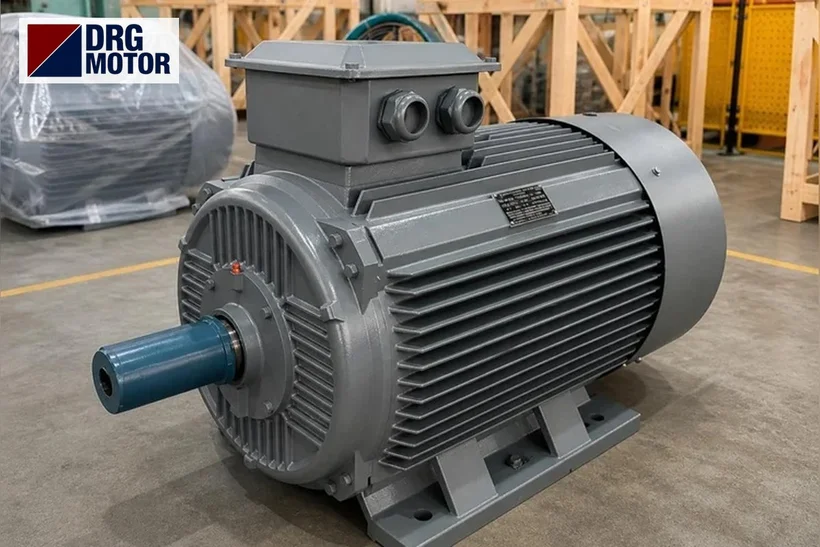
DRG-160M2-2 catalogue values
| Property | DRG-160M2-2 |
|---|---|
| Power | 15 kW / 20 HP |
| Poles / synchronous speed / rated speed | 2 / 3000 / 2945 rpm |
| Current 380 V – 400 V – 415 V | 27.9 A – 26.5 A – 25.5 A |
| Power factor (cos φ) | 0.89 |
| Rated torque | 48.6 Nm |
| Ts/Tn – Tmax/Tn – Is/In | 2.0 – 2.3 – 8.1 |
| Winding / connection at 380 V | 400/690 V (Δ/Y) – delta |
| Frame / shaft height | 160M cast iron / 160 mm |
| Shaft D×E / key F | 42×110 mm / 12 mm |
| Bearing | 6309-C3 |
| Cable entry | 2 × M40×1.5 |
Slip is (3000 − 2945) / 3000 ≈ 1.8%, smaller than the 2.3% of the 4-pole 15 kW model. Torque check: 9550 × 15 / 2945 ≈ 48.6 Nm, identical to the catalogue.
Does the pump really need 15 kW? Shaft power calculation
The shaft power of a centrifugal pump is P = ρ × g × Q × H / η_pump (ρ = 1000 kg/m³, g = 9.81 m/s², Q in m³/s, H in m). Pump efficiency comes from the pump manufacturer's curve; a margin of around 10% is usually added when selecting the motor.
| Application | Flow Q | Head H | Pump efficiency (example) | Shaft power | With 10% margin |
|---|---|---|---|---|---|
| Irrigation line, single-stage centrifugal | 60 m³/h | 55 m | 0.70 | ≈ 12.8 kW | ≈ 14.1 kW |
| Wellhead / tank feed | 40 m³/h | 80 m | 0.68 | ≈ 12.8 kW | ≈ 14.1 kW |
In both examples the power with margin stays below 15 kW, so the DRG-160M2-2 is sufficient. If the result exceeds 15 kW, the next step, the DRG-160L-2 (18.5 kW), is considered. Check the result with your own flow and head using the pump and fan motor power calculator.
What happens to the pump if speed is halved?
By the affinity laws, if the same pump turns at 1465 instead of 2945 rpm the speed ratio is about 0.50: flow falls to about half, head to about one quarter (0.25) and absorbed power to about one eighth (0.12). Fitting a 1500 rpm motor to a 3000 rpm pump is therefore not a "stronger" solution; the pump cannot deliver the required pressure.
Why does the motor overload on open discharge?
On a centrifugal pump, flow and absorbed power rise as head falls. If the pipeline is shorter than designed, the valve is run fully open or the line bursts, the operating point moves to the right of the curve and shaft power can exceed the calculated value. The motor then exceeds its 27.9 A nameplate current and the overload relay trips. If the power at the far right (maximum flow) end of the pump curve is above 15 kW, either a throttling valve/flow limitation is fitted at the outlet or the 18.5 kW model is selected.
Long cable to the wellhead: voltage drop table
When the pump is far from the panel, the cable size is set not only by current-carrying capacity but also by voltage drop. The design current is 27.9 × 1.25 ≈ 34.9 A, and the smallest copper size carrying it is 6 mm² (43 A) according to the example table on our site. As length increases the picture changes (ΔU = √3 × I × L × R × cos φ, 380 V, cos φ 0.89):
| Line length | 6 mm² (3.08 Ω/km) | 10 mm² (1.83 Ω/km) | 16 mm² (1.15 Ω/km) |
|---|---|---|---|
| 50 m | 6.6 V – 1.74% | 3.9 V – 1.04% | 2.5 V – 0.65% |
| 100 m | 13.2 V – 3.49% | 7.9 V – 2.07% | 4.9 V – 1.30% |
| 150 m | 19.9 V – 5.23% | 11.8 V – 3.11% | 7.4 V – 1.95% |
| 200 m | 26.5 V – 6.97% | 15.7 V – 4.14% | 9.9 V – 2.60% |
The tool on our site accepts 3% for the supply line. On that basis 6 mm² is enough up to about 50 m, 10 mm² is needed at 100 m and 16 mm² at 150–200 m. Since current rises to 8.1 times rated (about 226 A) at start, the motor struggles to start on a long, thin line; do not choose a borderline size. These are example calculations that change with installation method and ambient temperature; check your own line with the motor cable size calculator. Fuse selection and the cable calculation for the 1500 rpm 15 kW motor are in the article 11 and 15 kW motor cable size and fuse rating.
Connecting to the pump: foot-mounted with coupling, or flanged?
On horizontal centrifugal pumps the motor usually sits B3 foot-mounted on a common base and is connected to the pump through a flexible coupling. B3 dimensions for this layout: A 254, B 210, C 108, H 160, foot holes 4–Φ14.5, overall length L 608 mm. Where the motor bolts directly to the pump casing, a B5 flange is used; the B5 flange of the 160M frame is P 350, M 300, N 250, S 18.5, T 5, LA 15 mm.
For vertical wellhead pumps with a drive head, the motor's suitability for vertical mounting and the pump connection dimensions must be confirmed with the pump side before ordering.
Commissioning checks for a 2-pole pump motor
- Direction of rotation: check the arrow on the pump casing by briefly running the motor before fitting the coupling; in reverse the pump gives no pressure.
- Never run the pump dry; fill the suction line and casing before the first start.
- Check coupling alignment with a dial gauge; at 2945 rpm even a small misalignment shortens bearing (6309-C3) life.
- Terminal links must be in delta (Δ); set the overload relay to 27.9 A at 380 V.
- Pick the cable size from the table above by line length; use glands suited to the 2 × M40×1.5 entries.
- Protect a wellhead motor from rain and direct water spray, and close the terminal box cover with its gasket.
Neighbouring powers at 3000 rpm
- DRG-160M1-2 – 11 kW – 2945 rpm – 160M cast iron
- DRG-160M2-2 – 15 kW – 2945 rpm – 160M cast iron
- DRG-160L-2 – 18.5 kW – 2940 rpm – 160L cast iron
- DRG-180M-2 – 22 kW – 2955 rpm – 180M cast iron
- DRG-160L-4 – 15 kW – 1465 rpm – 160L cast iron (1500 rpm equivalent)
The 11 kW and 15 kW 2-pole models share the same 160M frame, so a pump upgrade to 15 kW can be done without changing base or coupling. The technical factors affecting price are power, speed, frame material and mounting type (B3, B5, B35).
Click to see current prices and order these motors nowSEE PRICES →
Frequently Asked Questions
How many amps does a 15 kW 3000 rpm motor draw?
The DRG-160M2-2 draws 27.9 A at 380 V and 26.5 A at 400 V at full load. With direct-on-line starting, starting current is 8.1 times this value.
What cable size for a 20 HP pump motor?
On a short line (about 50 m) 6 mm² copper is enough. At 100 m, 10 mm², and at 150–200 m, 16 mm² keeps voltage drop below 3%. The final size must be verified by an electrical engineer for the installation conditions.
What is the shaft size of a 20 HP 2-pole motor?
Shaft diameter is 42 mm, length 110 mm, key width 12 mm; the same as the 11 kW DRG-160M1-2.
Can a 1500 rpm motor be fitted to a 3000 rpm pump?
If fitted, the pump gives about half the flow and a quarter of the head. If the pump is designed for a 2-pole motor, the motor must also be 3000 rpm.
For questions about the DRG-160M2-2, call +90 (542) 666 11 11 or write to [email protected]; address and other channels are on the contact page. Compare other powers and speeds among the 120 models in our online store.