English
 Le français
 Türkçe




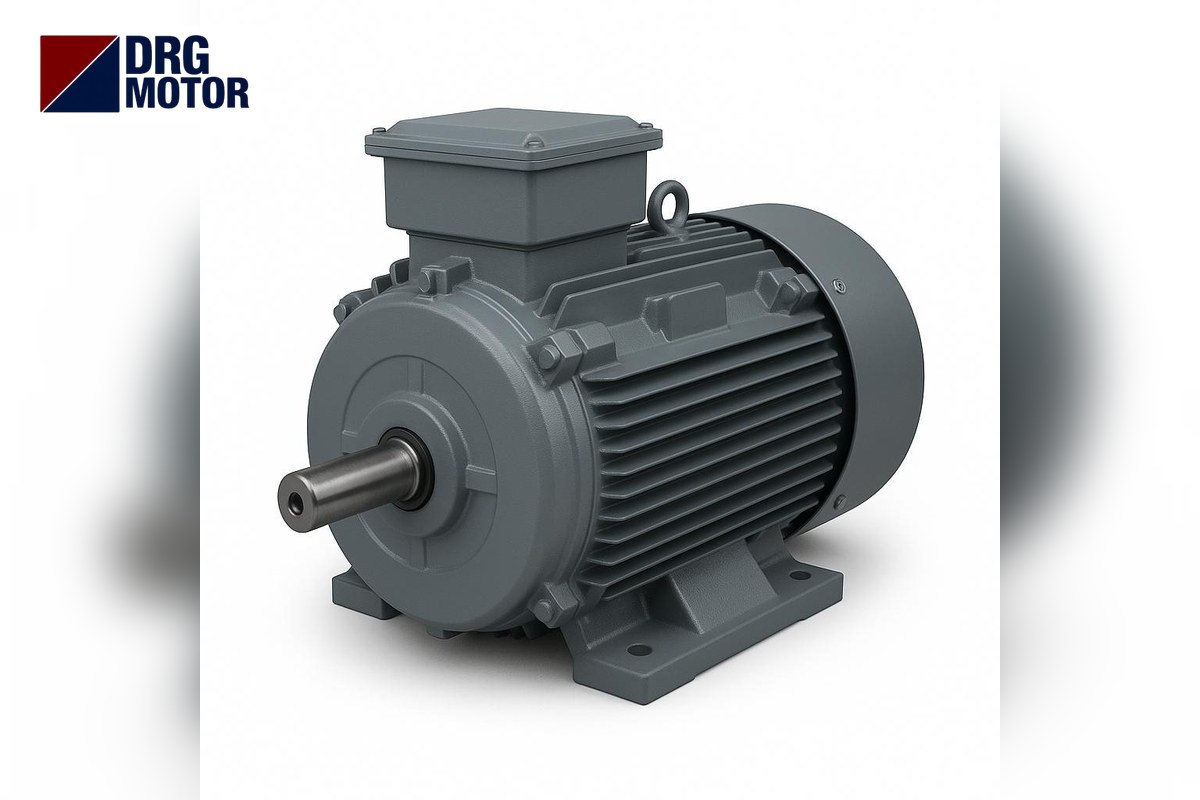

The same 10 HP (7.5 kW) output comes with three different shaft torques at three different speeds: the 3000 rpm DRG-132S2-2 produces 24.4 Nm, the 1500 rpm DRG-132M-4 49.1 Nm and the 1000 rpm DRG-160M-6 73.8 Nm. Halve the speed and the turning force roughly doubles, so the real question is not “how many horsepower” but “how much torque does my machine need at which speed”.
The price of that difference is paid in the frame. More torque means a larger rotor and stator: the 2- and 4-pole models stay at 132 shaft height while the 6-pole model moves up to a 160M frame and the shaft grows from 38 mm to 42 mm. Current also rises slightly, from 14.4 A to 16.2 A at 380 V. Below we compare the three speeds in one table, from one data source (DRG catalogue values).
Aluminium and cast iron versions of all three speeds are among the 120 models on our Buy Electric Motors Online page; the model codes in the table link straight to the product pages.
7.5 kW at 1000, 1500 and 3000 rpm side by side
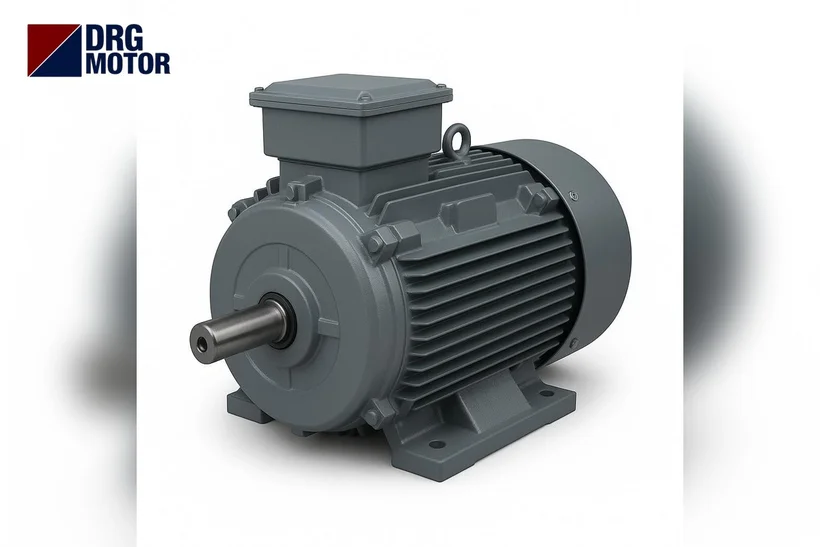
All electrical values in the table are identical for aluminium and cast iron frames; the housing material does not change current, speed or torque.
| Value | 3000 rpm | 1500 rpm | 1000 rpm |
|---|---|---|---|
| Model | DRG-132S2-2 | DRG-132M-4 | DRG-160M-6 |
| Number of poles | 2 | 4 | 6 |
| Rated speed (rpm) | 2930 | 1460 | 970 |
| Rated torque (Nm) | 24.4 | 49.1 | 73.8 |
| Current at 380 V (A) | 14.4 | 15.0 | 16.2 |
| Current at 400 V (A) | 13.7 | 14.3 | 15.4 |
| cos φ | 0.88 | 0.84 | 0.79 |
| Ts/Tn (starting torque ratio) | 2.0 | 2.0 | 2.0 |
| Tmax/Tn (breakdown torque ratio) | 2.3 | 2.3 | 2.1 |
| Is/In (starting current ratio) | 7.9 | 7.5 | 7.0 |
| IEC frame | 132S | 132M | 160M |
| Bearing | 6208-ZZ-C3 | 6208-ZZ-C3 | 6309-C3 |
| Cable entry | 2 × M32×1.5 | 2 × M32×1.5 | 2 × M40×1.5 |
| Price | See Prices | See Prices | See Prices |
Rated torque follows a simple rule: T = 9550 × P / n. For 7.5 kW at 1460 rpm, 9550 × 7.5 / 1460 ≈ 49.1 Nm; the same calculation gives 24.4 Nm at 2930 rpm and 73.8 Nm at 970 rpm. Table and formula match exactly.
Why does current rise as speed drops?
Mechanical output is 7.5 kW for all three models. But line current depends on power factor (cos φ) as well as power. As the number of poles increases, the reactive share needed for magnetising grows and cos φ falls: 0.88 for 2 poles, 0.84 for 4 poles, 0.79 for 6 poles. As a result, the 6-pole motor draws 1.8 A more at 380 V for the same work (16.2 − 14.4).
In practice, a panel prepared for 7.5 kW should have its overload setting, cable size and power factor correction chosen with the actual speed in mind. You can check panel values with the motor current chart. At start-up the picture reverses: the 2-pole model draws 7.9 times rated current, the 6-pole 7.0 times; once calculated, all three end up at about 113 A (14.4 × 7.9 ≈ 113.8 A; 16.2 × 7.0 ≈ 113.4 A).
Which speed for which load?
The right speed is the one that reaches the machine’s own working speed with the least conversion. The fewer belts, pulleys or gearboxes, the lower the losses and the maintenance.
- 3000 rpm (DRG-132S2-2): directly coupled centrifugal pumps, high-pressure fans, high-speed grinding and cutting machines. Low torque is enough; speed matters.
- 1500 rpm (DRG-132M-4): belt conveyors, screw conveyors, mixers, piston compressors, hydraulic units. The most common choice in the 7.5 kW class because gearbox and pulley ratios are mostly designed around 1500 rpm.
- 1000 rpm (DRG-160M-6): heavy-starting loads, slow machines with large pulleys, crushing and grinding equipment, large low-speed fans. It has the highest torque reserve.
Can a 4-pole motor with a pulley replace a 6-pole one?
Yes, if you do the maths. To go from 1460 rpm to 970 rpm the pulley ratio must be 1460 / 970 ≈ 1.5; ignoring belt losses, the machine shaft receives ≈ 49.1 × 1.5 ≈ 73.9 Nm, equal to the 6-pole motor’s torque. The decision depends on whether there is room for a pulley, whether you accept belt maintenance and whether the existing base is drilled for 132 or 160. Check the ratio with the pulley and belt calculator.
Frame and mounting dimensions: what changes with speed?
When replacing an old motor with one of a different speed, foot holes and shaft size are what people miss most. The 2- and 4-pole motors share the same 132 shaft height and the same 38 × 80 mm shaft, but dimension B (foot holes lengthwise) grows from 140 mm to 178 mm. The 6-pole motor sits on a completely different base.
| Dimension (mm) | 132S (2-pole) | 132M (4-pole) | 160M (6-pole) |
|---|---|---|---|
| H – shaft height | 132 | 132 | 160 |
| A – foot holes, across | 216 | 216 | 254 |
| B – foot holes, lengthwise | 140 | 178 | 210 |
| C – shaft shoulder to front foot hole | 89 | 89 | 108 |
| D × E – shaft diameter × length | 38 × 80 | 38 × 80 | 42 × 110 |
| K – foot hole | 4–Φ12 | 4–Φ12 | 4–Φ14.5 |
| L – overall length | 438 | 476 | 608 |
Practical consequences: moving from 132S to 132M only changes the lengthwise hole spacing on the base; moving to 160M raises the shaft height by 28 mm, the shaft becomes 42 mm and the coupling or pulley hub has to change. For all drawings see the DRG motor technical drawings page.
Aluminium or cast iron?
All three speeds come in both housings and the electrical values in the table are the same for both. The difference lies in the mechanical environment:
- Aluminium housing: lighter and easier to handle; adequate for clean workshops, pump rooms and fans with low vibration.
- Cast iron housing: more resistant to impact, dust and vibration; preferred for crushers, mills, marble and woodworking plants.
Since the 1000 rpm model is usually fitted to heavy loads, cast iron is chosen more often at 6 poles, while aluminium is common for 3000 rpm pump duty. This is not a strict rule; the environment decides.
Which technical factors determine the price of a 10 HP motor?
Several models exist at the same power because of technical differences, and these are reflected in the current price on each product page:
- Speed (number of poles): a 6-pole motor means a larger frame, more copper and more laminations.
- Housing material: aluminium or cast iron.
- Mounting: foot (B3), flange (B5) or foot-and-flange (B35).
- Voltage and connection: 400/690 V at this power, delta connection on a 380 V network.
Current prices are shown only on the product pages; our blog articles do not quote prices. To compare models, browse the 120 models in our online shop.
Pre-order checklist
- Do you know the speed and torque the machine needs? (The speed on the old motor’s nameplate tells you the number of poles.)
- Which frame is the existing base drilled for: 132S, 132M or 160M?
- Does the shaft (38 × 80 mm or 42 × 110 mm) match the coupling or pulley?
- On a 380–400 V network the terminal box is connected in delta; is the panel set for this current?
- Foot or flange mounting? If flange, has the flange size been confirmed?
- Is the site dusty and subject to vibration? Is a cast iron housing needed?
- Is the machine loaded at start? If so, are the starting method and starting torque (Ts/Tn 2.0) sufficient?
Our three-phase asynchronous motor selection guide, which covers power, speed, voltage and frame step by step, complements this list.
10 HP (7.5 kW) motors
- DRG-132S2-2 (aluminium) – 7.5 kW – 3000 rpm – 132S
- DRG-132S2-2 (cast iron) – 7.5 kW – 3000 rpm – 132S
- DRG-132M-4 (aluminium) – 7.5 kW – 1500 rpm – 132M
- DRG-132M-4 (cast iron) – 7.5 kW – 1500 rpm – 132M
- DRG-160M-6 (aluminium) – 7.5 kW – 1000 rpm – 160M
- DRG-160M-6 (cast iron) – 7.5 kW – 1000 rpm – 160M
Click to see current prices and order these motors nowSEE PRICES →
Frequently Asked Questions
How many kW is a 10 HP motor?
A 10 HP motor is sold as 7.5 kW. Mathematically 10 × 0.7457 ≈ 7.46 kW; the standard power step is 7.5 kW.
How many amps does a 10 HP motor draw?
At 380 V and full load, the 3000 rpm model draws 14.4 A, the 1500 rpm model 15.0 A and the 1000 rpm model 16.2 A. At 400 V the values are 13.7 / 14.3 / 15.4 A.
Is a 7.5 kW motor connected in star or delta?
The nameplate voltage of these models is 400/690 V, so on a 380–400 V network the terminals are connected in delta (Δ). Star is used only on a 690 V network or as the first step of star-delta starting.
Which speed is most common for a 10 HP motor?
For general machines such as conveyors, mixers and compressors, 1500 rpm (DRG-132M-4) is the most common. Pumps and fans use 3000 rpm; heavy-starting, slow-running loads use 1000 rpm.
Not sure which speed suits your machine? Send us a photo of the old motor’s nameplate: +90 (542) 666 11 11, [email protected] or our contact page. All models and current prices are on the Buy Electric Motors Online page.