English
 Le français
 Türkçe




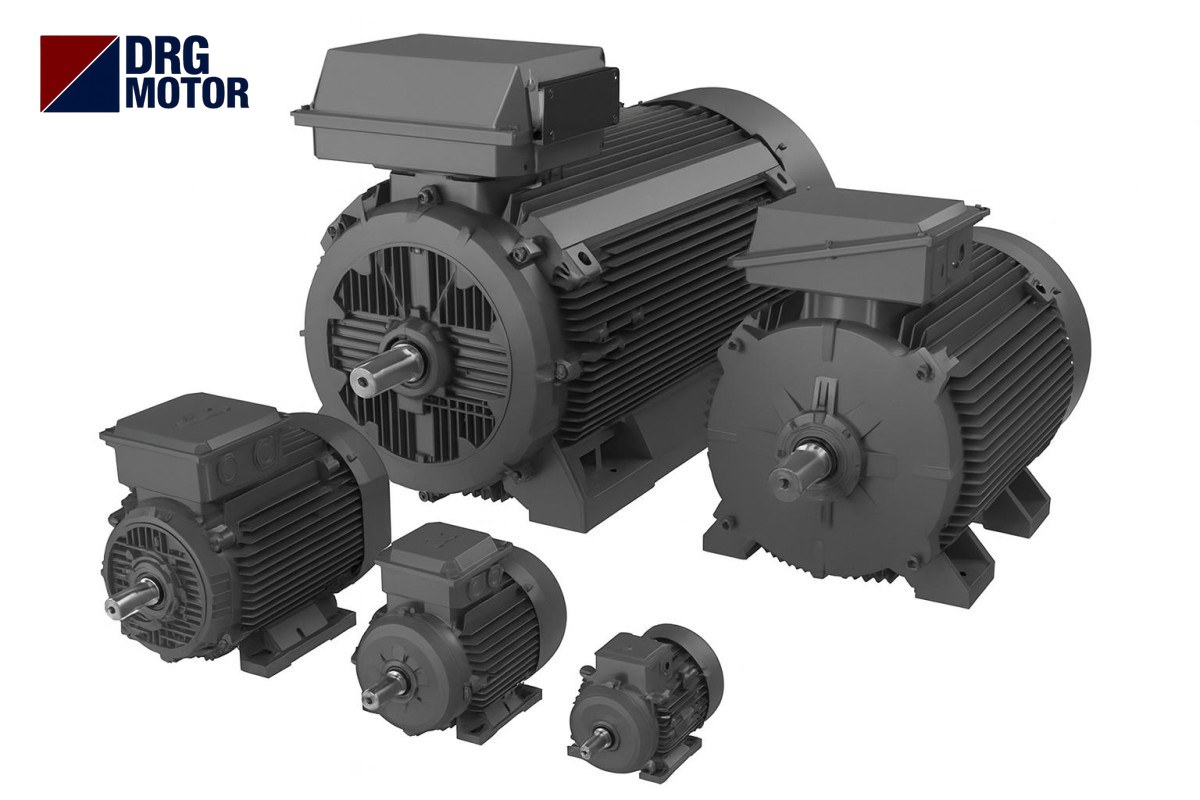

There is no single flange size for a 1.5 kW flange motor. The 2-pole DRG-90S-2 and the 4-pole DRG-90L-4 carry the same B5 flange: outside diameter P 200 mm, bolt circle M 165 mm, spigot N 130 mm, shaft 24×50 mm. The 6-pole DRG-100L-6 is one frame larger; its flange is P 250 / M 215 / N 180 mm and its shaft 28×60 mm. When choosing a motor for a pump or gearbox, settle this difference first and the speed second.
In short, "1.5 kW B5" does not complete an order: if the machine's mating face needs a 130 mm spigot you need a 90 frame, if it needs 180 mm you need a 100L frame. You can see the aluminium and cast iron versions of all three models, code by code, on our Buy Electric Motors Online page.
The dimensions below come from the IM B5 table of the DRG catalogue. B14 (small flange with tapped holes) dimensions are not part of this catalogue; we explain what to do if you need B14 in a separate section.
Three models, two different B5 flanges at 1.5 kW
Each row links to the aluminium version of the product in our store. T is the spigot depth and LA the flange plate thickness; both are useful when working out bolt length and lantern depth.
| Model | Poles / rated speed | IEC frame | P (flange OD) | M (bolt circle) | N (spigot) | S (hole) | T / LA | Shaft D×E | Price |
|---|---|---|---|---|---|---|---|---|---|
| DRG-90S-2 | 2 / 2895 rpm | 90S | 200 | 165 | 130 | 12 | 3.5 / 12 | 24×50 | See Prices |
| DRG-90L-4 | 4 / 1445 rpm | 90L | 200 | 165 | 130 | 12 | 3.5 / 12 | 24×50 | See Prices |
| DRG-100L-6 | 6 / 949 rpm | 100L | 250 | 215 | 180 | 14.5 | 4 / 13 | 28×60 | See Prices |
The flange and shaft dimensions of 90S and 90L are identical; the difference is the body length: overall length L is 336 mm on 90S and 361 mm on 90L. On the 100L frame it rises to 406 mm. If the motor has to fit into a narrow machine compartment, always measure this length behind the flange.
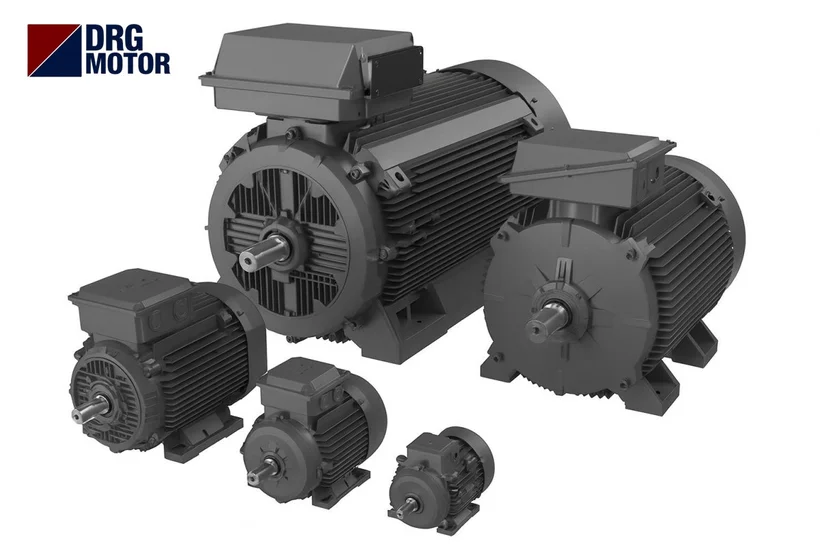
Why is the 6-pole 1.5 kW motor one frame larger?
To deliver the same power at a lower speed, the motor must produce more torque. The link between torque and power is T = 9550 × P / n. For the 2-pole model this gives 9550 × 1.5 / 2895 ≈ 4.95 Nm, for the 4-pole 9550 × 1.5 / 1445 ≈ 9.91 Nm and for the 6-pole 9550 × 1.5 / 949 ≈ 15.1 Nm; these match the rated torques in the catalogue.
A rotor and winding that carry three times the torque need more volume, which is why the 1000 rpm class 1.5 kW motor moves up to the 100L frame, the shaft grows from 24 mm to 28 mm and the flange from 200 mm to 250 mm. The practical result: if you choose 6 poles to drive a low-speed mixer or a slow feeder directly, the flange on the machine side must also accept a 180 mm spigot.
The electrical side changes with the number of poles too. Full-load current at 380 V is 3.22 A for DRG-90S-2, 3.47 A for DRG-90L-4 and 3.78 A for DRG-100L-6. All three are wound for 230/400 V and are connected in star (Y) on a 380 V supply. To check the overload setting and cable size, the motor current chart is a quick reference.
If B14 is requested, confirm the size from a drawing
B14 is a smaller flange close to the housing with tapped holes (FT type). You will find it on small pump casings and compact gearboxes. On a B5 flange the bolt passes through the flange hole and is fixed with a nut or into a tapped hole on the mating part; on B14 the bolt screws directly into the thread of the motor flange.
Since the DRG catalogue does not include a B14 dimension table, we do not give any B14 figures here. If you need a 1.5 kW motor with B14 mounting, measure the hole circle diameter, spigot diameter and thread size on your machine and send them to us; we will confirm the size together using the motor technical drawings. For details of FF and FT holes, see our article on the FF and FT hole difference on B5 and B14 flange motors.
Shaft end and key when coupling to a pump
Where a flange motor meets a pump, three dimensions must match at the same time: spigot diameter N, shaft diameter D and shaft length E. The spigot centres the motor on the pump axis, while the shaft enters the coupling or the pump hub.
- 90S / 90L frame: shaft 24×50 mm, key width F 8 mm, key base dimension G 20 mm, shaft end thread DH M8X19.
- 100L frame: shaft 28×60 mm, key width F 8 mm, G 24 mm, shaft end thread M10X22.
If the pump hub is bored to 24 mm, fitting the 100L motor means replacing or re-machining the hub. Because the key width is 8 mm on both frames, judging fit by the key alone is misleading; the shaft diameter is what decides.
For pumps the 2-pole DRG-90S-2 is usually chosen, because the head of a centrifugal pump drops quickly with speed. The 4-pole DRG-90L-4 is more common on gear pumps and low-speed circulation duties.
Input bore and output speed when coupling to a gearbox
On gearboxes the motor shaft usually enters the hollow input shaft of the gearbox. The gearbox input bore must then equal the motor's D dimension: 24 mm for the 90 frame, 28 mm for 100L. The IEC input size shown on the gearbox nameplate or catalogue must match the flange in this table on the motor side.
Worked example: if DRG-90L-4 (1445 rpm, 9.91 Nm) drives a gearbox with ratio i = 25, the output speed is 1445 / 25 = 57.8 rpm; ignoring losses, the output torque is 9.91 × 25 ≈ 247.8 Nm. The real value is lower by the gearbox losses; apply the service factor given by the gearbox maker. To try other ratios, use the gearbox output speed and torque calculator. Our article on choosing a flange motor for a gearbox covers the gearbox side of flange selection.
Finding the right model by measuring the old motor's flange
When replacing a motor with an unreadable nameplate, taking measurements is the safest way. Follow this order with a calliper and tape:
- Measure the flange outside diameter (P): about 200 mm points to a 90 frame, about 250 mm to a 100L frame.
- Measure the distance between the centres of two opposite holes; this is the bolt circle diameter M (165 mm or 215 mm).
- Measure the diameter of the spigot (N): 130 mm or 180 mm.
- Check the hole diameter (S): 12 mm on the 90 frame, 14.5 mm on 100L.
- Measure shaft diameter and length: 24×50 or 28×60 mm.
- Check whether the holes are tapped; if so the flange is B14 and the size should be confirmed with us.
- Note the old motor's speed (2 / 4 / 6 poles) and its connection at 380 V.
Technical factors that set the price of a 1.5 kW flange motor
At this power the main technical factors behind the price are the number of poles (the frame grows at 6 poles), housing material (aluminium or cast iron), mounting (B5 flange or foot + flange B35) and non-standard shaft or flange requests. Current figures are shown on each product page; for the full range go to the 120 models in our online store.
Motors at this power
- DRG-90S-2 – 1.5 kW – 2895 rpm – 90S – aluminium / cast iron
- DRG-90L-4 – 1.5 kW – 1445 rpm – 90L – aluminium / cast iron
- DRG-100L-6 – 1.5 kW – 949 rpm – 100L – aluminium / cast iron
Click to see current prices and order these motors nowSEE PRICES →
Frequently Asked Questions
What is the flange size of a 1.5 kW motor?
On 2- and 4-pole 1.5 kW motors (90S and 90L frames) the B5 flange is P 200, M 165, N 130 mm. The 6-pole 1.5 kW motor is in the 100L frame and its flange is P 250, M 215, N 180 mm.
What is the shaft diameter of a 1.5 kW motor?
24 mm (length 50 mm) on 90S and 90L frames, 28 mm (length 60 mm) on the 100L frame.
How many amps does a 1.5 kW 1500 rpm flange motor draw?
DRG-90L-4 draws 3.47 A at 380 V, 3.3 A at 400 V and 3.18 A at 415 V; it is star-connected on a 380 V supply.
Can I use a B5 flange motor with feet?
A pure B5 housing has no feet. If you need both feet and flange, ask for a B35 motor; the flange dimensions are the same as B5.
Send us the flange dimensions of your machine or a photo of the old motor's nameplate and we will pick the right 1.5 kW model together: +90 (542) 666 11 11 · [email protected] · contact.