English
 Le français
 Türkçe

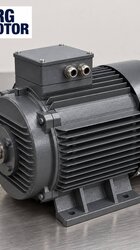
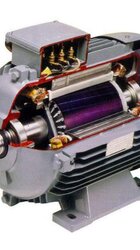
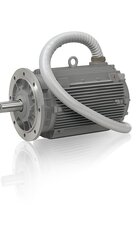

The motor of a dust extraction fan in a furniture workshop burned out. A month earlier, the maintenance technician had fitted a larger motor pulley so the same fan would pull more air. Airflow did increase, but the motor ran a little hotter every day until the winding finally gave up. This article is written to prevent exactly this kind of mistake when choosing a motor for a fan or extractor: calculating with the fan laws, belt drive versus direct coupling, starting time with a heavy impeller, dusty and hot exhaust environments, roof extractors and speed control with a drive.
First, Calculate the Power the Fan Needs
The power a fan demands at its shaft comes from three quantities: flow rate Q (m³/s), total pressure produced by the fan Δp (Pa) and fan efficiency ηfan. These values are read from the fan's catalogue curve or nameplate; the motor's job is to cover this power plus belt losses and a sensible margin.
Pshaft = Q · Δp / ηfan
Example: Dust extraction fan
Line data: flow 18,000 m³/h, total pressure 1200 Pa, fan efficiency from the catalogue 0.70, fan speed 1168 rpm, belt drive.
- Convert the flow to seconds: 18,000 / 3600 = 5 m³/s.
- Shaft power: 5 × 1200 / 0.70 = 8571 W ≈ 8.57 kW.
- Divide by 0.95 for belt losses: 8.57 / 0.95 ≈ 9.02 kW.
- Margin of 1.10–1.15 for dust load, filter clogging and calculation uncertainty: 9.92–10.38 kW.
- Result: the next standard rating up, an 11 kW, 1500 rpm motor.
The pulley ratio comes from the same calculation. A 1500 rpm motor runs at about 1460 rpm under load; with a 200 mm motor pulley and a 250 mm fan pulley, the fan speed is 1460 × 200 / 250 = 1168 rpm. To repeat the calculation with your own values, you can use our electric motor calculators.
Fan Laws: Calculate Before You Change the Pulley
For the same fan and the same air density, three quantities change at different rates when the speed changes:
- Flow is proportional to speed: Q ∝ n
- Pressure changes with the square of speed: Δp ∝ n²
- Power changes with the cube of speed: P ∝ n³
Back to the workshop in the introduction. If the fan draws 9.02 kW at 1168 rpm, raising the speed by a factor of 1.08 through a pulley change raises the power to 9.02 × 1.08³ ≈ 11.37 kW. While the flow increases only 1.08 times, the motor goes above its 11 kW rating. The reverse also holds: reducing speed to 0.9 times cuts flow to 0.9, pressure to 0.81 and power to 0.729 times. For these relationships together with the pump side, see our article on affinity laws and the motor.
Practical rule: if you raise the speed to get more flow, recheck the motor power with the cube ratio. If needed, move up one motor size; enlarging only the pulley overloads the motor.
Belt Drive or Direct Coupling?
The two arrangements affect motor selection differently. Use the table below to decide.
| Topic | Belt drive | Direct coupling (impeller on motor shaft) |
|---|---|---|
| Fan speed | Freely set by the pulley ratio | Tied to motor speed (about 2900, 1450 or 960 rpm) |
| Motor load | Radial belt force acts on the shaft; bearings and shaft end are checked accordingly | Impeller weight and unbalance go straight to the motor bearings |
| Mounting type | Usually foot-mounted (B3) on a tensioning slide rail | Flange (B5) or foot-and-flange (B35), often vertical |
| Additional loss | Belt loss is taken into account (0.95 in the example) | No belt loss |
| Maintenance | Belt tension and wear are checked regularly | No belt; balance and alignment become important |
| Hot gas | Motor can stay outside the gas stream | Motor close to the gas stream; heat can pass into the shaft and flange |
In a belt drive, fit the motor pulley as close to the shaft shoulder as possible and do not over-tension the belt; a large share of bearing failures comes from excessive tension. For a direct-coupled fan, confirm the impeller hub size together with the motor shaft diameter and key before ordering.
Starting Time and Inertia with a Heavy Impeller
A fan's running torque is low, but the inertia of a large steel impeller is high. So although the fan motor does not seem to struggle at start-up, acceleration takes a long time and the motor draws high current throughout.
Starting time is approximately t = Jtotal · ω / Macc. In a belt-driven fan, the impeller inertia is referred to the motor shaft by the square of the speed ratio: Jmotor = Jfan × (nfan / nmotor)².
Example starting calculation
- Impeller inertia (from the fan catalogue, example value): 12 kg·m²
- Referred to the motor shaft: 12 × (1168 / 1460)² = 7.68 kg·m²; adding an example rotor value of 0.10 kg·m² gives a total of 7.78 kg·m²
- Motor angular speed: 2π × 1460 / 60 ≈ 152.9 rad/s
- Rated torque of the 11 kW, 1500 rpm motor is 71.7 Nm; assume, as an example, an average motor torque of 1.5 times that during start-up (≈ 107.6 Nm)
- Fan load torque at full speed is 9.02 kW / 152.9 ≈ 59 Nm; since the torque rises with the square of speed, its average over the start is about one third, ≈ 19.7 Nm
- Accelerating torque ≈ 107.6 − 19.7 = 87.9 Nm; starting time ≈ 7.78 × 152.9 / 87.9 ≈ 13.5 s
A 13–14 second start can be enough to trip a thermal overload relay with a standard setting. In that case the relay class is chosen according to the starting time, or a soft starter or drive is used. The actual motor torque curve and permissible starting time should be requested at the quotation stage.
Caution with star-delta starting: in star, motor torque drops to about one third. In the example this is ≈ 35.9 Nm, which is below the 59 Nm fan torque at full speed. The motor cannot reach full speed in star, and a large current surge occurs at the switch to delta. With a heavy impeller, it is safer to set the star-to-delta changeover by speed or current rather than by time.
Dusty and Hot Exhaust Environments
The air drawn by the extractor also defines the motor's surroundings. On lines carrying wood shavings, flour, cement or paint dust, the outer frame and cooling fins of the motor gradually get covered; cooling decreases and winding temperature rises.
- Degree of protection: In dusty and humid environments, ask for at least IP55. IP55 limits dust ingress and protects against water jets from any direction.
- Cooling path: Leave at least a hand's width of clearance in front of the motor fan cover; a motor whose cover is clogged with dust cannot cool itself with its own fan.
- Hot gas: In furnace, dryer or boiler exhaust, the fan draws hot gas. When the gas cools, its density rises and the power demand at the same speed increases.
The cold start trap
When a fan selected for 150 °C gas is started on a cold morning with 20 °C air, the air density is (273+150)/(273+20) ≈ 1.44 times higher. A fan drawing 9.02 kW in hot gas needs about 13 kW in cold air, and an 11 kW motor is overloaded. The solution is either to size the motor for cold air (15 kW) or to keep the fan unloaded during a cold start by throttling the damper or reducing speed with a drive.
The Motor in a Roof Extractor
In roof extractors the motor is usually vertical and directly exposed to sun, rain and wind-blown dust. When selecting, check:
- A flange design suitable for vertical mounting (shaft-down or shaft-up position is stated in the order).
- If the shaft points up, a protective cap or canopy so rainwater does not run down the shaft into the motor.
- Condensate drain holes positioned at the bottom for the mounting position.
- Roof ambient temperature rises in summer; this margin must not be forgotten when choosing motor power.
- Maintenance access: a lifting point and cable length to remove the motor are planned in advance.
Most roof extractors run with a 1000 or 1500 rpm motor, at low pressure and high flow. In buildings with noise limits, a lower-speed motor and a larger impeller are preferred.
Speed Control with a Drive
If the required airflow changes during the day (shifts, number of machines, season), speed control with a drive makes more sense than throttling a damper. The fan laws work in your favour: reducing speed to 0.8 times cuts power to 0.8³ = 0.512 times.
- Upper speed limit: Running the motor above 50 Hz with a drive raises fan power with the cube ratio; the motor and the impeller's mechanical limit are checked together.
- Low speed: In a self-ventilated motor the fan load also falls at low speed, so most applications have no issue; still, if it will run at very low speed for long periods, motor temperature is monitored.
- Ramp times: With a heavy impeller, a short stopping ramp causes an overvoltage fault in the drive; the ramp is lengthened or a braking resistor is used.
- Cable: If the distance between drive and motor is long, shielded cable and the filter recommended by the drive manufacturer are used.
Motors Often Chosen for Fans and Their Prices
The table below shows 1500 rpm cast iron three-phase motors often used in medium-power fans and extractors. You can view all models in our online store.
| Model | Power | Speed | Frame (IEC) | Rated torque | Excl. VAT | Incl. VAT |
|---|---|---|---|---|---|---|
| DRG-132S-4 | 5.5 kW | 1500 rpm | 132S | 36 Nm | 15,438.50 TRY | 18,526.20 TRY |
| DRG-132M-4 | 7.5 kW | 1500 rpm | 132M | 49.1 Nm | 17,825.50 TRY | 21,390.60 TRY |
| DRG-160M-4 | 11 kW | 1500 rpm | 160M | 71.7 Nm | 25,674.00 TRY | 30,808.80 TRY |
| DRG-160L-4 | 15 kW | 1500 rpm | 160L | 97.8 Nm | 30,610.80 TRY | 36,732.96 TRY |
| DRG-180M-4 | 18.5 kW | 1500 rpm | 180M | 120.2 Nm | 39,429.50 TRY | 47,315.40 TRY |
| DRG-180L-4 | 22 kW | 1500 rpm | 180L | 142.9 Nm | 41,504.10 TRY | 49,804.92 TRY |
Prices are taken from the DRG Motor online store list dated 24.09.2026; a 3% discount applies to bank transfer/EFT payments, shipping is not included in the price and is paid by the buyer.
Fan Motor Checklist Before Ordering
- Fan flow, total pressure, efficiency and speed (catalogue curve or nameplate).
- Gas temperature; for hot gas, the power required at a cold start.
- Drive type: pulley diameters for belt drive, impeller hub size for direct coupling.
- Mounting: foot, flange or foot-and-flange; horizontal or vertical, shaft direction.
- Environment: dust, humidity, outdoors, roof; required degree of protection (at least IP55).
- Starting method: direct, star-delta, soft starter or drive; impeller inertia.
- Supply voltage and connection (400 V delta or star).
- For a replacement, the old motor's nameplate and its shaft, flange and foot dimensions.
Frequently Asked Questions
Should I change the motor or the pulley for more suction on an extractor?
Raising speed with a pulley increases flow in proportion to speed and power with the cube of speed. First calculate the power at the new speed; if the existing motor cannot cover it, move the motor up one size along with the pulley.
Should a fan motor be 1500 or 3000 rpm?
For a direct-coupled fan, the decision depends on the fan's design speed. For a belt-driven fan, 1500 rpm is usually preferred: the pulley ratio stays reasonable, and noise and bearing load are lower.
Why does the fan motor trip the overload relay at start-up?
Usually the start is long because of a heavy impeller, the overload relay is not set for that time, or a fan selected for hot gas is started with cold air. Calculate the starting time and choose the relay class and starting method accordingly.
What degree of protection is enough in a dusty environment?
For general industrial dust, IP55 is a suitable starting point. Combustible dust or an explosive atmosphere requires a different motor type, and the area classification must be stated clearly in the order.
Send us your fan data or a photo of the old motor's nameplate and let us identify the right motor together: phone +90 (542) 666 11 11, e-mail [email protected] or our contact page.