English
 Le français
 Türkçe




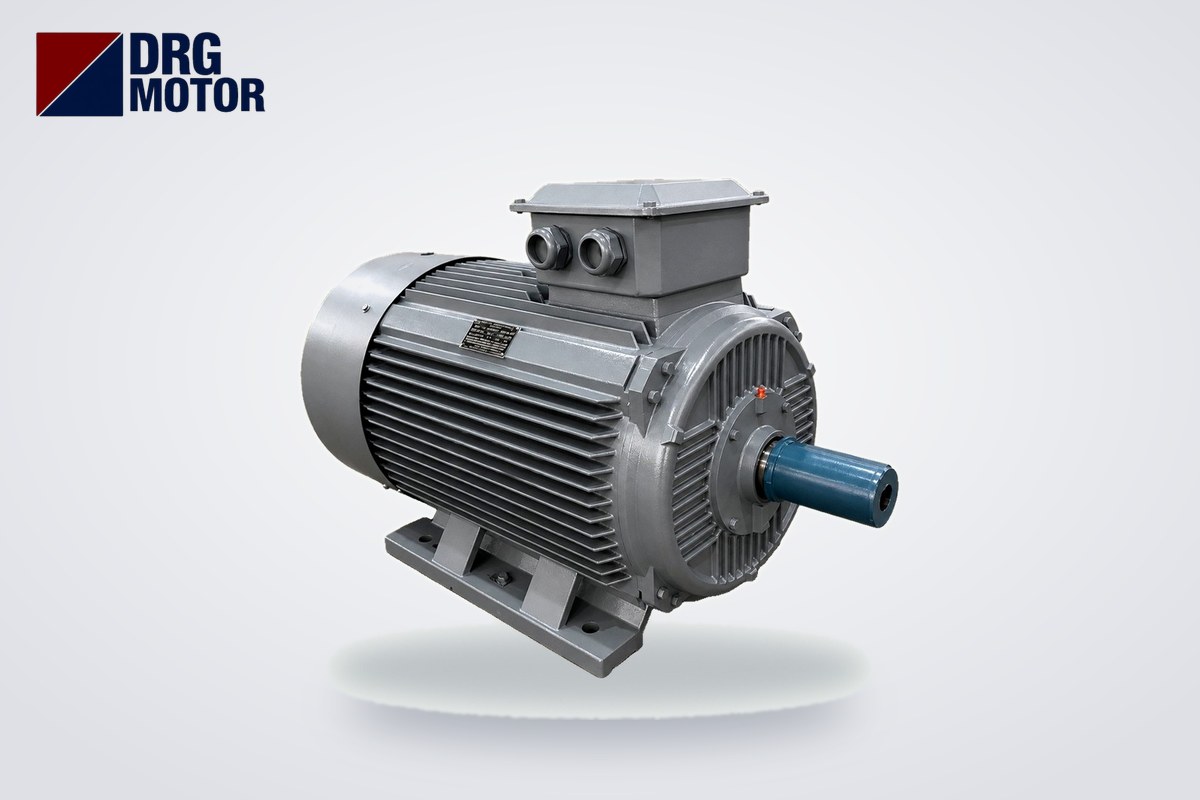

An 18.5 kW (25 HP) three-phase electric motor draws about 35.3 A at full load on a 380 V supply; this figure is for the 4-pole (1500 rpm) DRG-180M-4. At the same power, a 2-pole (3000 rpm) motor draws 34.2 A and a 6-pole (1000 rpm) motor 37.8 A. The current at the moment of starting, however, depends heavily on the starting method: with direct-on-line starting the 4-pole motor takes roughly 275.3 A from the supply, with star-delta roughly 91.8 A.
Rated current is the nameplate value, and once the motor reaches speed it stays the same whichever method you use. What changes is the first few seconds: the panel, fuses, generator or transformer must carry that short surge. In this article we compare four methods for 18.5 kW (direct-on-line, star-delta, soft starter and frequency drive) on the same motor. Nameplate data and technical pages for 120 models are available in the Buy Electric Motors Online section.
Rated Current of an 18.5 kW Motor: 2, 4 and 6 Poles
All three 18.5 kW models in our store have cast iron frames and 400/690 V (Δ/Y) windings. On a 380–400 V supply they are therefore connected in delta (Δ) in the terminal box, which means they are directly suitable for star-delta starting. The values in the table are catalogue data:
| Model | Synchronous / rated speed | cos φ | 380 V | 400 V | 415 V | Is/In | Rated torque |
|---|---|---|---|---|---|---|---|
| DRG-160L-2 | 3000 / 2940 rpm | 0.89 | 34.2 A | 32.5 A | 31.3 A | 8.2 | 60.1 Nm |
| DRG-180M-4 | 1500 / 1470 rpm | 0.86 | 35.3 A | 33.5 A | 32.3 A | 7.8 | 120.2 Nm |
| DRG-200L1-6 | 1000 / 980 rpm | 0.81 | 37.8 A | 35.9 A | 34.7 A | 7.3 | 180.3 Nm |
The reason current rises with the number of poles is cos φ: the power factor of 0.89 on the 2-pole motor falls to 0.81 on the 6-pole motor. To deliver the same mechanical power, the 6-pole motor draws more reactive (magnetising) current from the supply. The starting current ratio (Is/In), on the other hand, moves the opposite way: 8.2 → 7.8 → 7.3. As a result, the direct-on-line starting currents of the three motors end up very close to each other. To compare currents at other ratings, see the motor current chart.
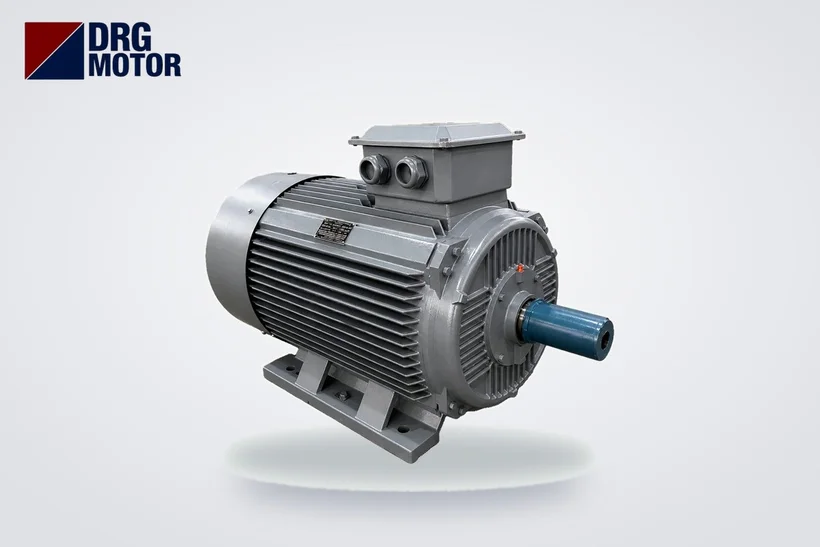
Supply Current by Starting Method
The comparison below is calculated for a 380 V supply at full load. For direct-on-line starting, current = In × Is/In; with star-delta the motor is first connected in star, so each winding sees 219 V (380/√3) and the current drawn from the supply is about one third of the direct-on-line value.
| Starting method | Calculation | DRG-160L-2 (2-pole) | DRG-180M-4 (4-pole) | DRG-200L1-6 (6-pole) |
|---|---|---|---|---|
| Direct-on-line (DOL) | In × Is/In | 280.4 A | 275.3 A | 275.9 A |
| Star-delta | ≈ DOL current / 3 | ≈ 93.5 A | ≈ 91.8 A | ≈ 92.0 A |
| Soft starter | set current limit × In | depends on setting | depends on setting | depends on setting |
| Frequency drive | drive current limit | depends on setting | depends on setting | depends on setting |
Direct-on-line starting
The contactor closes and the motor sees full voltage. This is the simplest panel with the fewest parts, and the motor delivers its full starting torque (Ts/Tn = 2.0 on the 4-pole model, i.e. about 240.4 Nm). The price is that for a few seconds the supply carries 7.8 times the rated current. With a strong transformer this may not matter, but if sensitive equipment shares the line a voltage dip will be felt, and the utility or the site electrical engineer is often reluctant to accept direct-on-line starting at this rating.
Star-delta starting
The motor starts in star and a timer switches it to delta as speed rises. This is the most common solution at 18.5 kW and, thanks to the 400/690 V winding, requires no change to the motor: the links in the terminal box are removed and the six leads are taken to the panel. A short current peak occurs at changeover; setting the timer to the moment the motor is really close to its speed keeps that peak small. For wiring details, see the star-delta starting calculator.
Soft starter
It raises the voltage along a ramp using thyristors. Giving a single figure for the supply current would be misleading: the current depends on the current limit you set on the device (entered as a multiple of In) and on how hard the load is to start. A lower limit means lower current but a longer start; with a limit that is too low a loaded motor may not start at all. How to choose the ramp and current limit is covered separately in our article on soft starter parameter settings.
Frequency drive (inverter)
The drive starts the motor from a low frequency, so there is no starting surge in the classic sense; the supply current depends on the drive current limit and the acceleration ramp. If speed control is needed (fan airflow, pump pressure, belt speed), it is the only sensible option anyway. When a drive is used, the rated current and speed from the motor nameplate must be entered exactly into the drive parameters.
Why Torque May Fall Short in Star Starting
Whatever cuts the current to one third also cuts the torque to one third. For the DRG-180M-4 the calculation is: rated torque 120.2 Nm, Ts/Tn = 2.0 → direct-on-line starting torque ≈ 240.4 Nm. In star this drops to ≈ 80.1 Nm, i.e. only about 0.67 times rated torque. Since Ts/Tn = 2.0 on all three models, the ratio is the same.
The practical consequence: a load that resists with close to rated torque at standstill (a full belt, a loaded crusher, a compressor starting against pressure) cannot reach speed in star; the motor lingers at low speed and the surge at changeover to delta becomes almost as large as a direct-on-line start. In that case you either start unloaded or change the method.
How Starting Current Affects Generators and Transformers
Converting current into apparent power is the easiest way to see whether the supply can handle the surge: S = √3 × U × I. For the DRG-180M-4 at 380 V in rated operation, S ≈ √3 × 380 × 35.3 ≈ 23.2 kVA. The same calculation gives ≈ 181 kVA for direct-on-line starting and ≈ 60 kVA for star-delta. In other words, a consumer that is a load of around 23 kVA while running asks the supply for roughly eight times more in the first seconds of a direct-on-line start.
On a large grid transformer this short load rarely causes trouble; but in generator-fed systems such as building sites, field irrigation or standby supplies, the generator voltage collapses, the contactor may drop out and the motor fails to start. With this kind of supply, the choice of method comes before the current calculation: star-delta, a soft starter or a drive reduces the starting surge, and generator capacity is discussed with its supplier on the basis of these values.
Which Starting Method for Which Load?
| Load / application | Suitable method | Why |
|---|---|---|
| Centrifugal fan, extractor | Star-delta or soft starter | Low torque demand at start, rising with speed |
| Centrifugal pump | Soft starter or drive | Soft stop reduces water hammer |
| Loaded conveyor, crusher, mixer | Direct-on-line or frequency drive | High starting torque needed; star torque may be insufficient |
| Compressor starting unloaded | Star-delta | Unloader valve reduces starting torque |
| Process needing speed control | Frequency drive | Controls both starting current and speed |
Overload Setting Depends on the Method
The most common mistake on site is setting the overload relay of a star-delta panel to the nameplate current. When the relay is connected after the main contactor, i.e. where the winding (phase) current flows, the setting must be In/√3. Calculation for 380 V:
- DRG-160L-2: ≈ 34.2 A for direct-on-line, ≈ 19.7 A for star-delta
- DRG-180M-4: ≈ 35.3 A for direct-on-line, ≈ 20.4 A for star-delta
- DRG-200L1-6: ≈ 37.8 A for direct-on-line, ≈ 21.8 A for star-delta
With soft starters and drives, motor protection is usually built into the device; the nameplate current is entered as a parameter. For fuse, contactor and overload sizes use the overload, fuse and contactor selection tool, and for the supply cable the cable size calculator; exact values depend on cable length, installation method and ambient temperature.
Pre-Commissioning Checklist
- Is the nameplate voltage 400/690 V? On a 380–400 V supply the running connection must be delta.
- In a star-delta panel, have the terminal links been removed and the U1-V1-W1 and W2-U2-V2 leads taken to the panel in the correct order?
- Is the overload relay set to In or In/√3 according to where it is connected?
- Is the timer set to change over to delta as the motor approaches speed (test unloaded first, then loaded)?
- If the load needs high starting torque, have direct-on-line or a drive been considered instead of star starting?
- At first start, measure all three phase currents with a clamp meter and compare with the nameplate; if there is a clear difference between phases, check the connection.
- Are suitable glands ready for the cable entries (2 × M40×1.5 / 2 × M50×1.5 on the 6-pole)?
Motors in This Rating
18.5 kW three-phase motors in our online store:
- DRG-160L-2 – 18.5 kW – 3000 rpm – cast iron, IEC 160L
- DRG-180M-4 – 18.5 kW – 1500 rpm – cast iron, IEC 180M
- DRG-200L1-6 – 18.5 kW – 1000 rpm – cast iron, IEC 200L
Click to see current prices and order these motors nowSEE PRICES →
Frequently Asked Questions
How many amps does an 18.5 kW motor draw at no load?
No-load current is not given in the catalogue; it consists of the magnetising current, which does not depend on the load. It is well below rated current but, because cos φ is very low, not close to zero. Full-load current of the 4-pole model is 35.3 A; assess the no-load current you measure against this value and against the balance of the three phases.
Should an 18.5 kW motor be started star-delta or direct-on-line?
If the supply and the load allow it, direct-on-line is possible, but about 275.3 A is drawn at start. For light-starting loads (fans, compressors starting unloaded) star-delta reduces the current to ≈ 91.8 A. For hard-starting loads the torque in star may be insufficient; a drive is the better solution.
What overload relay rating suits an 18.5 kW motor?
The relay is set to the motor current: for the 1500 rpm model ≈ 35.3 A for direct-on-line, ≈ 20.4 A in the phase line for star-delta. Choose a relay whose setting range has these values near its middle.
How many HP is 18.5 kW?
18.5 kW is about 25 HP. Current calculations are based on kW and the nameplate current, not on HP.
If you are unsure about the starting method or model, send us the application and supply details: +90 (542) 666 11 11, [email protected] or the contact page. For all models and current information, browse the 120 models in our online store.