English
 Le français
 Türkçe




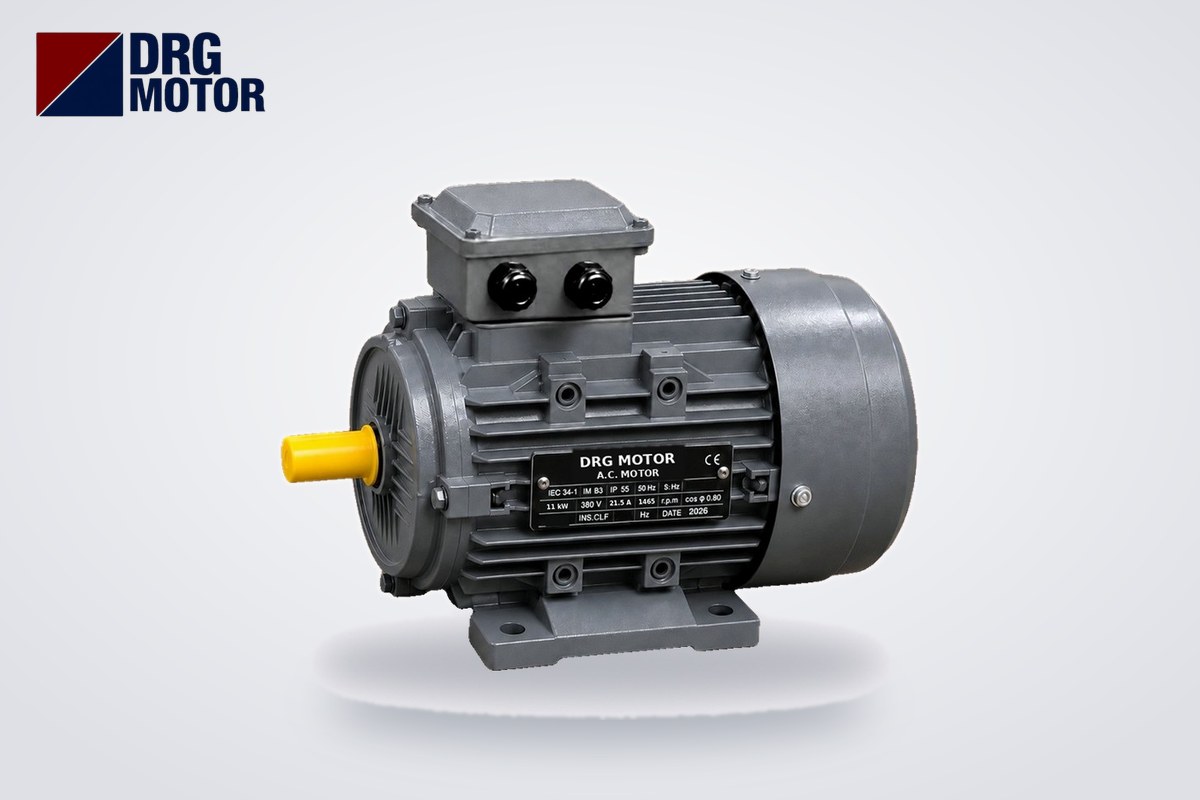

An 11 kW (15 HP) three-phase motor draws 20.6 A at 3000 rpm, 21.5 A at 1500 rpm and 23.1 A at 1000 rpm on a 380 V supply at full load; at 400 V these values are 19.6 A, 20.4 A and 22.0 A. Panel components are chosen from this rated current (In): the contactor's AC-3 current must not be lower than In, the overload relay's setting range must cover In, and the fuse or circuit breaker must not trip on the brief starting current of 166–167 A during direct-on-line starting.
Cable size and breaker rating, however, are not determined by motor current alone; line length, installation method, ambient temperature and starting method change the result. That is why we do not give a fixed cable size or breaker rating below, but show you how to calculate it with the right data. The values in the table are nameplate data of the 11 kW models in our Buy Electric Motors Online store.
11 kW motor current table: 3000, 1500 and 1000 rpm
| Model | Speed (rated) | IEC frame | Current at 380 V | Current at 400 V | Current at 415 V | cos φ | Is/In | Cable entry |
|---|---|---|---|---|---|---|---|---|
| DRG-160M1-2 | 3000 (2945) rpm | 160M | 20.6 A | 19.6 A | 18.9 A | 0.89 | 8.1 | 2 × M40×1.5 |
| DRG-160M-4 | 1500 (1465) rpm | 160M | 21.5 A | 20.4 A | 19.7 A | 0.85 | 7.7 | 2 × M40×1.5 |
| DRG-132M-4K (compact) | 1500 (1465) rpm | 132M | 21.5 A | 20.4 A | 19.7 A | 0.85 | 7.7 | 2 × M32×1.5 |
| DRG-160L-6 | 1000 (970) rpm | 160L | 23.1 A | 22.0 A | 21.2 A | 0.80 | 7.2 | 2 × M40×1.5 |
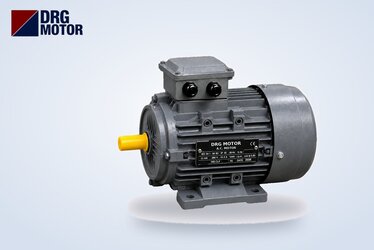
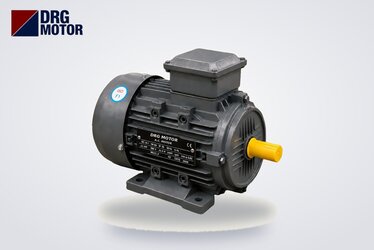
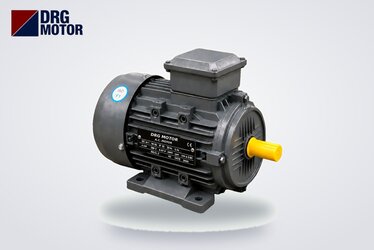
All our 11 kW models are wound for 400/690 V and are connected in delta (Δ) on a 380–400 V supply. Aluminium and cast iron versions have the same electrical values. The compact DRG-132M-4K has the same current, cos φ and starting values as the 160M-4 but comes in a frame one size smaller (132M); its cable entry is therefore 2 × M32×1.5, compared with 2 × M40×1.5 on the frame 160 models. Prepare the cable glands accordingly when ordering the panel.
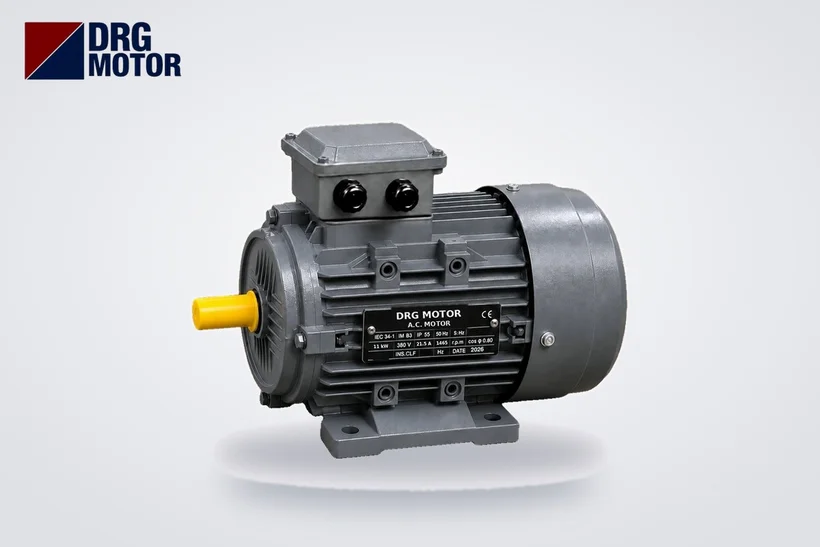
Why are panel components chosen from the nameplate current?
Each component in a motor feeder has a different job and looks at a different aspect of the motor current:
- The contactor switches the motor; it carries the rated current continuously and breaks the high current at every start. That is why its current in category AC-3 (squirrel-cage motor switching) is what matters.
- The overload relay protects against overload; it is set to the motor's actual In.
- The fuse or motor protection circuit breaker protects against short circuits; it must withstand the starting current and the starting time.
- The cable must carry In without overheating and keep the voltage drop within limits during starting and normal operation.
The nameplate current depends on supply voltage: the 1500 rpm 11 kW motor draws 21.5 A at 380 V and 20.4 A at 400 V. Measure the actual voltage at your site and work with the corresponding current. Even if the load is not always full, panel components are sized for full-load current.
Contactor selection: AC-3 current ≥ In
Direct-on-line starting uses a single contactor that carries the full line current. So the contactor's AC-3 current at the operating voltage must not be lower than the motor's In: for 380 V, look for an AC-3 rating above 21.5 A on the 1500 rpm model and above 23.1 A on the 1000 rpm model. Frequent start-stop, reversing or inching (jog) increase contactor duty; in that case choosing the next size up is common practice.
Star-delta starting uses three contactors. The line and delta contactors carry the winding (phase) current, which is In/√3. The star contactor is only engaged during starting and carries a lower current. For coil voltage, auxiliary contacts and category details, see our article on contactor selection in a motor panel.
| Model | In (380 V) | Direct-on-line starting current In × Is/In | Phase (winding) current in star-delta In/√3 | Line starting current in star-delta ≈ 1/3 |
|---|---|---|---|---|
| DRG-160M1-2 | 20.6 A | 166.9 A | 11.9 A | 55.6 A |
| DRG-160M-4 / DRG-132M-4K | 21.5 A | 165.6 A | 12.4 A | 55.2 A |
| DRG-160L-6 | 23.1 A | 166.3 A | 13.3 A | 55.4 A |
The figures in the table are calculated from nameplate data: for example, for the DRG-160M-4, 21.5 × 7.7 ≈ 165.6 A and 21.5 / √3 ≈ 12.4 A. Although the 3000 rpm model has the lowest In, its Is/In ratio is 8.1, so its starting current is almost the same as that of the 1000 rpm model.
Overload setting: the range must cover In
The overload relay is set to the nameplate current at the operating voltage; this value should fall in or near the middle of the relay's setting range. A relay where it falls at the lower or upper limit leaves no margin if the voltage changes later or the motor is replaced.
- With direct-on-line starting, the setting for the 1500 rpm model is 21.5 A at 380 V and 20.4 A at 400 V.
- In star-delta, the overload relay is usually connected below the line contactor, in the winding current circuit; it is then set to In/√3, about 12.4 A at 380 V for the 1500 rpm model. If the relay is on the line side, the setting is In; check your wiring diagram.
- Do not set the overload above In to stop it "tripping": if it trips often, first check current, voltage and mechanical load with a clamp meter.
- On machines with long starting times (large fans, heavy flywheels), confirm that the overload trip class suits the starting time.
Fuse and breaker: must withstand the starting current
Short-circuit protection is tested at starting, not at rated current. When started direct-on-line, an 11 kW motor draws 7.2–8.1 times In for a few seconds. The fuse or breaker must not trip during this time but must open quickly on a real short circuit. That is why motor feeders use a motor protection circuit breaker, a breaker with a curve suited to motor starting, or motor-rated fuses; choosing a general lighting-type miniature breaker from In alone can lead to tripping at start.
With star-delta starting the line starting current falls to about one third (around 55 A on the 1500 rpm model), which changes the choice of protective devices. You can compare which method suits your machine with our star-delta starting tool, and see fuse, breaker, overload relay and contactor together with our overload, fuse and contactor selection tool. Confirm the result against the manufacturer's selection table for the devices you use.
Cable size: why we don't give a single value
The question "what size cable for an 11 kW motor?" has no single correct answer. For the same 21.5 A, the main factors that determine the cross-section are:
- Distance between panel and motor: on a long run, voltage drop increases the size.
- Installation method: in conduit, on a tray, buried or bunched.
- Ambient temperature and other cables on the same route.
- Starting method: with direct-on-line starting, a current of about 166 A temporarily lowers the voltage at the motor terminals on a long run.
- Whether copper or aluminium conductors are used.
For the calculation, enter the following in our motor cable size calculator: motor power 11 kW, voltage (380 or 400 V), your motor's nameplate current (e.g. 21.5 A for 1500 rpm), cos φ (0.85), line length and the permissible voltage drop. For example, if the panel is 40 m from the motor, enter that distance and the installation condition to get the result, then check the cable's current-carrying capacity for that installation in the cable catalogue. For other calculations, see our electric motor calculators page.
Compact 132M or standard 160M?
At 1500 rpm there are two options: the standard DRG-160M-4 (frame 160M, shaft 42×110 mm, shaft height 160 mm) and the compact DRG-132M-4K (frame 132M, shaft 38×80 mm, shaft height 132 mm). Electrically they are identical: 21.5 A, cos φ 0.85, 1465 rpm and 71.7 Nm. So the choice of panel components does not change; what changes is the foot mounting dimensions, shaft, coupling and cable gland. If space is limited on an older frame 132 machine, the compact model fits directly; on a base designed for a standard frame 160, the 160M model does.
Motors in this power rating
All 11 kW models and other ratings are among the 120 models in our online store:
- DRG-160M1-2 – 11 kW – 3000 rpm – aluminium, frame 160M
- DRG-160M1-2 – 11 kW – 3000 rpm – cast iron, frame 160M
- DRG-160M-4 – 11 kW – 1500 rpm – aluminium, frame 160M
- DRG-160M-4 – 11 kW – 1500 rpm – cast iron, frame 160M
- DRG-132M-4K – 11 kW – 1500 rpm – aluminium compact, frame 132M
- DRG-160L-6 – 11 kW – 1000 rpm – aluminium, frame 160L
- DRG-160L-6 – 11 kW – 1000 rpm – cast iron, frame 160L
Click to see current prices and order these motors nowSEE PRICES →
Frequently Asked Questions
How many amps does an 11 kW 1500 rpm motor draw?
The DRG-160M-4 and the compact DRG-132M-4K draw 21.5 A at 380 V, 20.4 A at 400 V and 19.7 A at 415 V; cos φ is 0.85 and Is/In is 7.7.
What fuse size does an 11 kW motor need?
The fuse or breaker rating depends on the starting method, starting time and the type of protection used; with direct-on-line starting it must carry a brief current of about 166 A without tripping. Calculate the value with our overload, fuse and contactor selection tool and confirm it with the manufacturer's table.
What size cable does an 11 kW motor need?
The cross-section depends on line length, installation method and ambient temperature; no single value is correct. Enter the motor current and distance in our cable size calculator to get the result for your installation.
What is the overload setting for an 11 kW motor in star-delta?
If the overload relay is in the winding current circuit, it is set to In/√3: at 380 V, about 12.4 A for the 1500 rpm model, about 11.9 A for 3000 rpm and about 13.3 A for 1000 rpm. If the relay is on the line side, the setting is the nameplate current.
For help choosing an 11 kW motor or panel details, call us on +90 (542) 666 11 11, e-mail [email protected] or use our contact page. Prices and technical data are on the Buy Electric Motors Online page.