 English
 Le français
 Türkçe

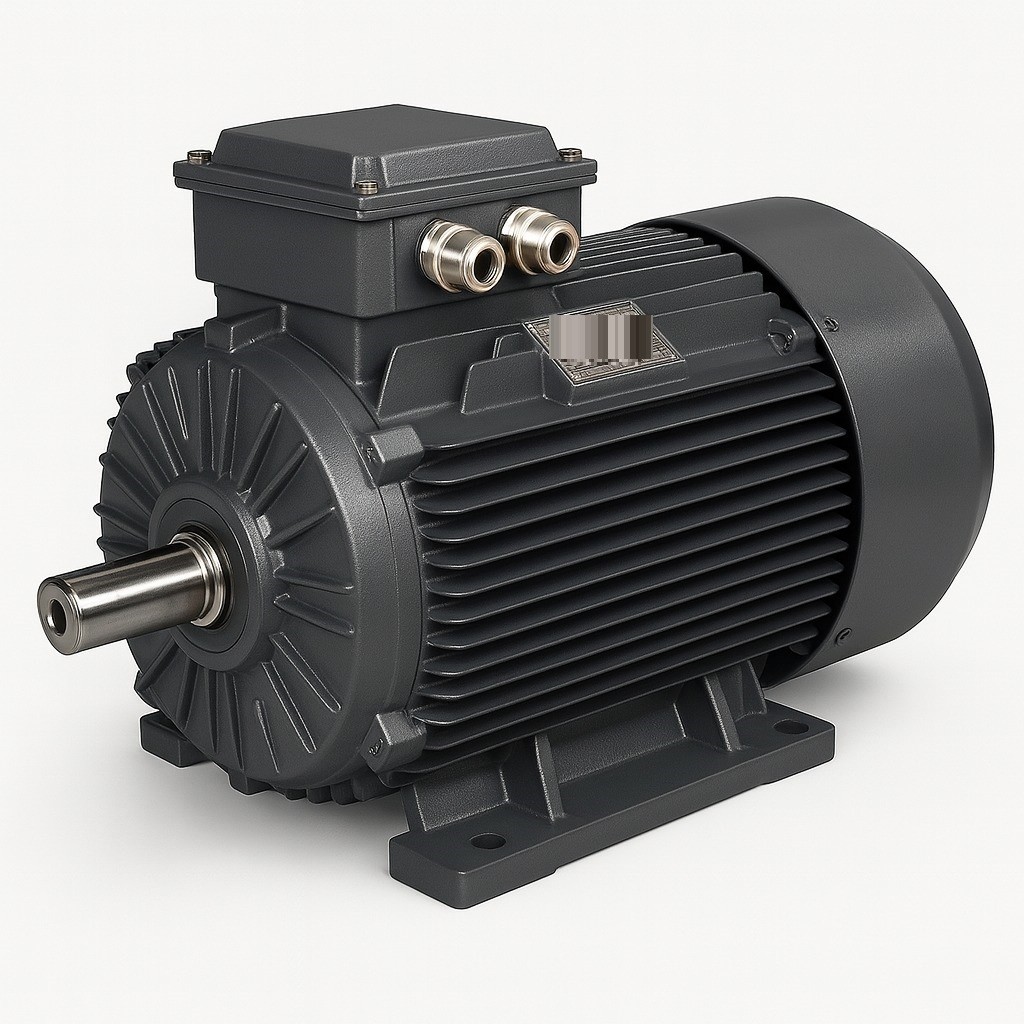

A plant's electricity bill mostly leaves through its motors, which makes efficiency the most concrete saving available to an operator. The gain costs no production time: identical work, less energy drawn.
Why Efficiency Is the Fastest Saving
Weigh a lifetime of electricity for a motor that never stops against what it cost to buy, and the invoice looks like small change. Where the line works 6,000 to 8,000 hours a year, moving one class higher is visible on the very next bill. Few improvements arrive without a production trade-off; this is one of them.
IE3, IE4 and IE5
IEC 60034-30-1 grades motor efficiency from IE1 up to IE5, where every step delivers identical output at lower losses:
- IE3 (Premium): the widespread industrial standard, balanced investment
- IE4 (Super Premium): cheaper energy on lines that run without stopping
- IE5 (Ultra Premium): for applications where the highest efficiency is required
Higher classes come from more and better copper in the winding and from low-loss steel, which also means less heating and longer insulation life. Class comparisons are set out further in our efficiency class guide.
Copper Winding and Magnetic Design
Efficiency rests largely on winding quality and on the design of the magnetic circuit. A full, low-resistance copper winding cuts the share of current that turns into heat. Low-loss silicon steel cuts eddy current and hysteresis losses in the magnetic field. Together they pull more mechanical power out of the same grid power. The motor then runs cooler; a cooler winding means insulation that ages slowly and a lower risk of unplanned stoppage. Efficiency and durability feed each other at this point.
Where the Difference Shows
High-efficiency machines stand out wherever the duty is long and heavy:
- Pump systems moving water, waste water and process fluids
- Fans for ventilation and process air flow
- Conveyors carrying material along the line
- Compressors, with their high starting torque demand
- Crushing and screening plants, with impact loading all shift
The common factor is running time, and running time is what multiplies the gain.
Putting a Number on It
Take a 30 kW motor working 7,000 hours a year. Raising the class so that total losses fall by roughly two percent translates into thousands of kilowatt-hours saved annually, and that figure grows linearly with running hours. On multi-shift sites the difference between classes becomes far more pronounced, which is why nameplate power alone is a poor basis for the decision.
Checks Before the Order
The most efficient motor on the market breaks its promise if it is sized wrongly. An oversized machine gives up efficiency and power factor when lightly loaded; too small a machine runs hot under constant strain. Correct selection follows the actual load profile and the torque-speed curve belonging to the driven machine, with an inverter added where flow varies on pumps and fans.
Duty Class, Protection and Insulation
Keeping the gain over the years depends on protection matching the room. IP55 secures the winding in a dusty, humid hall against ingress of dust and splashing water. F class insulation at 155 °C carries high winding temperature safely. Most industrial systems work in S1 continuous duty, so the machine has to be designed for it; fitting an intermittent-duty motor to a continuous application overheats the winding and brings the failure forward.
Payback Over the Whole Life
Metered energy is not where the return stops. A winding that runs cooler keeps its bearings and insulation longer, which lowers maintenance frequency and spare part spend. Ownership cost over the life is purchase price plus energy and maintenance, and read that way, the dearer efficient machine usually comes out cheapest wherever a line never stops. Start by reading the duty cycle plus the annual hours off your three biggest drives; those two figures decide which class earns its price.