English
 Le français
 Türkçe




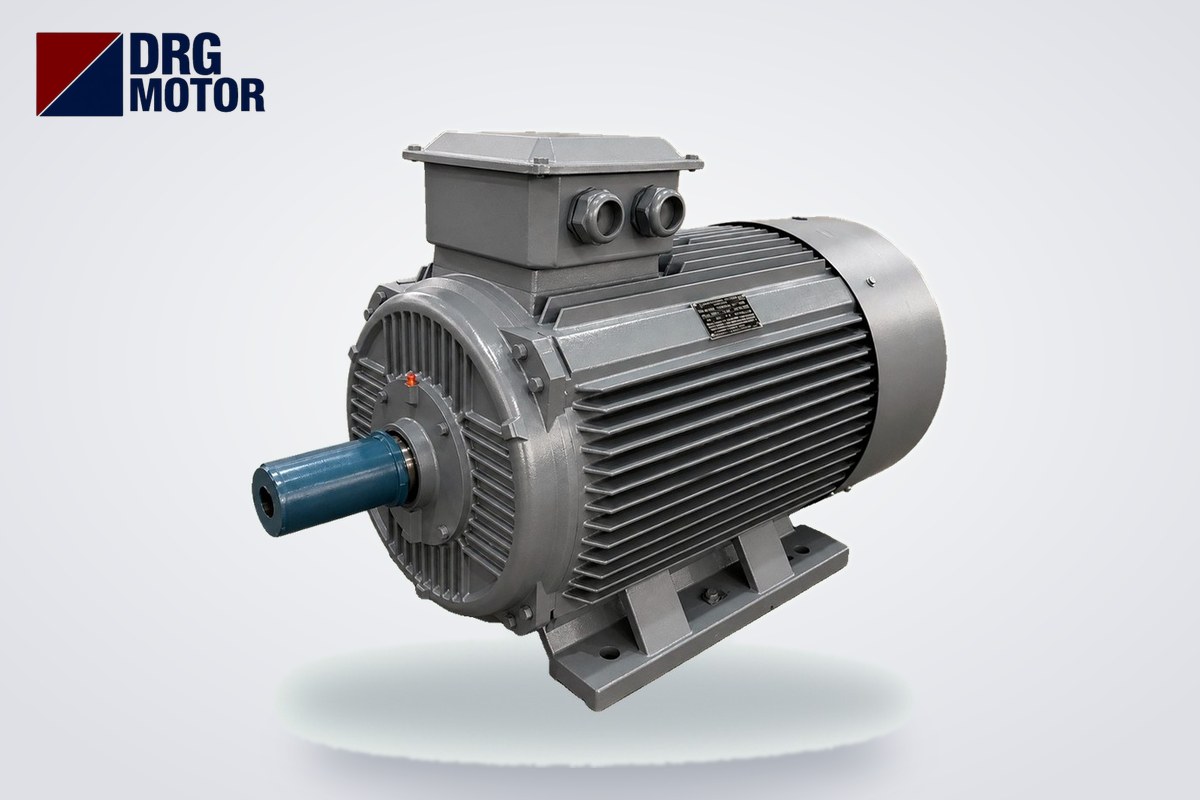

A 37 kW, 1500 rpm three-phase motor draws 69.6 A at full load on a 380 V supply, and a 45 kW, 1500 rpm motor draws 84.4 A. With direct-on-line (DOL) starting, the starting current rises to 7.4 times the rated value, i.e. about 515.0 A and 624.6 A; with star-delta starting the line current falls to one third of that, about 171.7 A and 208.2 A. The price is a starting torque that drops by the same ratio: in the star stage the motor delivers only 0.67 times its rated torque at standstill.
Current varies with the number of poles, the supply voltage and the load. The values below are the catalogue data of the cast-iron 37 and 45 kW models on our Buy Electric Motors Online page; all of them have 400/690 V windings and are connected in delta (Δ) on a 380–400 V supply. This makes them directly suitable for star-delta starting. The real subject of this article is the changeover itself: how far the current drops, how much torque is lost and on which machines that loss causes trouble.
Rated Current Table for 37 and 45 kW Motors (380 V and 400 V)
The table gives the full-load currents of the 2, 4 and 6-pole models and the ratios needed for the starting calculation. The current values are nameplate currents; if the motor is not fully loaded, your clamp meter will show a lower reading.
| Model | Power | Synchronous / rated speed | Frame | In 380 V | In 400 V | cos φ | Rated torque | Is/In |
|---|---|---|---|---|---|---|---|---|
| DRG-200L2-2 | 37 kW | 3000 / 2960 rpm | 200L | 67.4 A | 64.0 A | 0.89 | 119.4 Nm | 7.6 |
| DRG-225S-4 | 37 kW | 1500 / 1485 rpm | 225S | 69.6 A | 66.1 A | 0.86 | 237.9 Nm | 7.4 |
| DRG-250M-6 | 37 kW | 1000 / 985 rpm | 250M | 71.7 A | 68.1 A | 0.84 | 358.7 Nm | 7.1 |
| DRG-225M-2 | 45 kW | 3000 / 2965 rpm | 225M | 80.8 A | 76.8 A | 0.9 | 144.9 Nm | 7.7 |
| DRG-225M-4 | 45 kW | 1500 / 1485 rpm | 225M | 84.4 A | 80.2 A | 0.86 | 289.4 Nm | 7.4 |
| DRG-280S-6 | 45 kW | 1000 / 985 rpm | 280S | 85.8 A | 81.6 A | 0.85 | 436.3 Nm | 7.3 |
At the same power, current rises slightly as the number of poles increases, because cos φ falls: at 37 kW the 2-pole DRG-200L2-2 draws 67.4 A, the 6-pole DRG-250M-6 71.7 A. Torque, on the other hand, is inversely proportional to speed: the same 37 kW means 119.4 Nm on the shaft at 3000 rpm and 358.7 Nm at 1000 rpm. For the currents of other ratings, see our motor current chart.
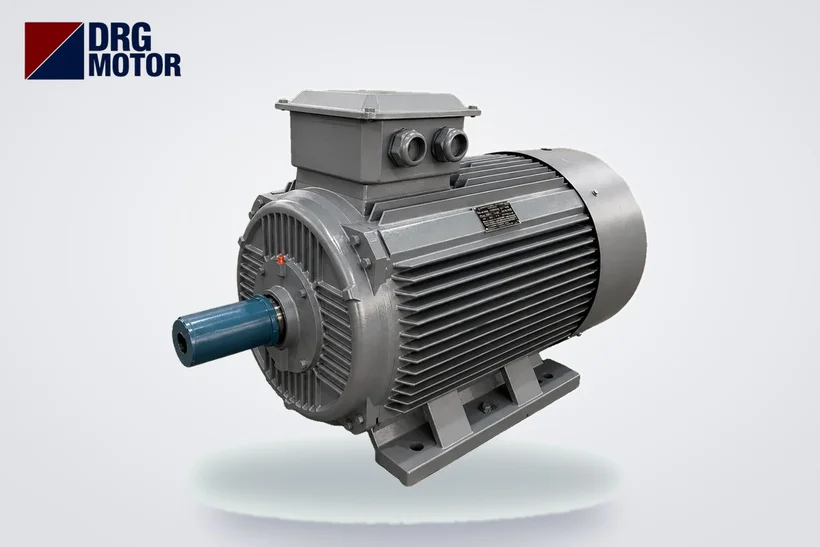
Why Does the Current Drop to One Third with Star-Delta Starting?
In a motor with a 400/690 V winding, each phase winding is designed for 400 V. In delta, each winding sees the 380 V line-to-line voltage. In star, only 380/√3 ≈ 219 V appears across each winding. When the voltage falls by a factor of √3, the winding current falls by √3 as well; since the line current is √3 times the winding current in delta but equal to it in star, the line current drops by a factor of 3 overall.
Example: for the DRG-225M-4, the DOL starting current is 84.4 A × 7.4 ≈ 624.6 A. In star it becomes about 624.6 / 3 ≈ 208.2 A, which is roughly 2.47 times the rated current. The starting surge seen by the transformer and the supply cable is therefore much smaller. If you want to know the physical reason for the high starting current, read our article why the starting (inrush) current of a motor is high; here we only deal with the star-delta side.
Torque Also Drops to One Third in Star: Starting Table
In an induction motor, torque varies with the square of the voltage. When the voltage falls by √3, torque falls by (√3)² = 3. A motor with a catalogue starting torque ratio of Ts/Tn = 2.0 starts in star with only ≈ 0.67 × Tn. The calculation for the six models:
| Model | In 380 V | DOL starting current (In×Is/In) | Line starting current in star (÷3) | DOL starting torque | Starting torque in star (÷3) | Ts/Tn in star |
|---|---|---|---|---|---|---|
| DRG-200L2-2 | 67.4 A | ≈ 512.2 A | ≈ 170.7 A | ≈ 238.8 Nm | ≈ 79.6 Nm | ≈ 0.67 |
| DRG-225S-4 | 69.6 A | ≈ 515.0 A | ≈ 171.7 A | ≈ 475.8 Nm | ≈ 158.6 Nm | ≈ 0.67 |
| DRG-250M-6 | 71.7 A | ≈ 509.1 A | ≈ 169.7 A | ≈ 717.4 Nm | ≈ 239.1 Nm | ≈ 0.67 |
| DRG-225M-2 | 80.8 A | ≈ 622.2 A | ≈ 207.4 A | ≈ 289.8 Nm | ≈ 96.6 Nm | ≈ 0.67 |
| DRG-225M-4 | 84.4 A | ≈ 624.6 A | ≈ 208.2 A | ≈ 578.8 Nm | ≈ 192.9 Nm | ≈ 0.67 |
| DRG-280S-6 | 85.8 A | ≈ 626.3 A | ≈ 208.8 A | ≈ 872.6 Nm | ≈ 290.9 Nm | ≈ 0.67 |
The "Ts/Tn in star" column is the critical value. If the machine needs more than about two thirds of the motor's rated torque to break away from standstill, the motor either will not turn in star or will accelerate very slowly. Breakdown torque also falls to one third: for the DRG-280S-6, Tmax/Tn = 2.0, so in star it becomes ≈ 0.67; in the star stage the motor cannot even carry its rated load.
Star-Delta Risk on Machines That Start Under Load
Motors in the 37–45 kW class often run crushers, mills, loaded belt conveyors, mixers and large fans. These machines behave very differently at start-up:
- Fans and centrifugal pumps: Load torque rises with speed and is very low at start. The ≈ 0.67 × Tn available in star is easily enough; star-delta is a suitable method.
- Stone crushers: No problem when starting empty. In a crusher with material left inside, breakaway torque can exceed the rated value; the motor stalls in star, the timer runs out, it switches to delta and the start effectively becomes a DOL start. Do not start the crusher without emptying it.
- Loaded conveyors and screw conveyors: With material on the belt, friction torque is highest at the moment of starting. On a conveyor that does not turn in star, the overload relay trips or the contactors are stressed. Either apply an empty-start procedure or use a drive.
- Mixers and agitators: If there is solidified material inside, the same risk as with crushers applies.
A practical check: watch the line current in the star stage with a clamp meter. If the current falls quickly after the starting surge and settles, the motor has accelerated. If the current stays high and the speed does not rise, the load is too heavy for star.
How to Set the Star-to-Delta Changeover Time
There is no single correct figure for the timer; the time depends on the inertia and load of the machine. The right setting is the moment when the motor approaches its rated speed in star and the current has fallen from the starting surge and settled. That time is very different for a crusher with a heavy flywheel and for a light fan.
- Early changeover: If the motor switches to delta before it has accelerated, a second current surge occurs. This surge can approach the DOL starting current and the whole benefit of star-delta is lost.
- Late changeover: If the motor stays in star longer than necessary, especially under load, the windings are stressed at reduced voltage and heat up.
- Changeover gap: In the classic circuit the delta contactor closes after the star contactor opens. During this short gap the motor is de-energised and slows down; a short current peak at changeover is normal. Electrical and mechanical interlocking is essential so that the contactors are never closed at the same time.
- Phase sequence: The output connections of the delta contactor must preserve the direction of rotation established in star. With the wrong sequence, the motor is momentarily forced in the opposite direction at changeover, causing a large current surge and a mechanical shock.
When setting it up, make the first test with the machine empty, time the moment the star current drops with a stopwatch and set the timer slightly above it. To compare starting methods, use our motor starting methods: star-delta tool.
What Current Are the Overload Relay and Contactors Sized For?
In a star-delta panel the motor wiring is split in two: six conductors go to the motor and no terminal links are fitted. On these models the cable entry is 2 × M50×1.5 for the 2 and 4-pole 37 and 45 kW motors and 2 × M63×1.5 for the 6-pole ones, so there is room for two cables.
The overload relay is usually connected after the main contactor, in the winding (phase) branch. It then sees the winding current rather than the line current and is set to In/√3: for the DRG-225M-4, 84.4 / √3 ≈ 48.7 A; for the DRG-225S-4, ≈ 40.2 A. If the relay is on the supply (line) side, the setting is simply In. Mixing up the two is the most common reason for a motor left unprotected or a relay that trips for no reason.
The usual sizing logic for the contactors is: the main and delta contactors carry the winding current, so their AC-3 rating is chosen ≥ In/√3 (≈ 0.58 × In). The star contactor only works during starting, so it is chosen ≥ In/3: for the DRG-225M-4, ≈ 28.1 A. The fuse or circuit breaker must carry the star starting current and the changeover peak without tripping. For the exact components, use our overload relay, fuse and contactor selection tool.
Checklist Before Building the Panel
- Does the nameplate say 400/690 V? A 230/400 V motor cannot be run star-delta on a 380 V supply; all these models are 400/690 V.
- Are all six ends free in the terminal box, with the links removed?
- Is the machine's starting torque below two thirds of the motor torque? If not, start it empty or consider a drive.
- Has the timer been set from a measurement? Was the first test done with the machine empty?
- Has the overload relay been set according to where it is connected (In or In/√3)?
- Is the direction of rotation the same in star and delta? Have the interlocks been tested?
- At full load, are the three phase currents close to each other and below the catalogue In?
Motors in This Power Range
The six models in the table are listed in the online store with cast-iron frames and 400/690 V windings:
- DRG-200L2-2 – 37 kW – 3000 rpm – 200L cast iron
- DRG-225S-4 – 37 kW – 1500 rpm – 225S cast iron
- DRG-250M-6 – 37 kW – 1000 rpm – 250M cast iron
- DRG-225M-2 – 45 kW – 3000 rpm – 225M cast iron
- DRG-225M-4 – 45 kW – 1500 rpm – 225M cast iron
- DRG-280S-6 – 45 kW – 1000 rpm – 280S cast iron
Click to see current prices and order these motors nowSEE PRICES →
You can compare all power and speed options among the 120 models in our online store.
Frequently Asked Questions
How many amps does a 37 kW motor draw in star?
The DRG-225S-4 (37 kW, 1500 rpm) draws a line current of about 171.7 A at the moment of starting in the star stage; the same motor draws about 515.0 A with DOL starting. Once the motor has accelerated it switches to delta, and at full load the current is 69.6 A. Running the motor under load in star for a long time is not correct.
What should the overload relay be set to on a 45 kW motor?
If the relay is in the winding branch of the star-delta circuit, use In/√3 ≈ 48.7 A for the DRG-225M-4; if it is on the line side, use 84.4 A. For the 2-pole DRG-225M-2 the line current is 80.8 A.
How many amps does a 45 kW motor draw at 400 V?
According to the catalogue, at 400 V the DRG-225M-2 draws 76.8 A, the DRG-225M-4 80.2 A and the DRG-280S-6 81.6 A. At 380 V the current is slightly higher.
Can a 37 kW motor be started direct-on-line?
Technically yes, but the transformer, cable and breaker must handle a starting current of about 515.0 A. If the supply is weak, star-delta, a soft starter or a drive is preferred. On a machine that starts under load, a drive is safer than star-delta because it provides high torque at low current.
If you would like help with your model and starting conditions, call us on +90 (542) 666 11 11 or write to [email protected]. For other ways to reach us, visit our contact page.