English
 Le français
 Türkçe




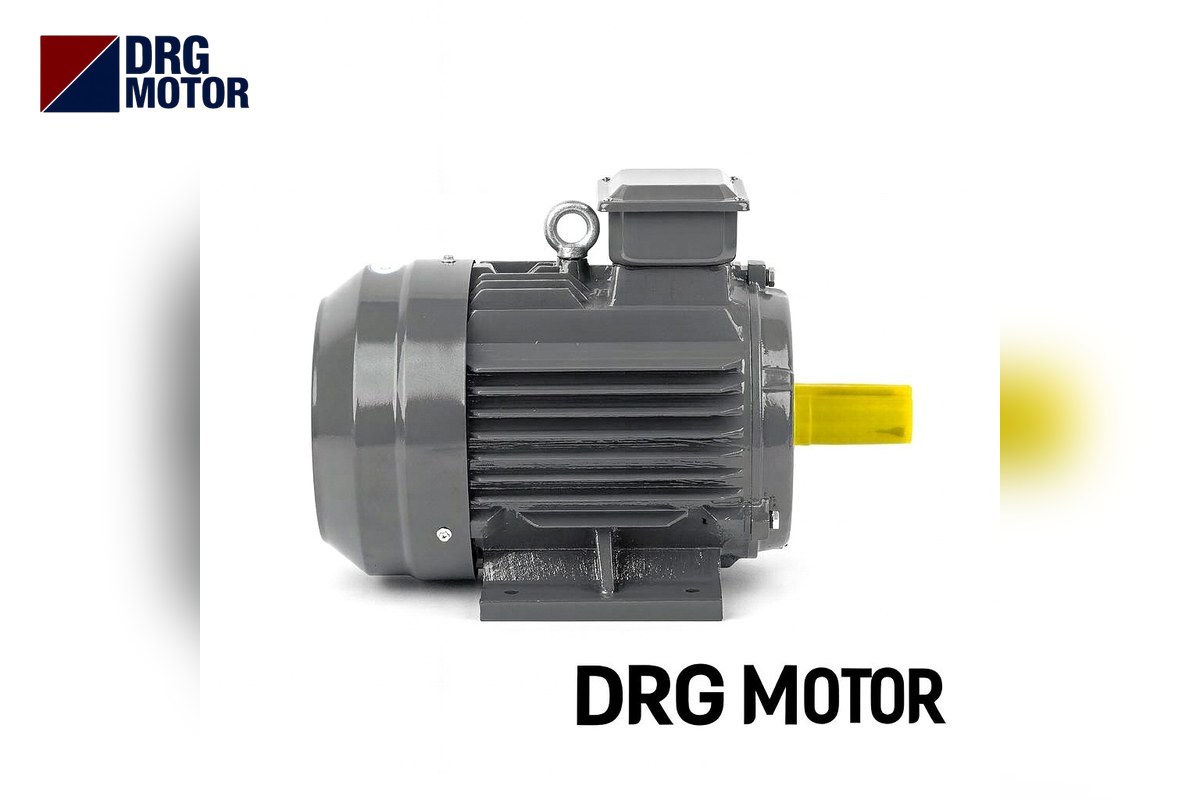

The motor people look for as a 3 HP electric motor carries a 2.2 kW rating on its nameplate: 2.2 kW is about 2.95 HP and the market rounds it to "3 HP". DRG Motor offers this power at three speeds — DRG-90L-2 for 3000 rpm, DRG-100L1-4 for 1500 rpm and DRG-112M-6 for 1000 rpm — and the aluminium and cast iron versions of each model are listed separately on our Buy Electric Motors Online page. For a workshop machine, the right choice is the model that reaches the spindle speed with the smallest transmission ratio.
Although all three models deliver the same power, shaft torque changes by more than a factor of two: the 2-pole motor gives 7.26 Nm, the 6-pole motor 22.0 Nm. That is why a sanding disc, a pillar drill and a small saw do not ask for the same "3 HP" motor but for different speeds. The values below are given for selection; connection and commissioning must be carried out by a qualified electrician.
Three 2.2 kW Models: Speed, Frame and Shaft
| Model | Poles / synchronous rpm | Rated speed (rpm) | IEC frame | Shaft D × E (mm) | Rated torque (Nm) | Price |
|---|---|---|---|---|---|---|
| DRG-90L-2 | 2 / 3000 | 2895 | 90L | 24 × 50 | 7.26 | See Prices |
| DRG-100L1-4 | 4 / 1500 | 1450 | 100L | 28 × 60 | 14.5 | See Prices |
| DRG-112M-6 | 6 / 1000 | 955 | 112M | 28 × 60 | 22.0 | See Prices |
The values in the table are identical for the aluminium and cast iron versions; the difference between the two housings lies in the material and the place of use, not in the electrical data. Frame size grows with the number of poles: the 2-pole model fits in a 90L frame while the 6-pole model moves up to 112M and the shaft height rises from 90 mm to 112 mm. If you are replacing an old motor, first compare these two dimensions (shaft height and shaft diameter) with the old one.
Which Speed for Which Workshop Machine?
The practical rule is simple: transmission ratio = motor rated speed ÷ required spindle speed. If the ratio is close to 1, the motor can be coupled directly; between 1 and 3 a pulley and belt solve it easily; as the ratio grows, a large pulley or a gearbox is needed. The table below shows the ratio of the three models for four example spindle speeds.
| Required spindle speed (rpm) | DRG-90L-2 (2895 rpm) | DRG-100L1-4 (1450 rpm) | DRG-112M-6 (955 rpm) |
|---|---|---|---|
| 700 | 4.14 | 2.07 | 1.36 |
| 1200 | 2.41 | 1.21 | 0.80 |
| 1800 | 1.61 | 0.81 | 0.53 |
| 2800 | 1.03 | 0.52 | 0.34 |
Cells below 1 mean stepping the speed up (small pulley on the spindle); this is possible but lowers belt speed and spindle torque. You can use the pulley and belt calculator to work out pulley diameters.
- Disc and belt sanders: The maximum speed printed on the disc decides. If the disc is rated below 3000 rpm, do not couple the 2-pole motor directly; use the 4-pole DRG-100L1-4 with a coupling, or a 2-pole motor with a reducing pulley.
- Pillar drill: Step-pulley drills commonly use a 4-pole motor; large holes need low speed and high torque, and on the smallest pulley step the 14.5 Nm motor torque is multiplied by the ratio at the spindle.
- Small circular saw: The blade needs a high speed for its peripheral velocity; a 2-pole motor is usually connected directly or with a ratio close to 1.
- Small band saw: The wheel turns slowly; the 6-pole DRG-112M-6 reduces the transmission ratio, so pulley and belt sizes become smaller.
Same Power, Different Torque: What Changes at Start-Up?
Torque is power divided by speed: T = 9550 × P ÷ n. For the 1500 rpm model, 9550 × 2.2 ÷ 1450 ≈ 14.5 Nm, matching the catalogue value. Starting torque is the rated torque multiplied by the Ts/Tn ratio in the catalogue:
- DRG-90L-2: 7.26 Nm × 2.2 ≈ 16.0 Nm starting torque
- DRG-100L1-4: 14.5 Nm × 2.3 ≈ 33.3 Nm starting torque
- DRG-112M-6: 22.0 Nm × 2.0 = 44.0 Nm starting torque
On machines with a heavy flywheel or a tight belt (band saw, sander with a large pulley) the run-up time gets longer. A lower-speed motor does the same job with a smaller transmission ratio and more torque on the shaft side; so on a machine that struggles at start-up, moving up one pole pair is often a cleaner solution than enlarging the pulley.
A numerical example: if a drill spindle that must turn at 700 rpm is driven by the 4-pole motor at a ratio of 2.07, rated spindle torque is about 14.5 × 2.07 ≈ 30.0 Nm, ignoring belt losses. If the same spindle is driven by the 6-pole motor at a ratio of 1.36, the result is 22.0 × 1.36 ≈ 29.9 Nm; spindle torque stays almost the same, but with the 6-pole motor the large pulley gets smaller and the belt runs slower. What decides here is not torque but whether the pulley size fits the machine.
Terminal Box: Star Bridge, Cable Entry and Bearings
The nameplate voltage of all three models is 230/400 V (Δ/Y). On a 380–400 V three-phase supply the terminals are bridged in star (Y); on an older 230 V three-phase supply they are connected in delta (Δ). At 380 V the rated currents are 4.58 A (2-pole), 4.76 A (4-pole) and 5.36 A (6-pole); for fuse and overload details see our article how many amps a 2.2 kW motor draws and the motor current chart tool.
The detail most often forgotten in the workshop is the cable gland: cable entry is 1 × M25×1,5 on the 90L and 100L frames and 2 × M32×1,5 on the 112M frame. Bearings are 6205-ZZ-C3 on the 90L and 6206-ZZ-C3 on the 100L and 112M; use this code when buying a spare bearing.
Which Housing Material in the Workshop: Aluminium or Cast Iron
Since the electrical values are identical, the choice depends entirely on where the motor is mounted:
- Aluminium: Lighter; makes work easier on portable benches, where the motor is removed and refitted by hand, and on sheet-metal machine bodies.
- Cast iron: Heavier and more rigid; preferred on machines bolted to the floor or to a steel base, running with vibration, or exposed to dust and impact.
Whichever you choose, the foot dimensions (A × B) and shaft height depend on the frame code; within the same frame code both materials give the same mounting dimensions.
Technical Factors Behind the Price of a 3 HP Motor
Differences between motors carrying the same 2.2 kW rating come from a few technical choices: number of poles (the 6-pole model moves up one frame), housing material (aluminium or cast iron), mounting type (foot B3, flange B5 or foot-and-flange B35) and the terminal box / cable entry layout. Once these are defined, you can see the current price on the related product page and compare all power ratings among the 120 models in our online store.
Checklist Before Buying a 3 HP Workshop Motor
- Have kW, speed and voltage been read from the old motor's nameplate?
- Do the shaft height (90 / 100 / 112 mm) and shaft diameter (24 / 28 mm) fit the machine?
- Has the transmission ratio been calculated from the spindle speed?
- Has the mounting type been set as B3, B5 or B35?
- Is the correct gland (M25 or M32) ready for the cable entry?
- Is a star bridge planned for a 380–400 V supply, or a delta bridge for a 230 V three-phase supply?
Motors in This Power Rating
- DRG-90L-2 – 2.2 kW – 2895 rpm – 90L aluminium
- DRG-90L-2 – 2.2 kW – 2895 rpm – 90L cast iron
- DRG-100L1-4 – 2.2 kW – 1450 rpm – 100L aluminium
- DRG-100L1-4 – 2.2 kW – 1450 rpm – 100L cast iron
- DRG-112M-6 – 2.2 kW – 955 rpm – 112M aluminium
- DRG-112M-6 – 2.2 kW – 955 rpm – 112M cast iron
Click to see current prices and order these motors nowSEE PRICES →
Frequently Asked Questions
How many kW is a 3 HP motor?
The exact equivalent of 3 HP is about 2.24 kW; the standard motor rating used is 2.2 kW. In catalogues and on nameplates a 3 HP motor appears as 2.2 kW.
What speed should a 3 HP motor have?
It depends on the machine. Saws and fans that need high speed take a 2-pole motor (2895 rpm), general workshop work a 4-pole motor (1450 rpm), and slow-running machines with heavy starts a 6-pole motor (955 rpm).
Does a 3 HP three-phase motor run on a 220 V socket?
No. These motors are three-phase and do not run directly from a single-phase 220 V socket. They can run on a 230 V three-phase supply in delta, and in star on a 380–400 V supply.
Can a 3000 rpm motor be fitted to a sander?
Yes, if the maximum speed printed on the disc is above 3000 rpm. If it is lower, use the 1500 rpm model or a speed-reducing pulley.
If you have questions about the models, call +90 (542) 666 11 11, write to [email protected] or use our contact page. You can review all power ratings and housing options on our Buy Electric Motors Online page.