English
 Le français
 Türkçe




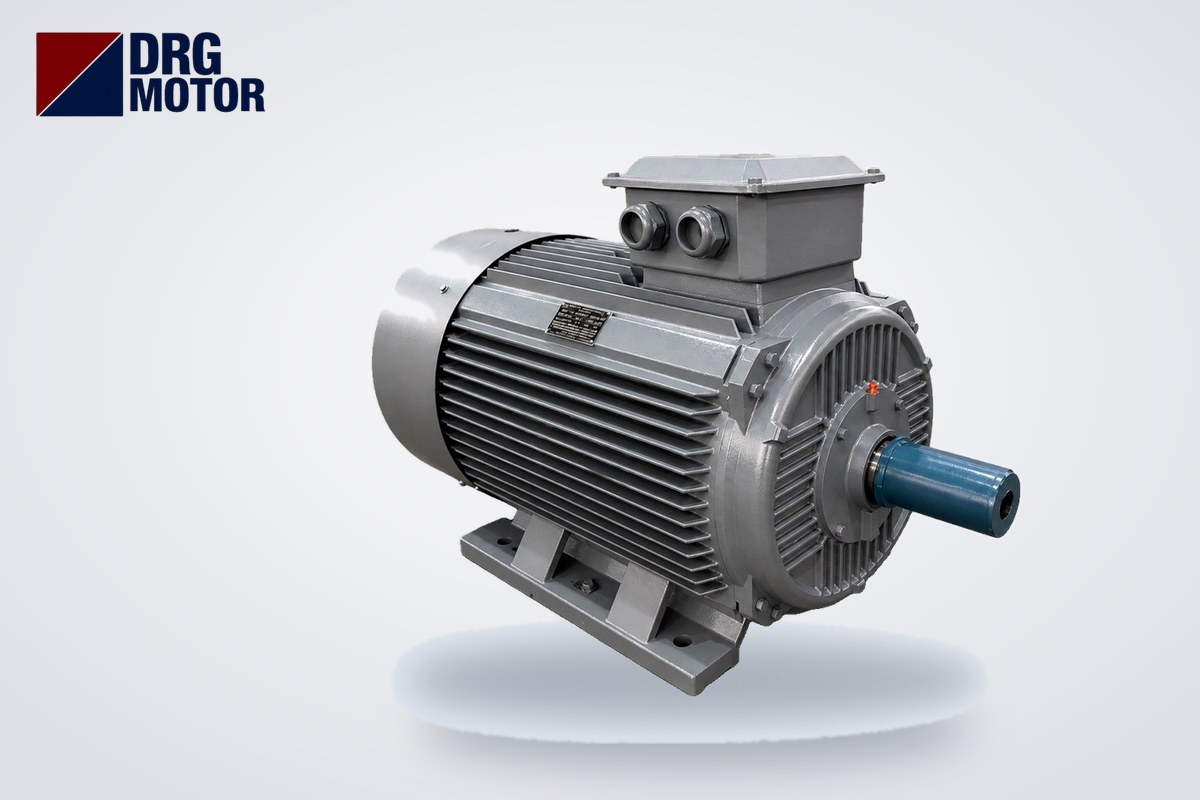

A 22 kW, 1500 rpm (4-pole) three-phase motor draws 41.8 A at 380 V; with the 1.25 factor the design current is 52.3 A, and the smallest copper size that carries it is 10 mm² (60 A). With a 3% voltage drop limit, 10 mm² is enough up to about 100 m; 16 mm² is needed between 100 and 159 m, 25 mm² between 159 and 251 m and 35 mm² between 251 and 349 m. These distances are an example calculation for copper PVC cable, ~30 °C ambient and a single circuit; an electrical engineer should confirm them for the installation method, grouping and ambient temperature.
On a short run the motor current sets the cable size; on a long run the cable resistance does. With a mid-size motor such as 22 kW the switch is clear: a 10 mm² cable is comfortably sufficient at 30 m, yet the same cable delivers a 6% voltage loss to the motor terminals at 200 m. In this article we find the cable size step by step according to distance. You can check the nameplate values and frame options of 22 kW motors on the Buy Electric Motors Online page.
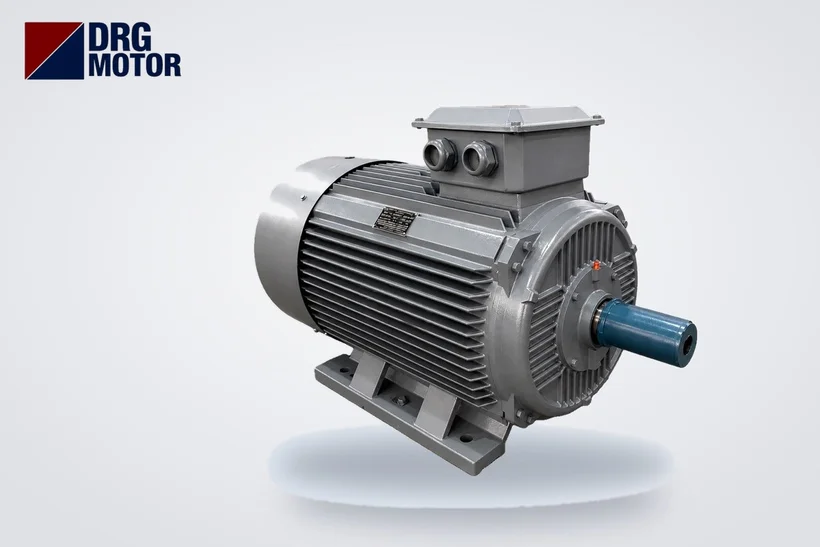
How Many Amps Does a 22 kW Motor Draw, and What Cable Size Does the Current Require?
Before the distance calculation, a current-carrying check is made: the rated current (In) on the nameplate is multiplied by 1.25 and the smallest size whose rating in the table meets that figure is selected. All three speed options of 22 kW lead to the same size:
| Model | Speed | cos φ | In 380 V | In 400 V | Design current (×1.25) | Size by current | Cable entry |
|---|---|---|---|---|---|---|---|
| DRG-180M-2 | 2955 rpm | 0.89 | 40.5 A | 38.5 A | 50.6 A | 10 mm² (60 A) | 2 × M40×1.5 |
| DRG-180L-4 | 1470 rpm | 0.86 | 41.8 A | 39.7 A | 52.3 A | 10 mm² (60 A) | 2 × M40×1.5 |
| DRG-200L2-6 | 980 rpm | 0.81 | 44.8 A | 42.5 A | 56.0 A | 10 mm² (60 A) | 2 × M50×1.5 |
A 6 mm² cable carries 43 A, so it fails the current check for every 22 kW model; the starting point is 10 mm². Since the motor does not use a neutral, the run is 3 phases + PE (e.g. 4×10 mm²). You can find the currents of other ratings in the motor current chart tool.
How Much Does Motor Voltage Drop as the Cable Gets Longer?
Every metre of cable adds resistance, and the current causes a voltage loss across it. On a three-phase run the loss is found with this formula:
ΔU = √3 × I × (L / 1000) × R × cos φ and %ΔU = ΔU / U × 100
Here I is the motor current (A), L the one-way run length (m), R the cable resistance per km (Ω/km) and U the supply voltage. Worked example: 22 kW 4-pole motor, 150 m, 16 mm² cable (R = 1.15 Ω/km): ΔU = 1.732 × 41.8 × 0.150 × 1.15 × 0.86 ≈ 10.74 V, which is 2.83% of 380 V. With 25 mm² (R = 0.727 Ω/km) on the same run, the loss drops to 6.79 V, or 1.79%.
The general limits used in the calculator on our site are 3% for the motor supply run and 5% in total from the transformer to the load. The two limits must be read together: if the run up to the main panel already loses 3%, only 2% remains for the motor run.
Voltage Drop Table for a 22 kW Motor at 25, 50, 100, 150 and 200 m
The values below are calculated for the 22 kW 4-pole motor (DRG-180L-4) with 41.8 A and cos φ 0.86 at 380 V. Values above 3% show that the size is insufficient for that distance.
| Cable size | 25 m | 50 m | 100 m | 150 m | 200 m |
|---|---|---|---|---|---|
| 10 mm² | 2.85 V (0.75%) | 5.70 V (1.50%) | 11.39 V (3.00%) | 17.09 V (4.50%) | 22.79 V (6.00%) |
| 16 mm² | 1.79 V (0.47%) | 3.58 V (0.94%) | 7.16 V (1.88%) | 10.74 V (2.83%) | 14.32 V (3.77%) |
| 25 mm² | 1.13 V (0.30%) | 2.26 V (0.60%) | 4.53 V (1.19%) | 6.79 V (1.79%) | 9.05 V (2.38%) |
| 35 mm² | 0.82 V (0.21%) | 1.63 V (0.43%) | 3.26 V (0.86%) | 4.89 V (1.29%) | 6.53 V (1.72%) |
| 50 mm² | 0.60 V (0.16%) | 1.20 V (0.32%) | 2.41 V (0.63%) | 3.61 V (0.95%) | 4.82 V (1.27%) |
A note on reading the table: at 100 m, 10 mm² sits exactly on the limit at 3.00%; once measurement error, extra joints and hours when the network is already low are taken into account, moving to 16 mm² on a run of around 100 m is the safer choice. At 200 m, 10 mm² reaches 6% and only about 357 V arrives at the motor terminals.
At What Distance Should You Move Up a Cable Size?
Turning the voltage drop formula around gives the longest permitted run for each size: Lmax = %ΔU × U / (√3 × I × R × cos φ). The table below gives these limits at 380 V for the three speed options:
| Cable size | 2-pole (3%) | 4-pole (3%) | 6-pole (3%) | 4-pole (5%) |
|---|---|---|---|---|
| 10 mm² | ≈ 99 m | ≈ 100 m | ≈ 99 m | ≈ 166 m |
| 16 mm² | ≈ 158 m | ≈ 159 m | ≈ 157 m | ≈ 265 m |
| 25 mm² | ≈ 251 m | ≈ 251 m | ≈ 249 m | ≈ 419 m |
| 35 mm² | ≈ 348 m | ≈ 349 m | ≈ 346 m | ≈ 582 m |
| 50 mm² | ≈ 471 m | ≈ 473 m | ≈ 468 m | ≈ 788 m |
There is an interesting result here: although the 6-pole motor draws more current, the permitted distance hardly changes. The reason is the I × cos φ product in the formula: 40.5 × 0.89 ≈ 36.0 for 2-pole, 41.8 × 0.86 ≈ 35.9 for 4-pole and 44.8 × 0.81 ≈ 36.3 for 6-pole. In other words, the distance limit is set by the motor's power, not its speed. On a 400 V supply the 4-pole motor draws 39.7 A and the 10 mm² limit extends to about 110 m.
Loss on the upstream run also shortens the limit: if there is already a 3% loss up to the main panel, 2% remains for the motor run and 10 mm² is enough only up to about 66 m for the 4-pole motor. To calculate with your own values, use the motor cable size calculator.
Why Is Starting Harder on a Long Run?
The tables are based on full-load current; at start-up, however, the 22 kW 4-pole motor draws 7.8 times In, about 326 A. Because the cable loss grows with current, the voltage drop at the moment of starting rises to several times the running value. The torque of an induction motor varies with the square of voltage: if the terminal voltage falls by 10%, torque falls by about 19% (0.9² = 0.81). This motor's starting torque is 2.0 times its rated torque (rated torque 142.9 Nm); on a full pump or loaded conveyor this margin melts quickly on a long run, starting takes longer and the protective device may operate. This is the real reason not to choose a cable size right at the limit on long runs.
Cable Size for the Two Cable Sets in Star-Delta Starting
All 22 kW motors are rated 400/690 V (Δ/Y) and run in delta at 380 V, so they are suitable for star-delta starting. In that case two separate 3-core cables (6 cores in total + PE) run from the panel to the motor, and each core carries the winding current, i.e. In/√3: 41.8 / 1.732 ≈ 24.1 A, with a design current of ≈ 30.2 A. By current, 4 mm² (34 A) per set is enough.
The distance calculation differs in this arrangement: the two cores going to and returning from each winding carry the same current, and the loss is found with ΔU ≈ 2 × (In/√3) × (L/1000) × R × cos φ.
| Size per set | 50 m | 100 m | 150 m |
|---|---|---|---|
| 2 × 3 × 4 mm² | 9.57 V (2.52%) | 19.14 V (5.04%) | 28.70 V (7.55%) |
| 2 × 3 × 6 mm² | 6.39 V (1.68%) | 12.78 V (3.36%) | 19.18 V (5.05%) |
| 2 × 3 × 10 mm² | 3.80 V (1.00%) | 7.60 V (2.00%) | 11.39 V (3.00%) |
| 2 × 3 × 16 mm² | 2.39 V (0.63%) | 4.77 V (1.26%) | 7.16 V (1.88%) |
Result: the 4 mm² sets that satisfy the current check are suitable only up to about 50 m; at 100 m two sets of 10 mm² are needed, and at 150 m two sets of 16 mm². The two M40×1.5 cable entries on the 180L and 180M frames let both cables enter the terminal box easily.
Example: A Field Pump 180 m from the Panel
On an irrigation line, a 22 kW 2-pole motor (DRG-180M-2) drives a surface centrifugal pump, and the pump station is 180 m from the panel. The motor draws 40.5 A at 380 V with cos φ 0.89. For direct-on-line starting and a 3-core run:
- 10 mm²: ΔU ≈ 20.57 V → 5.41% (not suitable)
- 16 mm²: ΔU ≈ 12.92 V → 3.40% (above the limit)
- 25 mm²: ΔU ≈ 8.17 V → 2.15% (suitable)
Although 10 mm² is enough by current, the distance pushes the cable up two steps to 25 mm². If the cable is buried or runs in a duct with other circuits, its current capacity changes; that derating must be done by an electrical engineer's calculation. If the pump is to be driven by a frequency converter, voltage reflection also occurs on the long cable; we explain this in dv/dt and reflected wave overvoltage on long motor cables.
Checklist Before Pulling Cable on a Long Run
- Measure the actual cable route from the panel to the motor terminals; do not use the straight-line distance.
- Take In and cos φ from the motor nameplate; measure whether the supply is 380 V or 400 V.
- Find the size by current (In × 1.25) first, then by 3% voltage drop; choose the larger.
- Find out the loss on the run up to the main panel; set the motor run's share so the total does not exceed 5%.
- If the result is very close to the limit, move up one size; remember the voltage drop at start-up.
- If star-delta is used, check both cable sets for distance separately.
- Have an engineer apply current-capacity derating for buried, ducted and grouped installation.
- Compare the outer diameter of the chosen cable with the motor cable entry (M40×1.5 / M50×1.5).
22 kW Motor Options
- DRG-180M-2 – 22 kW – 3000 rpm – cast iron 180M frame
- DRG-180L-4 – 22 kW – 1500 rpm – cast iron 180L frame
- DRG-200L2-6 – 22 kW – 1000 rpm – cast iron 200L frame
Click to see current prices and order these motors nowSEE PRICES →
For motors of other power and speed ratings, browse the 120 models in our online shop; for other calculations, see our electric motor calculators.
Frequently Asked Questions
What size cable for a 22 kW motor?
A 22 kW 4-pole motor draws 41.8 A at 380 V; with the 1.25 factor, the 52.3 A design current calls for a 10 mm² copper cable (60 A). This size is enough up to about 100 m with a 3% voltage drop; longer runs need 16 or 25 mm².
What cable size does a 22 kW motor need at 100 metres?
At 100 m, 10 mm² is exactly on the limit at 3.00%. In practice 16 mm² (1.88%) is the safer choice. On a 400 V supply the 10 mm² limit extends to about 110 m.
What cable size for a 22 kW motor at 200 metres?
At 200 m, 10 mm² gives a 6.00% loss and 16 mm² a 3.77% loss; neither is suitable. With 25 mm² the loss falls to 2.38%. This is an example calculation for copper PVC cable at ~30 °C; installation conditions should be confirmed by an engineer.
How many cables does a star-delta 22 kW motor need?
Two separate 3-core cable sets plus PE; each core carries In/√3 ≈ 24.1 A. By current, 4 mm² is enough, but two sets of 10 mm² are needed at 100 m and two sets of 16 mm² at 150 m.
For help choosing a 22 kW motor and calculating a long-run cable, call us on +90 (542) 666 11 11, write to [email protected] or use our contact page.