English
 Le français
 Türkçe




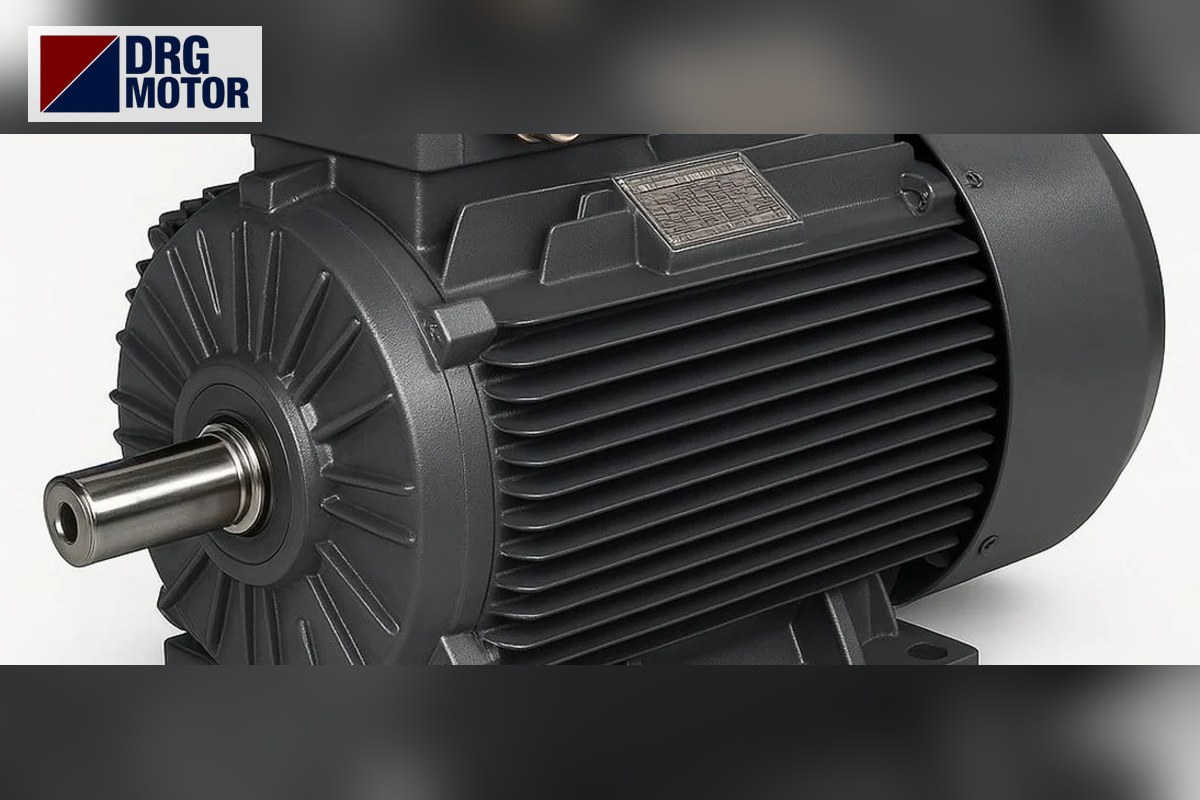

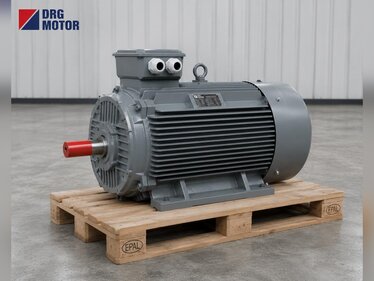
The 15 HP 3000 rpm DRG-160M1-2 (11 kW, 160M frame, 2 poles) draws 19.6 A when running on a 400 V supply; at the moment of direct-on-line start it rises to 8.1 times that current, about 159 A. This is the value that really has to be planned for in a pump application: the running current sets the cable and overload relay, while the starting current sets the fuse, contactor, generator and transformer. Panel and terminal wiring must be carried out by a qualified electrician.
This article looks at the DRG-160M1-2 from a centrifugal pump point of view: how starting current changes with the starting method, which flow-head point 11 kW is enough for, and how to check the cable running to a remote pump room. All models are listed on the Buy Electric Motors Online page for comparison with other power ratings and speeds.
Starting current: from 19.6 A to how many amps at three supply voltages?
The catalogue Is/In ratio is 8.1. Multiplying it by the rated current at each voltage gives the peak current on direct-on-line start. Apparent power is calculated as S = √3 × U × I.
| Supply | Rated current In | DOL starting current (8.1 × In) | Apparent power running | Apparent power at start |
|---|---|---|---|---|
| 380 V | 20.6 A | ≈ 166.9 A | ≈ 13.6 kVA | ≈ 110 kVA |
| 400 V | 19.6 A | ≈ 158.8 A | ≈ 13.6 kVA | ≈ 110 kVA |
| 415 V | 18.9 A | ≈ 153.1 A | ≈ 13.6 kVA | ≈ 110 kVA |
The starting kVA in the table is a conceptual figure: for a short time, about 8 times the running apparent power is drawn from the supply. If the pump is fed by a generator, or other loads share the same transformer, this surge can cause voltage dips, flickering lights and contactors dropping out on other motors. Transformer and generator sizing for this starting load should be assessed by an electrical engineer.
Current and torque by starting method
The motor has 400/690 V windings, so it runs in delta on a 400 V supply and is suitable for star-delta starting. Rated torque is 9550 × 11 / 2945 ≈ 35.7 Nm; Ts/Tn = 2.0, Tmax/Tn = 2.3.
| Method (400 V) | Starting current | Starting torque | What it means for a pump |
|---|---|---|---|
| Direct-on-line (DOL) | ≈ 159 A | ≈ 71.4 Nm (2.0 × Tn) | Simplest panel; the supply must handle the starting load |
| Star-delta | ≈ 53 A (one third) | ≈ 23.8 Nm (two thirds of Tn) | Usually enough for a centrifugal pump starting with a throttled valve |
| Soft starter / frequency inverter | Limited by setting | Depends on setting | Preferred to reduce water hammer and to control flow |
A centrifugal pump's torque demand is small at low speed and rises with the square of speed, so the ≈ 23.8 Nm in star is usually enough to accelerate the pump. The critical moment is the changeover to delta: if it happens before the motor has accelerated enough in star, current rises again. Use the star-delta starting tool for timer setting and contactor selection, and our article on cable size and fuse rating for 11 and 15 kW motors for the cable and fuse side.
DRG-160M1-2 catalogue data
| Group | Values |
|---|---|
| Power / poles | 11 kW (15 HP), 2 poles |
| Speed | Synchronous 3000 rpm, rated 2945 rpm (slip ≈ 1.8%) |
| Voltage / connection | Winding 400/690 V; Δ on a 400 V network, Y on a 690 V network |
| Current | 380 V: 20.6 A · 400 V: 19.6 A · 415 V: 18.9 A |
| cos φ | 0.89 |
| Torque | Rated 35.7 Nm; 2.0 times at start, 2.3 times at breakdown (≈ 82 Nm) |
| Starting current ratio | Is/In 8.1 |
| Bearing / cable entry | 6309-C3 · 2 × M40×1.5 |
| Shaft | 42 × 110 mm, key 12 mm, shaft end thread M16×36 |
| B3 dimensions | H 160 · A 254 · B 210 · C 108 · K 4–Φ14.5 · AC 314 · AD 251 · L 608 mm |
| B5 flange (160 frame) | P 350 · M 300 · N 250 · S 18.5 · T 5 · LA 15 mm |
Whether you pick the aluminium or the cast iron housing, every figure above stays identical. Cast iron is the common choice for damp pump rooms, wellheads and outdoor sites; aluminium for enclosed, dry plant rooms.
Which pump duty point is 11 kW at 2945 rpm enough for?
To get the shaft power, use the relation P = ρ × g × Q × H / ηp (ρ = 1000 kg/m³, g = 9.81 m/s², ηp: pump efficiency, from the pump curve). Calculation for four example points:
| Flow Q | Head H | ηp | Shaft power | Result for 11 kW |
|---|---|---|---|---|
| 50 m³/h | 40 m | 0.70 | ≈ 7.8 kW | Comfortable; above the 7.5 kW limit, so this rating fits |
| 90 m³/h | 30 m | 0.72 | ≈ 10.2 kW | Suitable, narrow margin |
| 60 m³/h | 45 m | 0.70 | ≈ 10.5 kW | Borderline; overload if the curve drifts right |
| 120 m³/h | 25 m | 0.74 | ≈ 11.1 kW | Exceeds; consider the 15 kW DRG-160M2-2 |
The calculation is for the pump's design point. Starting with the valve fully open into an empty pipeline, or running at low head, pushes the pump to the right of its curve and shaft power rises; select the motor for the pump's worst operating point. You can enter your own values in the pump and fan motor power calculator.
Remote pump room: cable size and voltage drop example
The calculation below is an example using the copper, PVC, approx. 30 °C table of the site's cable tool; it changes with installation method, grouping and ambient temperature and must be verified by the project engineer.
- Design current: 20.6 A at 380 V × 1.25 ≈ 25.8 A → at least 4 mm² (34 A) in the current-carrying table
- Voltage drop ΔU = √3 × I × L × R × cos φ (I = 20.6 A, cos φ = 0.89)
- 50 m, 4 mm² (4.61 Ω/km): ΔU ≈ 7.3 V → ≈ 1.9%
- 80 m, 4 mm²: ΔU ≈ 11.7 V → ≈ 3.1% (exceeds the 3% supply limit)
- 80 m, 6 mm² (3.08 Ω/km): ΔU ≈ 7.8 V → ≈ 2.1%
Since current rises eightfold at start, the voltage drop also becomes very large for a moment; this is one reason why direct-on-line starting struggles on long lines. Try different distances and sizes with the cable size calculator.
Pump installation checklist
- Is the speed on the pump nameplate around 2900, and is shaft power below 11 kW at the worst point?
- Does the coupling hub fit the 42 mm shaft and 12 mm key?
- Does the flanged pump housing match P 350 / M 300 / N 250?
- Has a starting method been chosen; can the transformer or generator supply ≈ 159 A on DOL start?
- Will the overload relay be set to about 19.6 A for 400 V?
- Were cross-section and voltage drop both checked for the actual run length?
- Are motor and pump aligned on the same base, and is dry-run protection fitted?
- If there is humidity or outdoor exposure, has a cast iron housing been chosen?
Motors at this power
- DRG-160M1-2: 11 kW, turning 2945 rpm, 160M aluminium version
- DRG-160M1-2: 11 kW, turning 2945 rpm, 160M cast iron version
- DRG-160M2-2: 15 kW, turning 2945 rpm, 160M cast iron option for larger pumps
- DRG-132S2-2: 7.5 kW, turning 2930 rpm, 132S cast iron option for smaller pumps
- DRG-160M-4: 11 kW, turning 1465 rpm, 160M cast iron 4-pole equivalent
Click to see current prices and order these motors nowSEE PRICES →
Looking for a 2-pole model for your pump line? Electric motor manufacturer and supplier DRG Motor gives each power step its own page in the list of 120 models in our online store.
Frequently Asked Questions
How many amps does a 15 HP 3000 rpm motor draw at start?
On direct-on-line start the DRG-160M1-2 draws about 159 A at 400 V (8.1 × 19.6 A); with star-delta this falls to about 53 A.
How many amps does an 11 kW 3000 rpm motor draw?
At full load it draws 20.6 A at 380 V, 19.6 A at 400 V and 18.9 A at 415 V.
What cable size is needed for a 15 HP pump motor?
In the example calculation the design current is about 25.8 A, so at least 4 mm² copper cable is required; on long runs such as 80 m it may be increased to 6 mm² because of voltage drop. The exact value must be set by an engineer according to installation conditions.
Will a 15 HP pump motor start with star-delta?
For a centrifugal pump starting with a throttled or closed valve, usually yes: starting torque in star is about 23.8 Nm and the pump's torque at low speed stays below that. Starting under load against a full pipeline must be assessed separately.
Email the pump's flow and head values and the line length to [email protected], or call +90 (542) 666 11 11, and we will match the model with you; address details are on the contact page.