English
 Le français
 Türkçe




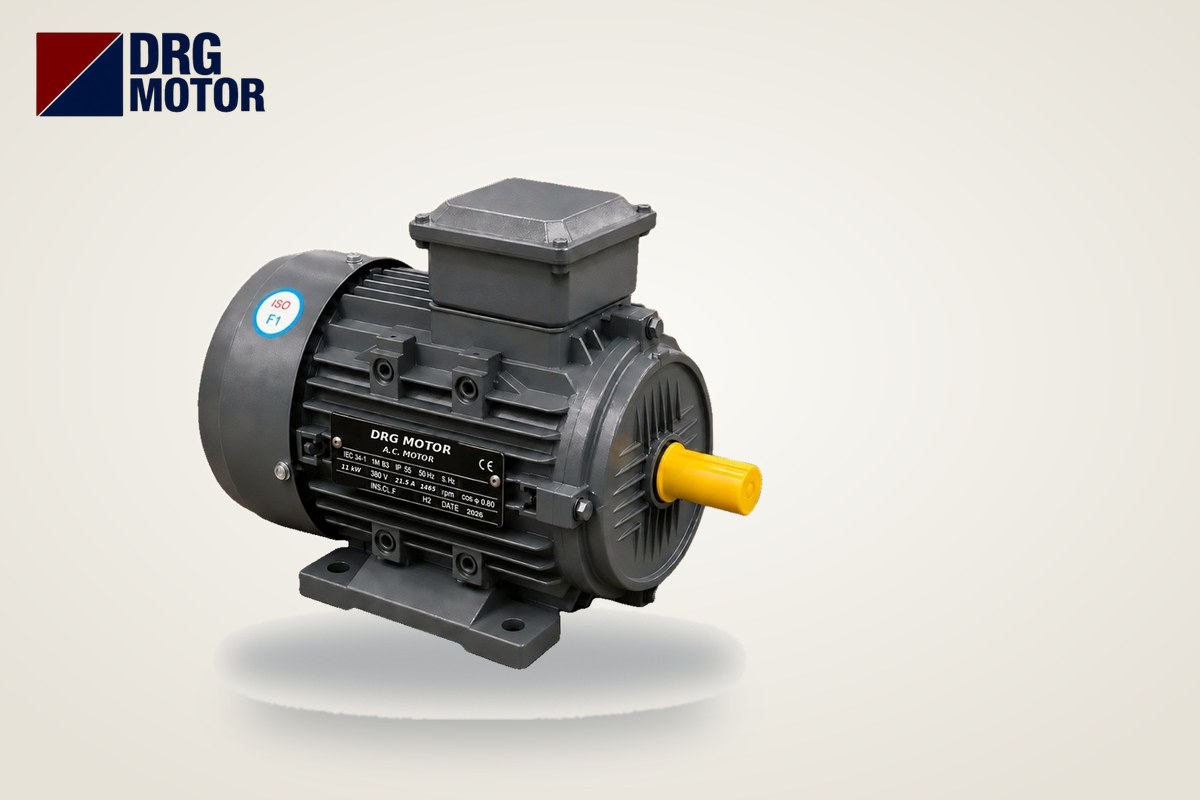

When an electric motor draws high amps, the cause almost always falls into one of two groups: either the machine is asking for more mechanical power than the motor is rated for (overload, a binding machine, an over-tightened belt, a misaligned coupling), or the electrical supply reaching the motor is wrong (low or unbalanced voltage, a lost phase, an incorrect star/delta connection). A winding fault is the seventh and less common cause. Before calling a reading "high", however, compare it with the rated current (In) on the nameplate and in the correct voltage column: an 11 kW, 1500 rpm DRG-160M-4 motor draws 21.5 A at 380 V and 20.4 A at 400 V at full load. Reading 21 A on a 380 V supply is normal operation, not a fault.
Current varies with load and rises sharply for a short time at start-up: the same motor draws about 165.6 A on direct-on-line starting (Is/In = 7.7) and settles back to its rated value within a few seconds. The problem is current that stays above the nameplate value after starting; this heats the motor, trips the overload relay and shortens winding life. The sequence below is designed to help you find the cause by measurement. If you end up needing a replacement, you can compare power and speed options among the 120 models on our Buy Electric Motors Online page.
High compared with what? Reading the rated current correctly
The current on a motor nameplate or data sheet is not a single number; it is given separately for each voltage. The difference between 380 V, 400 V and 415 V is a few amps, and someone reading the wrong column may remove a healthy motor because it "draws too much". The second key item is the voltage pair: a motor rated 230/400 V is connected in star on a 380 V supply, while a 400/690 V motor is connected in delta. The three examples below come straight from our store data.
| Model | Power / speed | In 380 V | In 400 V | In 415 V | cos φ | Is/In | Connection at 380 V |
|---|---|---|---|---|---|---|---|
| DRG-100L2-4 | 3 kW / 1450 rpm | 6.34 A | 6.02 A | 5.8 A | 0.82 | 7.6 | Star (230/400 V) |
| DRG-160M-4 | 11 kW / 1465 rpm | 21.5 A | 20.4 A | 19.7 A | 0.85 | 7.7 | Delta (400/690 V) |
| DRG-225S-4 | 37 kW / 1485 rpm | 69.6 A | 66.1 A | 63.7 A | 0.86 | 7.4 | Delta (400/690 V) |
The rule is simple: if the measured current is below or close to the In value for the voltage the motor is connected to, the motor is healthy. If it stays above that value, work through the seven causes below in order. To see how current changes with voltage for every power rating, use our motor current chart tool.
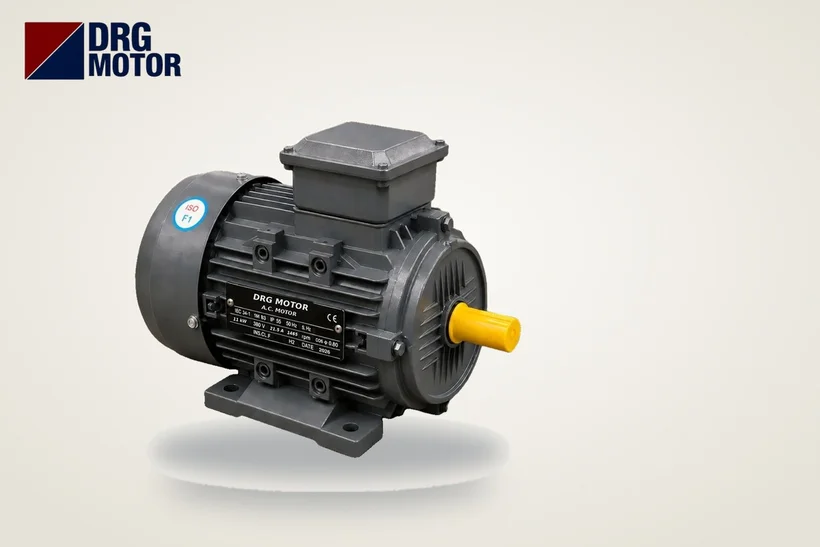
Measuring all three phases with a clamp meter and calculating unbalance
A reading from a single phase is misleading. Clamp L1, L2 and L3 one at a time (only one conductor inside the jaws), with the motor at its normal load and after starting has finished. At the same time, note the phase-to-phase voltages at the terminal box; half of all current problems come from the voltage.
Example reading (11 kW DRG-160M-4, 380 V): L1 = 22.0 A, L2 = 20.8 A, L3 = 22.6 A.
- Average current: (22.0 + 20.8 + 22.6) / 3 = 21.8 A
- Largest deviation from the average: 21.8 − 20.8 = 1.0 A
- Current unbalance: 1.0 / 21.8 × 100 ≈ 4.6%
- Average current relative to In: 21.8 / 21.5 ≈ 1.01 → the motor is running at its full-load limit
This reading carries two separate messages. Because the average equals In, the load is at the limit; the difference between phases may be coming from the supply or the connection. To locate the source of the unbalance, roll the motor connection one step (L1→L2, L2→L3, L3→L1) and measure again: if the high current stays on the same supply phase, the problem is in the supply; if it follows the same motor winding, the problem is in the motor.
7 reasons an electric motor draws high current, and how to fix them
1. Overload: the motor is doing more work than its rating
If a pump impeller has been enlarged, a fan damper opened fully, more material loaded on a conveyor or a new stage added to a machine, the motor delivers more than its rated power and the current rises on all three phases together. Measurement: balanced phases, normal voltage, but average current above In. If reducing the load step by step (throttling a valve, cutting the feed) brings the current down, the diagnosis is confirmed. Fix: reduce the load to the motor's rated power or replace the motor with the next size up.
2. Low or unbalanced voltage
If the voltage drops while the load stays the same, the motor draws more current to deliver the same power. As a rough estimate, an 11 kW motor fed with 350 V instead of 380 V rises to about 21.5 × 380 / 350 ≈ 23.3 A. Unbalanced voltage is more insidious: a small voltage difference between phases appears as a current unbalance several times larger. Measurement: L1-L2, L2-L3 and L3-L1 voltages at the terminals; for example, readings of 392 V, 381 V and 371 V give an average of 381.3 V, a largest deviation of 10.7 V and a voltage unbalance of about 2.8%. Fix: check loose busbar/terminal connections, oxidised contactor contacts and undersized or very long supply cables; if the unbalance comes from the grid, report it to the distribution company serving the site. You can check cable voltage drop with our motor cable size calculator.
3. Wrong star/delta connection (230/400 V vs 400/690 V)
This mistake is most common after a motor replacement. If a 230/400 V motor (for example the 3 kW DRG-100L2-4) is connected in delta on a 380 V supply, each winding sees 380 V instead of 220 V; the motor draws a very high magnetising current even at no load, trips the overload or burns its winding quickly. The reverse is also a problem: if a 400/690 V, 11 kW motor is connected in star at 380 V, the winding voltage falls to roughly 380/690 of rated and torque falls with the square of that ratio (≈0.30); the motor loses speed under load and current rises. Measurement: compare the voltage pair on the nameplate with the terminal links. Fix: on a 380/400 V supply, a 230/400 V motor is connected in star and a 400/690 V motor in delta.
4. Phase loss (single phasing)
A blown fuse, a burnt contactor contact or a loose terminal screw leaves the motor on two phases. A running motor may keep turning, but the current on the two remaining phases rises by roughly √3; on an 11 kW motor that means about 21.5 × 1.73 ≈ 37.2 A. A stationary motor cannot start on two phases at all and just hums. Measurement: zero or very low current on one phase, high current on the other two. Fix: check fuses, contactor contacts and terminal screws; a phase-failure relay catches this fault before the motor overheats.
5. Mechanical binding and bearing failure
A dry or damaged bearing, or rubbing on the machine side, increases the torque the motor has to overcome. Current then rises evenly on all three phases and the frame and bearing housings run hotter than normal. Measurement: with the motor isolated and locked out, turn the shaft by hand; stiffness, catching or a gritty feel points to the bearing. Remove the coupling and run the motor uncoupled: if current returns to normal, the problem is in the machine. Fix: replace the bearing or eliminate the rubbing in the machine. We cover bearing diagnosis from noise and vibration in detail in how to tell motor bearing failure.
6. Belt tension and coupling misalignment
An over-tightened belt loads the motor shaft and bearing sideways; a misaligned coupling adds load on every revolution. Both show up in the current as extra mechanical loss and usually come with bearing heating. Measurement: slacken the belt or disconnect the coupling and measure the current again; check pulley alignment with a straightedge and coupling alignment with a dial indicator or laser. Fix: set the tension recommended by the belt manufacturer and align the shafts accurately.
7. Winding fault
An inter-turn short or a winding with weakened insulation produces noticeably higher current on one phase and local heating. In the roll test, the high current follows the same motor winding. Measurement: with the motor de-energised, compare the resistance of the three windings with a micro-ohmmeter or precise ohmmeter and measure insulation resistance with a megohmmeter (these tests should be carried out by a qualified electrician). Fix: a motor with a damaged winding is assessed by a specialist workshop or replaced.
Quick diagnosis table by symptom
| What you measure | Likely cause | First check |
|---|---|---|
| Three phases balanced, all above In, voltage normal | Overload, binding, belt/coupling | Disconnect the coupling and measure no-load current |
| Three phases balanced, all high, voltage low | Low supply voltage, long/undersized cable | Measure voltage at the terminals under load |
| One phase clearly higher, follows the supply phase | Voltage unbalance, loose connection | Phase-to-phase voltages, busbar and contactor contacts |
| One phase clearly higher, follows the motor winding | Winding fault | Winding resistance and insulation test |
| No current on one phase, the other two very high | Phase loss | Fuses, contactor, terminal screws |
| High current even at no load, motor heats quickly | 230/400 V motor connected in delta | Nameplate voltage and terminal links |
| Long start, speed drops under load | 400/690 V motor connected in star, or low voltage | Terminal links, voltage during starting |
When is replacing the motor the right fix?
If the voltage is correct and balanced, the connection matches the nameplate, the mechanical side turns freely, and the average current is still above In, the machine genuinely needs more power than the motor can give. Raising the overload setting is not a solution; the motor will run hot continuously and its protection is effectively disabled. To estimate the required power roughly, use the ratio of measured average current to In: if an 11 kW motor draws 24.1 A continuously, the ratio is 24.1 / 21.5 ≈ 1.12, meaning the load has gone above 12 kW. The next standard rating, the 15 kW DRG-160L-4 (28.8 A at 380 V), carries that load with margin.
The speed must stay the same when replacing; fitting a 3000 rpm motor to a 1500 rpm machine increases the load and the current even further. Frame, shaft and flange dimensions should also be compared. For overload settings and protection logic, see what does a thermal overload relay do; for fuse sizing, use our overload, fuse and contactor selection tool.
On-site checklist for high motor current
- Have you read the voltage pair on the nameplate (230/400 V or 400/690 V) and the In value for 380/400 V?
- Do the terminal links match the nameplate (230/400 V → star, 400/690 V → delta)?
- Was the current on each of the three phases measured separately, at normal load, after starting?
- Have the average current and the unbalance percentage been calculated?
- Were phase-to-phase voltages measured at the terminals under load and the unbalance calculated?
- Has a roll test separated a supply problem from a motor problem?
- Was the motor run uncoupled to check no-load current and shaft freedom?
- Have bearing housing and frame temperatures been compared by hand or thermometer?
- Are fuses, contactor contacts and terminal screws tight and clean?
- Have winding resistance and insulation tests been done by a qualified electrician?
Motors in this power range
If your measurements show the motor is undersized, these store models let you move up a power step at the same speed:
- DRG-100L2-4 – 3 kW – 1500 rpm – aluminium frame
- DRG-112M-4 – 4 kW – 1500 rpm – aluminium frame
- DRG-132M-4 – 7.5 kW – 1500 rpm – aluminium frame
- DRG-160M-4 – 11 kW – 1500 rpm – cast iron frame
- DRG-160L-4 – 15 kW – 1500 rpm – cast iron frame
- DRG-225S-4 – 37 kW – 1500 rpm – cast iron frame
Click to see current prices and order these motors nowSEE PRICES →
Frequently Asked Questions
My motor draws more than its nameplate current. Is that normal?
Apart from the first few seconds after starting, running continuously above nameplate current is not normal. First make sure you are comparing your reading with the In for the voltage the motor is connected to; a reading at 380 V will be slightly higher than the 400 V column. If the difference persists, check the load, the voltage and the connection in that order.
Why does one phase of a three-phase motor draw more current?
The most common cause is supply voltage unbalance or a loose connection on one phase; less often it is a winding fault. Roll the motor connection by one position and measure again: if the high current stays on the same supply phase, the problem is in the supply; if it moves with the same motor winding, the problem is in the motor.
What causes high no-load current in a motor?
The most typical cause of high no-load current is a 230/400 V motor connected in delta on a 380 V supply, or a high supply voltage. A seized bearing or the rotor rubbing the stator also increases no-load current. Comparing the connection with the nameplate is the first step.
Is raising the overload setting a fix for a motor drawing high amps?
No. The overload relay is set to the In on the motor nameplate; raising it only silences the warning, does not stop the motor overheating and puts the winding at risk. Find the cause of the high current first; if the load really is larger, increase the motor power.
To discuss your measurements or choose the right motor, call us on +90 (542) 666 11 11, email [email protected] or use our contact page. You can browse every power and speed option among the 120 models in our online store.