English
 Le français
 Türkçe




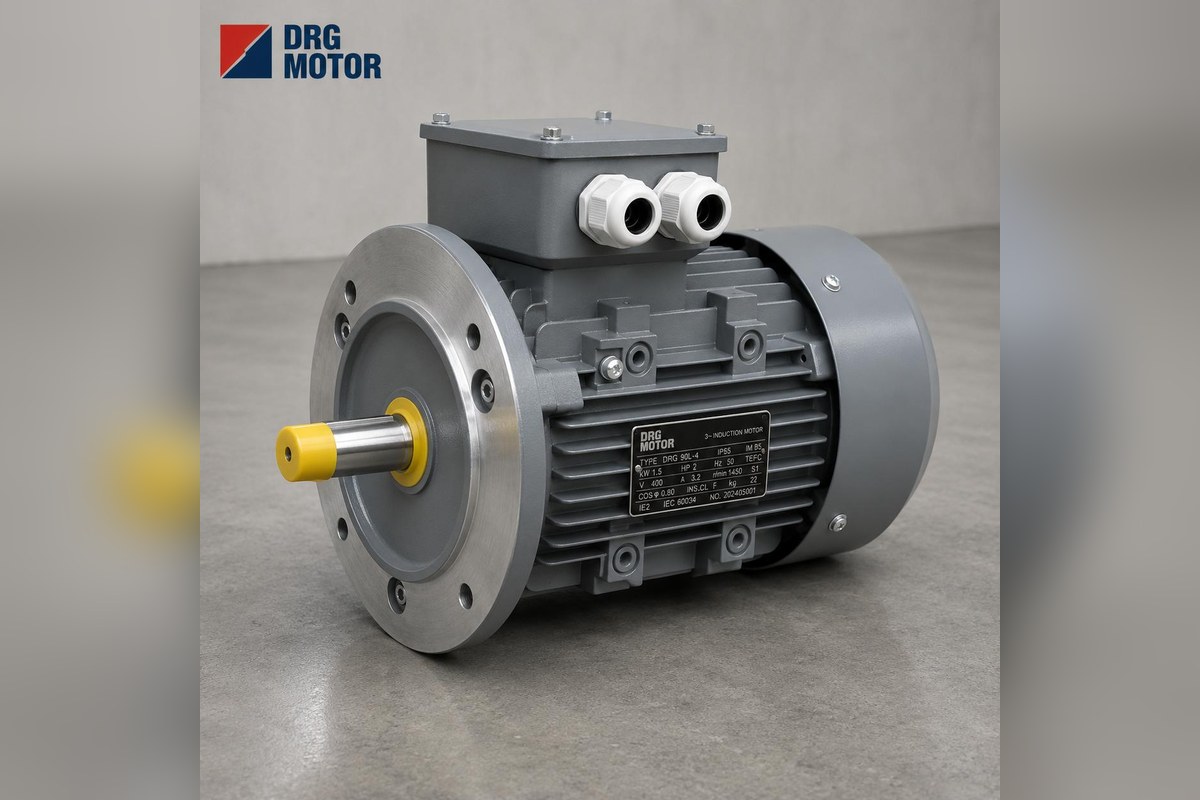

A 2.2 kW flange motor for a centrifugal pump is usually the 2-pole DRG-90L-2: 90L frame, B5 flange with 200 mm outside diameter, 165 mm bolt circle, 130 mm spigot, 12 mm holes and a 24×50 mm shaft. The 4-pole DRG-100L1-4 and the 6-pole DRG-112M-6 move up to a larger shared flange: P 250, M 215, N 180 mm, shaft 28×60 mm.
So if the flange on the pump casing needs a 130 mm spigot, only the 2-pole model fits directly; a pump or lantern with a 180 mm spigot matches the 4- and 6-pole models. The aluminium and cast iron versions of all three are listed on separate product pages under Buy Electric Motors Online.
Which motor size does the pump flange require?
The table below is compiled from the IM B5 dimensions of the DRG catalogue. Columns are arranged by frame; find the value you measured on the pump flange in a row and see which column it falls into.
| Dimension (mm) | DRG-90L-2 (90L) | DRG-100L1-4 (100L) | DRG-112M-6 (112M) |
|---|---|---|---|
| P – flange outside diameter | 200 | 250 | 250 |
| M – bolt circle diameter | 165 | 215 | 215 |
| N – spigot diameter | 130 | 180 | 180 |
| S – hole diameter | 12 | 14.5 | 14.5 |
| T – spigot depth | 3.5 | 4 | 4 |
| LA – flange thickness | 12 | 13 | 14 |
| D×E – shaft | 24×50 | 28×60 | 28×60 |
| F / G – key | 8 / 20 | 8 / 24 | 8 / 24 |
| L – overall length | 361 | 406 | 394 |
| AC – housing diameter | 182.4 | 205.4 | 230 |
| Price | See Prices | See Prices | See Prices |
A notable detail: the overall length of the 6-pole motor in the 112M frame (394 mm) is shorter than the 4-pole motor in the 100L frame (406 mm). The 112M frame is wider (AC 230 mm) but more compact in length; this helps if the pump base limits length.
Centrifugal pump: 2895 or 1450 rpm?
A pump curve is drawn for a given speed, and when the speed changes, flow, head and power change together. According to the affinity laws, flow varies in direct proportion to speed, head with the square of speed and shaft power with the cube of speed.
The rated speed of DRG-90L-2 is 2895 rpm and that of DRG-100L1-4 is 1450 rpm; the ratio is about 2. When the same impeller is turned by the 4-pole motor, flow drops to roughly half, head to roughly a quarter and absorbed power to roughly one eighth. A pump giving 30 m³/h and 15 m at 2900 rpm gives about 15 m³/h and 3.8 m at 1450 rpm.
That is why a 2-pole motor should be chosen when the pump nameplate says "2900"; with a 4-pole motor the pump appears to "run but not deliver". Conversely, spinning a large impeller designed for 1450 rpm with a 2-pole motor overloads the motor.
From pump power to motor power: is 2.2 kW enough?
You can roughly find the power the pump needs at its shaft with: P = ρ × g × Q × H / ηp. Here ρ is water density (1000 kg/m³), g is 9.81 m/s², Q is flow (m³/s), H is head (m) and ηp is the pump efficiency taken from the pump catalogue.
Example: Q = 30 m³/h (0.00833 m³/s), H = 15 m, pump efficiency 0.65. P = 1000 × 9.81 × 0.00833 × 15 / 0.65 ≈ 1.89 kW. A 2.2 kW motor covers this load with about 17% margin. Do not reduce this margin to zero, because absorbed power rises at the right-hand end of the pump curve (valve fully open, low back pressure). You can try other flows and heads in the pump and fan motor power calculator.
100L and 112M: same flange, different motor
The flanges of the 4- and 6-pole 2.2 kW models are identical, but other differences appear when coupling to a pump:
- Flange thickness (LA): 13 mm on 100L, 14 mm on 112M. That 1 mm matters when working out bolt length.
- Torque: DRG-100L1-4 gives 14.5 Nm, DRG-112M-6 gives 22.0 Nm (9550 × 2.2 / 955 ≈ 22.0).
- Current (380 V): 4.76 A and 5.36 A; cos φ 0.81 and 0.74.
- Bearing: 6206-ZZ-C3 on both; 6205-ZZ-C3 on the 2-pole 90L frame.
- Cable entry: 2 × M32×1.5 on the 112M frame.
If the pump hub or coupling is bored to 28 mm, either model can be used as long as the spigot and bolt circle also match; the pump's design speed decides. For details of coupling and key sizes, see our article on motor shaft diameter, key and coupling standards.
Starting current and protecting the pump line
A pump motor started direct on line draws several times its rated current at the first moment. Using the Is/In ratios in the catalogue, the starting current at 380 V is roughly 4.58 × 7.6 ≈ 34.8 A for DRG-90L-2, 4.76 × 7.6 ≈ 36.2 A for DRG-100L1-4 and 5.36 × 6.6 ≈ 35.4 A for DRG-112M-6. The fuse must not blow during this time, while the overload relay should be set close to the rated current.
All three models are wound for 230/400 V and are star-connected on a 380 V supply. The overload, fuse and contactor selection page works with these current values. Have the panel wiring done by a qualified electrician.
Checklist before mounting on the pump
- Is the design speed on the pump nameplate (2900 / 1450 / 950) in the same class as the motor's rated speed?
- Is the spigot diameter of the pump flange 130 mm or 180 mm?
- Is the bolt circle 165 mm (4 holes, 12 mm) or 215 mm (4 holes, 14.5 mm)?
- Is the pump hub 24 mm or 28 mm; is the keyway 8 mm?
- Is the calculated shaft power below 2.2 kW with a reasonable margin?
- Will the motor run vertically (shaft down)? State this when ordering.
- Is the overload set according to the rated current?
Technical items that affect the price of a 2.2 kW flange motor
At this power the deciding items are the number of poles (the frame goes from 90L to 100L/112M), housing material (aluminium or cast iron) and mounting type (B5 or B35). For the general pump motor range see the pump motors page; for current figures and ordering see all models in the online store.
Aluminium or cast iron: housing by pump environment
Each of the three 2.2 kW models is offered with an aluminium and a cast iron housing; flange and shaft dimensions are the same for both materials, so nothing changes on the pump side. The difference shows up in the installation environment. The aluminium housing is light; it makes the job easier for motors placed on the pump base by hand, removed and refitted often or used on a portable pump set.
The cast iron housing offers a tougher exterior on vibrating floors, on open sites where it may take knocks and in dusty or damp pump rooms. Cast iron is often chosen for a surface pump at an irrigation well head or a circulation line in an industrial plant, aluminium for booster sets or small pressurisation units. Choose according to where the pump stands; the electrical values are the same for both housings. Plants that keep spare motors benefit from standardising on one housing material, because a failed unit can then be swapped quickly with the same bolts and coupling; so also check which housing dominates your existing pump fleet.
Motors at this power
- DRG-90L-2 – 2.2 kW – 2895 rpm – 90L: aluminium · cast iron
- DRG-100L1-4 – 2.2 kW – 1450 rpm – 100L: aluminium · cast iron
- DRG-112M-6 – 2.2 kW – 955 rpm – 112M: aluminium · cast iron
Click to see current prices and order these motors nowSEE PRICES →
Frequently Asked Questions
What is the flange diameter of a 2.2 kW motor?
On the 2-pole 2.2 kW motor (90L frame) the B5 flange outside diameter is 200 mm; on the 4- and 6-pole models (100L and 112M frames) it is 250 mm.
How many amps does a 2.2 kW pump motor draw?
The 2-pole DRG-90L-2 draws 4.58 A at 380 V and 4.35 A at 400 V.
What is the shaft diameter of a 2.2 kW 3000 rpm motor?
The shaft of DRG-90L-2 is 24 mm in diameter and 50 mm long; the key width is 8 mm.
How many kW is a 3 HP pump motor?
A motor sold as 3 HP is 2.2 kW; all 2.2 kW models in our store belong to this class.
Send us a photo of your pump nameplate and the flange dimensions and we will pin down the right 2.2 kW motor together: +90 (542) 666 11 11 · [email protected] · contact.