 English
 Le français
 Türkçe

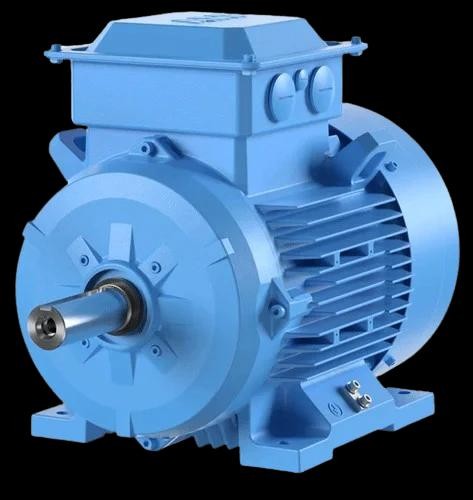

Aggregate and quarry plants are among the most demanding operating environments for electric motors. In these plants, where tonnes of rock are crushed, screens vibrate constantly and conveyors carry material all day long, motors must cope with heavy dust, high vibration, sudden load shocks and long operating hours. A wrongly selected motor quickly overheats, suffers premature bearing wear or struggles and fails during starting. The right motor selection, on the other hand, enables uninterrupted production, keeps energy costs under control and reduces maintenance expenses.
In an aggregate plant there is no single type of motor; each piece of equipment has its own load characteristic and operating profile. The motor driving the primary crusher, the vibration motor that shakes the screen and the motor turning the conveyor all face completely different demands. In this article we examine how to select the right motor for each piece of equipment in quarry and aggregate plants, which parameters are critical, and how these tough conditions are overcome with the DRG Motor engineering approach.
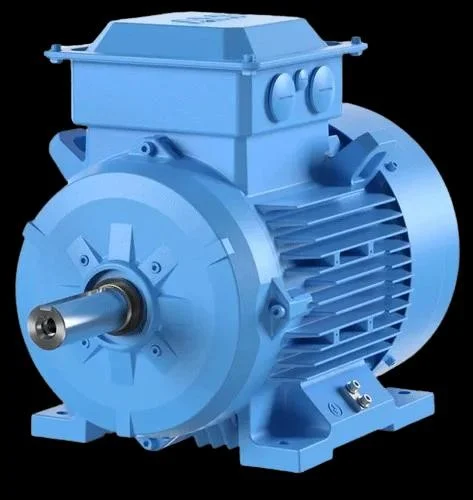
The General Structure of an Aggregate Plant and Its Motor Needs
A typical aggregate production plant consists of a series of equipment that gradually reduces raw rock to the desired sizes. The material is first fed into the primary crusher, then passes to the secondary and, where needed, tertiary crushers, is separated by size in screens and carried to stockpiles by conveyors. There is an electric motor at every link of this chain, and the weakest motor in the chain limits the capacity of the entire plant.
For this reason, motor selection in an aggregate plant is not a single decision but a holistic system design. The power, duty type, protection class and mechanical strength of each motor must be determined according to the demands of the equipment it serves. Within the industrial electric motors family, the ones suitable for these plants are usually models with high starting torque and a stiff frame structure.
Matching Equipment with Motor Type
The table below summarises the main equipment in an aggregate plant, their load characteristics and the appropriate motor selection criteria. This table allows you to quickly see which motor feature stands out for which equipment in plant design.
| Equipment | Load Characteristic | Key Motor Criterion |
|---|---|---|
| Primary crusher (jaw) | Very high starting torque, shock load | High starting torque, high inertia capacity |
| Secondary crusher (cone/impact) | High and variable load | High torque, good cooling |
| Tertiary crusher (vertical shaft) | High speed, continuous load | High speed, balance and vibration resistance |
| Vibrating screen | Continuous vibration, unbalanced load | Vibration motor, heavy-duty bearings |
| Vibrating feeder | Vibrating, intermittent | Vibration motor, IP66 protection |
| Belt conveyor | High inertia, incline load | High starting torque, S1 continuous |
Primary Crusher Motors: High Starting Torque Is Essential
The primary crusher is where the raw rock is broken for the first time, and jaw-type crushers are usually used. These crushers operate with a large and heavy flywheel; overcoming the inertia of this flywheel and setting a full crusher in motion requires a high starting torque. Primary crusher motors must be able to produce a starting torque well above their rated torque and withstand the heating that occurs during long starting periods.
In addition, the large pieces of rock falling into the crusher create sudden load shocks. The motor must continue to operate without stalling despite these shocks, that is, it must have sufficient pull-out torque. In selecting stone crushing plant motors, the starting and pull-out torque are far more decisive parameters than the rated power.
Secondary and Tertiary Crusher Motors
Secondary crushers (usually cone or impact type) reduce the material from the primary to smaller sizes. In these crushers the load is more uniform than the primary's but still high. In motor selection, in addition to continuous high torque, good cooling capacity stands out, because these motors run for hours without interruption.
Tertiary crushers (for example vertical shaft impact crushers) run at high speed and play a critical role in sand production. Here the dynamic balance and vibration resistance of the motor become important; an unbalanced motor damages both itself and the connected equipment at high speed. The relationship between pole count and speed is decisive in selecting a motor suited to the crusher's required speed.
Screen and Feeder Vibration Motors
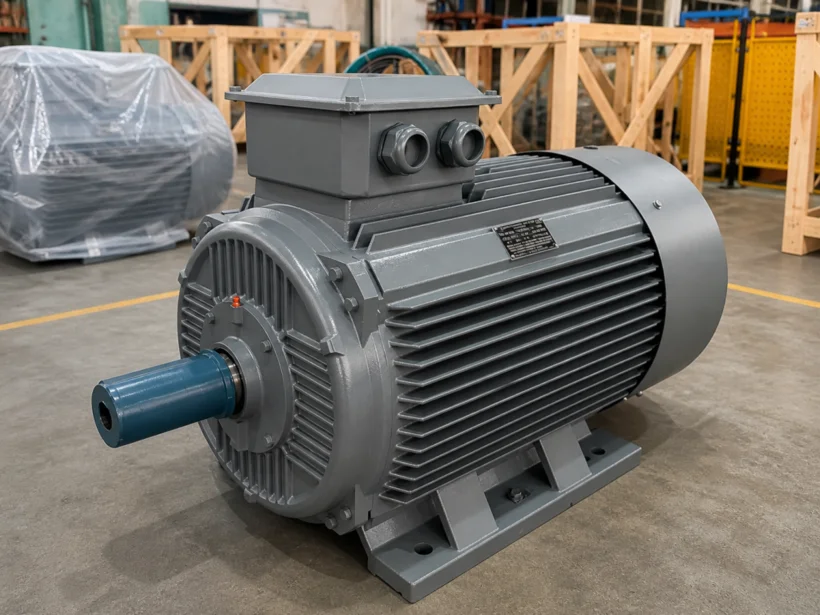
Vibrating screens and vibrating feeders produce continuous vibration to separate material by size and ensure regular flow. In these applications, specially designed vibration motors are used instead of a standard motor. These motors generate vibration thanks to adjustable unbalanced weights (eccentrics) at the end of the shaft and have reinforced bearings designed to operate under continuous vibration.
The most critical feature of vibration motors is the bearing system that withstands continuous dynamic load. A standard motor would suffer a bearing failure in a short time under these conditions. Furthermore, since these motors operate in a heavily dusty environment, they must have at least IP66 protection class. Since the plant's efficiency largely depends on the uninterrupted operation of the screens, the reliability of the vibration motors directly affects production capacity.
Conveyor Belt Motors and High Starting Torque
In aggregate plants, conveyors carry material between equipment and to stockpiles. A loaded conveyor belt must move together with the inertia of the tonnes of material on it; this requires a high starting torque. Especially in conveyors carrying material uphill, the motor must produce sufficient torque both at start-up and during continuous operation.
Conveyor motors typically operate in S1 continuous duty and rotate under constant load for most of the day. When making a conveyor belt motor selection, the length, incline and amount of material carried by the belt must be carefully calculated; sufficient starting torque must also be foreseen so that the loaded belt can restart after stopping.
Dust and Water: The Importance of the Protection Class
The quarry environment is an aggressive one where dust and moisture coexist for electric motors. Fine stone dust can clog the motor's ventilation channels, block cooling and seep inside to damage the windings. For this reason, motors used in aggregate plants must have a high protection class (IP55, preferably IP65/IP66).
Rain, wash water and damp material also pose a risk of water ingress into the motors. Correct protection class selection ensures the motor is protected from both dust and water. Among the challenges of electric motors in heavy industry, dust and moisture management is a particularly critical issue for aggregate plants.
Sudden Load Shocks and Pull-Out Torque
One of the toughest situations motors face in aggregate plants is sudden load shocks. A large rock falling into the crusher, a dense pile of material reaching the screen, or a heavy load suddenly placed on the conveyor requires the motor to produce very high torque instantaneously. The motor must not stall against these shocks, that is, it must not lose speed and stop. The motor's capacity to withstand these shocks is measured by the pull-out torque.
A motor without sufficient pull-out torque loses speed during a sudden load shock, its current rises excessively and the thermal protection trips, stopping the motor. This leads to interruptions in production and frequent stoppages. For this reason, aggregate motors should be selected with a pull-out torque of at least 2-2.5 times the rated torque. In primary crusher applications with intense shock loads, this ratio is kept even higher.
Ambient Temperature and Cooling
Quarries usually operate outdoors, in very hot conditions in summer and very cold ones in winter. High ambient temperature directly affects the motor's cooling capacity; at ambient temperatures above 40 °C, the motor's rated power must be reduced (derated) or a higher insulation class must be selected. Otherwise the motor cannot safely deliver the power stated on its nameplate.
The cooling method must also be selected to suit the ambient conditions. Standard totally enclosed fan-cooled (TEFC) motors are sufficient for most aggregate applications; however, forced ventilation (an external fan) may be required for motors running continuously at very low speed or driven by inverters. The right cooling solution allows the motor to operate safely even on hot summer days and prevents thermally caused failures.
Cast Iron Frame: Resistance to Vibration and Shock
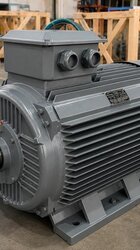
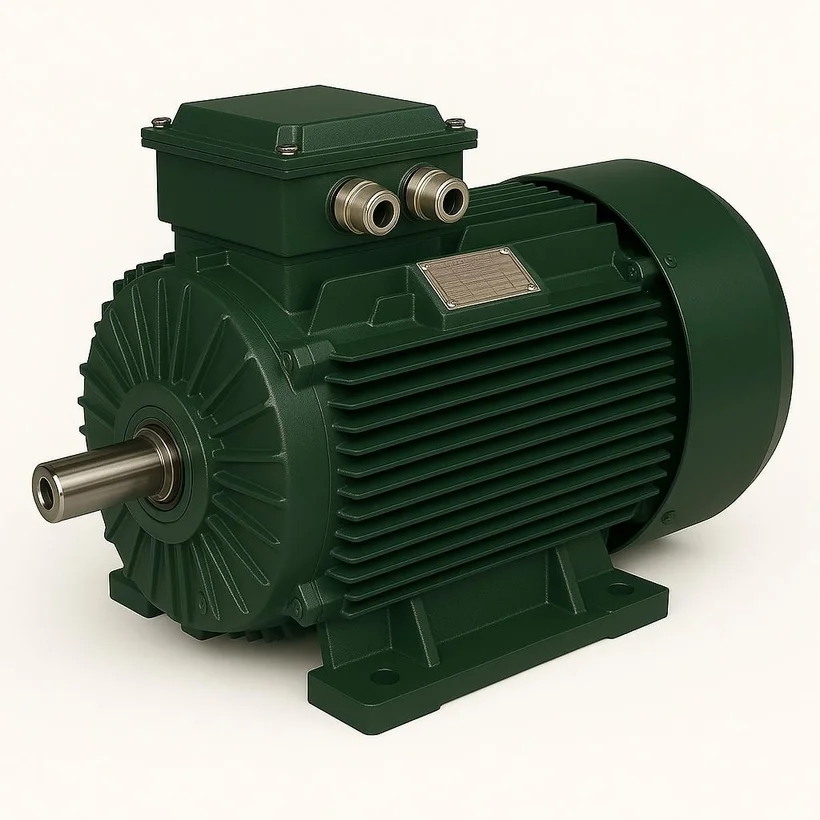
In the high-vibration, shock-prone environment of aggregate plants, the mechanical strength of the motor is critically important. Motors with a cast iron (grey cast iron) frame offer far higher vibration and shock resistance than their aluminium-framed counterparts. This rigid structure prevents the continuous vibration from crushers and screens from damaging the motor.
The cast iron frame also dissipates heat better and preserves the mechanical integrity of the motor for many years. For this reason, cast iron framed motors have become the standard choice in quarry and aggregate applications. The same durable frame structure is also preferred in other heavy applications such as mill and grinding motors.
Soft Starting and Energy Saving with Frequency Inverters
Direct-on-line starting of large crusher and conveyor motors both stresses the grid and creates mechanical shock due to high starting currents. Frequency inverters (variable speed drives) allow these motors to start smoothly, both limiting the starting current and reducing mechanical wear.
In addition, the ability to adjust conveyor speed according to material flow provides significant energy savings. Energy saving with frequency inverters is one of the most effective ways to lower operating costs in aggregate plants. In inverter-driven motors, forced ventilation should be foreseen against the weakening of cooling at low speed.
Efficiency and Operating Cost
Aggregate plants are high energy-consuming operations; crushers and conveyors run at high power all day long. For this reason, motor efficiency directly affects the operating cost. Motors with a high efficiency class (IE3, IE4), although slightly more expensive in the initial investment, quickly pay for themselves through energy savings in a continuously operating plant.
A correctly sized, efficient motor both lowers the energy bill and lasts longer by heating up less. The selection of high-efficiency electric motors is the foundation of long-term profitability in aggregate plants. Motors that comply with three-phase motor in industry standards and provide a balanced load distribution should be preferred.
Rotor Structure and Winding Selection
In aggregate applications with heavy starting conditions, the rotor design directly determines the motor's starting behaviour. Motors with high-resistance rotor bars produce higher torque at start-up and have no difficulty setting a full crusher or conveyor in motion. Conversely, very high rotor resistance reduces efficiency in continuous operation; for this reason, a careful balance is struck between starting torque and efficiency in aggregate motors.
Winding quality is also critical in this harsh environment. High-quality enamel-coated copper windings resistant to high temperature and vibration noticeably extend the motor's life. In environments where dust and moisture combine, windings with additional protective varnish (tropical protection) should be preferred. These details are engineering elements that do not appear in the catalogue but directly affect field performance.
Maintenance, Monitoring and Failure Prevention
In aggregate plants, unplanned stoppages are very costly; the failure of a single crusher motor can halt the entire production line for hours. For this reason, regular monitoring and preventive maintenance of motors are very important. Temperature sensors (PTC or PT100), vibration measurement and regular bearing inspection enable failures to be detected early.
Especially in dusty environments, the motor's cooling fins and fan must be cleaned regularly; blocked ventilation leads to overheating and premature failure of the motor. Careful application of the bearing lubrication programme is particularly critical in motors under continuous dynamic load, such as vibration motors. A well-planned maintenance programme extends motor life and minimises unplanned stoppages.
The Right Power Selection: Neither Too Little Nor Too Much
Selecting the correct motor power in an aggregate plant requires avoiding both insufficient and excessive power. A motor selected with insufficient power is constantly strained under heavy load, overheats and fails in a short time. A motor selected with excessive power, on the other hand, runs at a low load factor, its power factor drops and it consumes unnecessary energy. Striking the balance between high and low kW motors comes from correctly calculating the real load demand of each piece of equipment.
For correct power selection, the real load profile of the equipment, the starting torque requirement and the operating hours must be evaluated together. While starting torque is decisive for a primary crusher, correctly calculating the continuous torque and efficiency is important for a continuously running conveyor. This balanced approach protects both reliability and operating economy.
DRG Motor for Aggregate and Quarry Solutions
In an aggregate plant, each piece of equipment speaks its own language: the primary crusher demands high starting torque, the screen expects bearings that withstand continuous vibration, and the conveyor requires reliable torque both at start-up and during continuous operation. Understanding these different demands correctly and selecting the most suitable motor for each piece of equipment is the key to the plant's uninterrupted and economical operation.
At DRG Motor, we offer cast iron framed, high protection class and high starting torque motors specially designed for the tough conditions of quarry and aggregate plants. To determine the right solution for every point of your plant, from the primary crusher to vibrating screens, from conveyors to feeders, you can review our DRG Motor products and contact our engineering team. Visit the DRG Motor home page to explore our full range. A plant built with the right motors produces uninterrupted for years.