 English
 Le français
 Türkçe

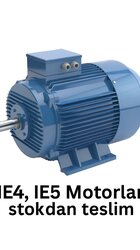
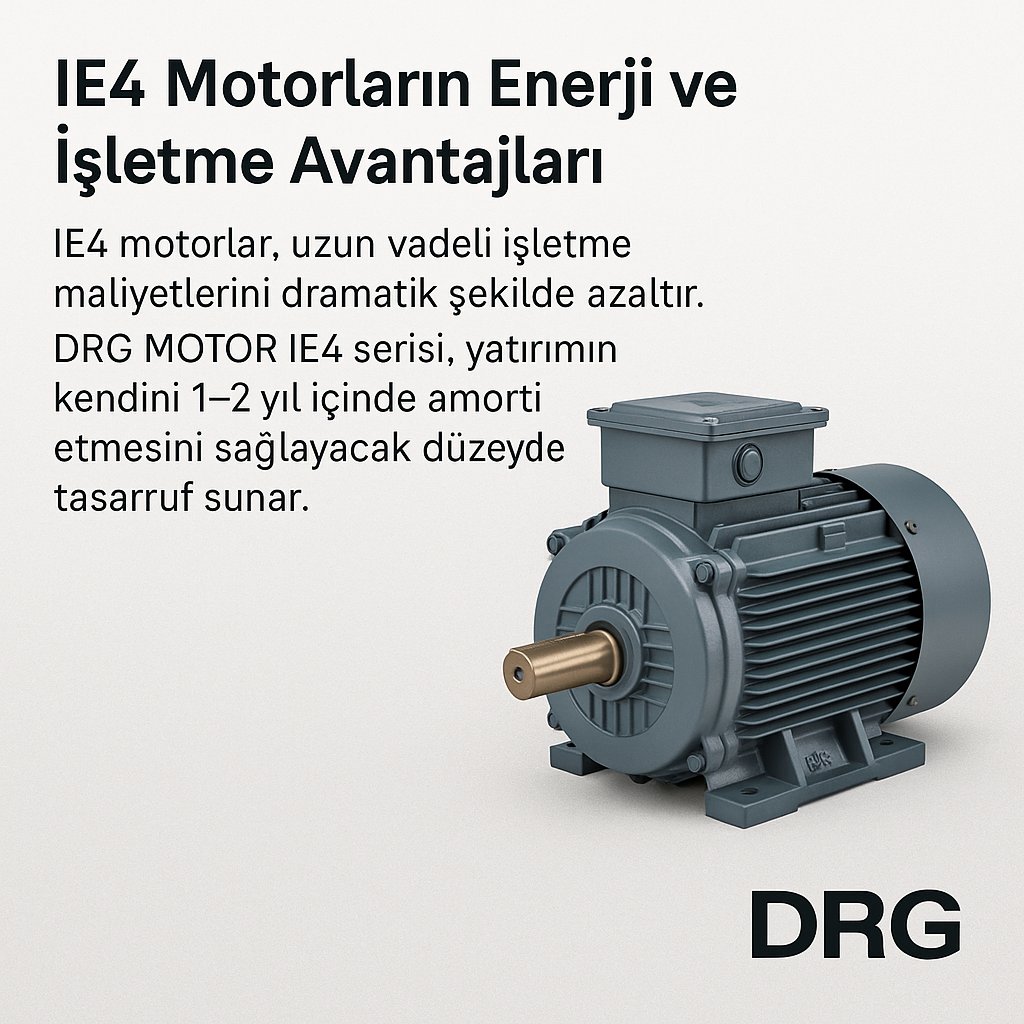

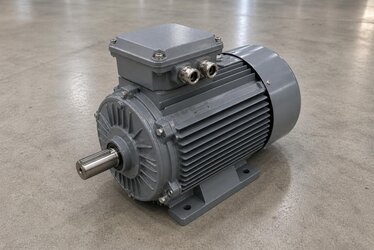
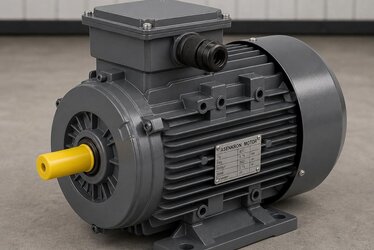
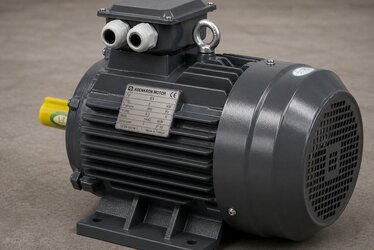
Premium and super premium three-phase asynchronous machines exist for one reason: most of a factory's electricity bill comes from rotating equipment. On that scale, as a cost item, the efficiency class outweighs the purchase price across a range running from 0.55 kW to 355 kW.
IE3 Against IE4
IEC 60034-30-1 defines the efficiency classes, stepping from IE1 up to IE5. IE3 means premium efficiency, IE4 super premium. On a 4-pole 15 kW machine, IE3 sits near 91.9 percent while IE4 reaches about 93.1 percent, and those 1.2 points reduce losses on every kilowatt drawn.
- IE3: meets the legal minimum in most applications, with a strong price to performance balance.
- IE4: cuts lifetime ownership cost on kit running 16 hours a day or more.
- In both, winding quality, lamination thickness and air gap tolerance set the efficiency.
Two, Four and Six Poles
Synchronous speed comes out of two things only: the mains frequency and how many poles are wound into the stator. At 50 Hz a 2-pole motor turns at 3000 rpm, a 4-pole at 1500 rpm and a 6-pole at 1000 rpm. Actual speed sits lower because of slip, typically 1 to 3 percent at full load. Conveyors and crushers that want torque at low speed move to six or eight poles.
Dust, Damp and Temperature
Class F insulation is standard, giving the winding thermal capability up to 155 °C. Environmental protection is IP55: sealed completely against dust, with spray from any direction resisted. Duty type is S1. Those three values cover everything from a dusty foundry to a damp food line.
Aluminium or Cast Iron
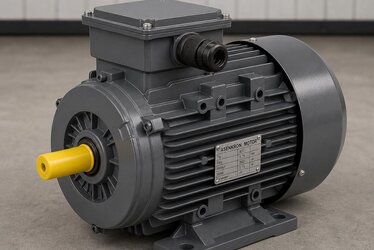
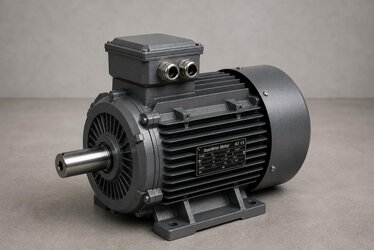
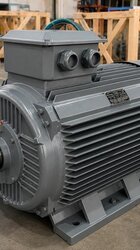
The frame material settles two things at once: how much shock the housing survives and how readily loss escapes as heat. Cast iron takes the heavy work wherever impact and vibration never let up; its mass damps vibration and buys service life. Aluminium is lighter, sheds heat quickly and is easier to mount, which suits smaller ratings. Our cast iron motor page covers those options.
Foot and Flange Options in the IE3-IE4 Series
Mounting type says which way the motor fastens onto the machine: foot mounting (B3), flange mounting (B5), and the combined or small-flange types (B14, B35). B3 goes on conveyors and compressors bolted to the floor; B5 bolts face-on to a reducer flange or a pump volute. Getting it right avoids alignment errors and early bearing wear.
Inside the Squirrel-Cage Rotor
Rotor bars are cast in aluminium or copper injection and shorted together by end rings. The copper-rotor variants offer lower rotor loss, and that is often what carries a design up into the IE4 class. Absent brushes and a commutator, maintenance demand stays minimal and service intervals stay long.
Working the Saving Out
Take a 22 kW motor running 6000 hours a year. At 92.1 percent for IE3 and 93.3 percent for IE4, the difference in input power is around 0.33 kW, which over 6000 hours is roughly 1980 kWh of electricity. At your unit rate the extra spend on the better machine typically returns inside two years, and across a fleet of motors the gain multiplies.
Selection Criteria in Practice
Pumps, compressors, fans, crushers, conveyors and agitators all run on these motors. Four points decide the order:
- Required power in kW and speed via pole count, calculated against the real load profile.
- Derating where the ambient exceeds 40 °C.
- Insulation suited to PWM waveforms where the motor sits behind a frequency inverter.
- A starting method, star-delta or soft starter, planned in advance for high-torque crushers and mixers.
Thermal Behaviour and Ambient Conditions
Rated values assume 40 °C ambient and 1000 metres of altitude; beyond either, derating keeps the winding inside its limit. Insulation life is roughly halved by each 10 °C of extra winding temperature. Under identical load a more efficient machine generates less heat, which alone keeps an IE4 unit cooler and longer-lived.
Pull the running hours for your ten largest drives, apply the 22 kW arithmetic above to each, and order IE4 for every one that clears the two-year payback.