English
 Le français
 Türkçe




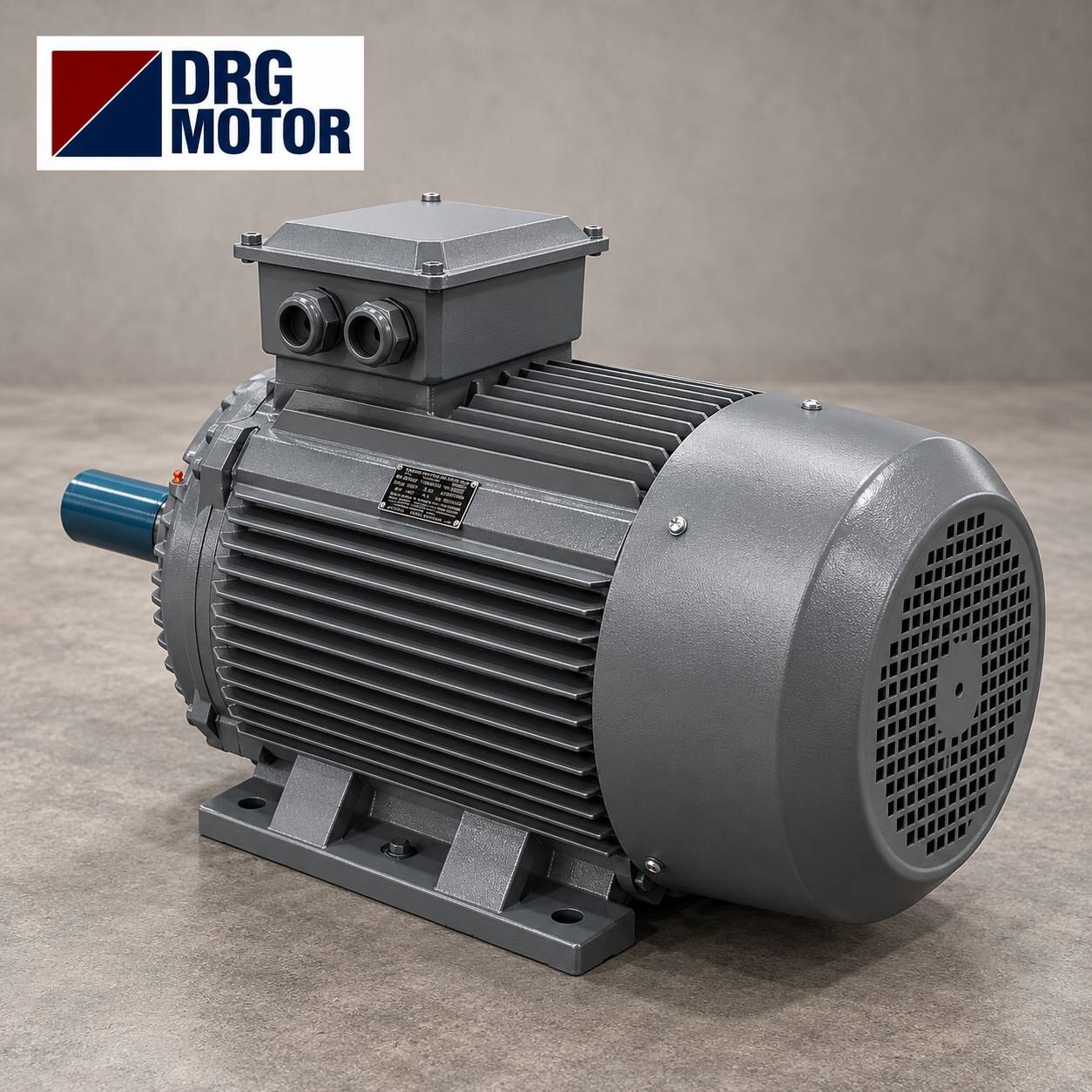

In the store you will see the same model code twice: DRG-132M-4 aluminium and DRG-132M-4 cast iron. Both are 7.5 kW, both run at 1500 rpm, both use the IEC 132M frame number. The only differences are the housing material and the figure on the price tag. This article is written to settle that dilemma: within the 0.55–11 kW range, where both housings are sold side by side, how large is the price gap, what do you get in return, and which housing makes more sense on which site.
Where you actually have a choice: 0.55 to 11 kW
The DRG Motor online store list dated 24.09.2026 makes the picture clear: 0.25 and 0.37 kW models are listed only with an aluminium housing, while models of 15 kW and above are listed only in cast iron. The range in which you can make a real housing choice is 0.55 kW to 11 kW. Here every power and speed comes in two versions, and both carry the same model code and the same IEC frame number.
In practice, the same frame number means that shaft height and foot/flange mounting dimensions match as standard. Choosing cast iron instead of aluminium (or the other way round) normally does not require changing the base or the coupling on the machine. Still, checking the old motor's dimensions on site with a caliper prevents surprises after delivery.
Aluminium vs cast iron prices for 1500 rpm motors (0.55–11 kW)
We based the comparison on 1500 rpm, the most commonly sold speed. Each row shows the two housing options of the same model code side by side.
| Power (kW) | Model / IEC frame | Aluminium excl. VAT | Aluminium incl. VAT (20%) | Cast iron excl. VAT | Cast iron incl. VAT (20%) |
|---|---|---|---|---|---|
| 0.55 | DRG-801-4 / 80 | 3,952.20 TRY | 4,742.64 TRY | 4,140.40 TRY | 4,968.48 TRY |
| 0.75 | DRG-802-4 / 80 | 4,392.15 TRY | 5,270.58 TRY | 4,601.30 TRY | 5,521.56 TRY |
| 1.1 | DRG-90S-4 / 90S | 5,346.60 TRY | 6,415.92 TRY | 5,601.20 TRY | 6,721.44 TRY |
| 1.5 | DRG-90L-4 / 90L | 6,210.75 TRY | 7,452.90 TRY | 6,506.50 TRY | 7,807.80 TRY |
| 2.2 | DRG-100L1-4 / 100L | 8,114.40 TRY | 9,737.28 TRY | 8,500.80 TRY | 10,200.96 TRY |
| 3 | DRG-100L2-4 / 100L | 8,783.25 TRY | 10,539.90 TRY | 9,201.50 TRY | 11,041.80 TRY |
| 4 | DRG-112M-4 / 112M | 10,960.95 TRY | 13,153.14 TRY | 11,482.90 TRY | 13,779.48 TRY |
| 5.5 | DRG-132S-4 / 132S | 14,736.75 TRY | 17,684.10 TRY | 15,438.50 TRY | 18,526.20 TRY |
| 7.5 | DRG-132M-4 / 132M | 17,015.25 TRY | 20,418.30 TRY | 17,825.50 TRY | 21,390.60 TRY |
| 11 | DRG-160M-4 / 160M | 24,507.00 TRY | 29,408.40 TRY | 25,674.00 TRY | 30,808.80 TRY |
Prices are taken from the DRG Motor online store list dated 24.09.2026; a 3% discount applies to bank transfer/EFT payments, shipping is not included in the price and is paid by the buyer. For current prices, please see the store page.
What the table shows: a fixed ratio, a growing TRY gap
If you divide the rows one by one, a clear pattern appears: at every power, the cast iron model is priced about 4.8% above its aluminium twin. The same ratio holds for the 3000 rpm and 1000 rpm models in the list, so the housing difference is reflected in the price as a fixed share, independent of speed.
Because the ratio is fixed, the absolute gap grows with motor size. At 0.55 kW the difference between the two housings is 188.20 TRY excl. VAT (4,140.40 − 3,952.20), while at 11 kW it rises to 1,167.00 TRY (25,674.00 − 24,507.00). For a single-motor purchase this gap is rarely decisive. For a workshop building machines in series, the calculation changes: on 20 units of 1.1 kW 1500 rpm motors the housing difference adds up to 20 × 254.60 = 5,092.00 TRY excl. VAT. In volume purchases, the housing decision should therefore follow the machine's real needs, not habit.
What do you get for the difference?
Weight and portability
The aluminium housing is noticeably lighter. In suspended installations, on moving platforms, in fan units hung from ceilings or walls and in small machines that are carried and fitted by hand, this lightness translates directly into easier labour. Weight also affects shipping cost; since shipping is not included in the price and is paid by the buyer, consider this item together with the information on the delivery and shipping page when sending many motors to a distant city.
Behaviour under impact and vibration
The mass and wall thickness of a cast iron housing damp vibration and tolerate external impact better. On crusher feed belts, heavy conveyors, marble and stone processing machines, and in areas where material may hit the motor or a forklift may scrape it, cast iron is the more reassuring choice.
Ambient conditions
Aluminium is protected by its natural oxide layer; even if the paint is scratched, it does not rust easily. Cast iron owes its protection to the paint: where an impact removes the paint, the spot can rust over time in a humid environment, so touch-up paint belongs on the maintenance list. On very dusty, rough sites the mechanical strength of cast iron counts; on humid sites with low impact risk the surface advantage of aluminium comes forward.
Decision table by site scenario
The table below summarises which housing stands out in common applications and why. Since the price gap is the same ratio in every row, the decision column is driven by where the machine operates.
| Application | Deciding condition | Preferred housing |
|---|---|---|
| Packaging and filling machine | Series production, light chassis, indoor hall | Aluminium |
| Ceiling/wall-mounted extractor | Suspension load, mounting at height | Aluminium |
| Crusher feed belt, heavy conveyor | Impact, dust, rough environment | Cast iron |
| Marble and stone cutting bench | Vibration, splashing water and slurry | Cast iron |
| Garden and irrigation pump | Outdoors, humidity, low impact risk | Aluminium (with shaded, sheltered mounting) |
| Workshop compressor, fixed floor | Fixed base, moderate vibration | Both suitable; cast iron if vibration is high |
Replacing a failed motor with a different housing
A common situation on site: the aluminium motor on a machine has failed and this time you want cast iron (or vice versa). As long as the model code and IEC frame number are the same, the switch is usually trouble-free, but check these four points before ordering:
- Mounting type: Foot-mounted (B3), flange (B5) or small flange (B14)? Confirm before ordering that the new motor has the same mounting as the old one.
- Extra weight: Switching to cast iron makes the motor heavier. A suspension bracket, motor slide rail or hinged tensioning plate must be able to carry this extra load.
- Terminal box position: If cable length and gland direction were set for the old motor, check which side the box is on.
- Shaft end and key: The pulley or coupling hub is machined for a given shaft diameter; compare the dimension on the nameplate and on site.
Pre-order checklist for housing selection
- Determine power and speed; the housing choice comes after these two.
- Describe where the machine operates: is there impact, dust, humidity or suspension load?
- If you need more than 5 units, calculate the housing difference as a total amount.
- Compare the mounting type and shaft size with the old motor.
- Choose the payment method; for the 3% bank transfer/EFT discount see the payment options and bank accounts page.
- Select the model on the buy electric motors online page according to housing type.
Frequently Asked Questions
Can aluminium and cast iron motors with the same model code replace each other?
The same model code and IEC frame number indicate that mounting dimensions match as standard, so in most cases they are directly interchangeable. Still check the mounting type, shaft size and extra weight on site.
How much more expensive is a cast iron housing than aluminium?
In the store list dated 24.09.2026, cast iron models in the 0.55–11 kW range are priced about 4.8% above aluminium models with the same code. The TRY amount grows with power.
Is there an aluminium option for 15 kW and above?
In the store list, powers of 15 kW and above are offered only with a cast iron housing. At these powers, choosing speed and mounting type matters more than the housing.
Is an aluminium motor more fragile because it is lighter?
An aluminium housing works comfortably in a normal industrial environment. If frequent impact, heavy material strikes or intense vibration are expected, a cast iron housing is the more suitable choice.
If you are unsure about the frame, power or speed, simply describe your application: call +90 (542) 666 11 11, write to [email protected] or reach us through our contact page.