 English
 Le français
 Türkçe

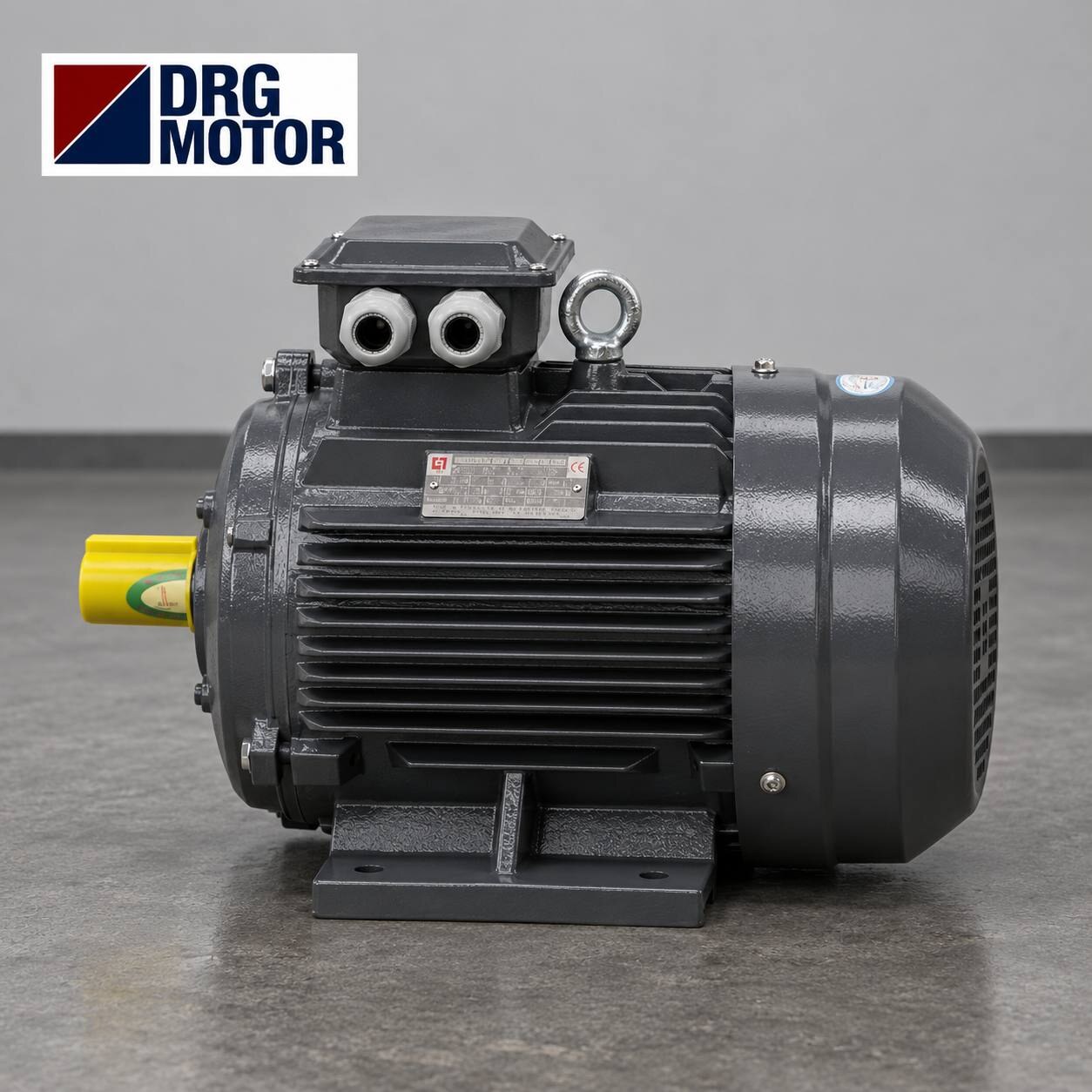

The path to selecting the right motor often does not run, as is commonly assumed, through looking only at the power value. What really matters is the character of the load the motor will drive. A conveyor and a centrifugal pump, or a winding machine, exhibit completely different torque-speed behaviors, and these behaviors directly determine which motor, which drive and which starting method will be selected. Reading the load profile correctly is of critical importance for both energy efficiency and reliability. At DRG Motor, we place the load character at the center of design in order to recommend our IE3, IE4 and IE5 class AC induction motors in a way suited to the load type of each application. In this article we address constant-torque, variable-torque and constant-power loads, their torque-speed behaviors, their suitability for a frequency inverter and the correct motor selection in detail.
Why Is the Load Type Important?
How a motor will behave in the field depends on how the torque demand of the load it drives changes with speed. A motor of the same power can work perfectly with one load yet fall short with another. This is because each load demands a different torque-speed profile from the motor. A motor selection made without understanding this profile results either in an unnecessarily large and expensive motor or in a motor that falls short and fails.
Three Fundamental Load Characteristics
Industrial loads are divided into three main groups according to their torque-speed behavior: constant torque, variable torque and constant power. The table below summarizes these three types, their typical applications, their torque-speed behaviors and their suitability for a frequency inverter.
| Load Type | Typical Applications | Torque-Speed Behavior | Inverter Suitability |
|---|---|---|---|
| Constant Torque | Conveyor, crane, compressor, extruder | Torque stays constant, independent of speed | Suitable across speed range, watch cooling |
| Variable Torque | Centrifugal pump, fan, blower | Torque increases with the square of speed | Ideal; highest energy saving |
| Constant Power | Winding machine, machine tool, reel | Torque decreases as speed rises, power constant | Field weakening for above-rated speed |
These three fundamental behaviors cover almost all industrial loads. Placing a load in the correct group is the first and most important step of motor and drive selection.
Constant-Torque Loads
In constant-torque loads, the torque the motor must produce is independent of speed; that is, even if the speed changes, the torque demand stays approximately the same. Conveyors, cranes, compressors and extruders fall into this class. A conveyor demands a similar torque to carry the load on the belt whether it turns slowly or quickly.
Power Demand in Constant-Torque Loads
Power is the product of torque and speed. When the torque is constant, the power demand increases linearly with speed. For this reason, in constant-torque loads, the motor draws low power at low speed while its power increases at high speed. This fundamental relationship is explained in detail in our article on the power, torque and speed relationship.
The Cooling Problem in Constant-Torque Loads
When constant-torque loads are driven at low speed with a frequency inverter, the motor continues to produce full torque while its own fan slows down and cooling weakens. In this case the winding temperature can rise. In applications that require high torque at low speed, an external cooling fan is preferred. Electric motor temperature control comes into play at this point.
Crane and Lifting: A Typical Constant-Torque Application
Lifting applications are typical constant-torque loads because they lift a constant load against gravity. The load begins to be lifted at full load from standstill, which requires high starting torque. In the selection of a crane and lifting motor, this constant-torque characteristic is decisive.
Variable-Torque Loads
In variable-torque loads, the torque demand increases rapidly with speed; typically with the square of the speed. Centrifugal pumps, fans and blowers fall into this class. When a fan turns at twice the speed, the torque demand quadruples.
Variable Torque and the Cube Law
While the torque increases with the square of the speed, the power increases with the cube of the speed. This is the key to why energy saving is so large in variable-torque loads. Running a pump at 80 percent speed can reduce the power consumption by about half. This is precisely why variable-torque loads are ideal candidates for a frequency inverter.
Click to see current electric motor prices and order nowSEE PRICES →
Energy Saving in Variable-Torque Loads
In pumps and fans, the flow is usually adjusted by throttling with a valve or damper; this method wastes energy. Instead, if the motor speed is reduced with a frequency inverter, large energy savings are achieved thanks to the cube law. Energy saving with a frequency inverter gives the highest return precisely in these loads.
Starting in Variable-Torque Loads
An important advantage of variable-torque loads is that the torque demand is also low at low speed. This means starting is easy; the motor gets moving with low torque and accelerates gradually. For this reason, in fans and pumps the starting current and starting stress are less than in constant-torque loads.
Constant-Power Loads
In constant-power loads, the power the motor produces stays constant across the speed range while the torque changes inversely with speed: as the speed increases the torque decreases, as the speed decreases the torque increases. Winding machines, machine tool spindles and reel systems exhibit this behavior.
The Logic of Constant-Power Behavior
In a winding machine, the diameter grows as the reel fills. To maintain the same material tension, a lower speed and higher torque are needed as the diameter grows. When the diameter is small, high speed and low torque are needed. As a result, the power stays constant. This requires the motor to operate over a wide speed range.
Constant Power and Field Weakening
Constant-power behavior appears when, in a frequency inverter, one goes above the rated frequency. In this region, because the voltage stays constant, the magnetic field weakens and the torque decreases, but the power is maintained. This is useful for applications requiring high speed, such as machine tools, but it must be ensured that the motor can produce sufficient torque in this region.
Load Profile and Motor Sizing
Once the load type is determined, the motor is sized according to the most demanding operating point of the load. In constant-torque loads the power at the highest speed is decisive, in variable-torque loads the power at the rated point, and in constant-power loads the torque at the lowest speed. Incorrect sizing means either unnecessary cost or early failure.
Load Type and Starting Method
The load type also affects the choice of starting method. Because constant-torque loads require high starting torque, direct-on-line or soft starting is preferred. Because variable-torque loads start easily, even low-torque methods such as star-delta may be sufficient. The advantage of soft starting must be evaluated according to the load type.
Load Type and Efficiency Class Selection
In applications that run continuously with a high load factor, an IE4 or IE5 class motor quickly pays for itself through energy savings. In variable-torque loads, a high-efficiency motor combined with a frequency inverter provides the highest total saving. The load profile is the basis for selecting the right efficiency class.
Mixed Load Profiles
Some applications do not fit a single load type exactly; for example, a mill can exhibit both high starting torque and constant-torque characteristics. In these mixed profiles, the motor is selected based on the most demanding operating moment. The DRG Motor engineering team analyzes mixed load profiles according to the real operating conditions.
Load Character in Compressor Applications
Compressors are constant-torque loads that require high starting torque because they start from standstill under pressure. This demanding starting condition directly affects the motor and starting selection. Our article on compressor motor starting torque examines this subject in detail.
Pole Count and Load Matching
The speed the load requires is matched with the pole count of the motor. A multi-pole motor may be suitable for a low-speed conveyor, while a two-pole motor may be suitable for a high-speed fan. The relationship of pole count and speed is the basis for meeting the speed demand of the load.
Load Type and Voltage Tolerance
Constant-torque loads are more sensitive to voltage drops, because at low voltage the torque decreases and the motor may not be able to move the load. Variable-torque loads, on the other hand, are more tolerant of voltage fluctuations because they require low torque at start-up. The subject of voltage, frequency tolerance and derating must be evaluated according to the load type.
Load Analysis in Industrial Applications
Under heavy industrial conditions, correct load analysis is the basis of production continuity. In our industrial electric motors range, the load type, the duty cycle and the speed range of each application are evaluated together to determine the most suitable motor.
The Consequences of Incorrect Load Matching
A motor selected for a variable-torque load but assuming a constant-torque characteristic is selected unnecessarily large and runs inefficiently. Conversely, a motor selected too small for a constant-torque load is constantly overloaded, overheats and fails early. Correct load matching brings both energy and reliability.
The Importance of Speed Control in Fans and Pumps
The most common examples of variable-torque loads are fans and pumps, and in these applications speed control offers the greatest saving opportunity. In the traditional method, the output of a motor running at constant speed is throttled with a valve or damper; this resembles adjusting water by throttling a tap and wastes excess energy as heat. Adjusting the motor speed to the need with a frequency inverter, on the other hand, drastically reduces consumption thanks to the cube law. Reducing the flow to 70 percent in a centrifugal pump can reduce the power consumption to as little as one third. For this reason, speed control in variable-torque loads is not merely a comfort but a direct efficiency strategy.
Demanding Constant-Torque Loads Such as Extruders and Mixers
Some constant-torque loads are much more demanding than an ordinary conveyor. Extruders, mixers and dough-kneading machines exhibit a high and fluctuating torque demand depending on the viscosity of the material. In these applications, the motor must both produce high rated torque continuously and have a sufficient breakdown torque reserve against sudden torque increases. Because the material is stiffer at a cold start, the starting torque demand also rises. At DRG Motor, we recommend motors with a high torque reserve in such demanding constant-torque applications.
Load Type and Maintenance Approach
The load type also shapes the maintenance requirement of the motor. Constant-torque applications running continuously at high torque require more frequent monitoring in terms of bearings and insulation. Loads that start and stop frequently require more careful follow-up because of the thermal fatigue caused by the starting current. Variable-torque loads, on the other hand, generally run more smoothly, so the maintenance burden is lighter. Knowing the load character points to the right motor, and to the maintenance plan that suits it.
The Effect of Load Inertia on Selection
In addition to the load type, the inertia of the load also affects motor selection. A high-inertia load stresses the motor for a long time as it goes from standstill to rated speed; during this time the motor draws high current and heats up. High-inertia loads such as flywheels, large fans or centrifuges seriously test the starting capacity of the motor. For this reason, even within the same load type, a load with high inertia requires a higher starting torque and a more careful thermal evaluation. Inertia is a factor that directly affects the life of the motor, especially in frequently starting applications.
Duty Cycle and Load Type Evaluated Together
Whether a motor will operate continuously or intermittently must be considered together with the load type. A continuously running constant-torque load brings the motor to a stable temperature, and this temperature must be kept below the design limit. In an intermittently running load, the motor has the chance to cool down between operating periods; in this case, higher short-term loads can be permitted. Whatever the load type, defining the duty cycle correctly determines how much the motor will be stressed and forms the basis of correct sizing.
The Meeting of the Load Curve and the Motor Curve
Each load type has its own torque-speed curve, and the motor must be selected powerful enough to exceed this curve across the entire speed range. In a constant-torque load the load curve is a horizontal line; the motor torque must stay above this line so that the load can accelerate. In a variable-torque load the load curve is a parabola curving upward and stays well below the motor curve at start-up. In a constant-power load the load curve is a falling hyperbola. The difference between the motor curve and the load curve determines how fast the acceleration will be and how much the motor will be stressed.
The Economic Return of the Right Selection
A motor selected to suit the load type pays off technically and economically. An unnecessarily large motor both increases the initial investment and runs inefficiently at a low load factor. An insufficient motor, on the other hand, runs constantly under overload, fails early and creates downtime cost. A motor that exactly matches the load profile provides low energy consumption, little maintenance and uninterrupted operation throughout its life. For this reason, correct load analysis is the most profitable stage of the purchasing decision.
Load-Focused Selection with DRG Motor
The load type is the invisible compass of correct motor selection. Constant-torque, variable-torque and constant-power loads require completely different motor, drive and starting strategies. At DRG Motor, we recommend our IE3, IE4 and IE5 class AC induction motors according to the real load profile of your application; this provides both energy efficiency and long life. To determine the motor most suitable for the load character of your application, you can contact the DRG Motor engineering team, and if you wish, you can solidify your choice by reviewing the basic operating principle of the electric motor.
DRG Electric Motors Suited to This Topic
The models below are available in the DRG Motor online shop. Click a model code to see its technical data, dimensions and current price, and order right away.
- DRG-802-4 – 0.75 kW – 1420 rpm – aluminium frame
- DRG-100L1-4 – 2.2 kW – 1450 rpm – aluminium frame
- DRG-132M-4 – 7.5 kW – 1460 rpm – cast iron frame
- DRG-180M-4 – 18.5 kW – 1470 rpm – cast iron frame
Click to see current prices of all electric motors and order nowSEE PRICES →