 English
 Le français
 Türkçe

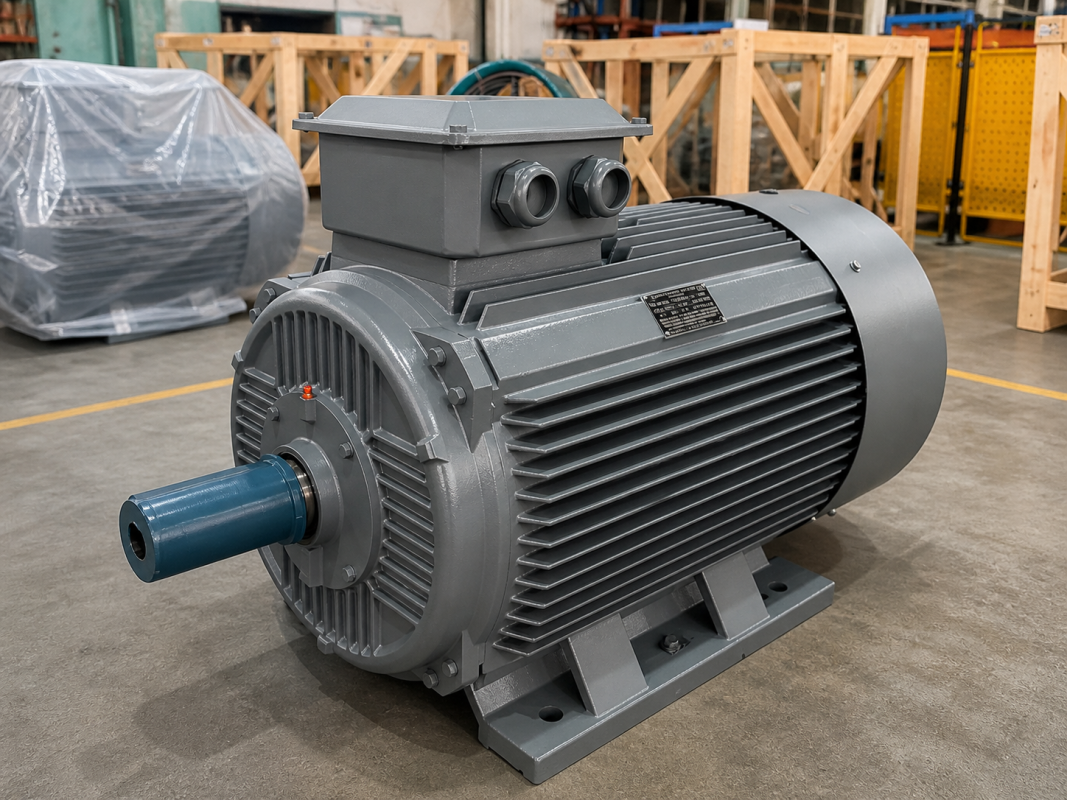

At the heart of choosing an electric motor correctly lies understanding the relationship between three quantities: power, torque and speed. These three concepts, which are often confused, are in fact tied together by a simple equation. Two motors of the same power, if their speeds differ, produce completely different torque values; for this reason, looking only at the kW value when selecting a motor for an application is misleading. In this article we cover the link between power, torque and speed, the effect of pole count on this link, and how to make the right choice according to the application. To deepen the speed side of the topic, we also recommend reading our article on the relationship between pole count and speed.
What Are Power, Torque and Speed?
Torque is the turning force the motor creates at its shaft and is measured in newton-meters (Nm). Speed is the number of revolutions the shaft makes per minute (rpm). Power is the work done per unit time and is expressed in kilowatts (kW). Power is in fact the result that torque and speed produce together: the motor both applies a turning force and, when it rotates, does work.
The Fundamental Equation Linking the Three
Power, torque and speed are tied together by the equation: P(kW) = T(Nm) × n(rpm) / 9550. The number 9550 here is a constant that makes the units (kW, Nm, rpm) consistent. This equation is the backbone of motor engineering, because when you know two of the three quantities, you can calculate the third directly.
Where Does the 9550 Constant Come From?
Power is basically torque times angular velocity. When you convert speed from revolutions per minute to radians per second and adapt it to kW, the constant 60,000 / (2π) ≈ 9550 emerges. So 9550 is a mathematical shortcut in the formula. Memorizing this constant makes quick field calculations easier.
A Worked Example
Suppose we know that a motor spinning at 1500 rpm produces 70 Nm of torque. Let us calculate the power: P = 70 × 1500 / 9550 ≈ 11 kW. Or conversely, if we want to find the torque of an 11 kW motor spinning at 1500 rpm: T = 9550 × 11 / 1500 ≈ 70 Nm. As you can see, the equation works in both directions.
Why Does Low Speed Mean High Torque at the Same Power?
Looking carefully at the equation reveals a very important result: when power is fixed, torque rises as speed falls. This is because the product of torque and speed must remain constant. For this reason, of two motors with the same kW value, the lower-speed one produces much higher torque at its shaft. In applications that require slow but powerful turning, this relationship is decisive.
Torque and Speed Comparison Table
The table below shows the approximate torque values produced by different speeds at a constant power of 11 kW. The table clearly shows that when speed halves, torque roughly doubles.
| Power (kW) | Speed (rpm) | Approx. Torque (Nm) | Typical Pole Count |
|---|---|---|---|
| 11 | 3000 | 35 | 2 poles |
| 11 | 1500 | 70 | 4 poles |
| 11 | 1000 | 105 | 6 poles |
| 11 | 750 | 140 | 8 poles |
The Effect of Pole Count on Speed
The synchronous speed of an induction motor is determined by the pole count and the grid frequency. On a 50 Hz grid, a two-pole motor has a synchronous speed of 3000 rpm, a four-pole 1500, a six-pole 1000, and an eight-pole 750 rpm. The actual (loaded) speed is slightly below these values due to slip. As the pole count rises, the motor slows down.
The Relationship Between Pole Count and Torque
Because pole count directly determines speed, it indirectly determines torque too. At the same power, an eight-pole motor produces much higher torque than a two-pole motor, because it spins much more slowly. For this reason, multi-pole (low-speed) motors are preferred in heavy-starting applications that require high torque. We covered this topic in detail in our article on pole count and speed.
Starting Torque and Rated Torque
The torque a motor produces is not constant; there are different torque values at the moment of starting, during acceleration, and at rated speed. Starting torque is critical for the motor to set a stationary load in motion. Rated torque is the torque the motor can produce continuously. If the load's starting torque requirement is greater than the motor's starting torque, the motor cannot move the load at all.
Breakdown (Pull-Out) Torque
Breakdown torque is the maximum torque an induction motor can produce. If the load rises above this value, the motor stalls (breaks down). The difference between rated torque and breakdown torque shows the motor's capacity to withstand sudden load increases. In applications with fluctuating load, it is important to leave a sufficient breakdown torque margin.
The Constant-Torque Region
In a motor driven by a frequency inverter, the region up to the base frequency (usually 50 Hz) is the constant-torque region. In this region the inverter keeps the magnetic field constant by raising the voltage in proportion to the frequency; thus the motor can produce the same rated torque at every speed. Power, being directly proportional to speed, reaches its maximum at the base frequency.
Click to see current electric motor prices and order nowSEE PRICES →
The Constant-Power Region
Above the base frequency, the inverter can no longer increase the voltage, because the voltage has reached its upper limit. Beyond this point, even though the frequency keeps rising, the magnetic field weakens (field weakening). As a result the speed rises but torque decreases inversely; power stays roughly constant. This region is called the constant-power region. It is used in applications that need high speed but low torque.
Understanding the Two Regions Together
Considering the constant-torque and constant-power regions together is the key to correct motor selection in variable-speed applications. If the load wants high torque below the base speed, the constant-torque region comes into play; if it wants high speed above the base speed, the constant-power region does. Whichever region the requirement is in, the motor and inverter are sized accordingly. Our article on energy saving with a frequency inverter complements this topic.
Torque Requirement by Load Type
Each load type has a different torque-speed characteristic. In centrifugal pumps and fans torque rises with the square of speed (variable torque). In conveyor and lifting systems torque is roughly constant regardless of speed (constant torque). In winding and coiling applications torque is inversely proportional to speed (constant power). When selecting a motor, the character of the load is decisive.
Variable-Torque Loads
Centrifugal loads such as pumps and fans are variable-torque; they want little torque at low speed and much torque at high speed. By the affinity laws, these loads provide large energy savings under speed control. In these applications the starting torque requirement is usually low, so standard induction motors are easily sufficient.
Constant-Torque Loads
Loads such as conveyors, elevators and cranes want roughly the same torque at every speed. In these applications the motor must be able to produce rated torque even at low speed; for this reason forced cooling or appropriate inverter control may be needed. In constant-torque loads, because power rises in direct proportion to speed, the highest power is needed at the highest speed.
High-Starting-Torque Applications
Compressors, crushers and some systems started under load want very high torque at startup. In these applications the motor's starting torque must be higher than the load's breakaway torque. Otherwise the motor is strained, current rises and it overheats. Our article on starting torque in compressor motors details this situation.
A Common Mistake in Power Selection
The most common mistake is looking only at the kW value and ignoring the speed. An 11 kW motor produces 35 Nm when chosen as two-pole and 140 Nm when chosen as eight-pole. If the application wants high torque and you choose a high-speed motor, the motor cannot handle the load even though the kW is sufficient. Correct selection requires evaluating the power-torque-speed trio together.
Increasing Torque With a Gearbox
Sometimes the application wants much higher torque and much lower speed than the motor can produce directly. In this case a gearbox (reducer) is placed between the motor and the load. The gearbox lowers the speed while increasing the torque by roughly the same ratio. Thus high torque can be obtained with a high-speed, small and economical motor. When selecting the gear ratio, the power-torque-speed equation is again the guide.
The Practical Way to Choose the Right Motor
The right motor is chosen in this order: first the torque and speed the application requires are determined, then the power is calculated from the equation, then the pole count and efficiency class suitable for this power and speed are chosen. If direct drive is not suitable, a gearbox comes into play. This systematic approach prevents both undersizing and oversizing. Our article on high and low kW motors supports this choice.
The Torque Fallacy of Oversizing
The idea that "a more powerful motor is always better" is wrong. An oversized motor runs at low efficiency and low power factor at partial load. Moreover, a large high-speed motor may not produce the torque that a small low-speed motor produces. For this reason the solution is not to increase power but to choose the right motor for the right speed and the right torque. Our article on the oversized motor and partial load trap covers this fallacy.
The Relationship Between Efficiency and Torque
A motor's efficiency reaches its highest value around the rated load. In the regions of very low torque (light load) or excessive torque, efficiency drops. For this reason, when the motor is chosen with a rated torque close to the real torque requirement, both efficiency and power factor are at their best point. Our article on electric motor efficiency losses explains this relationship.
Torque Behavior in a High-Efficiency Motor
High-efficiency (IE3, IE4, IE5) motors run with lower slip, which means they spin closer to their rated speeds under load. Lower slip means more stable torque and higher efficiency. These motors produce the same torque while consuming less energy at the same power. Our article on high-efficiency electric motors explains this advantage.
Power Factor and Torque
Torque production depends on magnetization, and this in turn affects power factor. At low load (low torque) the motor's power factor drops, because while the magnetizing current stays constant, the active current decreases. A motor running at the right torque offers both high efficiency and high power factor. Our article on power factor (cosφ) covers this link.
Noise, Vibration and Speed
Speed directly affects motor noise. High-speed (two-pole) motors usually run louder due to fan and aerodynamic noise. Choosing a lower-speed motor for the same application often provides a quieter solution. To reduce noise and vibration you can look at our article on reducing electric motor noise and vibration.
A Holistic View in Industrial Applications
In industrial facilities each machine wants a different power-torque-speed profile. Choosing the right motor begins with reading this profile correctly. In the same facility you may need variable-torque motors for pumps, constant-torque motors for conveyors, and high-starting-torque motors for compressors. Managing this diversity correctly determines both efficiency and reliability. Our article on industrial electric motors covers this whole.
Slip and Actual Speed
In an induction motor, the rotor cannot fully catch the rotating magnetic field; this difference is slip. Without slip, no current would be induced in the rotor and no torque could be produced. For this reason an induction motor always spins slightly below synchronous speed under load. As load increases, slip increases, the rotor current needed for torque production rises, and the speed drops somewhat. At rated load typical slip is between 1 and 5 percent; this ratio is higher in small motors and lower in large motors. When calculating actual speed, this slip must be taken into account; the rated speed on the nameplate already shows the actual speed with slip subtracted.
Reading the Torque-Speed Curve
The graph that best describes the behavior of an induction motor is the torque-speed curve. This curve starts at the starting torque, shows first a slight dip or rise as speed increases, peaks at the breakdown torque, and falls toward the rated point. When the load's torque-speed curve and the motor's torque-speed curve are plotted on top of each other, the point where the two curves intersect gives the stable operating point. Motor selection is in fact the task of making these two curves compatible. As long as the load curve stays below the motor curve, the motor can accelerate the load; at a point where the load curve crosses the motor curve, the motor settles into equilibrium at that speed.
The Effect of Inertia on Starting
Torque and the load's inertia (moment of inertia) together determine starting behavior. Loads with large flywheels or heavy rotors want high torque for a long time to get moving. The greater the inertia, the longer the time the motor takes to bring that load up to rated speed, and a high starting current flows during this time. In high-inertia loads, the motor must have a sufficient margin against heating during the long starting time. This shows that starting time, as much as starting torque, is important in motor selection.
Unit Conversions and Practical Tips
In the field, power is sometimes also given in horsepower (HP); 1 kW is about 1.34 HP. Torque should always be used in Nm and speed taken as revolutions per minute (rpm). When making calculations, the consistency of units is essential for the 9550 constant to work correctly. A quick check method is this: to roughly find a motor's rated torque, it is enough to multiply 9550 by the power (kW) and divide by the rated speed. This practical calculation helps quickly verify, while reading a motor nameplate in the field, whether the right pole count has been chosen, and catches early any torque shortfall caused by a wrong speed choice.
DRG Motor for the Right Torque and Speed
Establishing the relationship between power, torque and speed correctly is the foundation of a successful motor selection. Instead of looking only at the kW value, one must determine the real torque and speed requirement of the application and choose the pole count and efficiency class accordingly. DRG Motor, producing induction motors over a wide speed range from two poles to eight poles in the IE3, IE4 and IE5 efficiency classes, offers the power-torque-speed combination suited to every application. To choose the motor most suitable for your application, you can contact the DRG Motor team and review our motor portfolio on our DRG electric motor product page. To reinforce the fundamentals, you can also look at our article on what an electric motor is.
DRG Electric Motors Suited to This Topic
The models below are available in the DRG Motor online shop. Click a model code to see its technical data, dimensions and current price, and order right away.
- DRG-100L1-4 – 2.2 kW – 1450 rpm – aluminium frame
- DRG-132S-4 – 5.5 kW – 1460 rpm – cast iron frame
- DRG-160M-4 – 11 kW – 1465 rpm – cast iron frame
- DRG-180L-4 – 22 kW – 1470 rpm – cast iron frame
Click to see current prices of all electric motors and order nowSEE PRICES →