 English
 Le français
 Türkçe

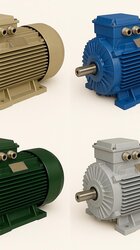
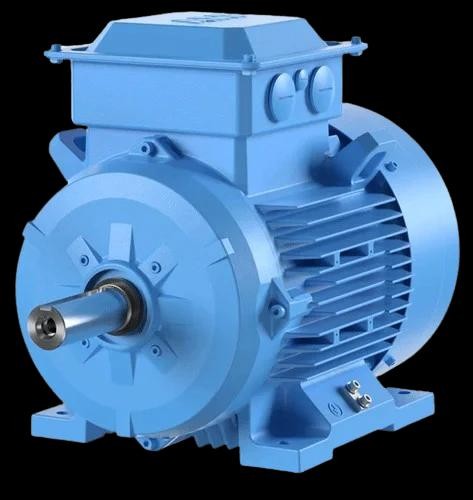

Induction motors draw active power from the grid to do useful work, and reactive power to build up their magnetic field. This reactive power never turns into work at the shaft; instead it loads the supply network, the cables and the transformer. The ratio that tells us how much of the total apparent power a motor draws actually becomes real work is called the power factor (cosφ). A low power factor leads both to reactive power penalties and to unnecessary line losses. In this article we look step by step at how to choose a power-factor correction capacitor connected in parallel with an induction motor, how the kVAr calculation is done, and why overcompensation is dangerous. To reinforce the fundamentals, we also recommend reading our article on power factor (cosφ) in electric motors.
What Is Power Factor (cosφ) and Why Does It Drop?
Power factor is the ratio of active power (kW) to apparent power (kVA). If a motor has a cosφ of 0.80, only 80 percent of the apparent power it draws becomes work at the shaft; the rest flows back and forth between the grid and the motor as reactive power. Because the magnetizing current in induction motors is nearly constant, the share of reactive power rises when the motor runs lightly loaded, and the power factor drops sharply. For this reason a power factor problem is often intertwined with motors running at the wrong load point.
What Exactly Is Reactive Power?
Reactive power (kVAr) is the power the motor continually takes and gives back to build up and collapse its magnetic field. This power is not metered as energy, but it physically loads the line. High reactive current causes heating in cables and transformers, voltage drop, and wasted distribution capacity. The purpose of a correction capacitor is to produce this reactive power locally so that it does not have to be drawn from the grid.
How Does a Correction Capacitor Work?
A capacitor produces capacitive reactive power in the opposite direction to the inductive reactive power the motor draws. While the motor draws lagging (inductive) current from the grid, the capacitor supplies leading (capacitive) current. When these two components cancel each other, the total reactive power drawn from the grid decreases and the power factor approaches unity. The reactive power now comes not from the line but from the capacitor right next to the motor.
What Is Individual (Parallel) Compensation?
In individual compensation the capacitor is connected directly in parallel with the motor terminal box and switches in and out together with the motor. The advantage of this method is that reactive power is supplied right at the source and the cable between the motor and capacitor is also compensated. For large, continuously running motors with steady load, individual compensation is the most efficient solution.
Difference From Central Compensation
In central compensation the capacitor bank is placed in the main panel and a reactive power relay measures the power factor of the whole facility and switches capacitor stages in and out step by step. This method suits facilities with variable loads and many small motors. Individual compensation, on the other hand, is preferred for single large, continuously running motors. In most facilities the two methods are used together.
The Logic of the kVAr Calculation
The size of a correction capacitor is calculated in kVAr. The basic logic is this: the capacitor must supply the difference between the reactive power at the motor's present power factor and the reactive power at the target power factor. The calculation needs the motor's shaft power (kW), the present cosφ value, and the target cosφ value we want to reach.
The kVAr Formula
The required capacitor power is found with the expression: Qc = P × (tanφ₁ − tanφ₂). Here P is the motor's active power (kW), φ₁ is the present power factor angle, and φ₂ is the target power factor angle. The tanφ value is obtained trigonometrically from the cosφ value. For example, if cosφ is 0.80 then tanφ is 0.75; if cosφ is 0.95 then tanφ is 0.33.
A Worked Example
Suppose we want to raise a 22 kW motor with a cosφ of 0.80 up to 0.95. Then tanφ₁ = 0.75 and tanφ₂ = 0.33. Accordingly, Qc = 22 × (0.75 − 0.33) = 22 × 0.42 ≈ 9.2 kVAr. So a capacitor of roughly 9-10 kVAr suits this motor. In practice the nearest standard value available on the market (for example 10 kVAr) is selected.
What Should the Target cosφ Be?
Most distribution utilities require the power factor to be kept at 0.95 and above. There is no need to push the target all the way to 1.00, because compensating that last slice between 0.95 and 1.00 requires a disproportionately large capacitor and increases the risk of overcompensation. The 0.95-0.98 band stays safely above the penalty threshold while keeping the capacitor a reasonable size.
Standard kVAr Values Table
The table below shows approximate capacitor values for common motor powers, assuming a rise from cosφ 0.80 to 0.95. The values are for guidance; if the actual motor's nameplate cosφ differs, the calculation must be repeated.
| Motor Power (kW) | Present cosφ | Target cosφ | Approx. Capacitor (kVAr) |
|---|---|---|---|
| 4 | 0.80 | 0.95 | 1.7 |
| 7.5 | 0.80 | 0.95 | 3.2 |
| 11 | 0.80 | 0.95 | 4.6 |
| 22 | 0.80 | 0.95 | 9.2 |
| 45 | 0.80 | 0.95 | 18.9 |
| 90 | 0.80 | 0.95 | 37.8 |
Reading Nameplate Values Correctly
The motor's rated cosφ is written on the nameplate; however this value is for full load. If the motor runs at partial load the actual cosφ is lower and the compensation requirement changes. For this reason the capacitor selection must be based on the real operating load. We covered choosing the right load point in detail in our article on the oversized motor and partial load trap.
What Is Overcompensation?
Overcompensation is the condition where the capacitor produces more reactive power than the motor needs. In this case the power factor crosses from inductive to capacitive; that is, reactive power begins to be fed back to the grid. Overcompensation can cause voltage rise, capacitive penalties and resonance risks. Therefore the notion that "the more capacitance the better" is wrong.
The Risks of Overcompensation
An oversized capacitor is especially dangerous when the motor stops. After the motor is disconnected from the grid, the capacitor can keep feeding the spinning motor for a while; this is known as self-excitation. This phenomenon can create voltages above the grid voltage at the motor terminals and damage the insulation. For this reason, in individual compensation the capacitor value is kept below the motor's no-load magnetizing power.
Safe Upper Limit in Individual Compensation
For a capacitor connected directly to the motor terminals, the general rule is that the capacitor power should not exceed about 90 percent of the reactive power the motor draws at no load. This limit prevents the risk of self-excitation and overvoltage. In practice, suppliers provide safe maximum kVAr tables by motor power; the selection should stay below this limit.
Caution in Inverter-Driven Systems
If the motor is driven by a frequency inverter, NEVER connect the capacitor between the motor and the inverter. The high-frequency pulsed voltage at the inverter output stresses the capacitor with excessive current and can destroy both the capacitor and the inverter. The inverter already keeps the power factor high on the input side, so a separate motor capacitor is not needed. For energy management of driven systems you can read our article on energy saving with a frequency inverter.
How Does an Inverter Affect Power Factor?
Seen from the grid side, a frequency inverter generally shows a high power factor, because its input stage stores energy through a rectifier and capacitor bank. However, inverters feed harmonic current back into the grid. For this reason, in inverter-driven facilities, instead of classic correction capacitors, harmonic-protected (detuned reactor) compensation systems are used.
Harmonics and the Detuned Reactor
If the facility contains inverters, soft starters or similar semiconductor loads, harmonic currents are present on the network. A bare correction capacitor can resonate with these harmonics and draw excessive current. To prevent this, a detuned reactor is added in front of the capacitor. This reactor shifts the resonance frequency outside the harmonic regions and protects the capacitor.
How Does a Reactive Power Penalty Arise?
Distribution utilities apply a reactive power penalty when the ratio of reactive energy drawn to active energy exceeds a certain threshold. The inductive reactive energy ratio generally cannot exceed 20 percent, and the capacitive reactive energy ratio cannot exceed 15 percent. When these thresholds are passed, the bill rises with extra charges. Correct compensation can eliminate this penalty entirely.
Understanding the Penalty Threshold
The 20 percent inductive reactive limit corresponds roughly to a cosφ of 0.98. For this reason, keeping the target in the 0.95-0.98 band is a balanced choice both for staying above the penalty threshold and for not crossing to the capacitive side and taking a capacitive penalty. The reactive power relay sets the stages so as to keep this balance automatically.
Capacitor Switching and Stages
In central systems, capacitors are switched in not as a single block but in stages. The reactive power relay measures the instantaneous power factor and switches as many stages on or off as needed. This way overcompensation is prevented at light load and sufficient compensation is provided at full load. The number and values of stages are designed according to the facility's load profile.
Capacitor Life and Maintenance
Correction capacitors lose their capacitance over time. Overvoltage, harmonics and frequent switching accelerate this aging. Capacitor currents and capacitances should be measured regularly and weakened units replaced. A capacitor with reduced capacitance, if unnoticed, will cause the facility to be penalized again.
Temperature and Mounting Conditions
Capacitors are sensitive to heat; high ambient temperature shortens their life. The compensation panel should be well ventilated and the capacitors kept away from direct heat sources. In cramped, poorly ventilated panels the capacitor life falls far below expectation.
The Relationship Between Motor Selection and Compensation
Correct motor selection also reduces the compensation requirement. High-efficiency (IE3/IE4/IE5) motors offer a higher power factor at rated load. Moreover, when the motor power is scaled correctly to the application, the motor runs close to its rated load and the cosφ stays high. Our article on high-efficiency electric motors deepens this topic.
The Importance of the Right Power Motor
An oversized motor runs continuously at partial load and its power factor drops, which in turn requires more compensation. Choosing a motor of the right power for the application improves both efficiency and power factor. Our article on high and low kW motors covers correct power selection.
Compensation in Pump and Fan Applications
In pump and fan systems the motor often runs at variable load. If an inverter is used for speed control in these applications, the capacitor must be connected to the main panel, not to the motor. Our articles on water pump electric motor selection and fan and blower motor selection focus on these applications.
The Situation in Compressor Applications
Compressor motors draw high starting torque and fluctuating load. When compensating these motors, the load profile must be taken into account. In frequently stopping-starting compressors, individual compensation can cause the capacitor to be switched frequently together with the motor; for this reason a central solution is often more suitable for compressor groups. You can look at our article on starting torque in compressor motors.
Contactor or Direct Connection?
In individual compensation the capacitor is usually connected to the motor terminals after the motor contactor. This way, when the motor stops the capacitor is also de-energized and the self-excitation risk is reduced. A capacitor left permanently connected directly to the grid can cause overcompensation and voltage rise while the motor is stopped.
Discharge Resistors
Capacitors continue to carry voltage after their supply is cut. For this reason a discharge resistor is connected to each capacitor; this resistor empties the capacitor within a safe time, improving both personnel safety and reducing the inrush current when re-energized. A capacitor without a discharge resistor is both dangerous and harmful to equipment life.
Energizing Inrush Current
When a capacitor is switched in, it draws a high inrush current. This surge wears the contactor contacts and can cause sudden voltage dips on the network. To limit this, special pre-charge resistor type capacitor contactors are chosen, or inrush-limiting reactors are used.
Its Relationship to Efficiency and Losses
Correcting the power factor reduces the line and transformer losses across the facility independently of the motor's own efficiency. When reactive current drops, heat loss (I²R) in cables decreases. To understand the losses inside the motor itself, our article on electric motor efficiency losses is a good starting point.
The Savings Compensation Brings
Correct compensation, in addition to removing the reactive power penalty, also frees up transformer and cable capacity. More active load can be supplied from the same transformer, voltage drop decreases and line losses recede. These gains let the capacitor investment pay back quickly in most facilities.
Measurement and Monitoring
To know that compensation is working correctly, the facility power factor must be monitored continuously. Modern reactive power relays provide information about the instantaneous cosφ, stage status and capacitor health. Through monitoring, weakening capacitors, faulty contactors and changing load profiles are noticed early.
Approach to a Large Motor Fleet
In facilities with many motors of different powers, fitting a separate capacitor to each motor is both costly and hard to manage. In such facilities, the most balanced strategy is to apply individual compensation to large, continuously running motors and central automatic compensation to the remaining variable load. Our article on industrial electric motors offers a broad view of motor fleet management.
Is There a Relationship With Noise and Vibration?
Compensation does not directly change the motor's mechanical noise; however harmonic-related problems can produce magnetic hum in the motor and transformer. Detuned reactor compensation reduces this hum by limiting harmonic currents. For motor-related noise and vibration you can look at our article on reducing electric motor noise and vibration.
Pole Count and Power Factor
The pole count of a motor affects both speed and power factor. Generally, multi-pole (low-speed) motors have a lower power factor than low-pole motors, because the magnetizing share is higher. For this reason low-speed motors usually have a greater compensation requirement. Our article on the relationship between pole count and speed explains this link.
Common Mistakes
The most common mistakes are: selecting the capacitor according to the nameplate cosφ instead of the real load, connecting a capacitor between the inverter and the motor, not using a discharge resistor, installing a reactor-less capacitor in a facility with harmonics, and never monitoring capacitor health. Each of these mistakes either renders the compensation ineffective or damages the equipment.
Planning the Compensation Project
Sound compensation begins with measurement. First the facility's load profile and present power factor are recorded and the harmonic level is measured. Then it is decided where individual and central compensation will be used, capacitor values are calculated, and a detuned reactor is added if needed. Well-planned compensation both removes the penalty and relieves the facility's energy infrastructure.
Starting With the Right Motor Is the Best Compensation
Compensation is a powerful tool, but the soundest solution starts with the right motor. A high-efficiency motor running close to its rated load and correctly scaled to the application offers a high power factor from the start and reduces the capacitor requirement. DRG Motor supplies induction motors in the IE3, IE4 and IE5 efficiency classes that stand out with their high power factor and well-dimensioned magnetic design. For selecting a motor of the right power, speed and efficiency class for your project, and for the right compensation approach, you can contact the DRG Motor team; you can review our motor portfolio on our DRG electric motor product page. To reinforce the fundamentals, our article on what an electric motor is is also a good starting point.