 English
 Le français
 Türkçe

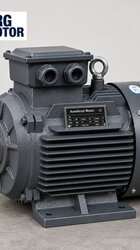

90 kW 1500 RPM Three Phase Motor – Shock Load, Dust and the Maintenance It Demands
A 90 kW motor in a quarry does not fail from being undersized. It fails from dust in the cooling path, from a load that hits it rather than builds up, and from a grease interval that nobody kept. Those three causes account for most of the 90 kW frames that come back, and none of them is a design fault.
So the useful part of a 90 kW 1500 RPM electric motor price comparison is not the figure but what the machine is being asked to survive. DRG Motor supplies the 90 kW four-pole three-phase frame at 380–400 V, 50 Hz for exactly these duties, and what follows is what keeps one running.
Shock Load Is Not Overload
A crusher taking an oversized feed, a screen starting under a full bed, a conveyor restarting loaded: each of these puts a torque spike through the motor that lasts seconds and repeats all day. It is not a sustained overload, so it does not necessarily trip anything, but it works the rotor bars, the coupling and the bearings every time.
A drive like that is specified against its start and its repetition rate, not against the power it draws once the load is moving.
The Dust Path Nobody Inspects
The second cause is simpler. A 90 kW machine rejects a great deal of heat and gets rid of it through the fan cover and the cooling ribs. In a crushing or screening plant those ribs fill with dust in weeks, the winding runs hotter for the same output, and the insulation ages faster than any calculation predicted.
The items that decide whether that happens:
- Fan cover and cooling ribs cleaned on a fixed interval
- Clear air space around the frame at the installed position
- Motor sited out of the direct dust fall where possible
- Cooling air not drawn from immediately behind a discharge point
- IP55 sealing intact, especially around the terminal box gasket
- Shaft seals checked where the position is washed down
- Winding temperature monitored rather than assumed
- Bearing temperature trended, not just measured once
- Grease type and interval matched to the ambient conditions
- Vibration reading taken at commissioning as a baseline
- Coupling alignment rechecked after the drive has run warm
- Base bolts retorqued after the first weeks of shock loading
- Every one of those is a maintenance decision, and together they matter more to the life of the machine than the difference between two suppliers.
For accurate pricing, tell us the driven machine and the duty it starts against; the figure follows from that rather than from the rating alone.
Specification Table
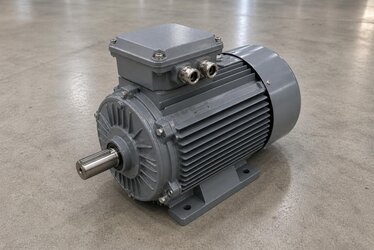
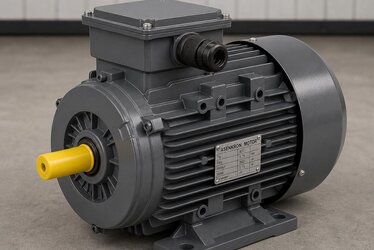
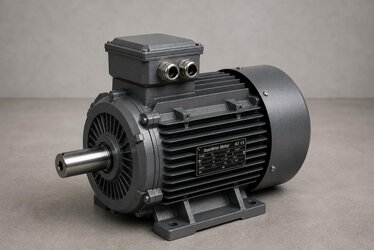
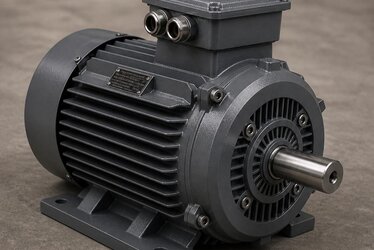
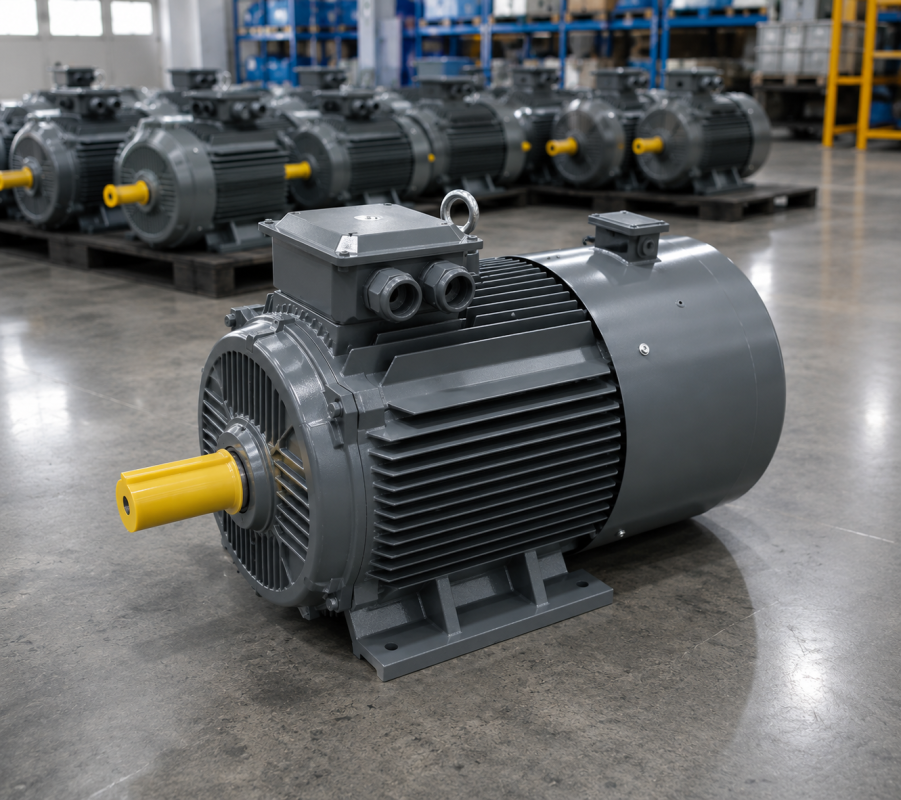
The 90 kW three-phase machine is built to IEC dimensions in a heavy-duty cast iron frame for continuous duty under load.
Main Technical Features
- Rated Power: 90 kW
- Speed: 1500 RPM
- Four-pole induction motor
- Three-phase operation
- Operating Voltage: 380–400 V
- Frequency: 50 Hz
- IE3 Premium Efficiency
- IE4 Super Premium Efficiency options
- 100% copper windings
- Heavy-duty cast iron housing
- IP55 protection class
- Class F insulation
- Low vibration
- Quiet operation
- Long-life industrial bearings
- Continuous-duty design
- IEC-compliant construction
- B3 foot-mounted version
- B5 flange-mounted version
- B35 foot and flange-mounted version
Cooling and Continuous Duty
Continuous duty at 90 kW means the machine reaches a stable temperature and holds it. That equilibrium depends on the air it can move over the frame, so anything that restricts the airflow shortens the life of the winding without changing anything electrical.
IE3 and IE4 machines help here for a mechanical reason as much as a financial one: fewer losses means less heat to reject, and less heat to reject means the dust in the ribs matters slightly less.
Where a 90 kW frame ends up: from quarry to steel plant
The 90 kW rating sits on main plant equipment that runs loaded all day:
- Jaw and impact crushers
- Cone and vertical shaft crushers
- Vibrating screens and grizzly feeders
- Aggregate washing and log washers
- Sand classifying plants
- Concrete batching plant mixers
- Cement mill auxiliary drives
- Mine dewatering pumps
- Overland and inclined conveyors
- Bucket elevators on heavy material
- Steel plant roll table drives
- Scrap shredders and shears
- Rolling mill auxiliary pumps
- Dust extraction and bag filter fans
- Induced draught fans on kilns and boilers
- Screw and reciprocating air compressors
- Slurry and tailings pumps
- Process pumps in chemical plants
- Plastic and rubber granulators
- Wood chippers and hogs
- Recycling shredders and balers
- Paper mill pulper drives
- Ceramic ball mills
- Feed mill hammer mills
Why Cast Iron on a Shock-Loaded Drive
A frame taking repeated torque spikes has to hold its bearing housings in line while it does so, and it has to survive the mechanical treatment a heavy plant gives it. That is what the cast iron housing is for:
- Strength at the feet against repeated torque reaction
- Mass that damps vibration coming back from the driven machine
- Bearing housings that stay aligned over years of shock loading
- Heat conducted out through frame and ribs
- Resistance to impacts and site handling
- Dimensional stability through temperature cycling
- A housing that can be lifted and reinstalled without distortion
Copper Windings and Overload Margin
The winding is 100% copper, and on a shock-loaded drive that matters for a specific reason: the margin to absorb a short torque spike without the winding temperature climbing past where the insulation is comfortable.
What the copper content gives on this duty:
- Lower resistive loss, so less heat at full load
- Headroom to ride out a repeated starting spike
- Cooler running, so the dust in the ribs costs less
- Slower insulation ageing at the working temperature
- Stable efficiency after years of heavy service
- Less heat rejected into a plant room already hot
- Longer intervals before a rewind is discussed
Where DRG Motor Differs
On heavy plant the supplier is judged when something stops, not when the order is placed.
What we provide:
- Sizing checked against the starting duty and the repetition rate
- Heavy-duty cast iron frames as standard at this rating
- Winding and bearing sensors fitted at the works
- IE3 and IE4 quoted side by side for continuous duty
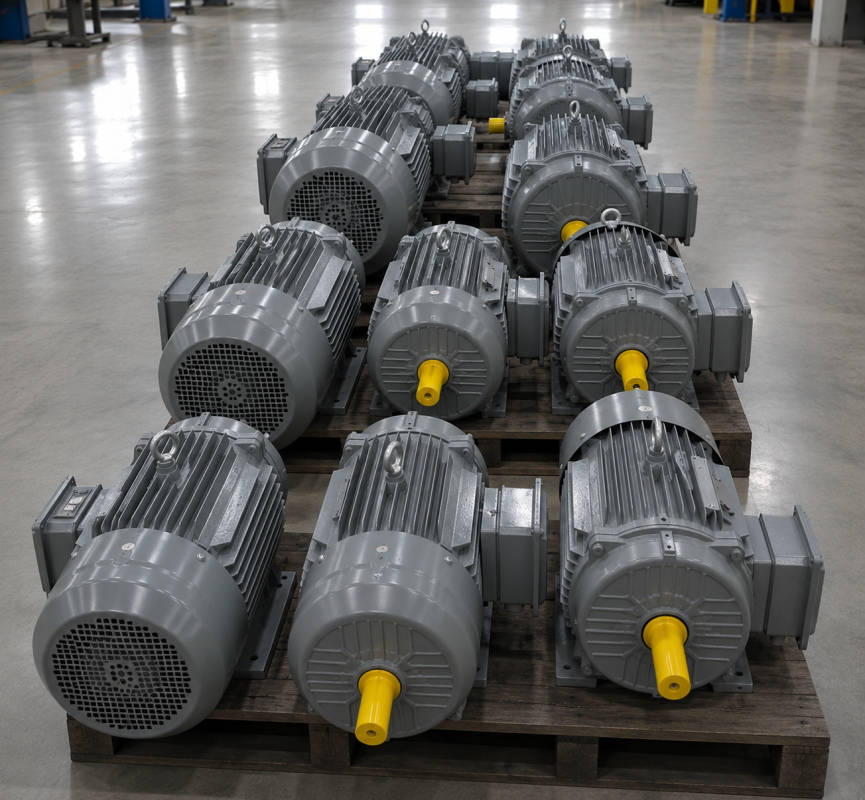
- Common heavy ratings held in stock for short lead times
- Bearing and spare-part references recorded at delivery
- Terminal box orientation set for your cable route
- Support on grease intervals and cleaning schedules
- Guidance on baseline vibration and temperature readings
- A spare motor planned where the drive is unique in the plant
Before You Order a 90 kW Motor for Heavy Duty
Settle these before the rating is confirmed:
- The driven machine and what it starts against
- Torque demand at breakaway, not just at running speed
- Starts per hour and whether they occur under load
- Load ratio in normal production
- How dusty the position is, and how often it can be cleaned
- Air space available around the frame
- Washdown or open-air exposure at the position
- Ambient temperature and installation altitude
- Mounting as B3, B5 or B35 and the foundation available
- Coupling type and the alignment tolerance it needs
- Protection class required, from IP55 upward
- Sensors the control system expects to read
- Whether an inverter or a soft start will be used
- Supply at the board, as 380–400 V, 50 Hz
- Crane access for installation and future removal
- Who records the commissioning readings and keeps them
- Grease and cleaning intervals to be written into the plan
Answered honestly, that list predicts the life of the motor far better than the price does.
Ordering a 90 kW 1500 RPM Motor from DRG Motor
Send the driven machine, the starting duty and the conditions at the position, and the 90 kW frame is specified against the shock load and the dust rather than against the running power alone.
The machines are built with 100% copper windings, heavy-duty cast iron frames, IP55 protection and Class F insulation to IEC dimensions, in IE3 Premium and IE4 Super Premium efficiency classes.
Ask for the commissioning checklist with the quotation, and the baseline readings that protect the drive are recorded from the first day rather than after the first failure.