 English
 Le français
 Türkçe


Printing machines demand one of the most challenging characteristics expected from an electric motor: flawless speed stability. Print quality depends directly on how smoothly and precisely the paper or film passes through the machine. A speed fluctuation lasting a small fraction of a second leads to misregistration of colors, a blurred image or a winding error. For this reason, in the printing sector the motor is not merely an element that provides power; it is a precise control instrument that determines the sharpness and quality of the print. This article examines how precise speed and tension control is achieved on printing and winding lines, the role of the inverter and vector control in this work, and the effect of stable, low-vibration operation on print quality.
Unlike heavy-duty sectors, printing applications demand precision and repeatability rather than high torque. The motor must respond to every command in the same way, and all sections of the line must work in harmony with one another. For a broad framework on the subject, our article on industrial electric motors offers a good foundation.
The Relationship Between Print Quality and Speed Stability
The printing process relies on the paper or film passing through the rollers at a constant and predictable speed. The more stable the speed, the more uniform the ink transfer and drying. The smallest fluctuation in speed leads to visible defects in the print pattern. For this reason the fundamental task of the printing motor is to keep its speed constant despite changes in load.
Synchronization in Multicolor Printing
In multicolor printing, each color is applied in a separate print unit, and all of these units must print in perfect alignment on the same paper. The smallest speed difference between units causes the colors to shift and the image to blur. In modern printing machines each unit is driven by a separate motor, and these motors are synchronized electronically. This synchronization is provided by frequency inverters and precise feedback systems. We addressed the foundations of the control precision provided by inverters in our article on energy saving with a frequency inverter.
Tension Control on Winding and Unwinding Lines
On roll feeding and winding lines, keeping the tension of the material constant is critical for print quality. As the roll unwinds its diameter shrinks, which requires the motor to continuously adjust its speed to maintain the same linear speed. If the tension loosens the material curls; if it is stretched too much it tears. To maintain this delicate balance, the torque and speed of the motor are continuously controlled. On winding lines, one motor usually pulls the material while another applies a controlled braking torque; the harmony of these two motors keeps the tension constant.
The Role of the Inverter and Vector Control
In printing machines a simple on-off control is not sufficient. The speed and torque of the motor must be adjusted instantly and precisely. For this reason the frequency inverter is an indispensable part of printing lines. The inverter changes the motor speed smoothly from zero to full speed and holds the desired speed at every stage of the printing process. However, the highest precision is achieved with vector control. We compared in detail the fundamental difference between vector control and V/f control in our article on the difference between inverter V/f and vector control.
The Need for Full Torque at Low Speed
Printing machines need full torque even at low speeds when starting to print and accelerating. When the machine begins to run slowly, if there is not enough torque to move the paper or film, print defects form in the first few meters. Vector control provides stable and high torque even at low speeds by precisely managing the magnetic field of the motor. This feature ensures that the print is of high quality from the very first moment.
Comparison: Line Section and Motor Expectation
The main sections on a printing line and their demands on the motor are summarized in the table below:
| Line Section | Load Character | Key Expectation |
|---|---|---|
| Print unit | Constant speed, precise sync | Speed stability |
| Unwind (feed) | Variable diameter, constant tension | Torque control |
| Wind | Variable diameter, braking torque | Tension control |
| Cutting / folding | Position accuracy | Fast response |
The Effect of Vibration on Print Quality
In printing machines, vibration is the hidden enemy of print quality. The smallest vibration in the rollers leads to streaking, shadowing or pattern distortion in the print. For this reason it is of great importance that printing motors be balanced and low-vibration. A well-balanced motor runs quietly and does not transmit vibration to the printing surface. We gathered the ways to reduce vibration in our article on reducing electric motor noise and vibration.
Smoothness in Speed Transitions
Printing machines frequently accelerate, decelerate and stop. The smoothness of these transitions is necessary both for protecting the material and for print quality. A sudden acceleration or deceleration disrupts the tension balance and causes the material to curl or tear. The frequency inverter softens the acceleration and deceleration ramps, making these transitions controlled. Thus the machine operates while protecting the material during every speed change.
Ink Pumps and Auxiliary Drives
Pumps are used in the printing process to feed ink in a controlled manner. The flow of these pumps must match the printing speed; otherwise too much or too little ink is transferred. We examined the basic criteria for pump motor selection in our article on water pump electric motor selection. In addition, for the correct selection of the fans used in the printing and drying sections, you can look at our article on fan and blower electric motor selection.
Drying and Air Management
After printing, drying units and air systems are used to dry the ink. The flow of the fans in these systems is adjusted according to the printing speed and ink type. Drying fans controlled with a frequency inverter both provide energy savings and ensure that the print dries correctly. The harmony of drying speed with printing speed ensures that the ink dries without smudging.
Conveyor and Handling Systems
After printing is complete, the product is transported to the cutting, folding and packaging sections. These handling systems run on electric motors, and their speed must match the main printing line. The correct selection of the handling drives provides an uninterrupted flow along the line. We addressed the subtleties of conveyor motor selection in our article on conveyor belt electric motor selection. For those who want to recall the basic working principles of the motor, our article on what is an electric motor will be useful.
Energy Efficiency and Inverter Savings
Since printing machines run continuously, the efficiency of the motors is an important cost item. Motors in the IE3, IE4 and IE5 efficiency classes produce significantly fewer losses than standard motors. When speed control is performed with a frequency inverter, the motor draws only as much energy as it needs; this provides large savings in motors running idle or at low load. We explained in detail what the efficiency classes mean in our article on high-efficiency electric motors.
Heating and Cooling Management
When printing motors run at low speeds for long periods, their own cooling may weaken. Especially in motors running at low speed with an inverter, the cooling provided by the fan decreases and the motor heats up. In this case additional cooling solutions or motors selected in a suitable class come into play. Monitoring the winding temperature ensures that the motor operates within a safe range. We explained this topic in detail in our article on electric motor temperature control.
Environmental Protection and Cleanliness
The printing environment contains paper dust, ink particles and moisture. These factors can seep into the motor and affect the insulation and bearings. For this reason the protection class of printing motors must be selected according to environmental conditions. The correct IP protection class ensures the long-lasting and reliable operation of the motor. We explained which protection class is required in which environment in our article on electric motor IP protection class.
Repeatability and Production Consistency
In the printing sector, the same job is expected to be printed at the same quality at different times. This repeatability depends on the motor giving the same speed and torque response every time. A stable and precisely controlled motor secures production consistency. Repeatability is decisive both for customer satisfaction and for reducing the scrap rate. A well-designed drive system delivers the same high quality in every print job.
The Correct Motor and Drive Match
In printing applications the motor and frequency inverter must be selected as a whole. The best result is achieved when the control precision of the inverter, the structure of the motor and the feedback system are compatible with each other. A mismatched motor-drive pair adversely affects speed stability and print quality. For this reason, when designing the drive system, the motor, drive and control must be evaluated together.
Motor Needs That Vary by Printing Method
The printing sector is not a single technology. In sheet-fed offset machines, paper sheets are fed one by one, and each sheet must enter the rollers with flawless timing. In rotary printing machines, the paper flows as an uninterrupted roll at high speed; here speed stability and tension control come to the fore. In methods such as gravure and flexo, the uniformity of cylinder printing depends directly on the motor's speed stability. In digital printing, the position accuracy of the feeding and handling motors is decisive. Each printing method demands a different control character from the motor, so motor selection must be customized to the technology used.
Register Marks and Automatic Alignment
In multicolor and multilayer printing, register marks are used to keep the colors and patterns in exact alignment with one another. These marks are read by sensors, and when a shift in alignment is detected the motor speed is corrected instantly. This automatic alignment requires the motor to respond to commands very quickly and precisely. A vector-controlled motor applies these small and sudden corrections with stability and keeps the print in alignment. The success of automatic alignment depends directly on the precision of the drive system, so the response speed of printing motors is of great importance.
Flexibility in Operating Speed
Printing businesses run at different printing speeds for different jobs. A precise print on thin paper requires a different speed than a print on thick cardboard. The frequency inverter provides this flexibility by adjusting the motor speed smoothly over a wide range. Moreover, the same machine can switch quickly between different jobs; the operator easily changes the printing speed according to the requirement of the job. This flexibility increases both production variety and the utilization efficiency of the machine. A motor that provides stable torque over a wide speed range is the foundation of this flexibility.
Maintenance and Long Life
Since printing machines operate with high precision, the regular maintenance of motors is necessary to preserve print quality. Bearing wear or imbalance increases vibration over time, leading to defects in the print. Regular bearing checks, insulation resistance measurement and vibration monitoring preserve the precision of the motor for many years. A well-maintained motor lasts longer and keeps print quality constant. Planned maintenance prevents unexpected downtime and secures production continuity.
Special Requirements in Packaging Printing
Packaging printing requires printing on a wide variety of surfaces such as flexible films, cardboard and label materials. Each material demands a different tension and speed profile; a thin film tears easily when overstretched, while thick cardboard requires higher torque. This variety makes it essential for the motor and drive to provide precise control over a wide operating range. On packaging lines, varnishing, embossing and cutting units also work in synchronism with the printing line. The harmonious movement of all these sections becomes possible thanks to the precise speed control of the motors. The correct drive solution secures both quality and production speed in packaging printing.
Operator Control and Automation Compatibility
Modern printing machines are managed by a central control system. The operator adjusts the printing speed, tension and alignment from a single panel; these commands are transmitted to the motors through frequency inverters. The seamless integration of the motors into this control system is necessary for the smooth operation of the line. The feedback data provided by the inverter gives the operator instant information about the state of the motor and enables early detection of possible problems. This automation compatibility both increases production efficiency and lowers the error rate. A well-integrated drive system reveals the full potential of the printing machine.
Feedback and Closed-Loop Control
The highest print quality is achieved with closed-loop control systems. In these systems the actual speed and position of the motor are continuously measured and compared with the target value; the smallest deviation is corrected instantly. Thanks to feedback, the motor keeps its speed constant despite changes in load and maintains the same speed throughout the print. This closed-loop structure prevents shift and misalignment especially in high-speed and multicolor prints. The precision of the feedback system is reflected directly in print quality, so in printing drives the motor, drive and feedback are designed as a whole. A well-built closed-loop system delivers a consistent result on every meter of the print job.
Soft Start and Mechanical Protection
When printing machines start running, the motor engaging with a sudden torque damages both the material and the mechanical transmission elements. A sudden start leads to the paper tearing or the gears and belts being overstressed. The frequency inverter provides a soft start by accelerating the motor gradually from zero speed. This soft start both protects the material and extends the life of the transmission elements. Likewise, a controlled deceleration when the machine is stopped preserves the tension balance and prevents the material from being damaged. Soft starting and stopping is a fundamental feature that increases both the reliability and the lifespan of the printing line.
DRG Motor Advantage for Printing Machines
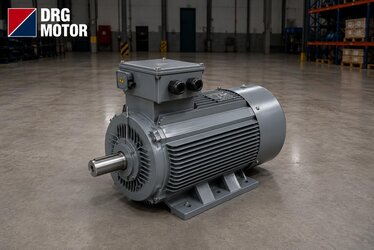
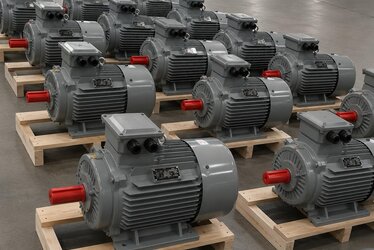
DRG Motor offers IE3, IE4 and IE5 efficiency-class AC induction motors suited to the precise speed and tension control requirements of printing machines. Full compatibility with frequency inverters and vector control, a balanced low-vibration structure, stable torque at low speed and a suitable protection class make DRG motors a reliable choice for printing, winding, cutting and drying applications. To achieve flawless speed stability and high print quality in every section of your printing line, you can contact the DRG Motor engineering team for the correct selection of motor, drive and efficiency class.