 English
 Le français
 Türkçe

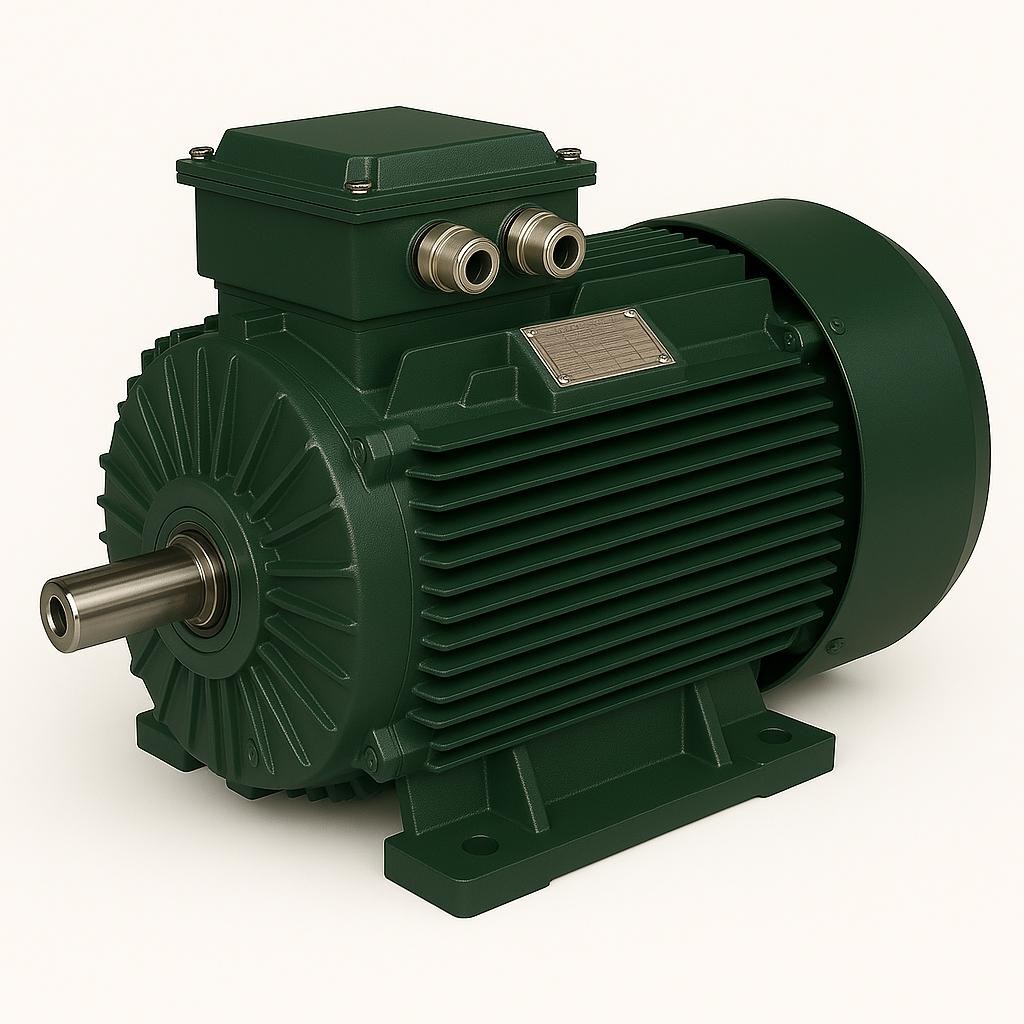

The only reliable way to understand how efficiently an electric motor truly runs is to measure it. The efficiency value printed on the nameplate is a reference obtained by the manufacturer under laboratory test conditions; in the field, however, the motor's actual load, supply voltage, ambient temperature, and mechanical condition may be quite different from those conditions. For this reason it is impossible to know a motor's real efficiency by looking at the nameplate; but when you measure the electrical power the motor draws from the grid and the mechanical power it delivers at the shaft, then take their ratio, you obtain the motor's real efficiency at that moment. In this article we examine, step by step from the DRG Motor engineering approach, how input power is measured, how output power is determined, the role of the power analyzer, the importance of power factor, and how efficiency verification is carried out in the field. Accurate measurement makes energy-saving opportunities visible and gives early warning about the motor's health. We address the topic so that both the technician new to the measuring instrument and the engineer wanting to lower plant energy costs can put it into practice.
Why measure efficiency?
The cost of the energy a motor consumes over its lifetime far exceeds its purchase price. In a continuously running motor, even a difference of a few percent in efficiency turns into a serious sum over the years. That is why efficiency must be measured rather than estimated. Measurement shows numerically which motor should be replaced, which line wastes unnecessary energy, and which improvement actually works.
The definition of efficiency
Efficiency is the ratio of the mechanical output power the motor delivers at the shaft to the electrical input power it draws from the grid. It is expressed as a percentage. Input power is always greater than output power; the difference is the losses that turn into heat inside the motor. The higher the efficiency, the less energy is spent for the same work. We examined in detail where these losses come from in our article on electric motor efficiency losses.
How is input power measured?
Input power is the active power the motor draws from the grid and is expressed in kilowatts (kW). In a three-phase motor, input power is found by evaluating phase voltage, phase current, and power factor together. Simply multiplying voltage by current is misleading, because that product gives the apparent power (kVA), not the active power. The difference is determined by the power factor.
Apparent, active, and reactive power
Three kinds of power are spoken of in an electric motor. Active power (kW) is the power that actually does work, turning into mechanical output and losses. Reactive power (kVAr) is the power needed to establish the magnetic field, which does no work but loads the lines. Apparent power (kVA) is the vector sum of these two. The power that must be used in the efficiency calculation is active power. Distinguishing these three powers forms the basis of measurement, because a calculation made with the wrong type of power can show efficiency very differently from reality. It is impossible to obtain a reliable efficiency value without correctly measuring active power.
The role of power factor
Power factor is the ratio of active power to apparent power and is denoted by cosφ. Induction motors are inductive by nature, so their power factors are less than one. While the power factor of a motor running at no load is very low, it rises at full load. A low power factor means more current is drawn from the lines for the same active power, which increases cable and transformer losses. Power factor is an inseparable part of efficiency measurement, because it must be known to correctly calculate active power. A low power factor alone does not mean the motor is inefficient, but it creates extra load and cost on the grid side. Therefore both efficiency and power factor should be evaluated together.
What is a power analyzer?
A power analyzer is a device that measures voltage, current, power factor, active/reactive/apparent power, and often harmonics all at once. What distinguishes it from a simple multimeter is that it evaluates these quantities simultaneously and in correct phase. In efficiency measurement, the power analyzer provides input power in a single step and with high accuracy; it is therefore the indispensable tool of field efficiency verification.
Measuring with a power analyzer
During measurement, current clamps or current transformers are connected to each phase of the motor, voltage probes touch the phase terminals, and the device automatically calculates active power. Modern power analyzers measure the three phases together rather than single/dual channel, also making unbalance visible. Making the measurement while the motor runs at full load is important so that it reflects the real efficiency.
How is output power determined?
Output power is the mechanical power the motor delivers at the shaft. Its direct measurement requires shaft torque and rotational speed; mechanical power is the product of torque and angular velocity. A torque sensor or dynamometer is used for torque measurement. Because this equipment is not always available in the field, output power is often estimated by indirect methods.
Indirect output power estimation
The most practical approach in the field is to determine the motor's load percentage and adjust the nameplate efficiency according to this load. The slip in rotational speed gives a clue about load; the further from synchronous speed, the more loaded the motor is. The ratio of drawn current to rated current is also used as a load indicator. These methods are not as precise as a dynamometer but provide adequate accuracy under field conditions. What matters is knowing the limits of the method used and interpreting the results accordingly. Using more than one method together, for example evaluating both slip and current ratio, increases the reliability of the estimate and reduces possible errors.
The torque, speed, and power relationship
Mechanical output power depends on the product of torque and rotational speed. The same power can appear as high torque at low speed or low torque at high speed. Understanding this fundamental relationship is the key to correctly interpreting output power and therefore efficiency. We addressed the topic in our article on the motor power, torque, and speed relationship.
Calculating efficiency
Efficiency is found by dividing output power by input power and multiplying by one hundred. For example, if the input power is measured as 11 kW and the output power is determined as 10 kW, the efficiency is approximately 91 percent. This simple ratio summarizes the motor's real performance at that moment. The reliability of the calculation depends on the accuracy of both the input and output measurements.
Field efficiency verification table
The table below summarizes the logic of field verification by showing an example of the input power, estimated output power, and efficiency of a typical induction motor at different load levels. The values are illustrative; on a real motor they must be determined by measurement.
| Load condition | Input power (kW) | Output power (kW) | Efficiency (%) | Power factor |
|---|---|---|---|---|
| No load | 1.2 | ~0 | low | 0.20 |
| 25% load | 3.6 | 3.1 | 86 | 0.55 |
| 50% load | 6.3 | 5.7 | 90 | 0.72 |
| 75% load | 8.8 | 8.1 | 92 | 0.82 |
| 100% load | 11.8 | 11.0 | 93 | 0.86 |
As the table shows, efficiency and power factor rise as load increases and generally reach their best value around full load. When an oversized motor constantly runs at low load, both efficiency and power factor drop, which shows the importance of correct motor selection.
The effect of correct sizing
A motor selected well above the need wanders in the low-load region throughout its life and never reaches its most efficient point. A correctly sized motor, on the other hand, mostly runs in the high-efficiency region. For this reason, efficiency measurement also reveals whether the motor has been selected suitably for the application.
Measurement errors and their causes
There are many sources of error in field measurements. Incorrectly connected current clamps, low-accuracy devices, ignoring harmonics, and unstable load conditions corrupt the result. Measurement should be made, if possible, under a stable and typical load with a calibrated power analyzer.
The effect of harmonics on measurement
In motors fed by an inverter, the current waveform deviates from a sine wave and contains harmonics. Simple instruments that do not account for harmonics measure power incorrectly. A power analyzer capable of true RMS and harmonic measurement gives the correct result in this case. Harmonics also create extra heating and efficiency loss in the motor.
The effect of unbalance on measurement
Voltage unbalance causes power to be distributed unequally between phases; a measurement made on a single phase becomes misleading. Therefore all three phases must be measured together. We addressed the effects of unbalance on the motor in our article on the effect of supply voltage unbalance on electric motors; this phenomenon must definitely be taken into account during measurement. A power analyzer that measures the three phases together both gives the total power correctly and makes the difference between phases visible, providing two-way information about both efficiency and motor health.
Choosing the moment of measurement
When the efficiency measurement is made directly affects the meaning of the result. The motor must have run long enough to warm up and reach a steady state; a measurement made right after a cold start does not reflect the real condition. Also, a moment when the load is typical and steady should be chosen. A single measurement taken under a constantly fluctuating load may not represent the average; in that case, making a short recording and taking the average gives a more accurate result.
Correct setup of the device
For the power analyzer to give the correct result, it must be set up correctly. The current clamps must be connected in the correct direction and to the correct phase, and the voltage probes must touch the correct points. Wrong polarity or phase confusion can show power as lower than it is or even negative. For this reason, connections should be carefully checked before measurement, and the reasonableness of the values shown by the device should be quickly assessed.
Instantaneous measurement versus continuous monitoring
A one-time measurement shows the motor's condition at that moment; however, the load changes over time. To see the real saving potential, continuous monitoring is needed. Continuous monitoring reveals the slow decline in efficiency, increasing losses, and the changing load profile. We detailed this topic in our article on electric motor energy monitoring.
Saving through monitoring
Continuous energy monitoring not only collects data; it also makes saving opportunities visible. Which motor runs unnecessarily, which line is overloaded, and the payback period of which improvement become clear with monitoring data. To calculate the saving numerically, our high-efficiency motor savings calculation article guides step by step.
Verifying the payback period
The payback period of switching to a high-efficiency motor can only be verified by real measurement. Estimates based on nameplate values may be optimistic; field measurement shows how long the investment will actually take to pay for itself. For this reason, efficiency measurement is also part of the purchasing decision.
The advantage of high-efficiency motors
High-efficiency motors draw less energy for the same work and heat up less. When verified by measurement, the saving these motors provide is often even higher than expected. Our article on high-efficiency electric motors covers the advantages this class offers.
Measurement practice in industrial plants
In industrial plants where many motors run, efficiency measurement should start with the lines that consume the most energy. Large, continuously running motors carry great saving potential even with small improvements. Our article on industrial electric motors covers the requirements of these applications broadly.
Including measurement in the maintenance routine
Efficiency and power measurement should be part of periodic maintenance. An efficiency that declines over time is often a harbinger of a mechanical problem, increasing friction, or a bearing issue. Thus efficiency measurement serves energy management and doubles as a predictive-maintenance tool.
The relationship between efficiency decline and failure
A slow decline in efficiency is a sign that something has changed inside the motor. Increasing bearing friction, misalignment, clogged cooling channels, or winding aging lower efficiency. For this reason, the efficiency trend is a valuable indicator of the motor's overall health and should be monitored regularly.
The effect of alignment on efficiency
When the coupling alignment between the motor and the driven machine deteriorates, the motor runs under extra mechanical load, and this extra load is directly reflected in efficiency. Misalignment produces both extra friction and vibration; both move energy away from useful work and turn it into heat. For this reason, a technician measuring efficiency should also check the mechanical alignment when seeing a lower-than-expected efficiency. We addressed the importance of alignment in our article on motor shaft and coupling alignment.
The relationship between vibration and efficiency
High vibration shows that part of the energy in the motor goes not to useful work but to shaking and structural strain. Vibration also shortens bearing life, increasing friction over time and lowering efficiency further. For this reason, efficiency measurement and vibration measurement complement each other. We examined methods of reducing vibration-related losses in our article on reducing electric motor noise and vibration.
The contribution of cooling to efficiency
The cooler a motor runs, the lower the winding resistance stays and the smaller the copper losses. Clogged cooling channels, dirty fin surfaces, or insufficient ventilation heat the motor; the rising temperature raises both resistance and loss. For this reason, even a simple cleaning can provide a measurable efficiency increase. Efficiency measurement also indirectly reveals cooling problems.
Measurement reporting and tracking
Every efficiency measurement made should be recorded together with the date, load condition, and measurement conditions. A single measurement is like a photograph; the real value is the film these photographs create over time. Thanks to regular recording, even the smallest regression in efficiency is noticed and its cause investigated. A good reporting discipline is the foundation of energy management.
DRG Motor for measurable efficiency
Efficiency gains real value when it is a quantity that is measured, not assumed. With the right power analyzer, the right method, and regular monitoring, you see the real performance of your motors and bring your energy costs under control. DRG Motor offers measurable savings with the AC induction motors it produces in the high-efficiency class; you can contact the DRG Motor engineering team for the right motor selection, correct sizing, and efficiency verification for your application. The plant that measures is the plant that wins.