English
 Le français
 Türkçe


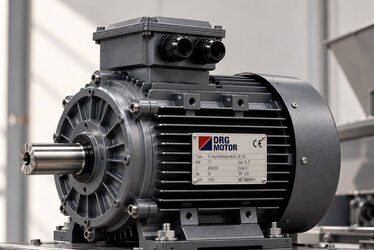
When we talk about an electric motor's power, we often look at the kilowatt figure; yet what actually moves a load is torque. Torque is the turning force a motor produces on its shaft and lies at the basis of every job, from starting a conveyor to turning a heavy crusher. In this article we examine in detail how torque is produced in electric motors, what types of torque exist, and why it is so important for choosing the right motor.
To review the general operation of a motor, see the how an electric motor works article; here the focus is entirely on the production and importance of torque.
What Is Torque?
Torque is the force that creates rotation around an axis. When tightening a bolt, the force you apply to the wrench multiplied by the length of the wrench is actually a torque. In an electric motor, this turning force is produced on the shaft and turns the connected machine. Torque is measured in newton-meters (Nm) and shows how strongly the motor can turn a load.
Power and torque are often confused but are different. Power expresses how fast the work is done; torque expresses how forcefully it is done. Lifting a heavy load slowly requires high torque, while turning a light load quickly requires high speed. The right motor choice comes from balancing these two.
How Is Torque Produced in an Electric Motor?
In an electric motor, torque arises from the interaction of two magnetic fields. The rotating magnetic field produced by the stator and the rotor's own magnetic field push and pull each other. This interaction creates a force that tries to turn the rotor; this force is torque. The greater the angle and strength between the two fields, the higher the torque produced.
In an asynchronous motor, the rotor's field arises from the current induced by the rotating field. This is why torque is directly related to the current induced in the rotor. The greater the current, the higher the torque. You can find a detailed look at how current is induced in the rotor in the induction motor article.
The Relationship Between Torque and the Magnetic Field
The magnitude of torque depends on the magnetic flux in the stator and the current in the rotor. A stronger magnetic field and a higher rotor current mean more torque. This is why motor designers carefully optimize the core material, winding arrangement and air gap to obtain the highest possible torque with the least loss.
How the rotating field produced by the stator forms is critical for understanding the basis of torque. For the details, see the rotating magnetic field article. In the end, torque is the concrete mechanical result of invisible magnetic forces.
Types of Torque
An electric motor produces different torque values at different stages of operation. The main ones are starting torque, pull-up torque, breakdown torque and full-load torque. Starting torque is the torque produced while the motor is still stationary and must be enough to set the load in motion. Full-load torque is the torque produced at the motor's normal operating point.
Breakdown torque is the maximum torque the motor can produce; above this point, if the load increases, the motor stalls, that is, stops. Pull-up torque is the lowest torque value between start-up and full speed and ensures the motor does not get stuck while accelerating the load. Knowing these torque types is essential for choosing the right motor.
The Torque-Speed Curve
A motor's torque behavior is summarized by the torque-speed curve. This curve shows how much torque the motor produces at different speeds. A certain torque is produced at start-up, then as speed increases the torque first drops a little, then rises to the breakdown point, and finally decreases rapidly toward the full-load point.
This curve is used to understand whether a motor is compatible with a load. The motor's torque curve must be above the torque curve demanded by the load at every point; otherwise the motor cannot start or gets stuck. Correct matching is the key to trouble-free operation.
The Relationship Between Torque and Load
An asynchronous motor automatically adjusts its torque according to the load. When the load increases, the rotor slows down a little, slip grows, and the motor produces more torque. When the load decreases, the opposite happens. This self-balancing behavior allows the motor to run stably under different load conditions.
However, if the load exceeds the motor's breakdown torque, the motor stalls and overheats by drawing excessive current. This is why the maximum torque demanded by the load must always be considered when choosing a motor. You can find a detailed look at the relationship between slip and torque in the slip in induction motors article.
The Relationship Between Torque and Power
Torque, speed and power are closely related. A motor's power depends on the product of the torque it produces and its rotation speed. This leads to a very important result: at the same power, a low-speed motor produces higher torque, while a high-speed motor produces lower torque.
This is why low-speed, high-torque motors are preferred in applications handling heavy loads. To understand this inverse relationship between speed and torque, see the motor speed article. The right power-speed-torque balance is the basis of an efficient system.
| Torque Type | When It Occurs | Importance |
|---|---|---|
| Starting torque | While motor is stationary | Sets the load in motion |
| Pull-up torque | While accelerating (lowest) | Prevents stalling |
| Breakdown torque | Maximum point | Sets the upper limit |
| Full-load torque | In normal operation | Does continuous work |
Why Is High Starting Torque Important?
Some applications require very high torque at start-up. A loaded conveyor belt, a loaded crane or a crusher full of material requires a large initial force to move from a standstill. If the motor's starting torque is insufficient, the motor cannot move the load, strains and overheats.
For such heavy-duty applications, motors with high starting torque are chosen. Stone crushing and crushing-screening plants are typical examples. For these applications, you can review the high-torque options on our stone crusher motors page.
Factors Affecting Torque
The main factors affecting the torque a motor can produce are the supply voltage, rotor resistance, the strength of the magnetic field and the motor's design. When the voltage drops, the torque decreases significantly; in fact, torque is proportional to the square of the voltage. This is why a motor running at low voltage cannot produce the expected torque.
Rotor resistance also affects torque; high-resistance rotors produce more torque at start-up. Motor designers optimize these parameters according to the application's needs. A well-designed motor safely provides enough torque for the targeted load.
How Is Torque Measured?
Torque can be evaluated directly with torque sensors (torque meters) or indirectly through the current the motor draws. Under laboratory conditions, a torque sensor placed between the motor shaft and the load precisely measures the instantaneous torque. In the field, the current the motor draws offers a practical indicator of torque.
The relationship between current and torque is used to monitor how loaded the motor is. A higher-than-normal current indicates that the motor is producing more torque than expected, that is, overloaded. This monitoring is valuable for both efficient operation and fault prevention.
Torque and the Right Motor Choice
Choosing the right motor is not done by looking only at its power; the motor's torque behavior must match the load's torque demand. First, how much torque the load needs at start-up and in normal operation is determined; then a motor that can meet this demand at every point is chosen. A motor with too little torque cannot start; a motor with too much torque brings unnecessary cost and energy consumption.
This is why torque analysis is at the center of choosing the right motor. To determine the torque and power combination suited to your application, you can review the three-phase asynchronous motor options and get support from the DRG Motor team for the right choice.
Torque and Efficiency
Torque production is also closely related to the motor's efficiency. The less loss with which the motor produces torque, the more efficient it is. A motor running under excessive load, that is, running close to its breakdown torque, heats up a lot and loses efficiency. The ideal is to run the motor slightly below its full-load torque, at its most efficient point.
High-efficiency motors are designed to produce the same torque with less energy. For high efficiency-class options, see the high efficiency motors section. When the right torque, the right load and high efficiency come together, both performance and savings are achieved.
The Instant-Torque Advantage of Electric Motors
One of the greatest advantages of electric motors over internal combustion engines is that they can produce high torque from the moment of start-up. While an internal combustion engine reaches its maximum torque only at a certain speed, an electric motor offers strong torque from the very first turn.
This feature is a great advantage for setting heavy loads in motion from a standstill. Cranes, elevators and conveyors move their loads smoothly thanks to this instant torque. This characteristic of the electric motor makes it ideal for many industrial applications.
Torque and Soft Starting
When large motors are connected directly to the grid, they produce high torque at start-up while also drawing very high current. This sudden torque and current can damage both the motor and the connected mechanical system; belts can stretch, gears can be strained, and a voltage drop can occur on the grid. This is where starting methods come in.
Methods such as star-delta or soft starters keep the torque and current at start-up under control. A soft starter introduces the torque smoothly by gradually increasing the voltage, protecting the system from sudden shocks. You can find a detailed look at which method suits which situation in the star-delta starting comparison.
Torque and Moment of Inertia
Setting a load in motion depends on the load's weight and on its moment of inertia. The moment of inertia expresses the resistance an object shows to rotational motion. A large, heavy flywheel or drum requires a high starting torque to move from a standstill, because its inertia is high.
In motor selection, the load's moment of inertia and the motor's starting torque must be evaluated together. High-inertia loads cause the motor to draw high current for a longer time, which can lead to heating. The right torque and the right starting method allow such loads to be accelerated safely.
What Is the Service Factor?
A motor's nameplate sometimes carries a value called the service factor. This value shows how much above its rated power the motor can run for a short time. For example, a motor with a service factor of 1.15 can withstand short-term overloads up to fifteen percent above its rated power.
The service factor provides a safety margin in applications with sudden load increases. However, this margin is for temporary peak loads, not continuous overload. Using the service factor continuously shortens the motor's life. In the right motor choice, this value is treated as a buffer against unexpected load increases.
Torque Fluctuation and Vibration
An ideal motor produces smooth torque; but in some cases torque fluctuation can occur. Machines carrying shock loads, for example piston compressors and presses, naturally create a variable torque demand. This fluctuation can lead to vibration and mechanical strain.
A flywheel can be used to smooth torque fluctuation; the flywheel balances torque by storing excess energy and giving it back when needed. In systems with frequency drives, advanced control minimizes torque fluctuation. Smooth torque is important for both equipment life and product quality.
Torque Needs by Application
Every application has a different torque demand. A centrifugal pump or fan needs low torque at start-up, and the torque demand rises as speed increases; this is why it runs comfortably on motors with normal starting torque. By contrast, a conveyor, crusher or mixer requires high starting torque to move when full.
This is why the application's torque-speed profile must be considered when choosing a motor. Fan motors for ventilation and pump motors for water systems are offered with suitable torque characteristics. The right torque profile provides both a trouble-free start and efficient operation.
Frequently Asked Questions
What is the service factor? It is the value showing how much above its rated power a motor can run for a short time; it provides a safety margin against sudden load increases.
How does moment of inertia affect torque selection? High-inertia loads require more starting torque and a longer acceleration time, which must be considered in motor selection.
What is the difference between torque and power? Power expresses how fast the work is done, torque how forcefully. Power depends on the product of torque and speed.
How is torque produced in an electric motor? The magnetic interaction between the stator's rotating field and the rotor's field creates the force that turns the shaft, that is, torque.
Why is starting torque important? It is needed to set the load in motion from a standstill; if insufficient, the motor cannot move the load and strains.
Why does a low-speed motor produce higher torque? At constant power, torque and speed are inversely proportional; so at low speed the same power means higher torque.
Does low voltage affect torque? Yes, torque is proportional to the square of the voltage; when voltage drops, torque decreases significantly.
Why Torque Really Matters
Torque is the real work capacity of an electric motor. This turning force, arising from the magnetic interaction between the stator's rotating field and the rotor's field, is the basis of setting a load in motion and turning it. Knowing different values such as starting torque, breakdown torque and full-load torque allows you to understand whether a motor is compatible with a load. The right motor choice depends not only on power but on matching torque with the load, which brings both trouble-free operation and high efficiency.