English
 Le français
 Türkçe




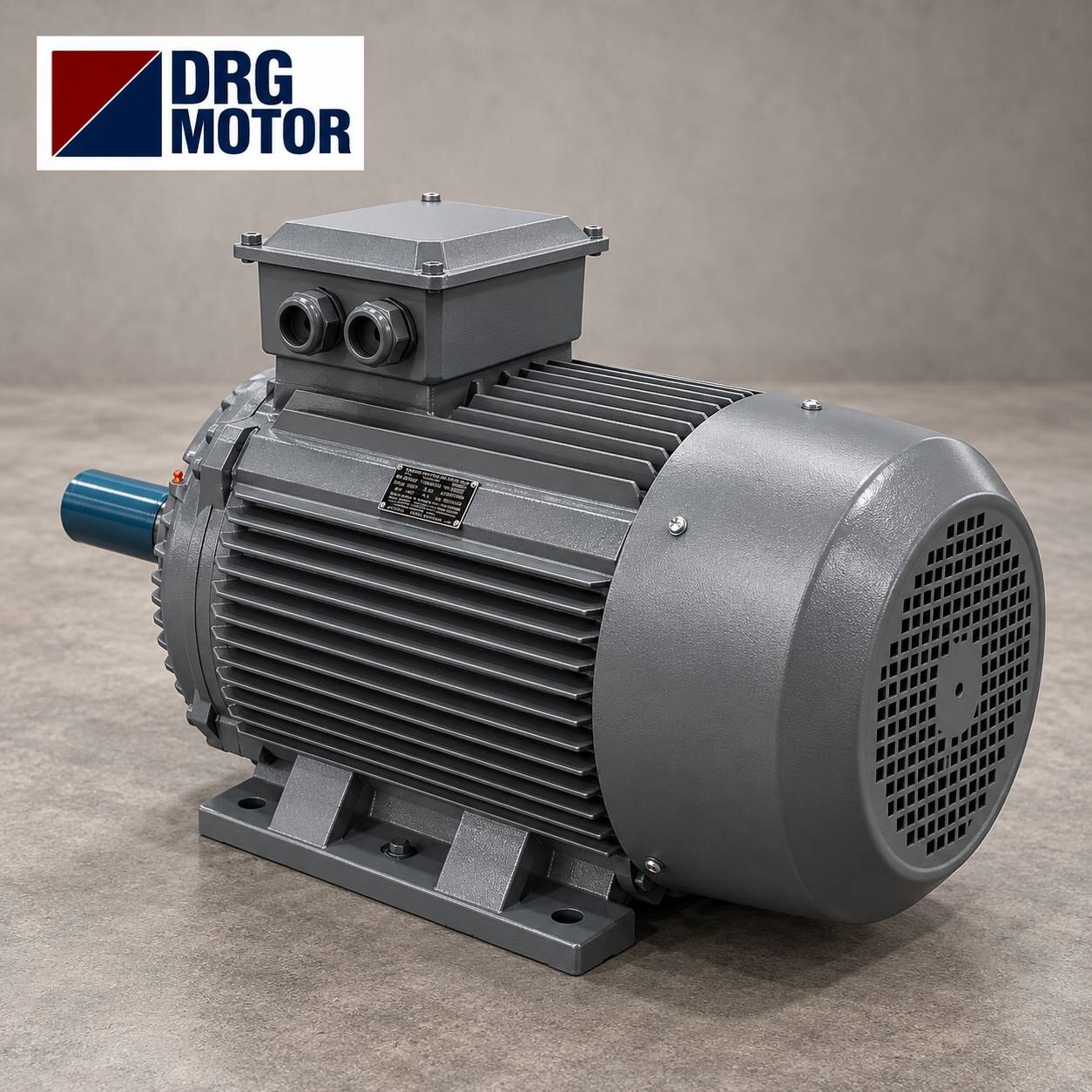

Many customers asking for a quote know the power rating but hesitate when asked about speed: "Does it matter, it's 11 kW, isn't it?" It does. Buying the same 11 kW at 3000, 1500 or 1000 rpm changes the torque delivered to the shaft, the frame size and the price tag all at once. In this article we place the prices of three speeds side by side for four power ratings with cast iron housings, show where the difference comes from in physical terms, and explain with examples how a motor bought at the wrong speed becomes expensive on site.
The last digit of the model code tells you the speed
The speed is not hidden in the store's codes; the digit at the end of the code is the motor's number of poles. DRG-160M1-2 has two poles, i.e. the 3000 rpm class; DRG-160M-4 has four poles, 1500 rpm; DRG-160L-6 has six poles, the 1000 rpm class. On a 50 Hz grid the synchronous speed is 3000 divided by the number of pole pairs. Under load the motor turns slightly below this value, which is why nameplates show figures such as 2900, 1450 or 960. If the speed cannot be read on the old motor's nameplate when buying a replacement, the pole count has to be found from the stripped winding or from the machine builder's documentation.
Price and torque of three speeds at four power ratings
We compared 4, 11, 30 and 75 kW using cast iron models, so the housing material stays constant and the difference comes from speed alone. The torque column is the rated torque value in the store list.
| Power (kW) | Speed (rpm) | Model / IEC frame | Torque (Nm) | Excl. VAT | Incl. VAT (20%) |
|---|---|---|---|---|---|
| 4 | 3000 | DRG-112M-2 / 112M | 13.1 | 10,186.00 TRY | 12,223.20 TRY |
| 4 | 1500 | DRG-112M-4 / 112M | 26.3 | 11,482.90 TRY | 13,779.48 TRY |
| 4 | 1000 | DRG-132M1-6 / 132M | 39.5 | 14,718.00 TRY | 17,661.60 TRY |
| 11 | 3000 | DRG-160M1-2 / 160M | 35.7 | 23,831.50 TRY | 28,597.80 TRY |
| 11 | 1500 | DRG-160M-4 / 160M | 71.7 | 25,674.00 TRY | 30,808.80 TRY |
| 11 | 1000 | DRG-160L-6 / 160L | 108.3 | 30,195.00 TRY | 36,234.00 TRY |
| 30 | 3000 | DRG-200L1-2 / 200L | 96.8 | 57,464.00 TRY | 68,956.80 TRY |
| 30 | 1500 | DRG-200L-4 / 200L | 194.2 | 55,748.00 TRY | 66,897.60 TRY |
| 30 | 1000 | DRG-225M-6 / 225M | 292.3 | 67,155.00 TRY | 80,586.00 TRY |
| 75 | 3000 | DRG-280S-2 / 280S | 240.8 | 130,180.60 TRY | 156,216.72 TRY |
| 75 | 1500 | DRG-280S-4 / 280S | 482 | 131,670.00 TRY | 158,004.00 TRY |
| 75 | 1000 | DRG-315S-6 / 315S | 727.2 | 175,560.00 TRY | 210,672.00 TRY |
Prices are taken from the DRG Motor online store list dated 24.09.2026; a 3% discount applies to bank transfer/EFT payments, shipping is not included in the price and is paid by the buyer. For current prices, please see the store page.
How the torque formula explains the price: T = 9550 · P / n
The rated torque a motor delivers to its shaft depends on the ratio of power (kW) to speed (rpm): T (Nm) = 9550 × P / n. At constant power, halving the speed doubles the torque. For 4 kW, the formula with synchronous speeds gives about 12.7 / 25.5 / 38.2 Nm; the table values of 13.1 / 26.3 / 39.5 Nm are slightly higher because the motor turns below synchronous speed under load, so n in the denominator becomes smaller.
Torque is produced by the rotor diameter and stack length. More torque means a larger rotor, more lamination steel and copper, and ultimately a larger frame. The table shows this clearly: at 4 kW the 3000 and 1500 rpm models use the 112M frame while the 1000 rpm model moves up to 132M; at 11 kW it goes from 160M to 160L, at 30 kW from 200L to 225M, at 75 kW from 280S to 315S. What raises the price is not the speed itself but the extra material needed to carry that torque.
What pushes the price up at 1000 rpm: one frame size larger
Taking the 1500 rpm model as the reference, the 1000 rpm counterpart is clearly more expensive at every power. The differences excl. VAT are: 3,235.10 TRY at 4 kW (14,718.00 − 11,482.90), 4,521.00 TRY at 11 kW (30,195.00 − 25,674.00), 11,407.00 TRY at 30 kW (67,155.00 − 55,748.00) and 43,890.00 TRY at 75 kW (175,560.00 − 131,670.00). In percentage terms the increase is about 18% at 11 kW and about 33% at 75 kW.
But when you divide the price by torque, the picture reverses. At 4 kW, 1 Nm of torque costs about 777.56 TRY excl. VAT on the 3000 rpm model, 436.61 TRY on the 1500 rpm model and 372.61 TRY on the 1000 rpm model. At 75 kW the same calculation gives 540.62 / 273.17 / 241.42 TRY. So the low-speed motor is more expensive, but every lira you pay buys more torque. If your machine genuinely needs high torque at low speed, a 1000 rpm motor is not expensive, it is the right choice.
3000 rpm is not always cheaper
The idea that "a two-pole motor is small, therefore cheap" holds at low power: at 4 kW the 3000 rpm model is 1,296.90 TRY cheaper than the 1500 rpm model, and at 11 kW 1,842.50 TRY cheaper. As power grows, however, this advantage disappears. At 30 kW the 3000 rpm model (57,464.00 TRY) is 1,716.00 TRY more expensive than the 1500 rpm model (55,748.00 TRY). The list shows the same for 45 kW (79,530.00 TRY vs 76,219.00 TRY) and 55 kW (98,450.00 TRY vs 93,247.00 TRY). At 75 kW the two speeds are practically level. A likely explanation is that at high power, high-speed motors place greater demands on rotor balancing, fan and bearings; above 30 kW, the list therefore suggests not reading speed as the sole driver of price.
The on-site cost of choosing the wrong speed
Scenario 1: One speed step up on a pump
It may look tempting to couple a cheaper 2900 rpm motor that happens to be available to a centrifugal pump selected for 1450 rpm. Yet by the pump affinity laws, head rises with the square of speed and absorbed power roughly with the cube. The result is overcurrent, thermal tripping, seal and bearing damage, and even pressure problems in the piping. The few thousand lira saved here are lost at the first failure through removal, refitting and downtime.
Scenario 2: 1000 rpm on a conveyor "for more power"
If a 1000 rpm motor is fitted to an 11 kW belt conveyor whose gearbox was selected for a 1500 rpm motor, belt speed drops by a third and line capacity falls. Moreover, because the frame is 160L instead of 160M, the base holes may not match. The first bill for this mistake is an unnecessary price difference of 4,521.00 TRY excl. VAT; the second is base modification work and lost production.
Scenario 3: Changing speed on a direct-coupled machine
On fans, mixers or mills connected directly by a coupling, without pulleys, the motor speed is the machine speed. Replacing a failed 1000 rpm motor with a 1500 rpm motor because it is in stock means the machine turns fifty per cent faster; if the fan blade, mixer shaft and coupling are not designed for this speed, a serious safety risk arises.
Checklist for determining the right speed
- Note the speed on the old motor's nameplate and the last digit of the model code.
- Is the machine direct-coupled, belt-driven or geared? Write down the ratios.
- Calculate the shaft speed and torque the machine requires; the electric motor calculators page makes this step easier.
- If the speed will change, compare the new frame number with the existing base.
- Compare prices only among models of the same speed; when placing different speeds side by side, remember the torque difference.
- Select the model by speed and power on the buy electric motors online page; read the return and exchange policy before ordering for post-delivery conditions.
Frequently Asked Questions
Why is a 1000 rpm motor more expensive at the same kW?
To deliver the same power at a lower speed, the motor must produce more torque. That requires a larger rotor and frame; the table shows the 1000 rpm models moving up one IEC frame size.
Is a 3000 rpm motor always more affordable than a 1500 rpm one?
No. In the store list dated 24.09.2026, the 3000 rpm model is more affordable at 4 and 11 kW, while the 1500 rpm model is more affordable at 30, 45 and 55 kW.
Can I fit a 1500 rpm motor in place of a 1000 rpm motor?
Only if the machine speed is re-adapted with pulleys or a gearbox and the frame size fits the base. On direct-coupled machines, a change of speed directly changes the machine's speed.
How do I calculate a motor's torque?
Use the formula T (Nm) = 9550 × P (kW) / n (rpm). For example, for 11 kW and 1500 rpm the synchronous speed gives about 70 Nm; the rated value in the store list is 71.7 Nm.
If you are unsure about the frame, power or speed, simply describe your application: call +90 (542) 666 11 11, write to [email protected] or reach us through our contact page.