 English
 Le français
 Türkçe


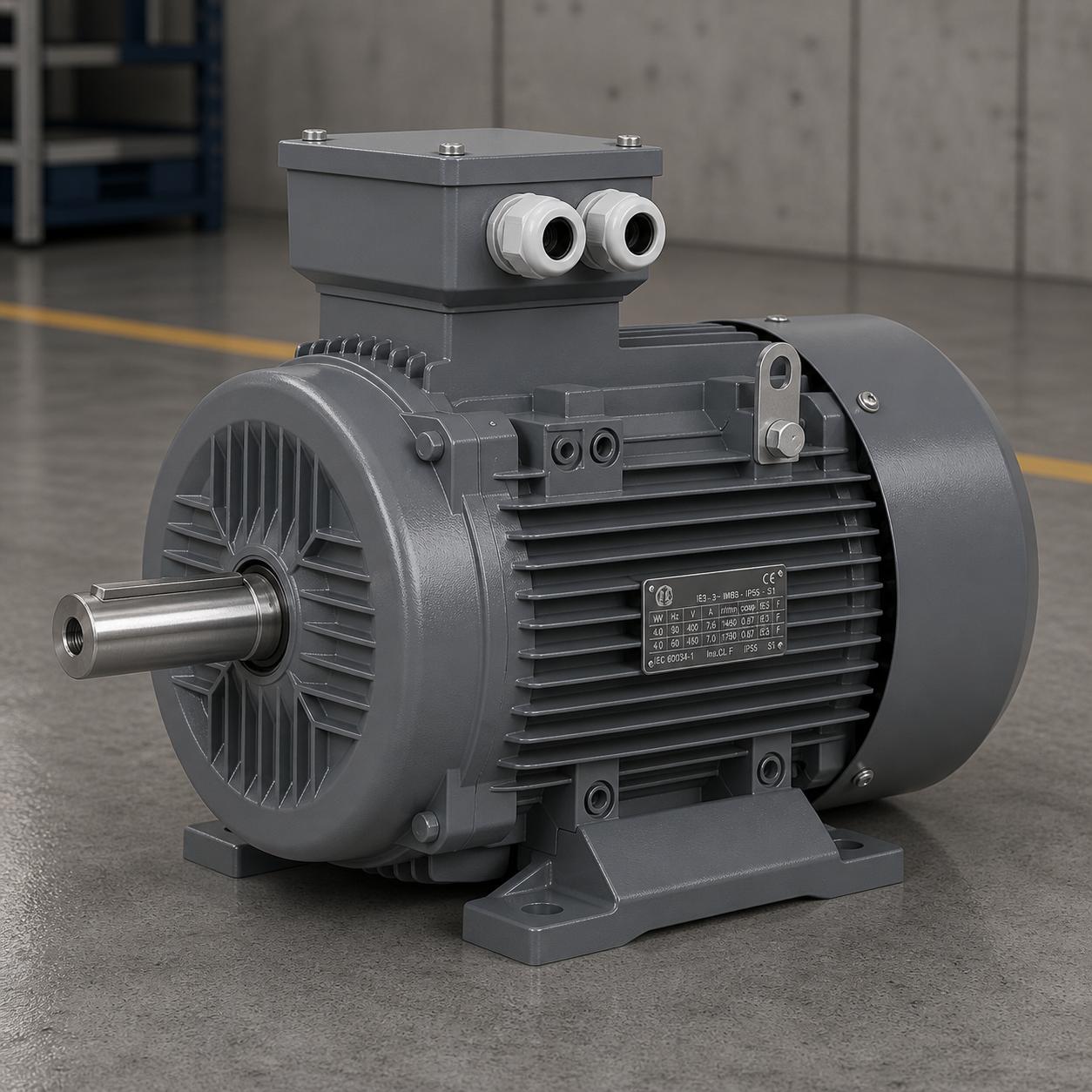

When a heavy industry buyer purchases a cast iron motor, the deciding factor is rarely raw power or price alone; it is the certification, the test report and the standards compliance inside the supply file. A cast iron frame may well be durable, but undocumented durability is an unmeasurable risk for the buyer. At DRG Motor, behind every cast iron three-phase electric motor we quote, we treat documentary proof that matches the buyer's technical specification as the real work of the supply process. This article explains, in procurement language, which document to request and why, and what is reasonable to expect from a supplier when sourcing a cast iron frame.
Documentation turns a durability claim into something measurable
The rigidity, heat dissipation and vibration damping of a cast iron frame only become commercial value when they are tested against the right standard. The question on the buyer side is simple: against which norm was this frame measured, and where is the result written down? An undocumented motor, regardless of catalogue wording, leaves the buyer alone when an efficiency gap or insulation weakness surfaces after commissioning. To close this gap on the cast iron motors we supply, we compare the pre-shipment document set against the specification.
From the procurement department's point of view, the matter is not only whether the motor runs; it is how strong the evidence in hand is, retroactively, in the event of a failure or dispute. When a drive line stops, the loss far exceeds the price of the motor. This is why receiving the cast iron frame's technical superiority together with its documentation moves the buyer's risk from the field to the supply file. The document is not insurance for the motor but for the purchasing decision; when the mechanical stability of the cast iron frame is backed by the right test framework, both operational safety and the buyer's position in any warranty claim become clear.
The IEC 60034 family: the buyer's common language
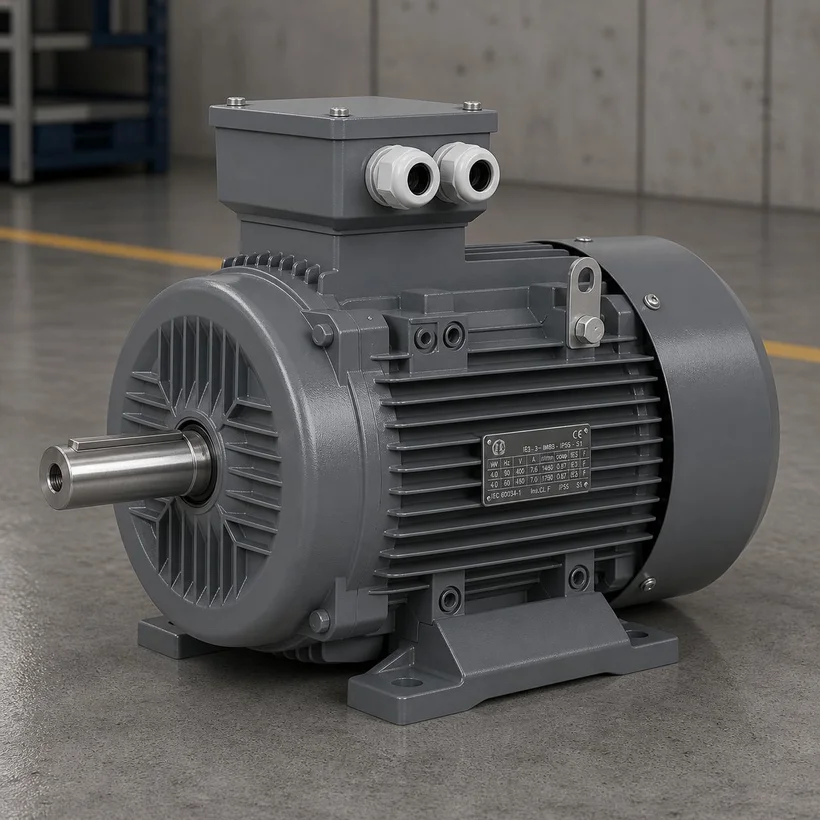
The electrical and mechanical characteristics of three-phase asynchronous motors are defined by the international IEC 60034 series. This series establishes a shared measurement language between buyer and seller; nameplate values, duty type (S1-S9), tolerance bands and classification all rest on this framework. When you write "compliance with IEC 60034-1" into your specification for a cast iron motor, you also fix how items such as rated power, voltage tolerance and temperature rise are to be measured.
- IEC 60034-1 — rating and general performance; the reference for every nameplate value.
- IEC 60034-2-1 — efficiency measurement methods; defines how an IE class claim is verified.
- IEC 60034-5 — degrees of protection (IP); the frame's rating against dust and water ingress.
- IEC 60034-6 — cooling methods (IC codes); classifies the cast iron frame's heat management.
- IEC 60034-30-1 — global definition of efficiency classes (IE1-IE4).
Each of these clauses means a separate test and a separate proof document. When preparing the supply file, clarifying which clauses the buyer refers to prevents disputes before they arise. The strength of the series is that it makes offers from different suppliers comparable on the same footing; when two offers both cite the same clause, the buyer is comparing like with like. Otherwise, what one supplier calls "high efficiency" may not rest on the same measurement method as what another calls "standard", and the comparison loses meaning.
Clear references to the cited clauses in the specification also protect the right to object in tenders and procurement processes. If a line item offer carries no standard number, the claim has no measurable counterpart and cannot be verified on site. When we prepare an offer we prefer to state the cited clause explicitly, because a vague conformity statement is a gap that later turns into a cost for the buyer.
IE efficiency class: a claim without a report is incomplete
An IE3 or IE4 label directly affects the operating budget of facilities with high energy costs. Yet the text "IE3" is not a commitment on its own; it must be backed by an efficiency measurement report made to IEC 60034-2-1. In a cast iron motor, a high efficiency class means lower losses and more controlled heating, which is directly linked to the frame's heat dissipation and cooling behaviour. Ask for the IE class to be supported by a test report at the quotation stage; we add the efficiency report to the file when we select the supply item.
On continuously running large drive lines, the efficiency class is the most concrete item that determines payback period. For a motor turning thousands of hours a year, a few points of difference between two efficiency classes can correspond to an energy item far larger than the motor's purchase price. Matching the efficiency claim with a document turns the purchasing decision from an emotional one into a financial calculation.
When evaluating the efficiency class it is also important not to look only at the full-load point. Many industrial drives follow a variable profile below rated load; in that case part-load efficiency and power factor enter the picture too. Stating the typical operating point in your specification makes it possible to select the right IE class and the right motor size together. An oversized motor, even with a high IE class on paper, may not deliver the expected saving at part load.
CE conformity and the technical file expectation
For supplies aimed at the European market or facilities referencing European standards, the CE marking represents a declaration of conformity to the relevant directives. What matters to the buyer is not just the mark on the label but the declaration of conformity behind it and the technical file being available from the supplier. In cast iron three-phase motor supply, it is in the buyer's interest to state in the specification whether low-voltage and electromagnetic compatibility headings are covered alongside the CE declaration.
The value of the CE marking is measured by how accessible the documentation supporting it is. Being able to reach the declaration of conformity and the technical file quickly when an audit or a customer request arrives also strengthens the buyer's position towards their own customer. For this reason we recommend discussing, at the start of the supply relationship, in what format and within what timeframe the documents can be provided. Even if the motor runs correctly on site, the buyer creates a gap in their own supply chain when a document request cannot be met.
IP protection class: matching the frame to the environment
An IP55, IP56 or higher protection degree determines how long the motor will withstand dusty, humid or wash-down environments. The cast iron frame carries this protection level together with sealing gaskets and cover workmanship. In sites such as quarries, cement and mining, the IP class is not just a number but a supply criterion that sets failure frequency. For the stone crushing plant motors we select for such harsh conditions, we evaluate the IP class together with the environmental analysis.
- IP55 — a level coded under IEC 60034-5 and treated as a baseline in general industry; in procurement its value comes not from being printed on the nameplate but from being verified by type test and recorded in the documentation.
- IP56 — added protection against powerful water waves; open sites and washed lines.
- IP65 / above — fully dust-tight; for aggressive environments.
A higher protection class does not always mean the right choice; an IP demand out of proportion to the environment raises cost needlessly, while too low a demand brings early failure. The right match is made by evaluating dust density, wash-down regime, humidity and temperature profile together. The sealing surfaces and cover seating quality of the cast iron frame are the physical basis on which the IP figure on the label is actually met in the field; this is why frame workmanship cannot be considered separately from the protection class.
Insulation class and temperature rise
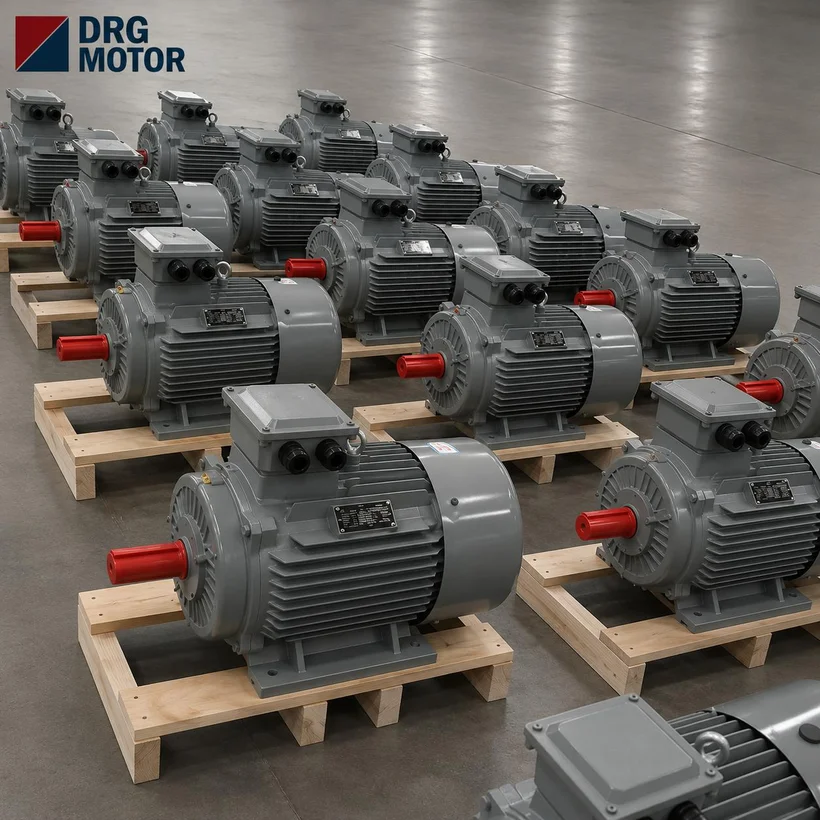
The winding insulation class (typically F, utilised at B) determines the motor's thermal life. The gap between the insulation class and the temperature rise class shows how much thermal margin (reserve) the motor operates with. Using class F insulation with a class B temperature rise, combined with the heat-shedding capacity of the cast iron frame, offers the buyer a long service life and a low risk of early failure. This thermal behaviour is intertwined with the motor's mechanical stability; the frame rigidity we discuss under vibration damping and quiet operation also supports proper seating of the winding and balanced distribution of thermal load.
The value of the thermal margin becomes even more pronounced in hot environments and at high altitude. When ambient temperature rises above the standard reference or altitude increases, the real load the motor can carry drops; in that case the thermal reserve reduces the need for derating. Stating ambient temperature and altitude in your specification allows us to choose the insulation class and frame according to these conditions. A high thermal margin also acts as a buffer against short-term overloads and protects the winding during unexpected process fluctuations.
Pre-shipment routine tests
As important as a cast iron motor's document is the fact that the tests underpinning that document were actually performed. As a heavy industry buyer, it is reasonable to request the results of the following routine tests:
- High-voltage (hi-pot) test — proof that insulation withstands the stated voltage.
- Insulation resistance measurement — the state of winding insulation at shipment.
- No-load current and vibration measurement — mechanical balance and bearing condition.
- Winding resistance and phase balance — symmetry across the three phases.
- Rotation and nameplate verification — confirmation of direction and nameplate values.
The report of these tests gives the buyer visibility before the motor goes to site and reduces commissioning surprises. Routine tests are checks applied to every motor; in some critical applications, type tests or additional verifications on a sample come into play. It is sensible to determine which test set you need according to the criticality level at which the motor will operate. For facilities holding spare motor stock, the shipment report also serves as a reference point when the stored motor is commissioned years later.
Another practical point is that the serial number on the test report must match the motor nameplate exactly. This traceability link between document and physical product proves which report belongs to which motor in multi-item shipments. In a supply where traceability is broken, even a technically existing document loses its evidentiary value for the buyer.
Bearing, grease and mechanical acceptance items
The items that determine a cast iron motor's life are not limited to winding and efficiency; bearing selection, grease type and lubrication interval are also part of the supply decision. In heavy-impact applications exposed to high radial load, selecting the bearing type according to the application directly affects the motor's expected service life. Writing the bearing type, whether you need a re-greasable arrangement and the target lubrication interval into your specification ensures the motor fits your maintenance plan in the field. The mechanical stability the cast iron frame provides also sets the ground for correct alignment of the bearing housings and balanced transfer of load.
On the mechanical acceptance side, items such as shaft tolerance, coupling surface and foot/flange flatness determine assembly quality. Having these values visible in the offer or acceptance protocol makes it easier for the motor to seat smoothly into the existing drive line. In multi-item projects, dimensional consistency between motors also matters for redundancy and interchangeability; the ability to swap motors of the same type simplifies the facility's spare parts strategy.
Document handover, warranty and the shipment file
A supply backed by documentation also strengthens the buyer's hand in the warranty process. When a claim arises, if nameplate values, the test report and the standard reference can be presented together, the technical discussion shortens and resolution speeds up. For this reason defining the content of the shipment file from the outset is as important as the warranty clause. A typical file contains the declaration of conformity, the routine test report, nameplate information and, where needed, dimensional/mounting drawings.
The format of document handover also makes a practical difference. A digital, traceable file is more useful in audit and internal reporting processes than physical paperwork; especially in multi-item shipments, being able to reach each motor's document by serial number saves time. Discussing the document format and delivery time at the start of the supply relationship eliminates, from the outset, the delay experienced when searching for documents in the field.
Why Document Visibility Matters
In the market we often see that cast iron motor sales talk about power and price, while documentation only surfaces when asked. Yet the real risk in heavy industry purchasing is performance gaps that appear on site and cannot be proven retroactively. The visibility you should demand from us is this: which standards are referenced, which tests are concluded and whether this evidence is presented together with the quotation. Placing this visibility at the start of the supply relationship strengthens the buyer's position.
An advantage of demanding document visibility at the quotation stage is that it screens suppliers early. Proceeding with a party that cannot clearly provide the standard reference and test scope carries the risk of leaving the buyer alone with a document gap in the field. By contrast, a supplier who presents documentation as a natural part of the offer makes the purchasing process predictable from the outset. For this reason we recommend treating document visibility not as a luxury but as a standard clause in the supply specification.
What to Confirm Before You Order
Before requesting a quote for cast iron three-phase motor supply, we recommend writing these items into your specification: target IE efficiency class and measurement report, IP protection degree, insulation and temperature rise class, duty type (S1-S9), connection type and ambient conditions. For general-use lines we determine the suitable configuration together from the general-purpose industrial motors family, and reinforced-frame items for heavy-impact applications. For standard three-phase needs, the three-phase asynchronous motors portfolio covers options that match your certification expectations.
When clarifying your specification, a few more practical items are worth adding: voltage and frequency, mounting form (foot, flange), pole number or target speed, whether it will run with a drive (VFD), and terminal box orientation. When this information is given together with the document request, the supplier can put the right item and the right document set in front of you in a single pass. An incomplete specification both lengthens the quotation time and increases the risk of the wrong configuration.
Additional expectations when running with a drive (VFD)
If the motor will be driven by a frequency converter, supply expectations differ from classic mains feeding. In variable-speed applications, the insulation system's resistance to voltage spikes, the adequacy of cooling at low speeds and, where needed, insulated bearings or a grounding arrangement come into play. Writing into your specification that the motor will run with a drive and the target speed range allows us to determine the right insulation and cooling configuration together. The heat-shedding capacity of the cast iron frame helps preserve the thermal margin in cases where fan efficiency drops at low speed.
Protection hardware that watches winding temperature also belongs in the specification as a quality-assurance item: which insulation class (for example a class F insulation with a class B rise) a PTC thermistor or PT100 element should trip against is settled by the test report. Such a monitoring capability turns the motor's thermal behaviour into measurable field data that can be compared against the limit values defined in the factory test protocol. Naming the sensor type, the threshold temperature and the test scope individually in the offer closes off, from the outset, the costly ambiguities that otherwise surface at acceptance.
Factor-based pricing gains meaning with the document
The cost of a cast iron motor varies with power, efficiency class, protection degree, frame workmanship and the requested test and document scope. Rather than a fixed list price, it is more accurate to present a quote that includes the document and standards requirements in your specification; a buyer asking for IE4 and an extended test set cannot have the same cost table as one asking for a basic configuration. This is why we prefer to discuss price together with the document scope.
It is in the buyer's interest to evaluate cost not by looking at the moment of purchase but as total cost of ownership. A higher efficiency class or a sturdier protection degree may raise the cost at the outset, but it returns over the long term through energy consumption and failure/downtime items. A documented supply ensures this calculation rests on measurable data rather than estimates; the price difference between offers then becomes explainable by a concrete technical counterpart.
Traceability and the long-term supply relationship
Documentation matters even in a one-off purchase, but its real value emerges in repeated supplies and expanding facilities. In purchases tied to the same specification, having each motor's document consistent makes the facility's maintenance and redundancy processes predictable. Thanks to document and serial-number traceability, even a spare motor commissioned years later can be traced back to the standards it was supplied against. This continuity builds a cumulative trust relationship between supplier and buyer that does not start from scratch with every offer.
In a long-term supply relationship, the language of standards and documents lets both parties share the same expectation. The efficiency class, protection degree and test scope clarified once serve as a reference frame in later orders, so the specification does not have to be rewritten for every new need. For the heavy industry buyer this is a concrete gain in both time and risk.
Next step: let us align your specification with certification
Share with us the target efficiency class, protection degree and the test and document scope you need for your project; we will respond with a quote from a cast iron three-phase motor supplier whose certification and standards compliance are clarified in advance. By placing documentation at the start of the supply, not the end, you put your heavy industry purchase on measurable ground, so send us your request for quotation.