 English
 Le français
 Türkçe

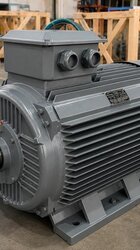
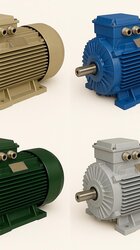
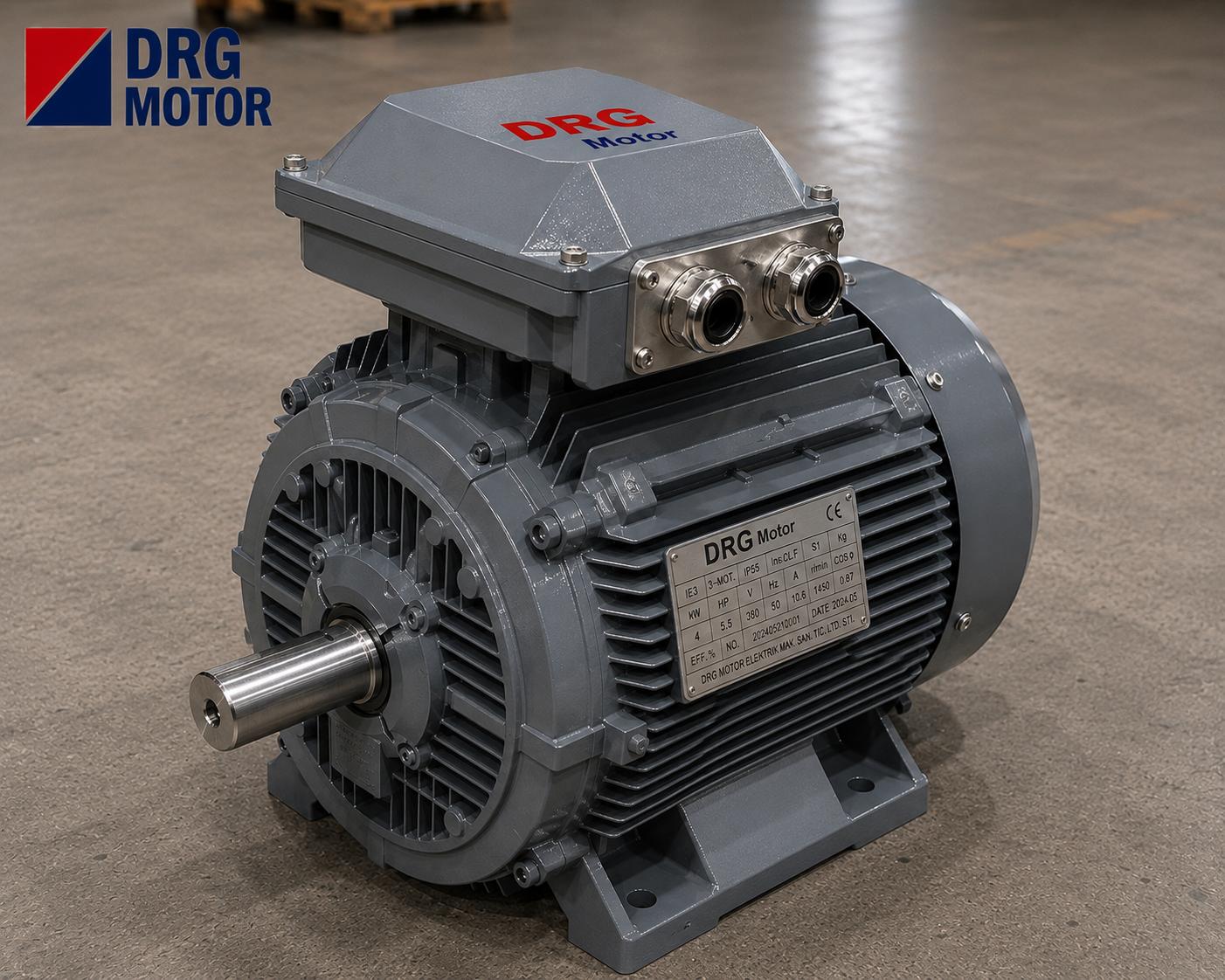

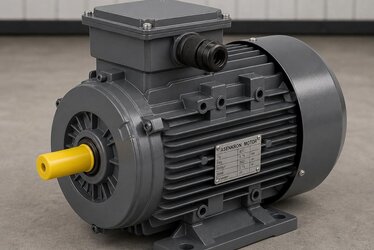
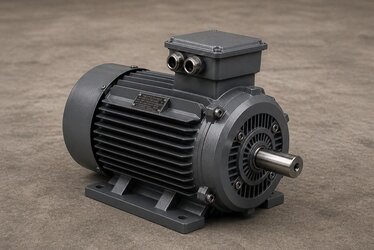
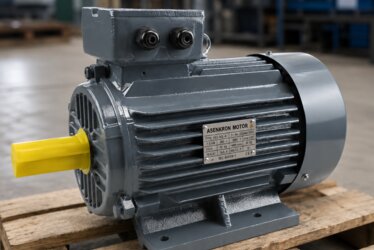
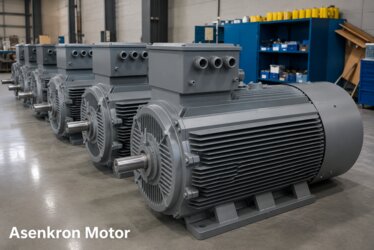
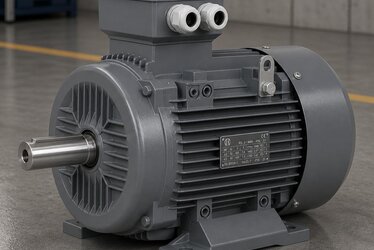
A stopped production line ultimately depends on how many days it takes for a spare motor to arrive after a winding burns out. With grey cast iron three-phase motors, the deciding factor is rarely the housing material itself, but when that housing actually reaches the floor. At DRG Motor we approach the subject from exactly this angle: models that ship from stock, project-based bulk shipments, accurate power-speed-mounting matching and a clear quotation flow. Below we set out, in concrete terms, the practical side of sourcing a cast iron three-phase motor from a B2B supplier, the factors that shape the price and how delivery actually works; our aim is not an encyclopaedic narrative but field knowledge that makes your purchasing decision easier.
Why availability matters more than the housing alloy
Breakdowns in an industrial plant never pick a convenient hour. When a motor on a pump, fan, compressor or conveyor line fails overnight, whether the morning shift runs comes down to one thing: is there a spare that can reach the site in time. Cast iron housings are already the right choice for durability and thermal behaviour; but the ability to pull that motor off the shelf and dispatch it the same day is what keeps a plant's daily output loss close to zero. This is where real competition happens on the supply side: at the same IE efficiency class and the same speed, who gets the motor to the floor faster.
For this reason, a catalogue comparison alone is not enough when choosing a supplier. What actually sits in the warehouse, which frame sizes (IEC 80 to 315) are kept continuously, and how quickly an alternative foot/flange configuration can be proposed in an emergency are the decisive points. In most plants, the cost of one hour of downtime far exceeds the price of the motor itself; so the real value of a supplier shows up not in shaving a few points off the price, but in cutting days off the delivery time.
Stock availability is also a matter of planning discipline. By tracking demand data we observe which frame sizes move more often and which sectors raise demand in which season, and we set warehouse levels accordingly. This lets us work on a ready-stock logic for critical items rather than "ordering once demand arrives and keeping the customer waiting".
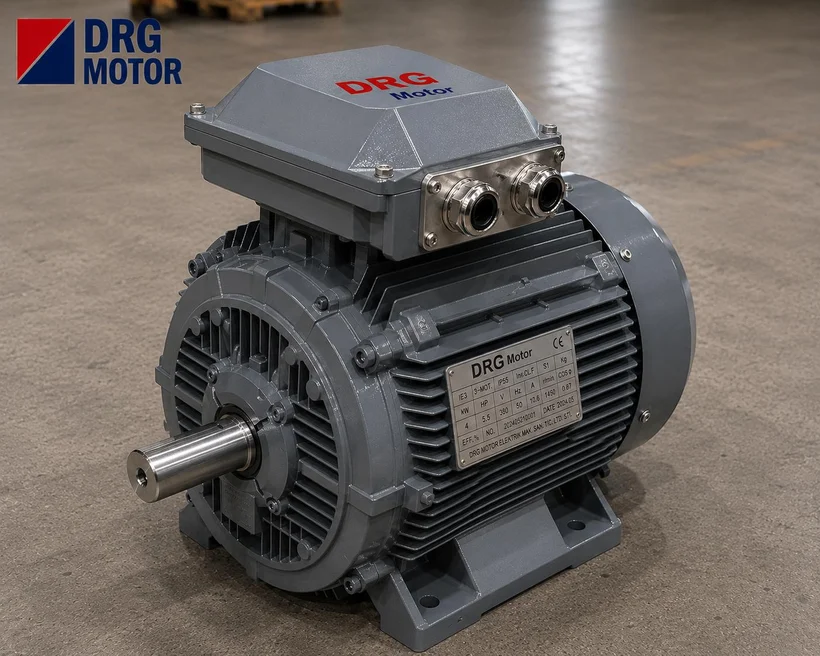
Configurations DRG keeps continuously in stock
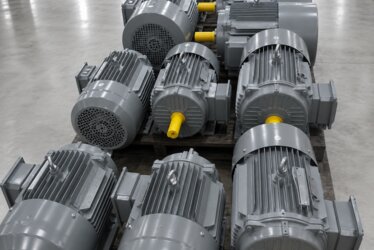
We hold the high-demand items at shelf level. In practice, the most frequently moving frame and connection types are:
- 4-pole (1500 rpm) foot-mounted (B3) models from 0.75 kW up to 30 kW, covering the bulk of general industrial applications.
- 2- and 6-pole variants for high-speed fan/blower duties and low-speed mixer applications.
- B5 and B14 flange frames wait ready in the warehouse; most customers request them the same day once dimensional fit with the gearbox or pump is confirmed.
- IE3 premium efficiency frames for continuously running lines where the energy payback is short.
- IP55 frames are a standard shelf item for us; since most urgent spare requests heading to dusty sites are filled from this protection class, we hold them in high quantity at all times.
If a special combination is not in stock, we propose the closest equivalent and state the lead time upfront. For higher-power items (45 kW and above), where demand is more project-driven, we work through supply channels that can be confirmed quickly in that class. For those who want to understand the material side in depth, our cast iron three-phase electric motor page covers the alloy and durability aspects in detail.
Keeping a frame size continuously in stock means holding not just the motor but the matching bearings, terminal box and connection accessories within reach. So when we propose an equivalent, we check electrical compatibility and every small part on the mounting side.
Fast supply: how the flow works during a breakdown
To shorten the process during an urgent spare request, we have standardised how we gather information. Once we receive the nameplate photo, power, speed, voltage/connection (380V Δ / 660V Y) and frame size, we confirm the equivalent model the same day. For in-stock items, dispatch usually starts within the same business day. Whether by intercity freight or our own vehicle network, the delivery window is shared from the outset depending on distance; we do not allow the vague "it's on its way, arrival unknown" situation.
When we propose an equivalent, we do not look only at kW; the torque curve, starting current, duty type (continuous S1 or intermittent S3), mounting dimensions and shaft diameter are evaluated together. A mismatched spare may rescue the line temporarily but soon repeats the same failure. On shock loads in particular, a motor with correct nameplate power but insufficient torque reserve will reveal itself within the first weeks through overheating or bearing fatigue.
To ease the panic of a breakdown, even when the customer's nameplate photo is unreadable, we determine a safe equivalent range from the application type of the line. This is the opposite of a "send whatever you have" approach; our goal is to prevent a second breakdown call from the outset.
What drives the price in project and bulk purchases
A single motor and a fifty-motor line investment are not priced with the same logic. The main variables that shape a bulk quotation are:
- Quantity and power spread: a high count from the same frame size lowers logistics and preparation cost.
- Efficiency class: moving from IE2 to IE3 raises the upfront cost but lowers total cost of ownership on energy-intensive lines.
- Delivery schedule: one-shot or phased shipment, which affects storage and planning cost.
- Connection and accessories: thermal protection (PTC), forced cooling fan, encoder preparation, special shaft end and similar add-ons.
- Protection and environment class: high IP, tropicalisation or special paint requests reflect on the cost.
For this reason, instead of a flat list price, we provide a quotation calculated with project-specific factors. The transparent part is the factors themselves: we openly share why each item affects the cost. For a buyer, the worst scenario is a quotation that looks cheap but balloons with hidden items; we do the opposite, laying the items out clearly to make the decision easier.
We ask you not to read the quotation through the sticker price alone, but to factor in the running cost that will hit the electricity bill after dispatch. An efficiency-class choice that looks minor at the supply stage turns, on a shift-running line, into an item exceeding the motor's own cost within a few years. That is why we can add the requested model's estimated annual energy cost to our quotation as a separate line; when you decide, you see the stock-price-operation trio on a single sheet.
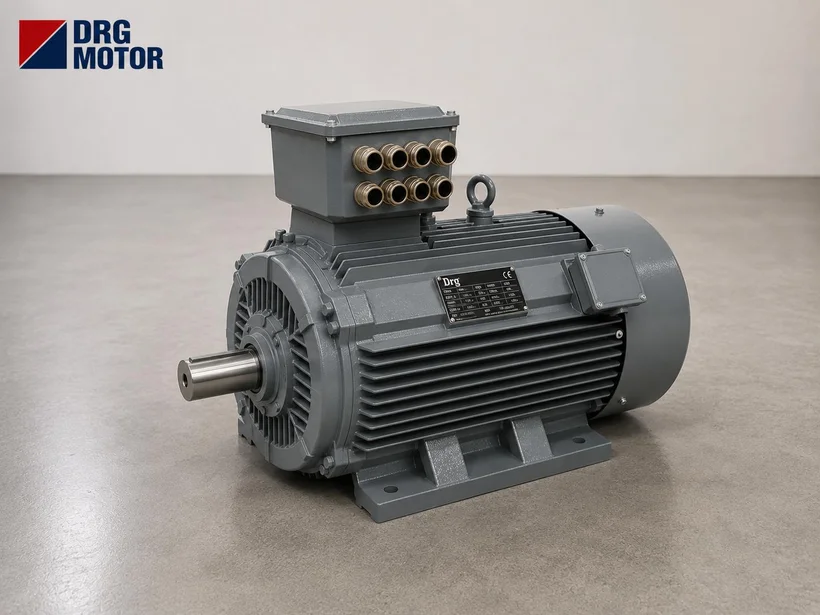
Matching the right motor to the application
Cast iron three-phase motors serve a wide range of applications, but each application carries a different priority. On a continuously running industrial line, efficiency and thermal stability come first, while on crushing-and-screening plants that carry shock loads, mechanical strength and high starting torque are decisive. On variable load profiles such as pumps and fans, drive (VFD) compatibility and cooling capacity at low speed come to the fore.
For general-purpose use, general-purpose industrial motors handle most pump, fan and conveyor lines. On sites with heavy impact and dust loads, the stone crushing plant motors category includes models selected for reinforced housings and high torque demand. For standard three-phase asynchronous needs, the three-phase asynchronous motors category offers a broad power-speed combination.
When the application is defined correctly, a smaller and more economical frame is often enough; conversely, the cost of starting with an undersized motor returns as short life and frequent stoppages. That is why, at the quotation stage, we always ask what the line does, how many hours a day it runs and under what load. Correct matching is also the soundest route to price optimisation.
Information we ask for during the quotation process
A sound quotation starts with the right input. To clarify your request, we ask you to share the following:
- Power (kW) and pole/speed information, or the output torque the application requires.
- Mounting type: foot (B3), flange (B5/B14) or combined.
- Supply voltage and desired connection arrangement; any 50/60 Hz frequency difference.
- Operating environment: ambient temperature, dust/moisture conditions, protection class (IP55 etc.) expectation.
- Quantity and target delivery date; nameplate data of the existing motor if available.
Once these details reach us, we quickly prepare a quotation that includes stock status and equivalent options. If information is missing, instead of guessing we confirm it in a single verification round, eliminating the risk of shipping the wrong model. Many customers start the first quotation with a single nameplate photo sent over WhatsApp; this is the fastest way to move the process.
A quotation is not just a price line; it arrives as a package containing stock status, estimated dispatch day, equivalent alternative and, where needed, mounting notes. So when you compare, you compare like with like, not with surprise items.
Equivalent model and brand flexibility
The brand of the existing motor on site cannot always be sourced again, or its lead time may be long. In that case we propose an equivalent compatible in connection dimensions, shaft diameter, foot hole spacing and electrical characteristics. The aim is to offer a solution that does not require additional mechanical rework when rebuilding the line. Where dimensional match cannot be achieved, we state the necessary adaptation (coupling, base plate, flange transition) in advance so there are no surprises.
The equivalent approach is the opposite of locking the customer into a single brand. As a B2B supplier, our ability to source a suitable product from different channels frees you from being a hostage to one brand's stock on the market. Especially for old or discontinued models, finding the right dimensional equivalent is often both faster and more economical than insisting on the original.
Removing Uncertainty in Delivery and Logistics
A common problem in the sector is that the technically correct motor is found, yet uncertainty arises on the delivery side. We treat delivery as a commitment, not a guess: stock status, dispatch day and estimated arrival window are shared in writing from the start. For bulk projects, a phased shipment plan is drawn up so motors arrive in installation order without piling up storage load on site. This approach saves time especially on investments with a tight commissioning schedule.
Logistics is an item not to be underestimated with cast iron motors, because they are heavy and high-power frames require special handling. By preparing packaging, pallets and lifting lugs before dispatch, we ensure the motor reaches the site undamaged and is unloaded safely by forklift. For remote job sites, we also share a post-arrival visual inspection checklist so any transport-related damage is noticed immediately.
Post-installation technical support
Supply does not end when the motor reaches the site. We support connection diagrams, correct rotation checks, soft starter/drive compatibility and the first run-up checks under load. One advantage of the cast iron housing is that it transfers heat efficiently to the outer surface; using this correctly on the mounting side directly affects performance. For thermal behaviour and ventilation layout, our content on heat dissipation and cooling in cast iron housings offers field-oriented detail. On precision lines where vibration and noise are critical, the topic of vibration damping in cast iron housings helps with base and mounting selection.
On drive-driven applications, matters such as carrier frequency and cooling at low speed determine performance; at these points we share the correct parameters and, where needed, a forced-fan recommendation. The aim is for the motor to run at expected efficiency not just on day one but for years. A supplier's value is measured by keeping the phone open after the sale.
Pre-commissioning site checklist
Once the motor reaches the site, a few simple checks at first start prevent most early failures. The practical check items we share with our customers are:
- Transport check: look for impact marks on the housing, terminal box and shaft end; inspect before discarding the packaging.
- Insulation measurement: for motors that have been stored a long time, measure the winding insulation resistance before starting.
- Shaft rotation: turn it by hand to confirm it spins freely and that there is no abnormal noise.
- Connection and direction: wire the terminals per the diagram and verify the rotation direction with a short test.
- First run under load: compare the current with the nameplate value and watch heating and vibration in the first hours.
Simple as these steps look, skipping them can make even a new motor cause trouble in its first days. If you hit a snag during commissioning, we provide quick support by phone or by sharing visuals; our aim is not only to deliver the motor but to see it running trouble-free on the line.
How to read the nameplate and why it matters
The key to the correct equivalent is the label on the motor. A nameplate photo often gives us enough information on its own; but knowing which lines are critical speeds up the process. The standout items are:
- Power (kW) and frequency: the basic selection parameter; the 50 Hz versus 60 Hz difference changes speed and performance.
- Speed (rpm) and pole count: at the same power, different speeds mean completely different applications.
- Voltage and connection (Δ/Y): critical for supply compatibility; will it run on 380V delta or 660V star.
- Frame size and mounting code (B3/B5/B14): determines mechanical compatibility.
- Protection class (IP) and insulation class: indicate environmental and temperature resilience.
If the label is worn or wiped, there is no need to panic; even sharing the dimensions on the housing and what the application is usually lets us determine a safe equivalent range. We recommend photographing the old motor from the label, the shaft and the terminal box; this lets us confirm mounting compatibility from the start.
Stock management and spare motor strategy
On production-critical lines, the soundest approach is to position the spare motor in advance rather than waiting for a failure. With plants that operate many similar lines, we set up a stock strategy based on keeping one spare of each critical frame size. This completely removes the "do we have it, how many days" scramble at the moment of failure. We decide together which items are worth stocking based on the line's criticality level and historical failure frequency.
A spare motor strategy also eases budget planning. Emergency purchases are always expensive and under pressure; a pre-planned spare offers a far more comfortable picture on both price and delivery. By drawing up your plant's critical motor list together, we can build a practical plan for which frame size should be held where and in what quantity.
Typical demand profiles by sector
Different sectors expect different things from a cast iron three-phase motor, and that expectation shapes both model selection and supply priority. A few typical profiles:
- Water and wastewater plants: pumps running 24 hours; efficiency and thermal stability in continuous duty come first, IE3 is preferred.
- Mining and aggregate: crushers, screens and belts; high starting torque, reinforced housing and a high protection class against dust.
- Food and packaging: a surface resistant to the cleaning cycle, hygienic layout, many motors at medium power.
- Textile and plastics: fan, blower and extruder lines; drive compatibility and vibration sensitivity.
- Cement and heavy industry: high-power lines under continuous load where planned spares are critical.
Because we recognise these profiles, when your request arrives we can often focus on the right range without extra questions. If there is a sector-specific requirement (for example high altitude, extremely hot environment or a corrosive atmosphere), we reflect it in the quotation from the start; we prefer conditions clarified upfront over surprises that emerge later.
Common supply mistakes and how to avoid them
A few recurring mistakes we have seen over the years needlessly eat into a buyer's time and budget. Spotting them upfront is half of correct sourcing:
- Looking only at kW and skipping speed and mounting type; a motor with correct power but wrong connection is useless on site.
- Choosing the cheapest quotation without asking the lead time; a one-week delay more than wipes out the price difference.
- Not stating the duty type; a motor chosen for intermittent duty tires early under continuous load (S1).
- Skipping environmental conditions; a low protection class motor in a dusty or humid site is the leading cause of early failure.
- Relying on a single motor with no spare plan; running a critical line without a spare is the most expensive risk.
All of these mistakes can be prevented by a short information exchange at the quotation stage. That is exactly why we prefer to ask a few basic questions before quoting; the aim is not to lengthen the process but to send the right motor the first time, with no need for a second order or a return.
Drive and soft-start compatibility
Most modern lines now run with a frequency inverter (VFD) or a soft starter. When connecting a cast iron three-phase motor to these systems, a few points stand out: the suitability of the insulation class for inverter supply, whether cooling is sufficient at low speed, and the prevention of unwanted currents on the shaft/bearing side. If you are choosing a motor that will run continuously at low speed, the housing's natural cooling may not be enough; in that case we recommend a variant with a forced (independent) fan. At higher powers, we assess per application whether measures against bearing currents are needed.
On compressor and pump lines running with a soft starter, reducing the inrush current lowers both the grid-side load and the mechanical shock. Correct motor-drive matching delivers long-term gains on both energy and maintenance. That is why, at the quotation stage, we always ask whether you will run this motor with a drive or with direct-on-line starting; the answer directly affects the recommended model.
Warranty, invoicing and B2B purchasing convenience
In corporate purchasing, the process matters as much as technical suitability. The cast iron three-phase motors we supply are delivered invoiced and under warranty; a corporate current account, a project-based payment plan and flexible terms on bulk purchases can be discussed. We share the technical documents purchasing departments need (dimension drawings, performance data, conformity information) as quotation attachments, speeding up the approval cycle.
On multi-item projects, proceeding through a single point of contact significantly reduces the buyer's workload. From stock confirmation to dispatch, invoicing and after-sales support, we run the whole flow from one point. This makes a difference especially on investments where many concurrent items must be coordinated.
Why working with DRG makes your job easier
What makes a supplier valuable is not the number of catalogue lines, but finding the right model quickly, giving an honest delivery promise and staying reachable when a problem arises. For your grey cast iron three-phase motor needs, we bring stock, equivalent proposals, project pricing and installation support under one roof. Our brand position is clear: we are not a manufacturer but a B2B supplier that gets the right product to the floor at the right time.
Whether it is an urgent spare for your line or a motor list for a new project, send us your requirement; let us share stock and equivalent status the same day, followed by a clear quotation. For a wider product range and application examples, you can reach us through our homepage as a cast iron three-phase motor supplier. To get the right motor by plan rather than by waiting, a single message is enough; our stock and delivery discipline handles the rest.