 English
 Le français
 Türkçe

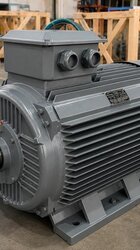
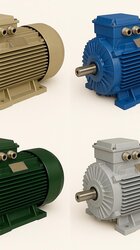
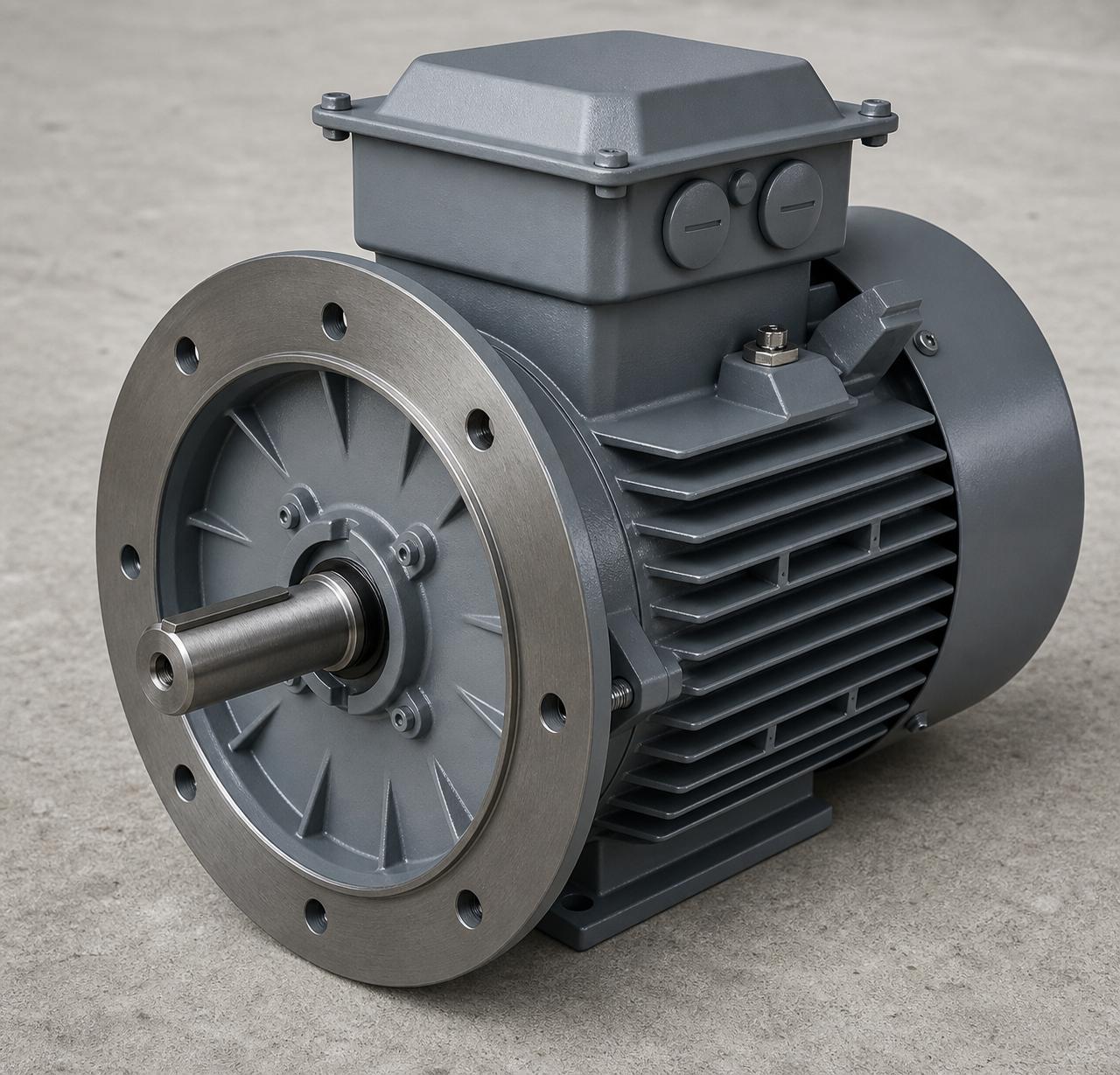

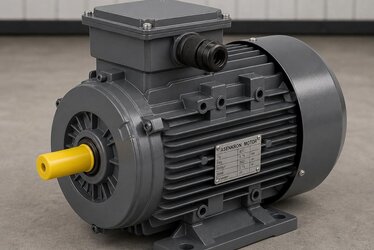
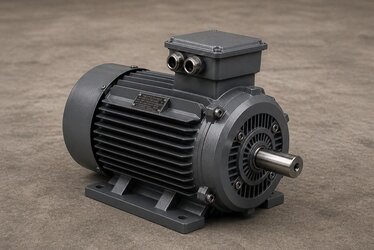
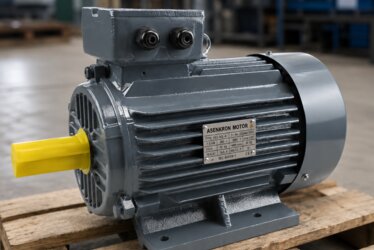
When sourcing a three-phase motor, the most expensive mistakes are rarely in the catalogue price; they hide in the wrong power rating and frame size. Cast iron motors span a wide band from 0.55 kW up to 355 kW, and where you sit in that band, together with pole count, load profile and frame size, directly shapes your electricity bill, maintenance schedule and motor lifetime. As a stock-holding supplier, DRG Motor helps you pin down the correct power point for your project and turns around a fast quotation.
Why cast iron leads across a wide power range
A grey cast iron housing is heavier and more rigid than an aluminium one; that mass helps the motor shed heat across a large finned surface and damp vibration. At low power aluminium is often enough, but as load rises the mechanical strength and thermal mass of cast iron become decisive. That is why cast iron is the de facto standard in the medium and high power classes.
Our overview of the cast iron three-phase electric motor, where we discuss the long-term return of the housing material, frames the sizing decisions in this article. Housing material and power class are not independent choices; they should be weighed together.
How to read the 0.55-355 kW range in practice
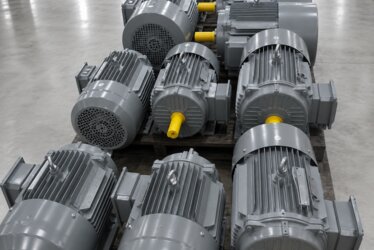
Thinking of the broad catalogue as three bands makes selection easier. Each band has its own sourcing, mounting and operating logic:
- 0.55-7.5 kW (low power): Pumps, fans, small conveyors and dosing duties. Buyers who choose cast iron here usually run damp or dusty environments, expect mechanical knocks, or want a long service life.
- 11-90 kW (medium power): The backbone of industry. Compressors, large fans, mixers, granulation lines and general drives. The thermal and mechanical edge of cast iron stands out clearly in this band.
- 110-355 kW (high power): Stone crushing, mills, large pump stations and heavy-industry drives. Here, housing rigidity, the bearing system and cooling are no longer a preference but a requirement.
Whichever band you are in, we assess it together with speed and mounting, then confirm stock and lead time. For standard industrial drives the three-phase asynchronous motors family covers most of these three bands in a single technical language.
How speed and pole count shape power
Two motors with the same kW label can suit completely different jobs if their pole counts differ. Pole count sets the synchronous speed: 2 poles ~3000 rpm, 4 poles ~1500, 6 poles ~1000, 8 poles ~750 rpm (50 Hz). Even with constant power, as speed drops the torque the motor produces rises and the housing grows physically larger.
The practical upshot: a 2-pole 11 kW may be plenty for a high-speed fan, while a hard-starting mixer may need that same 11 kW in a 6-pole build. The wrong pole choice ends in either insufficient torque or a needlessly large, expensive motor. Fixing speed first, then power, eliminates the error at the source.
The frame size and power relationship
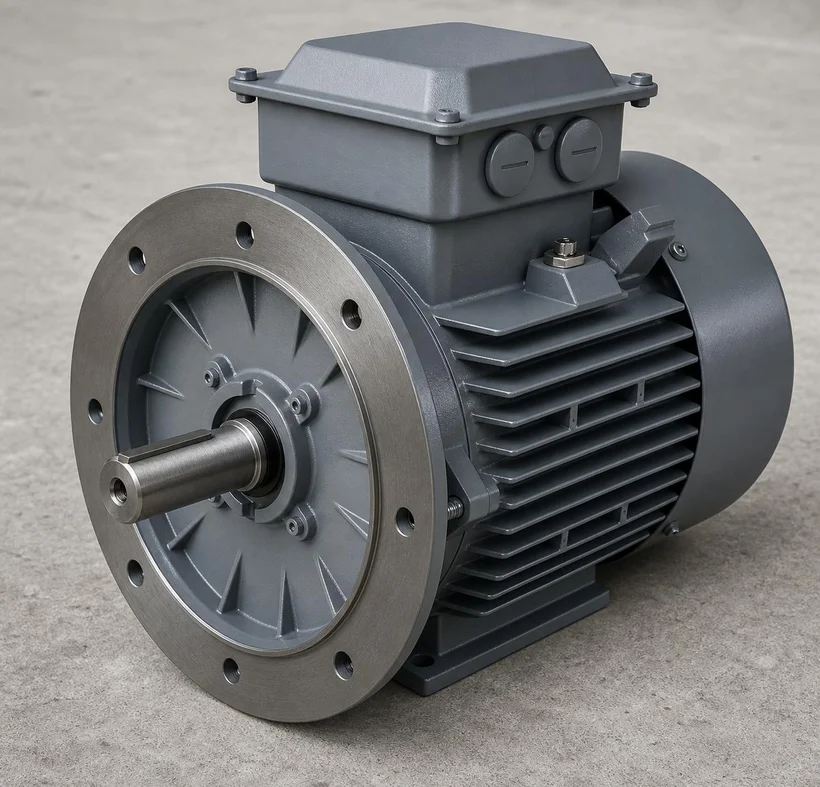
The IEC frame number (for example 80, 132, 200, 315) gives the shaft centre height in millimetres and governs both power and mounting compatibility. The frame directly affects how the motor fits your existing base plate, coupling and transmission elements; in retrofit projects, therefore, not only kW but the frame must match.
- The same power can sit on a different frame at a different pole count; 6/8-pole motors are typically in a larger housing.
- The mounting type (B3 foot, B5 flange, B35 foot-and-flange) should be fixed up front with the frame for order clarity.
- When retrofitting, telling us the old motor's frame and shaft diameter speeds up an exactly compatible quotation.
Load profile: continuous, variable and shock loads
The heart of sizing is the load profile. A pump draws an almost constant load, while a crusher reaches peak torques within seconds. The motor must be chosen for the character of the load, not its average power.
- Continuous load (S1): Pumps, fans, compressors and other steady duties. A choice close to rated power is economical.
- Variable load: Speed-controlled (inverter-fed) duties; because cooling drops at low speed, the thermal mass of cast iron is an advantage.
- Shock / high-inertia load: Crushers, mills, presses. High starting torque and frequent repetition; here housing rigidity and bearing life come to the fore.
The stone crushing plant motors we evaluate specifically for shock and abrasive duties are a typical example of how high inertia and repeated starts stress a motor; on such loads, leaving a power margin translates directly into service life.
The hidden cost of under-sizing power
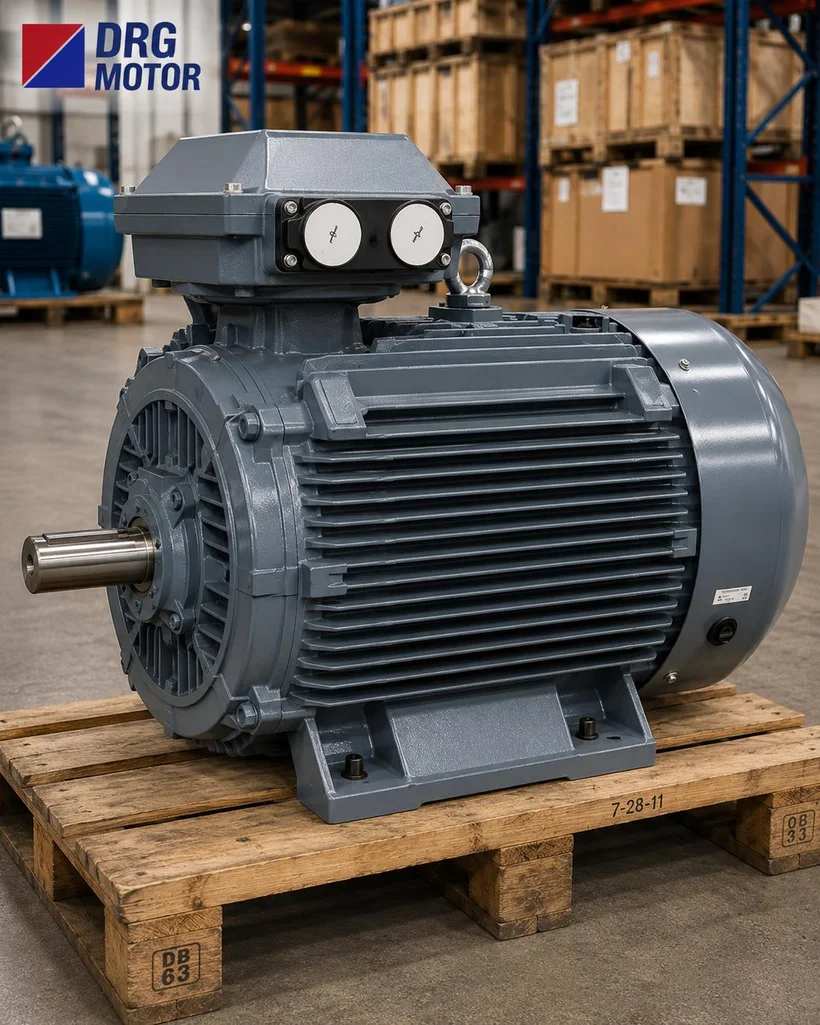
Choosing one class lower to protect the budget usually backfires. A motor running above its continuous rating overheats; the winding insulation ages fast, and every 8-10 degrees of excess temperature roughly halves its life. The result is a motor you must replace within a few years, creating far more lost production and replacement cost than you saved at the first purchase.
Under-sizing also shows up as downtime, frequent thermal trips and lost efficiency. The risk taken to save a few hundred at the procurement stage comes back multiplied in operation.
Over-sizing is not free either
The mistake in the other direction is costly too. An oversized motor runs continuously at low load; the power factor (cosφ) falls, line current becomes inefficient, and compensation investment may rise. A larger frame also means a more expensive motor, a stronger base and sometimes a bigger drive. The right choice leaves a reasonable safety margin while avoiding needless upsizing.
How the efficiency class (IE) affects power selection
Different efficiency classes (IE2, IE3, IE4) exist for the same kW. A higher class costs a little more up front, but on a continuously running motor the difference on the electricity bill pays for itself many times over within a few years. On medium and high power motors that run long hours, the efficiency class is as critical a decision as the power rating. Share your operating hours at the quote stage and we will calculate together which efficiency class minimises your operating cost.
Where cooling, vibration and the power band meet
As power rises, so does the heat to be shed and the vibration to be damped. The finned structure and mass of the cast iron housing come into play exactly here. Our approach to heat dissipation and cooling in cast iron housings and our look at vibration damping and quiet operation at high power show concretely why the housing material becomes more critical as the power band climbs. When the right power meets the right housing, long life and low noise follow naturally.
General-purpose or application-specific
For the vast majority of plants, a solution from the standard catalogue is enough. For common duties like pumps, fans, conveyors and general drives, the general-purpose industrial motors family is favourable for both stock availability and fast delivery. If the load profile is unusual (high inertia, abrasive environment, frequent starts) we recommend an application-specific housing and power margin rather than steering you needlessly to a larger motor.
Winding temperature, insulation class and the life relationship
Whether you actually get the kW you read on paper out in the field is, more often than not, decided by how hot the winding runs. This ceiling, easy to overlook during sizing, is drawn by the insulation class (usually F or H); the class marks the highest temperature the winding can safely carry. Running an F-class motor at a B-class temperature rise leaves a safety margin in the winding and extends its life. Conversely, pushing the same motor continuously at the class limit accelerates the ageing of the insulation.
So the right power choice is also a decision to keep the winding temperature in a reasonable region. A motor running just below rated power, in the high-efficiency region, stays cooler, lives longer and needs less maintenance. In plants with high ambient temperature, moving the insulation class up a level can be an alternative or complement to leaving a power margin. Share your environment and operating regime at the quote stage and we will optimise insulation class and power choice together.
The duty cycle (S1-S8) changes the power requirement
How long and in what pattern a motor runs directly affects the power needed. A continuously running application (S1) and one that starts and stops several times an hour (S3, S4) should be sized differently even if they do the same job. In short but frequently repeated operation the motor finds no chance to cool; so even if the average power looks low, a thermally larger motor may be needed.
- In continuous duty (S1) an economical choice close to rated power is made.
- In intermittent duty (S3) start frequency and load duration are assessed together; a higher power band is often needed.
- In braked or regenerative duties (S4-S8) extra thermal load arises and special assessment is required.
Clarifying your duty cycle prevents both under-selection and needless upsizing. Knowing how many starts you make per hour and how long you stay under load is the key to finding the right power point.
The logic of the power calculation in pumps, fans and compressors
In the three most common applications the power requirement follows different curves, and knowing them makes the right choice easier. In pumps, power is proportional to flow, head and efficiency; wherever the operating point sits on the pump curve, the motor must be chosen accordingly. In fans, power rises with air flow and pressure, and because fan power varies with the cube of speed, even a small speed increase raises the power requirement substantially.
In compressors, the pressure stage and air demand are decisive; the load is mostly continuous and heavy, so cast iron and the right efficiency class make a difference in the long run. In all three applications the motor must be sized not on its own but together with the operating point of the machine it drives. Choosing a motor by looking only at the machine's nameplate power often leads to needless upsizing or under-selection.
Starting torque in conveyors, mixers and mills
In applications that start under load, the real determinant is not continuous power but starting torque. A loaded conveyor, a heavy mixer or a material-filled mill needs a peak torque well above the rated value to set the stationary mass in motion. Choosing the motor by rated power alone here causes the motor to fail to start and trip its thermal protection.
- In high-inertia (flywheel-effect) applications the acceleration time lengthens; during this time the motor draws high current and heats up.
- On lines needing frequent start-stop (jog), thermal load accumulates; a higher power class or a suitable starting method may be required.
- In shock applications such as mills and crushers, both high starting torque and a rigid housing are demanded at once.
Protection class (IP) and environment cap the power band
A motor of the same power should be specified in a different protection class depending on the environment it will run in. IP55 is a common baseline for industrial settings exposed to dust and splashing water; flour, cement, mining or agricultural plants with heavy dust need higher protection. As the protection class rises, the motor's heat-shedding behaviour changes; in totally enclosed housings heat is shed only from the surface, so the wide finned surface of cast iron becomes decisive.
Choosing the wrong protection class leads the motor to early failure even if the power is correct. Dust enters between the windings, water reaches the bearings, and the motor's life shortens even when running at rated power. When sizing, we always weigh power and protection class together; share your environmental conditions and we will include the correct IP class in the quotation.
The bearing system and shaft load must not be overlooked
Even with the right power and speed, the type of load the motor connects to determines bearing life. A belt-and-pulley drive imposes a radial load on the shaft; a direct coupled connection demands axial and alignment precision. At high power and low speed, bearing loads rise; so on 6- and 8-pole large-frame motors, bearing selection, lubrication and, where needed, re-greasing points are part of sizing.
- If belt tension is excessive, the shaft and bearing fatigue early; the transmission ratio and pulley diameter must be set correctly from the start.
- For heavy loads and frequent starts, a reinforced bearing or a re-greasable bearing solution is recommended.
- The rigidity of the cast iron housing keeps the bearing seats aligned, directly extending bearing life.
Starting current and grid impact enter the power choice
Another dimension as important as a motor's rated power is its starting behaviour. A direct-on-line (DOL) asynchronous motor can draw 5-7 times its rated current at start. As power grows, this sudden current demand strains the grid, causing voltage dips and affecting other devices on the same line. That is why, at medium and high power, the need for star-delta starting, a soft starter or a variable frequency drive is an inseparable part of the power choice.
When sizing, you must consider not only the motor but the panel, cable cross-section and protective devices that feed it. The right power class, paired with the wrong starting method, harms both the motor and the grid. Share your supply conditions at the quote stage and we will recommend the motor and the starting strategy as one whole.
Service factor and the real operating margin
The kW on the nameplate is the motor's rated value; the service factor (SF) shows how far above that value it may run for short periods. Treating the service factor as a continuous load reserve is a common error. In sound sizing, choosing the motor to run in the 70-90 percent band of rated power keeps it in its highest-efficiency region and leaves a natural buffer against sudden load increases.
Ambient temperature and altitude also affect this window. High ambient temperature or high altitude reduces the motor's cooling capacity and effectively lowers usable power. For environments above 40 degrees or sites above 1000 metres, an extra margin must be added in sizing; otherwise the power printed on the nameplate cannot be fully obtained on site.
The power window in speed-controlled applications
In motors driven by a frequency converter, power selection is not limited to the rated point; torque must be maintained across the whole speed range. At low speed the motor's own fan moves less air, so cooling weakens; here the thermal mass of cast iron and, if needed, an external fan (forced cooling) come into play. For applications demanding constant torque over a wide speed range, a slightly higher power class or a force-cooled solution can make sense compared with a fixed-speed application.
Inverter-fed systems also raise topics such as insulation class and bearing currents. When choosing the right power class, we take these details into account and recommend a motor that is compatible with the drive.
Retrofit or sizing from scratch
There are two scenarios we meet most often in the field. The first is the like-for-like replacement of a burned-out or end-of-life motor; here speed, frame and shaft compatibility lead, and fast delivery is critical. The second is sizing from scratch for a new line or capacity increase; here load profile, speed and efficiency-class decisions must be set up correctly from the start.
- In a like-for-like replacement, copying the old nameplate exactly is usually right, but if the old motor was already wrongly sized we review the profile so as not to repeat the error.
- For a capacity increase, we balance leaving room for the future against needless upsizing, based on your operating hours.
- In both scenarios we issue a project-specific quotation that clarifies power, mounting and lead time rather than a list price.
Total cost of ownership is the real measure of the power decision
Choosing the power point by the price tag alone means missing most of the arithmetic. On a motor that turns without pause, the electricity paid out over the years routinely dwarfs what the motor first cost; slipping down a power band or into a lower efficiency class looks cheap at purchase yet runs expensive for life. A correctly sized power and a fitting efficiency class return incomparably more than ticking the cheapest line in the catalogue. The long life of cast iron strengthens this calculation further by meaning fewer replacements and less downtime.
Sizing should be seen not as a mere technical table but as an investment decision. A well-chosen motor is an asset that quietly produces profit for years; a poorly chosen one loads the bill and the schedule every month.
Let us find the right power point together
In a cast iron three-phase motor, the right power is the single point where speed, frame, load profile and operating hours intersect. Pinning that point with your application data rather than a guess lowers both the initial investment and the running cost. As a stock-holding cast iron three-phase motor supplier, we clarify your power, mounting type and lead time and prepare a project-specific quotation instead of a list price. Send the nameplate details of your current motor (kW, poles, frame, mounting) and we will offer you the power point that is both technically correct and commercially most suitable.