English
 Le français
 Türkçe

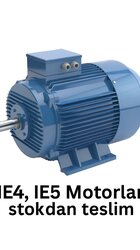
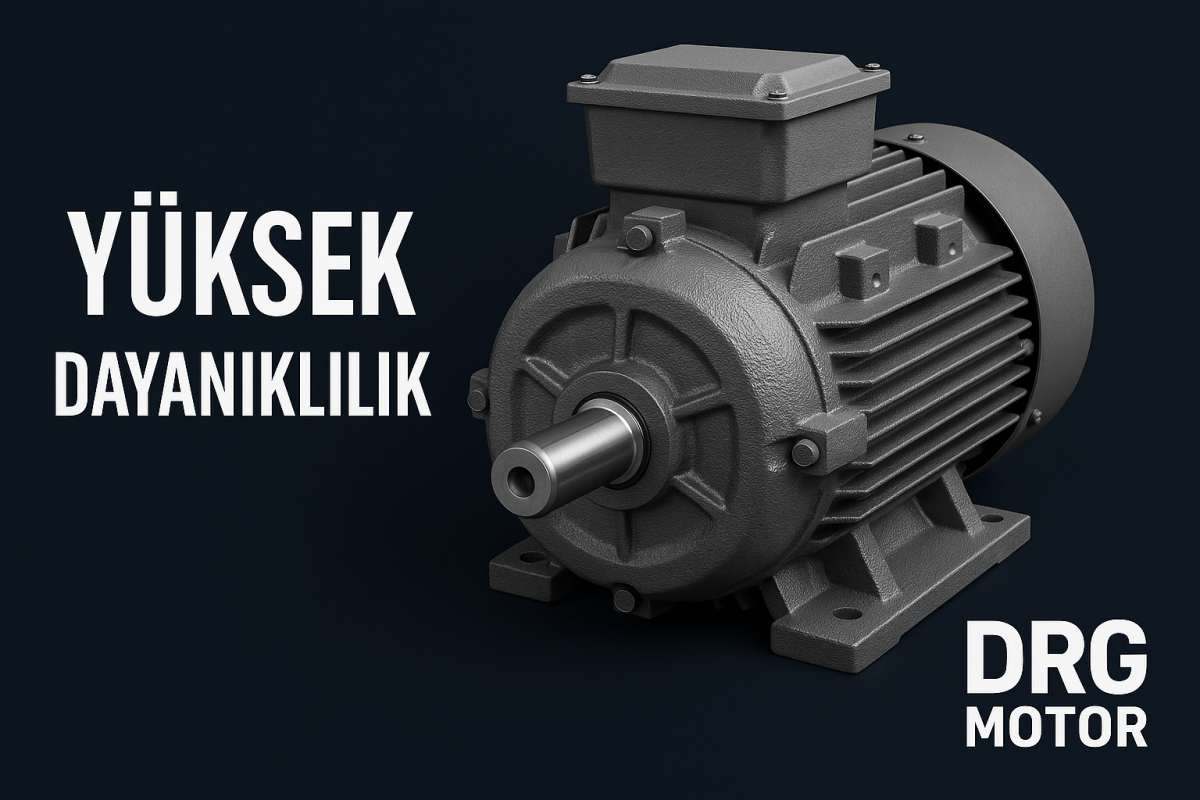

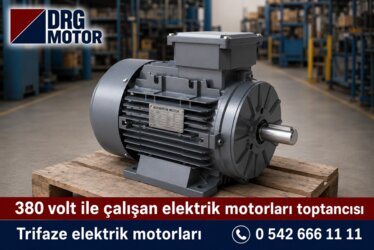
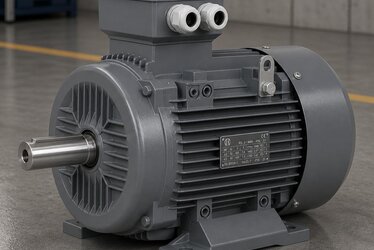
The feed belt of a packaging machine, a workshop fan, a small dosing pump or a mixer… Motors between 0.25 and 4 kW are the most numerous items in a factory, yet the least considered when buying. Because each one is inexpensive, mistakes are often overlooked; however, a small motor that is wrongly connected, wrongly protected or does not fit the machine can cause more downtime loss than its own price. This article focuses only on the small power class: it first lists the prices of 1500 rpm aluminium-frame models in the DRG Motor online store, then explains nameplate reading, connection, protection setting and volume buying with practical examples.
2026 Prices for 0.25–4 kW Aluminium-Frame Motors (1500 rpm)
The table covers the 4-pole models most commonly used on small machines. The current column is the catalogue value for a 400 V star connection and is used directly in the protection setting described below.
| Model code | Power (kW) | Speed (rpm) | IEC frame | Rated current 400 V (A) | excl. VAT | incl. VAT (20%) |
|---|---|---|---|---|---|---|
| DRG-711-4 | 0.25 | 1500 | 71 | 0.66 | 3,302.25 TRY | 3,962.70 TRY |
| DRG-712-4 | 0.37 | 1500 | 71 | 0.92 | 3,465.00 TRY | 4,158.00 TRY |
| DRG-801-4 | 0.55 | 1500 | 80 | 1.31 | 3,952.20 TRY | 4,742.64 TRY |
| DRG-802-4 | 0.75 | 1500 | 80 | 1.75 | 4,392.15 TRY | 5,270.58 TRY |
| DRG-90S-4 | 1.1 | 1500 | 90S | 2.48 | 5,346.60 TRY | 6,415.92 TRY |
| DRG-90L-4 | 1.5 | 1500 | 90L | 3.3 | 6,210.75 TRY | 7,452.90 TRY |
| DRG-100L1-4 | 2.2 | 1500 | 100L | 4.52 | 8,114.40 TRY | 9,737.28 TRY |
| DRG-100L2-4 | 3 | 1500 | 100L | 6.02 | 8,783.25 TRY | 10,539.90 TRY |
| DRG-112M-4 | 4 | 1500 | 112M | 7.95 | 10,960.95 TRY | 13,153.14 TRY |
Prices are taken from the DRG Motor online store list dated 24.09.2026; a 3% discount applies to bank transfer/EFT payments, shipping is not included in the price and is paid by the buyer. For current prices please see the store page.
In this range the price ladder is quite gentle: going from 0.25 kW to 0.75 kW, power triples while the price rises only by about thirty percent. The reason is that in small motors fixed parts such as the frame, terminal box, bearings and fan make up most of the cost. The practical result: in an application at the limit of its requirement, choosing one step up has little effect on the budget; but choosing a motor two or three steps larger than needed enlarges the frame and complicates the machine design.
What Does 230/400 V on the Nameplate Mean? Making the Star Connection Correctly
The nameplate of small three-phase motors usually reads “230/400 V” or “Δ/Y 230/400 V”. This means the winding is connected in delta at 230 V and in star at 400 V. Since the industrial network in Turkey is 400 V phase-to-phase, these motors are connected to the grid in star.
- Star connection: The lower row of terminals (usually W2–U2–V2) is linked with two bridge links, and the supply phases go to the upper row (U1–V1–W1).
- Delta connection: The links are fitted vertically; this connection is used with 230 V phase-to-phase voltage.
The most common field mistake is connecting a 230/400 V motor in delta on a 400 V line. The motor seems to run at first, but because the winding receives more voltage than it was designed for, it overheats quickly. Conversely, if you connect a 400/690 V motor in star at 400 V, it lacks power and cannot start under load; this winding type is rare in small sizes but may be found on second-hand or imported machines.
If your home or small workshop only has single-phase 230 V, you cannot connect a three-phase motor directly. Using a frequency drive with single-phase input and three-phase 230 V output, the motor can be connected in delta and run. This solution is common at small power, but the drive output current must be selected according to the 230 V current on the motor nameplate.
Why Does the Aluminium Frame Stand Out at Small Power?
In this power class the motor is often part of a machine, and a few kilograms matter to the machine designer. Reasons the aluminium frame is preferred at small power:
- Lightness: With flange mounting, the load on the gearbox or pump housing drops; vibration risk on sheet-metal frames is lower.
- Mounting flexibility: On most models the feet are removable; the same motor can be used foot- or flange-mounted.
- Corrosion behaviour: In closed, dry environments the aluminium frame keeps a good appearance for a long time without maintenance.
In the store list, 0.25 and 0.37 kW are offered only with aluminium frames; the cast iron option starts at 0.55 kW. In heavy environments with impacts, vibration or dust, cast iron can be considered. For example, for the 1.1 kW 1500 rpm model the aluminium frame is 5,346.60 TRY excl. VAT while the cast iron version is 5,601.20 TRY; at small power the difference between the two frames is limited, and the environment matters more than price.
Set the Overload According to the Nameplate Current
Most small motors are protected by a motor protection circuit breaker or a thermal overload relay. Its setting must follow the rated current on the motor nameplate; the “set it a bit higher so it won't trip” approach leaves the motor unprotected.
A few examples using the table values:
- The 0.75 kW motor (DRG-802-4) draws 1.75 A at 400 V; choose a protection breaker whose range covers this value and set it to 1.75 A.
- The 2.2 kW motor (DRG-100L1-4) draws 4.52 A; a breaker with a 4–6.3 A range suits this motor.
- The 4 kW motor (DRG-112M-4) draws 7.95 A; here a 6.3–10 A range does the job.
For cable cross-section and breaker selection, you can use the current calculator on the electric motor calculators page. If the motor is run with a drive, protection is handled by the drive; in that case remember to enter the nameplate current into the drive parameters.
A Volume Purchasing Plan for Machine Builders
For a workshop building machines in series, motor selection is a recurring decision, not a one-off. Using a different model in each batch of the same machine creates confusion in spare parts, wiring diagrams and user manuals. A few suggestions:
- Fix the model code: Write the model code (e.g. DRG-90S-4) rather than the power on drawings and the bill of materials. The assembler then always expects the same shaft and flange dimensions.
- Freeze the frame size at the start of the design: A frame designed around a 90S motor for 1.1 kW may not accept a motor with a larger frame at the same power.
- Make the connection in the factory: Ship the machine with the star links fitted and the cable gland tightened; the risk of wrong connection on site falls.
- Keep spares: In series production, keeping a few motors of the same model in stock allows a quick response to a machine failing at the customer.
Example calculation: 20 pcs of 1.1 kW motors
Suppose a builder is planning 20 pcs of DRG-90S-4 (1.1 kW, 1500 rpm, aluminium) for a new machine series. The unit price is 5,346.60 TRY excl. VAT, 6,415.92 TRY incl. VAT. For 20 pcs the total is 106,932.00 TRY excl. VAT, 128,318.40 TRY incl. VAT. With bank transfer/EFT payment, the 3% discount is applied to the VAT-inclusive amount and the payable total becomes 124,468.85 TRY. Shipping is not included; small motors are sent by courier or freight carrier and the cost is borne by the buyer. For volume requests you can contact us before ordering. For payment methods see the payment options and bank accounts page.
Choices That Change the Price of a Small Motor
The table prices are for standard foot-mounted (B3) models. If the following preferences change in the order, price and suitability may change too, so clarify them before requesting a quote:
- Flange type: Large flange (B5) or small flange (B14)? Provide the flange requested by the gearbox or pump manufacturer together with its dimensions.
- Speed: Choosing 1000 rpm at the same power enlarges the frame. For example, at 4 kW the 1500 rpm model is in a 112M frame while the 1000 rpm model moves to a 132M frame, and its price rises too.
- Brake motor: Lifting and positioning applications need a brake; brake versions should be requested separately.
- Terminal box position: Inside a tight machine, whether the box sits on top or on the side directly affects assembly.
Short Pre-Order Checklist
- Are the required power and speed known? If there is an old motor, do you have a photo of its nameplate?
- Is the supply 400 V three-phase, or only 230 V single-phase?
- Do the mounting type (foot, B5 flange, B14 flange) and shaft diameter fit the machine?
- Does the protection breaker's setting range cover the motor current?
- Is the environment dry and enclosed, or are there impacts/dust (frame choice)?
- Are quantity and delivery address clear? Has it been considered that shipping is paid by the buyer?
For the delivery process see delivery and shipping; to order directly use the online store.
Frequently Asked Questions
How do I connect a 230/400 V motor to a 400 V network?
Connect it in star: short the three terminals of the lower row with the links in the terminal box and connect the supply phases to the upper row.
I only have single-phase 230 V at home; can I use a small three-phase motor?
Not directly. You can run it in delta with a frequency drive that has single-phase input and three-phase 230 V output.
Is there a cast iron version of the 0.37 kW motor?
In the store list, 0.25 and 0.37 kW are aluminium-frame only. Cast iron options start at 0.55 kW.
How are small motors shipped?
Small motors are sent by courier or contracted freight carriers. Shipping is not included in the price and is paid by the buyer.
For small motor selection or volume requests, contact us: +90 (542) 666 11 11 · [email protected] · contact page.