 English
 Le français
 Türkçe

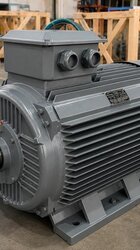
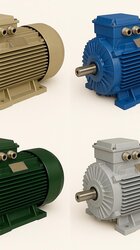
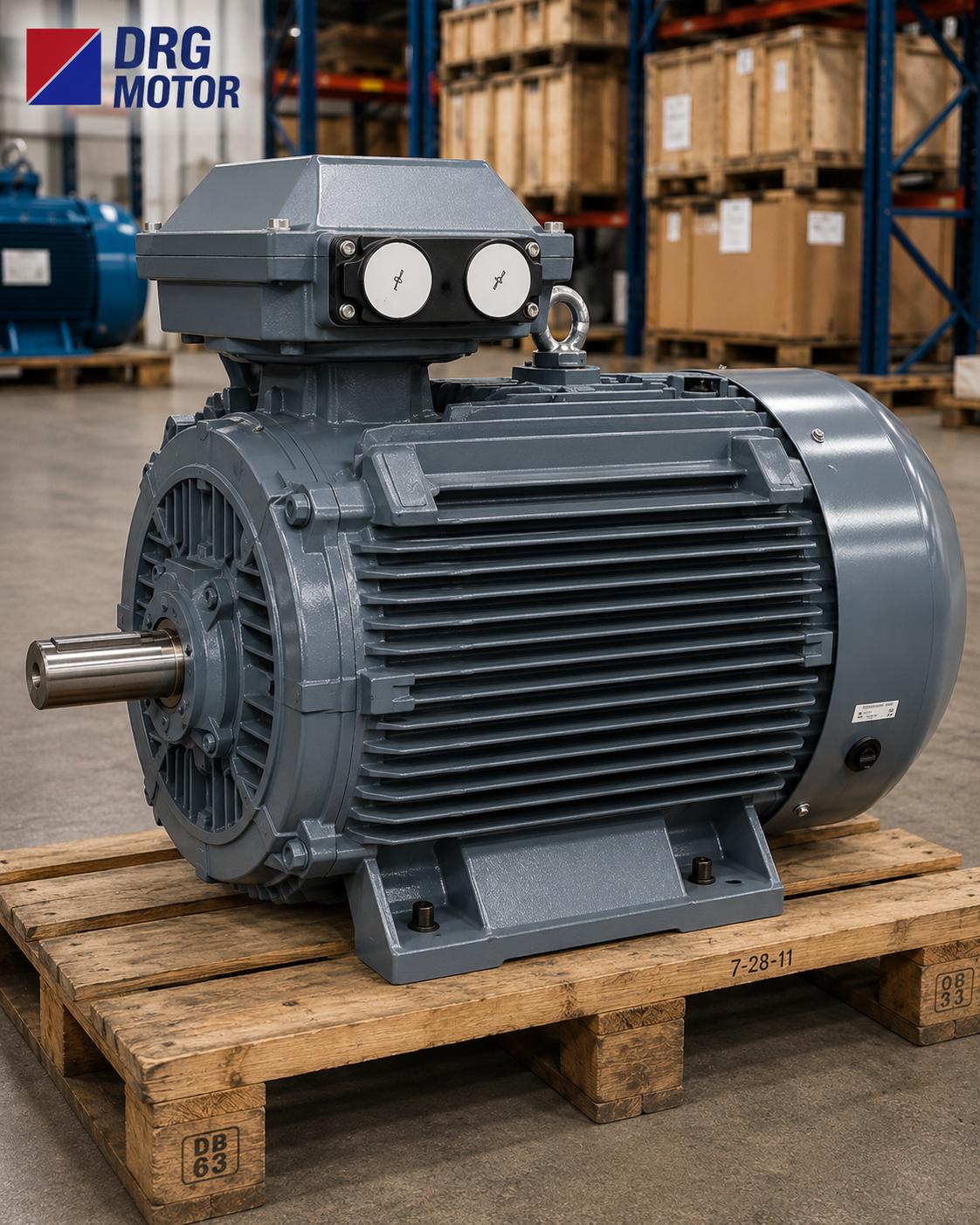

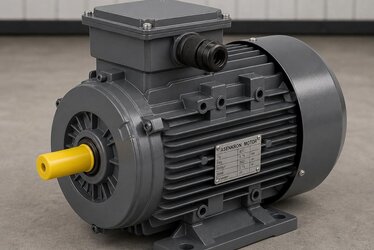
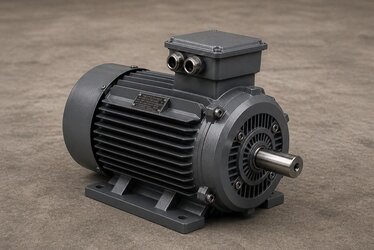
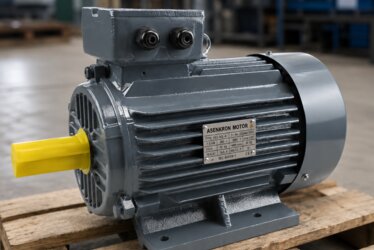
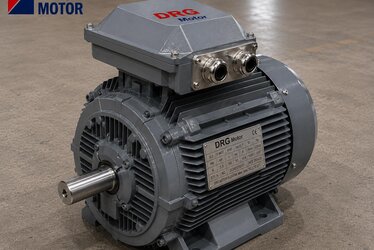
The cast iron frame is the first technical criterion that decides how many years a three-phase motor will survive in the field and up to what load it will run safely. For a motor working on a crusher feed line, on the vibrating platform of a concrete batching plant, or next to a grinding mill, the frame material is not a label detail but a question of service life. As a wholesale supplier, DRG Motor supplies grey cast iron framed 3-phase 380V motors across a wide range from 0.55 kW up to 355 kW; we match the right frame, the right efficiency class and the right ingress protection to the buyer's application and prepare a quote accordingly. This page explains, at the material level, why a cast iron frame separates itself from aluminium for an industrial buyer, and helps you reach the correct selection.
Why the Frame Material Sits at the Centre of the Buying Decision
Two motors may show the same power, the same speed and the same efficiency class on their nameplate, and their prices may be close. The difference is usually in the part you cannot see: the frame. An aluminium framed motor is light and adequate in clean, low-vibration environments. But where the load is impact-prone, the environment is dusty and the mounting base vibrates, the aluminium frame fatigues mechanically, resonates and the bearing seats gradually go out of round. A grey cast iron frame, with its mass, internal damping capacity and compressive strength, absorbs these conditions. For a plant that bases its purchase not on the initial price but on expected service life and downtime cost, the cast iron frame almost always delivers a lower total cost of ownership.
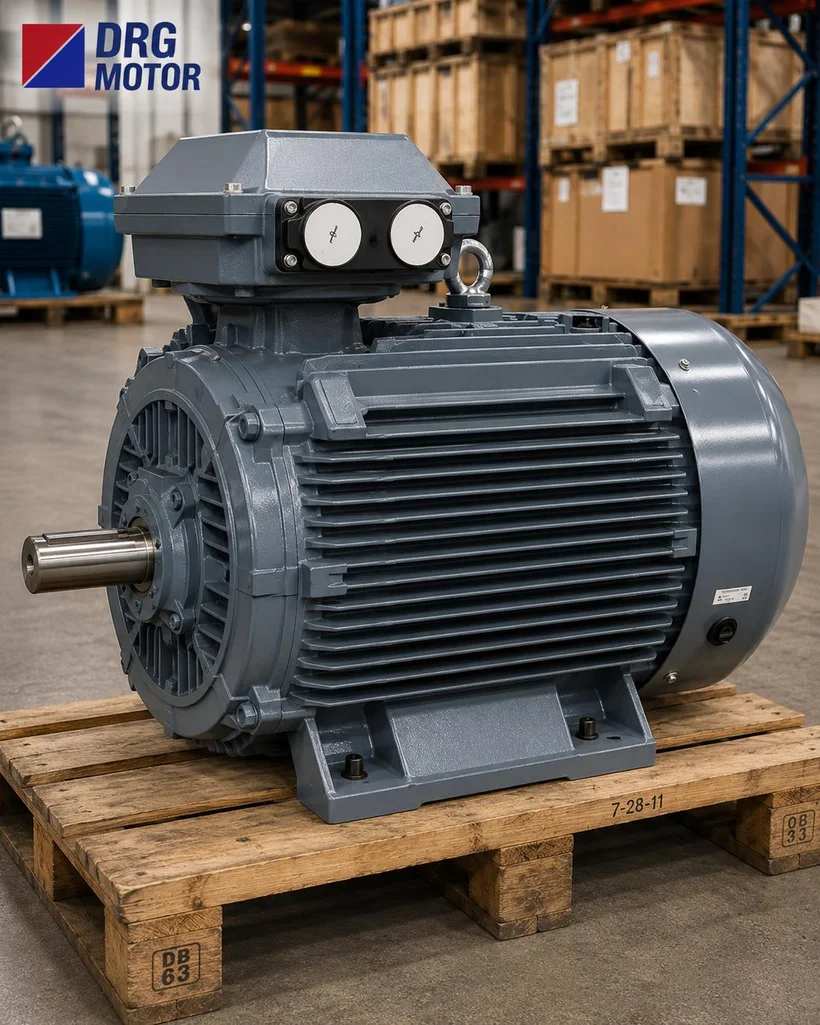
Throughout this page we link to dedicated technical content that explores each topic the frame material affects, because the advantage of cast iron does not come from a single property but from the sum of several mutually reinforcing physical properties. Doing justice to each one requires its own technical article.
The Physical Difference Between Grey Cast Iron and Aluminium
The free graphite flakes in the structure of grey cast iron give the material two critical properties: high internal friction (the ability to damp vibration energy by converting it to heat) and good thermal conductivity. Aluminium is lighter and conducts heat faster, but its elastic modulus is low; at the same cross-section it bends more easily and damps far less under vibration. In an industrial three-phase motor this difference produces the following practical results:
- The cast iron frame holds the stator rigidly; the air gap (rotor-to-stator clearance) stays more stable under load, preserving efficiency and quiet operation.
- Under impact loads, cast iron tends to distribute energy rather than crack; aluminium shows micro-crack initiation earlier.
- The mass of the cast iron frame keeps the bearing centres aligned, extending bearing life.
- Against corrosion and wear, the cast surface combined with a suitable paint system lasts longer in harsh environments.
This is why aluminium frames are not chosen for applications such as crushers, breakers, mills and concrete plants; in these fields the cast iron frame is the de facto standard.
Thermal Management: The Real Test at Continuous Load
A motor's ability to deliver its rated power continuously depends on its ability to reject the heat it generates. If the winding temperature rises above the level the insulation class allows, insulation life drops sharply; roughly every 10 °C increase halves insulation life. The cast iron frame, thanks to the deep, wide cooling fins formed during casting, increases the surface area and makes efficient use of the air pushed by the fan. The thermal mass of the frame also acts as a buffer during sudden load increases, protecting the winding from short-term overloads. For motors that will run under continuous load or in hot ambients, the frame's heat dissipation and cooling advantage translates directly into service life and warrants careful sizing on its own.
Vibration Damping and Noise Behaviour
A three-phase asynchronous motor always produces some vibration due to magnetic field variation and mechanical imbalance. How much of that vibration the frame damps affects the life of both the motor's own bearings and the connected gearbox, coupling and base frame. The high damping coefficient of grey cast iron disperses vibration energy within the frame; the result is a lower noise level and steadier operation. In drive lines requiring precise alignment, or in facilities where noise matters, the frame's vibration damping and quiet operation behaviour gives a clear advantage over aluminium. Reduced vibration also delays the loosening of fasteners and leakage of lubrication.
Impact, Overload and Mechanical Stress
On crushing-screening, mining, recycling and heavy industry lines the load is rarely smooth. A large piece entering the feed, sudden torque spikes, or jammed material impose shock loads on the motor shaft and frame. The cast iron frame carries these impacts thanks to its high compressive strength and its ability to distribute energy within its structure. Because the terminal box mounting area, the feet and the flange thicknesses can be designed more generously in cast iron, the mounting points are also more resistant to these stresses. In demanding sites, the motor's durability under heavy impact and harsh conditions is a critical factor that directly determines production continuity; here the frame material should not be a point of compromise.
Dust, Humidity and Ingress Protection (IP)
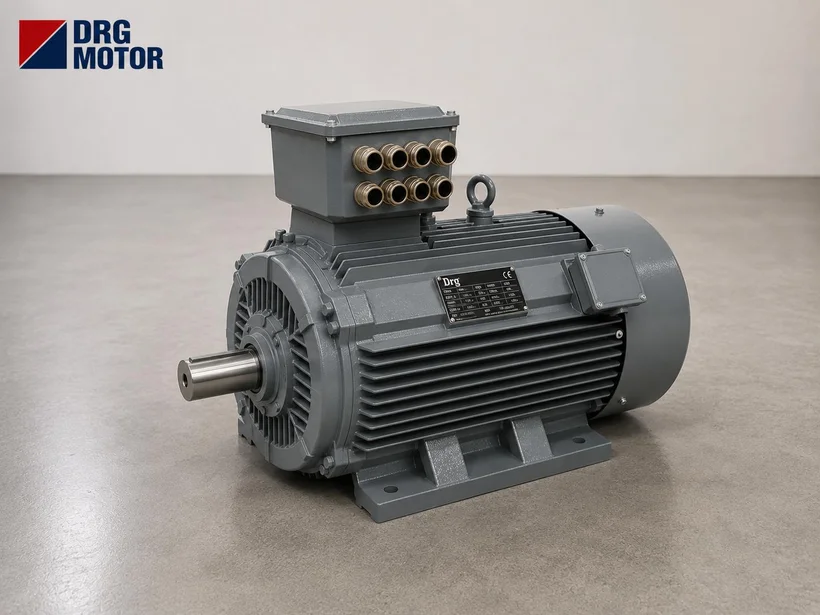
Site contamination and humidity raise the question of ingress protection as much as the frame itself. Standard industrial three-phase motors are usually supplied in IP55 protection class, meaning dust-protected and resistant to water jets from any direction. Very dusty, washdown or outdoor applications may require higher classes such as IP56/IP65 or additional gasket/seal solutions. The dimensional stability of the cast iron frame helps the sealing surfaces remain leak-tight over time. To select the correct class for your environment, we evaluate the criteria for dusty and humid environments and ip protection together with your application and add the appropriate configuration to the quote.
Power Range and Correct Sizing (0.55–355 kW)
We supply cast iron three-phase motors from 0.55 kW up to 355 kW with different pole counts (2, 4, 6 and 8 poles; i.e. 3000, 1500, 1000 and 750 rpm synchronous speeds) and different frame sizes (IEC shaft heights). The right choice is not only about power; speed, torque characteristic, starting frequency, moment of inertia and the use of a drive (soft starter / frequency inverter) must be evaluated together. Oversizing brings unnecessary initial investment and poor part-load efficiency; undersizing means overheating and early failure. We work out the power range and correct sizing with you according to your application and lay out options such as fan/no-fan cooling, braked models and special shafts in a clear table.
What We Watch in Sizing
- The torque-speed curve of the driven load and the starting torque requirement.
- How many starts per hour will occur (frequent starting generates thermal load).
- Ambient temperature and altitude (above 40 °C and 1000 m require derating).
- Long operation at low speed with a frequency inverter (additional cooling may be needed).
- Mounting type: foot-mounted (B3), flange-mounted (B5/B14) or combined.
Efficiency Class and Operating Cost (IE3/IE4)
The larger part of a motor's lifetime cost is not the purchase but the electricity consumption. For a continuously running motor, the annual energy bill can climb to many times the price of the motor. That is why we highlight our cast iron motors in IE3 (premium) and, in suitable models, IE4 (super premium) efficiency classes. High efficiency lowers the energy bill and also means the motor runs cooler, which eases the thermal load on the frame. To see how quickly the investment pays back, we include an ie3-ie4 efficiency and operating cost comparison in the quote based on your running hours and load profile; in most continuous applications the move to IE4 pays for itself within a few years.
Standards, Certificates and Quality Assurance
An industrial motor can deliver its expected performance only if its design and testing follow recognised standards. The cast iron three-phase motors we supply comply with IEC 60034 (rotating electrical machines) and, for efficiency, IEC 60034-30-1; they come with CE marking and the relevant declarations of conformity. Dimensional and connection compatibility is ensured through IEC 60072 shaft heights, so compatibility with your existing gearboxes and couplings is not an issue. So that you can check the suitability of documents and test reports for the project in advance, we clarify certification, standards and quality assurance at the quotation stage; this completeness of paperwork saves time in tender and audit processes.
Application Areas: Which Solution for Which Site
Cast iron three-phase motors are used in almost every heavy industry branch where mechanical stress and continuity are high. Typical application areas and the reason for the frame choice:
- Crushers and breakers: high starting torque and continuous impact; the cast iron frame carries vibration and shock.
- Concrete batching plants: dusty, humid and vibrating environment; high IP and a rigid frame are required.
- Compressors: continuous load and heat generation; cooling fins are decisive.
- Conveyors and belts: long-duration operation and precise alignment; frame rigidity preserves bearing life.
- Mills and mixers: high inertia and frequent torque fluctuation; the cast iron frame resists fatigue.
For these sites, three-phase asynchronous motors form our main product group; for crushing-screening plants we offer specialised stone crushing plant motors and, for versatile drive needs, general-purpose industrial motors.
Mounting, Connection and Shaft/Flange Options
The cast iron frame also provides flexibility in mounting variety. Foot-mounted (B3) models are preferred for direct mounting on a base frame, while flange-mounted models (B5 large flange, B14 small flange) are preferred for direct connection to pumps and gearboxes. The terminal box position can be rotated on the frame so that cable entry is arranged to suit the site. The shaft end comes with a standard keyway; if needed, special shaft diameter, double shaft end, braked or encoder configurations are provided to order. Sharing your existing connection dimensions allows the exactly compatible model to be identified quickly.
Compatibility with Frequency Inverters and Soft Starters
In modern plants, cast iron motors are mostly driven by a frequency inverter (VFD) or a soft starter. While the inverter provides variable speed and energy saving, it raises issues such as additional voltage stress on the winding and insufficient cooling at low speed. Therefore, for motors to be driven by an inverter, measures such as reinforced insulation, an independent cooling fan (forced cooling) and proper bearing earthing should be planned from the start. We determine which model will be driven by an inverter and how, together with cable length and filter requirements, at the quotation stage.
Supply, Stock and Fast Quotation
In industry a motor usually comes onto the agenda not as a plan but through an unexpected stoppage; that is why lead time matters at least as much as the technical specification. We supply the most commonly used power-speed combinations from stock and special configurations on a short lead time. From a single motor to full plant projects, we run the supply: stock, delivery and quote process transparently across different scales, and deliver a clear quote by factoring the price according to your application (power, efficiency class, protection, mounting and quantity).
The Technical Meaning of Efficiency Classes and the Load Profile
The efficiency class is not just a label but a measured value describing the motor's losses. In an asynchronous motor the losses fall into four main items: copper losses (energy turned into heat in the winding resistance), iron losses (magnetic cycling and eddy currents), mechanical losses (bearing friction and the fan) and stray load losses. IE3 and IE4 motors reduce these losses through a higher-grade lamination stack, more copper and an optimised design. What matters is how the motor runs at its real load profile: a motor that gives high efficiency at full load will not deliver the expected saving if it runs continuously at low load. That is why sizing according to the load profile is as important as choosing a high efficiency class. On continuous, heavily loaded lines the move to IE4 pays more, while on partially loaded lines correct sizing brings the larger gain.
Pole Count, Speed and the Torque Relationship
In three-phase asynchronous motors the speed is set by the pole count: 2 poles run at around 2900 rpm, 4 poles around 1450 rpm, 6 poles around 960 rpm and 8 poles around 720 rpm under load (lower than synchronous speed by the slip). At the same power, a lower-speed motor produces higher torque and is physically larger, therefore carrying more cast mass. For applications requiring high starting torque such as crushers, mills and mixers, 4 or 6-pole motors are usually preferred; for high-speed pumps and fans, 2 poles are suitable. Because the correct pole choice also affects the gearbox ratio and the drive cost, it should be evaluated together with the whole drive line. A wrong speed selection means either an unnecessary gearbox cost or insufficient torque.
Corrosion Protection, Paint and Environmental Resistance
The grey cast iron surface, combined with proper surface preparation and a paint system, forms a long-lasting barrier against corrosion. Standard industrial motors usually come with an epoxy or polyurethane-based paint resistant to outdoor conditions; where coastal, chemical or high-humidity environments are involved, thicker film build and special primer systems can be applied. The smooth-machined bearing and flange surfaces of the cast iron frame are shipped with a protective oil or coating against corrosion. For motors that will work outdoors, the frame paint class is not just aesthetics but a matter of service life; the right paint system is the frame's first line of defence in the field. When you share your environmental conditions, we add the appropriate paint and protection option to the quote.
How the Casting Process Reflects on Motor Quality
The final quality of the frame is determined not only by material selection but by the casting itself. If grey cast iron is not cooled in a controlled way after pouring, internal stresses remain; while the motor runs, these stresses are gradually released, which can cause micro-deformation of the frame and a shift in alignment. That is why quality cast frames go through stress-relief annealing so that dimensional stability is preserved for many years. Machining the bearing seats and flange surfaces in a single setup keeps the rotor and stator coaxial, which means the air gap is uniform around the circumference. A uniform air gap balances the magnetic forces, reduces vibration and preserves efficiency. In the motors we supply, this casting and machining quality is the invisible but decisive reason for long service life in the field.
Insulation Class, Winding and Thermal Protection
The thermal advantage of the cast iron frame reaches its full value when combined with the right insulation class and thermal protection. In industrial three-phase motors the winding insulation is usually made with Class F (155 °C) material, but the temperature rise is kept within the Class B (130 °C) limit; this leaves a safety margin for the winding and extends insulation life. In harsh conditions or inverter applications, Class H (180 °C) insulation and reinforced winding may be preferred. To protect the winding against overheating, options such as a thermistor (PTC), a thermal protection contact (klixon) or a PT100 temperature sensor can be added to the order; together with the protection relay in the motor panel, these sensors take the winding out of circuit before it burns. In continuous and critical processes, this thermal protection is the insurance not of the motor but of production.
Bearing Selection, Lubrication and Maintenance Intervals
In practice, the part of the motor that reaches end of life most often is the bearing; therefore, as important as the cast iron frame keeping the seats aligned is the correct selection of the bearing. At small and medium powers, lifetime-greased (sealed) bearings are sufficient and require no maintenance. At high powers or high speeds, re-greasable bearings (with grease nipples) are preferred; in these models grease is replenished at specific running hours. In coupled and belt-pulley drives where axial or radial load is high, a bearing type suited to the load direction (for example a reinforced bearing in belt drives) should be selected. Sharing your existing drive arrangement allows us to determine the right configuration to protect bearing life from the start; a wrong bearing selection causes early failure even in the best frame.
Frame Weight, Handling and Site Installation
The weight that is considered the only disadvantage of the cast iron frame actually turns into an advantage in most industrial applications: a heavy, rigid frame sits more stably on the floor and transmits less vibration to the base frame. In return it requires handling and installation planning. Above a certain power, lifting eyebolts come as standard on the frame; heavy motors must be moved with a crane or forklift and must never be lifted by the shaft end or the terminal box. A flat and rigid mounting base, foot bolts tightened to the correct torque value and laser-checked coupling alignment are essential to benefit fully from the stability the cast iron frame provides. Correct installation is the field equivalent of frame quality.
Total Cost of Ownership: Why Cast Iron Pays Back
The real cost of a motor is not the purchase price but lifetime energy consumption, maintenance costs and, most importantly, unexpected stoppages. In heavy industry, one hour of stopped production can mean a loss far above the price of the motor. The cast iron motor reduces the frequency of failures and stoppages thanks to its high mechanical strength and thermal stability; it reduces the energy bill with IE3/IE4 efficiency; and it extends the replacement interval with its long life. Compared with an aluminium frame, the difference in initial investment is usually recovered within a few months through gained operational continuity and lower energy cost. That is why the cast iron frame is not cheap but economical; when deciding, one should look not at the label price but at this holistic picture.
Let Us Determine the Right Motor Together
Selecting a cast iron three-phase motor is done not by a single nameplate value but according to the reality of the site: load character, environment, running hours and existing connection dimensions, evaluated together, optimise both the initial investment and the operating cost. Send us your application, your power and your mounting type; as a cast iron three-phase motor supplier, we will respond quickly with a recommendation covering the right frame, the right efficiency class and the right protection degree. In the field, a wrong choice means stoppage and repeated expense; the right motor from the start means years of trouble-free production.