 English
 Le français
 Türkçe


Choosing an electric motor by glancing at the kilowatt rating on the nameplate is one of the most common and most expensive mistakes a buyer can make. Two motors with the same rated power can behave completely differently depending on how they are loaded; one runs flawlessly on a continuous line while the other overheats under intermittent loading and burns out long before its expected life. The key to the right choice is the duty cycle, the code that defines how the motor will actually be loaded. The S1 S3 duty distinction is precisely the technical detail that shapes your purchasing decision, and as a DRG Motor supplier it is one of the first things we ask about when preparing a quote.
The Duty Code Is the Most Important Line on the Plate
The code beginning with the letter S on a motor label tells you which load profile the motor was tested and certified for. The IEC 60034-1 standard defines eight basic duty types, but the overwhelming majority of real-world cases fall into S1 and S3. Ignoring this code is like buying a vehicle without knowing whether it was built for steady highway cruising or stop-and-go city traffic. Both will move, but under the wrong use one wears out far faster than the other.
A significant share of the companies that contact us order a continuous-duty motor without realising their application is intermittent; or, the other way round, they buy an oversized and costly S1 motor for a classically intermittent load such as a crane. In both cases either reliability or budget takes the hit.
S1: Steady Operation Under Continuous Load
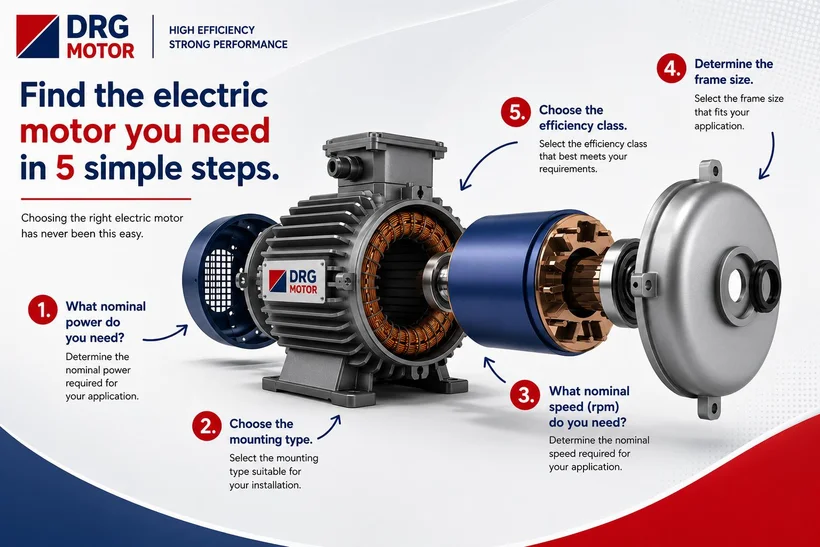
S1 is the continuous duty type. The motor is designed to run at a constant load until it reaches thermal equilibrium and then keep turning at that temperature for hours, even days, without interruption. Pumps, fans, compressors, conveyor lines and continuously running extruders are typical S1 applications. Here the motor starts once, settles at its operating temperature and stays at a thermally stable point.
The advantage of S1 motors is predictability. The power on the nameplate is the real power the motor can deliver continuously; you do not need to apply any correction factor. That is why the right choice for equipment running all day on a line is almost always a properly sized S1 motor. For continuous process applications, S1-rated general-purpose industrial motors can usually be supplied quickly from stock, which also shortens delivery times.
The Logic Behind S3 Periodic Intermittent Duty
S3 is periodic intermittent duty, and it is the most frequently misunderstood code in the field. Here the motor runs under load for a period, then stops or is de-energised, and the cycle repeats. The critical point is this: the rest interval is too short to let the motor fully cool back down, so it never reaches full thermal equilibrium. Cranes, lift mechanisms, presses, gate drives and dosing systems are classic S3 applications.
The S3 code is always accompanied by a percentage; for example S3 40%. This figure is called the cyclic duration factor and shows how long, within one cycle, the motor is under load. The 40% value means that within the standard ten-minute cycle the motor runs for four minutes and stays idle for the remaining six.
- S3 15%: very short, heavily pulsed operation; relatively high peak power.
- S3 25%: short duty cycles; common on presses and moulding lines.
- S3 40%: medium-intensity intermittent load; most crane and hoisting applications.
- S3 60%: long run, short rest; a profile approaching S1.
Why the Same Power Rating Means Different Things
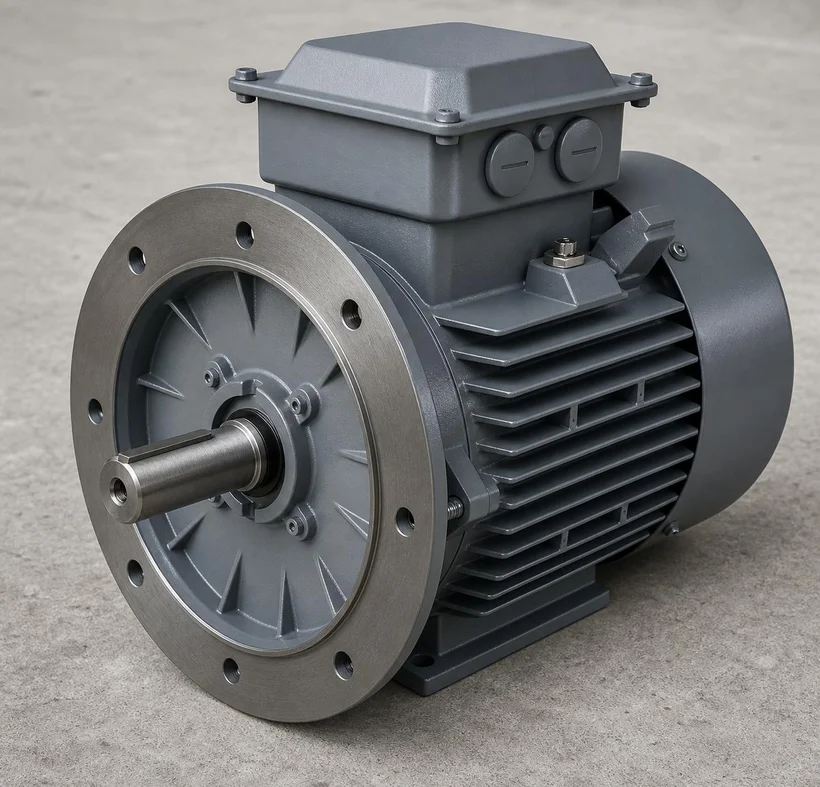
This is what really drives the economics. A motor labelled S3 40%, because it runs intermittently and cools in between, can deliver a higher peak power than its continuously running equivalent. In other words, from the same frame size, in the right duty, you draw more instantaneous torque. The reverse is also true: if you overload a motor labelled S1 with S3 logic, the rated duty is violated and your warranty and performance expectations lose their footing.
For this reason, comparing only the kilowatt figure when weighing two applications is misleading. A power number quoted before the S1 S3 duty profile is clear is not even a solid basis for comparing prices. When you send us the cycle time and the cyclic duration factor with your enquiry, we can optimise the frame size correctly and propose something that is both reliable and within budget.
The Real Cost of Choosing the Wrong Duty
Getting the duty wrong is costly in two directions. If you select an oversized S1 motor for an intermittent application, you overpay from the start through unnecessary investment, a larger gearbox, heavier mounting and higher energy draw. Conversely, if you push an intermittent-class motor on a continuous load, the windings sit at high temperature far longer than they were designed for; the insulation ages prematurely and failure arrives much sooner than expected.
The insulation class comes directly into play here, because in intermittent applications the thermal stress cycle is constant. We previously covered in detail why choosing f sınıfı izolasyon matters for extending winding life through thermal margin; real durability only emerges when duty cycle and insulation class are assessed together.
Starting Frequency and Inrush Load
Another variable that is routinely overlooked in intermittent applications is how many times per hour the motor starts. On every start the motor draws an inrush current several times its rated value, and this brief surge heats the windings significantly. Even when an application appears to have a low cyclic duration factor, if it is started very frequently the thermal load turns out higher than expected. That is why some S3 applications shift, as the number of starts rises, into higher duty types that also account for the starting and braking component.
In practice, three questions settle most decisions in the field: how many times per hour the motor starts, how long it stays under load in each cycle, and whether the load is applied at the moment of start or after the motor has come up to speed. When you pass us this trio, we match the frame size to the real thermal load rather than the power figure alone, and recommend a motor that is neither oversized nor overstressed.
Relationship with the Drive and Brake System
Duty cycle has to be considered together with the system feeding the motor. In an intermittent application driven by a frequency inverter, if the motor runs at low speed for long periods, the efficiency of its own cooling fan drops; in that case, even when the S3 label is adequate, forced cooling or a one-frame step up comes into the picture. Likewise, in crane and hoisting applications the frequent engagement of the electromagnetic brake increases both thermal load and mechanical wear.
For that reason, discussing not just the motor but also the drive type and the braking requirement at the quoting stage keeps the project cost realistic. With the right pairing, the motor duty and the drive behaviour stay in harmony and the system life lengthens.
Data to Confirm Before Ordering
Supplying the right motor on the first attempt requires no complex calculation beyond a few basic facts from you. Having these details ready speeds up the quoting process and prevents surprise returns.
- The type of application: does it run continuously or intermittently.
- If intermittent, the cycle time and the cyclic duration factor.
- How many times per hour it roughly starts and stops.
- The ambient temperature and mounting conditions.
- The mounting arrangement of the driven equipment and the shaft orientation.
That last item is more critical than it seems; because even with the right duty, the wrong mounting type makes the order unusable. We explained the differences between foot, flange and combined mounting and what to watch for when ordering in our b3 b5 b35 montaj guide; when you send the duty and the mounting information together, the quote is settled in a single pass.
What to Watch When Replacing an Existing Motor
Many orders arise from the need to replace a burnt-out or worn motor. In that case the safest approach is to photograph the old motor's nameplate and send it to us. Read together, the duty code, the cyclic duration factor, the pole count and the frame size let us identify an equivalent or better-suited model quickly. One caveat is needed here, though: there is a chance the old motor was wrongly specified in the first place.
If the previous motor failed far sooner than it should have, the duty very likely did not match the application. So before supplying an identical unit, we also question the real load profile of the application and, where necessary, steer you toward a more appropriate duty. The goal is to stop you from buying the same failure twice.
What You Gain by Ordering with the Right Duty
Defining the duty cycle correctly from the outset is not just technical diligence; it is a direct cost and reliability decision. An order placed with a clear S1 S3 duty profile leads neither to overpaying for an oversized motor nor to a production stoppage caused by a unit that burns out within weeks. At DRG Motor we assess the load profile of your application together, match the frame size, insulation class and mounting type, and prepare a clear quote with stock status and delivery time. Send us the cycle details of your application and let us supply, quickly and in the right duty, the motor that fits the first time.